Think of tax preparation as your annual physical. It’s a snapshot in time, telling you what happened last year after the fact. Tax planning services, on the other hand, are like having a dedicated wellness coach who works with you all year long to improve your financial health. It's the critical difference between reacting to the past and strategically building your future.
Going Beyond Tax Prep with Tax Planning Services

Too many successful people treat tax season as a mad dash to the finish line—a reactive chore focused on filing correctly and paying whatever the bill says. While compliance is non-negotiable, this rearview-mirror approach leaves a massive amount of money on the table. It completely misses the opportunity to build real, lasting wealth.
This is where true tax planning flips the script. It turns a defensive, once-a-year headache into a powerful, year-round strategy. We work with you continuously to legally and ethically minimize your tax burden by making sure every significant financial move aligns with your bigger goals. This means taxes are part of the conversation in June and October, not just in April.
The core idea is simple but incredibly powerful: instead of just reporting what happened, you actively shape what’s going to happen. This isn’t a single action but a coordinated series of them, from timing your income and expenses to structuring your investments for peak tax efficiency.
To put it simply, most people are just playing defense. We help you go on offense.
The table below breaks down this fundamental mindset shift.
Tax Preparation vs Proactive Tax Planning
| Aspect | Tax Preparation (Reactive) | Tax Planning (Proactive) |
|---|---|---|
| Focus | Reporting historical data | Shaping future outcomes |
| Timing | Annual (Jan-Apr) | Year-round and continuous |
| Goal | Compliance and filing accuracy | Wealth creation and tax reduction |
| Outcome | A filed tax return | A strategic roadmap for savings |
| Relationship | Transactional, short-term | Partnership-based, long-term |
Viewing tax through a planning lens opens up possibilities that simply don't exist when you're just trying to get your return filed on time.
Shifting from Compliance to Strategy
It's not just a hunch; the numbers show a massive shift in thinking. The global tax advisory market is set to grow by an astounding USD 12.82 billion between 2025 and 2029. This isn't just a trend—it's a clear signal that people are waking up to the need for expert guidance. With its web of federal, state, and local tax laws, North America is predicted to drive 36% of this global growth, as market research from Technavio.com highlights.
For the people we serve—business owners, real estate investors, and high-net-worth families—this move from simple compliance to proactive strategy is everything. It's how you protect and grow what you've worked so hard to build.
So, what does this look like in practice?
- Timing Income and Deductions: We might advise you to accelerate a major business expense into December or defer a large income payment until January, all to put you in a better tax bracket for both years.
- Maximizing Credits and Deductions: This goes far beyond the standard deductions. We dig deep to uncover every single credit you're entitled to, ensuring you never overpay by a single dollar.
- Structuring Investments: Are your investments in the right kind of accounts? We help you use tax-advantaged vehicles that let your money grow faster with less tax drag.
- Retirement Planning: It's not just about how much you save, but how you save. We optimize your contributions and plan for tax-efficient withdrawals down the road.
- Estate and Gift Planning: A well-structured plan ensures your wealth transitions smoothly to your loved ones or charitable causes, not to the IRS.
At the end of the day, expert tax planning gives you a framework for making smarter financial decisions. When tax implications are woven into your strategy from the start, you improve cash flow, build wealth faster, and gain the confidence that you're in complete control of your financial destiny.
The Building Blocks of a Powerful Tax Strategy

Smart tax planning isn’t a single action; it’s a toolkit of specialized strategies. Think of it less like a generic wrench and more like a custom set of instruments, each designed for a specific financial situation. The right strategy, applied with precision, can fortify your financial health and legally minimize what you send to the government.
This goes way beyond simply tracking income and expenses. It's about a deep, practical understanding of the intricate rules at the local, state, federal, and even international levels. Let's peel back the curtain on the core components that make up a truly effective tax plan.
Year-Round Proactive Planning
The biggest leap you can make is shifting your mindset from tax preparation to tax planning. This means moving from a once-a-year scramble to a continuous, proactive cycle. It’s about looking at the tax implications of major financial decisions before you make them, not just adding up the score after the game is over.
Take a growing tech startup, for example. In the early days, every dollar counts, and cash flow is everything. A year-round approach would look something like this:
- Smarter Estimated Payments: Instead of facing a shocking tax bill in April, we project your revenue and expenses throughout the year. This allows us to calculate accurate quarterly payments, preventing nasty underpayment penalties and keeping your cash flow smooth and predictable.
- Strategic Timing of Expenses: We might advise you to purchase that new server or software suite in December rather than January. Why? To immediately lower your taxable income for the current year.
- Uncovering Hidden Opportunities: Many startups don't realize they qualify for valuable R&D tax credits. We actively hunt for these, as they can provide a dollar-for-dollar reduction in your tax bill, injecting cash directly back into your business for growth.
This constant oversight turns your tax strategy from a defensive chore into an offensive tool for smarter business management.
A tax plan is a living document. It should adapt in real-time to your financial life, reflecting changes in your business, investments, and personal circumstances to ensure you are always in the most advantageous position.
Navigating the Maze of State and Local Tax (SALT)
For anyone with a footprint in more than one state, State and Local Tax (SALT) rules can feel like a tangled, expensive mess. Every state plays by its own rulebook for income, sales, and property taxes. One misstep can lead to hefty fines. That’s where a dedicated SALT strategy becomes absolutely critical.
Picture a real estate developer based in New York who owns properties in New Jersey and Florida. Their tax world is instantly complicated. A SALT expert brings clarity by:
- Defining Your Footprint (Nexus): We analyze your operations to figure out exactly where you have a significant business presence, or "nexus." This determines where you’re required to file and pay taxes.
- Allocating Income Correctly: We help you properly "apportion" your business income among the states where you operate. This is key to avoiding double taxation and staying compliant with each state's unique formulas.
- Managing Residency Rules: If the developer spends a lot of time in Florida, we provide clear guidance on residency requirements. This could help them legally establish domicile in a low-tax state, potentially saving them tens of thousands in personal income taxes.
Getting SALT right isn’t just good practice; it's essential for anyone doing business across state lines.
International and Cross-Border Tax Guidance
In today's connected world, global assets and business operations are more common than ever. But they also bring a whole new level of tax complexity. For families with overseas investments or companies expanding abroad, expert guidance is non-negotiable for handling treaties, reporting rules, and foreign tax credits.
Let’s say a family has investments in Europe and a vacation home in the Caribbean. Our job is to structure their global assets to be as tax-efficient as possible. This involves:
- Using Foreign Tax Credits: We make sure they get full credit for taxes paid to foreign governments, so they aren't taxed twice on the same income.
- Staying Compliant: We handle all the necessary filings, like the FBAR (Report of Foreign Bank and Financial Accounts), to help them avoid the incredibly steep penalties for non-compliance.
- Leveraging Tax Treaties: We use our knowledge of tax treaties between the U.S. and other nations to minimize withholding taxes on things like dividends and investment income.
Estate and Gift Planning for the Next Generation
Finally, a truly complete tax plan looks beyond your own lifetime. Estate and gift planning is all about making sure your wealth is transferred smoothly and efficiently to your children, grandchildren, or the charities you support. Without a solid plan, a huge chunk of what you've built could be wiped out by federal and state estate taxes.
The goal here is simple: use smart, legal strategies like gifting, trusts, and other structures to minimize transfer taxes. It’s the ultimate way to preserve your legacy and take care of your loved ones, exactly as you intended.
Let's talk about the bottom line. What are the real, measurable results you can expect from professional tax planning?
When done right, tax planning isn't just about compliance; it's a powerful wealth-building tool. The goal is to lower your effective tax rate—what you actually pay as a percentage of your total income. Lowering that number means more cash stays in your pocket, ready for you to reinvest, expand your business, or secure your family's future.
Think of it like this: just filing your taxes is like walking into a dealership and paying the sticker price for a car. No questions asked. Strategic tax planning is the negotiation. It's about knowing every legal advantage, every credit, and every deduction available to get you the best possible outcome. For many of our clients, this proactive approach slashes their overall tax bill by 15% to 25%.
Better Cash Flow and a More Stable Business
If you’re a business owner, you’ll feel the impact of smart tax planning almost immediately. When you can predict your tax liabilities and time your expenses strategically, your cash flow improves—and cash flow is the lifeblood of any business.
Here’s how this plays out in the real world:
- No More Guessing on Quarterly Payments: We help you project your income accurately throughout the year. This means you stop overpaying the IRS (and giving them an interest-free loan) or underpaying and getting hit with nasty penalties.
- Smarter Asset Purchases: Thinking about buying a new piece of equipment or a building? We’ll help you time that purchase to maximize depreciation deductions, which can drastically lower your taxable income and free up cash for other priorities.
- The Right Business Structure: How your business is set up (as an S-Corp, C-Corp, or LLC) has huge tax consequences. We’ll analyze your specific situation to make sure your structure is giving you the best possible tax advantages and liability protection.
This isn't just about saving money; it's about creating financial breathing room. It gives you the stability to expand, hire that key employee, or just build a stronger foundation for the future.
The real win isn't a one-time tax saving. It's creating a cycle where the money you save gets put back to work in your business or portfolio, fueling more growth year after year.
Growing Your Wealth Faster Over the Long Haul
For high-net-worth families and serious investors, the effects of tax planning are even more dramatic over time. Every single dollar you don't send to the IRS is a dollar that can be reinvested to generate even more returns. This is the power of compounding at its best.
It's no surprise that the demand for this kind of strategic advice is booming. The tax advisory services market was valued at USD 49.65 billion in 2025 and is expected to more than double to USD 106.1 billion by 2034. This surge is fueled by ever-changing tax laws, especially in high-tax states like New York, where firms like Blue Sage provide crucial guidance. A recent market analysis points out that people are realizing just how much value expert planning brings to the table. You can read more about the tax advisory market growth at MarketResearch.com.
So, what are some of the strategies that make this happen?
- Tax-Loss Harvesting: We’ll strategically sell investments that have lost value to offset the gains from your winners. It’s a surprisingly simple move that can make a huge difference in how much tax you pay on your investment profits.
- Smarter Retirement Planning: It’s not just about contributing to your 401(k) or IRA. We help you maximize your contributions and, just as importantly, plan for tax-efficient withdrawals when you’re ready to retire.
- Asset Location: This is a big one. It’s not just what you own, but where you own it. We help you place assets that generate a lot of taxes (like corporate bonds) into tax-deferred accounts, while keeping more tax-friendly assets (like index funds) in your regular brokerage accounts. This minimizes the tax drag on your entire portfolio.
The key is to stop thinking of tax planning as a cost and start seeing it for what it is: one of the highest-return investments you can make. It's one of the most effective ways to protect your finances and ensure your wealth grows as efficiently as it possibly can.
Understanding the Tax Planning Process
Working with a tax planner for the first time might seem a little intimidating, but a good process makes all the difference. Think of it less like a transaction and more like building a custom blueprint for your financial future. It's a true partnership, where every financial move is deliberately aligned with your biggest goals.
This partnership unfolds over a clear, four-phase journey. We start with the big picture, then dive into the details, and finally, we stay on top of things together. Each step builds on the last, creating a comprehensive financial roadmap that can adapt as your life changes.
Phase 1: Initial Discovery and Goal Setting
It all starts with a deep dive into your unique financial world. This first conversation is the foundation for everything that follows. We're not just glancing at last year's tax return; we're trying to understand your aspirations, your concerns, and what you ultimately want your wealth to accomplish for you and your family.
We'll talk about everything. Are you looking to sell your business in a few years? Expand your real estate portfolio? Or maybe you're thinking about retirement or setting up a charitable foundation. Getting these long-term goals on the table right away is absolutely critical to crafting a plan that actually works.
Phase 2: Data Gathering and Scenario Analysis
Once we're clear on your objectives, the real number-crunching begins. We'll collect all the relevant financial documents—investment statements, business financials, real estate details, and any estate plans you already have. Precision is key here, as this data fuels all of our projections.
From there, we start modeling different "what-if" scenarios. What happens if you accelerate business investments to maximize deductions? How would selling a highly appreciated stock affect your overall tax bill for the year? We use sophisticated software to run these projections, showing you the tangible, after-tax results of different strategic choices. This is where abstract goals turn into hard numbers you can actually use to make decisions.
This is how a smart plan directly impacts your bottom line, pushing down your tax rate and letting you keep more of what you earn.
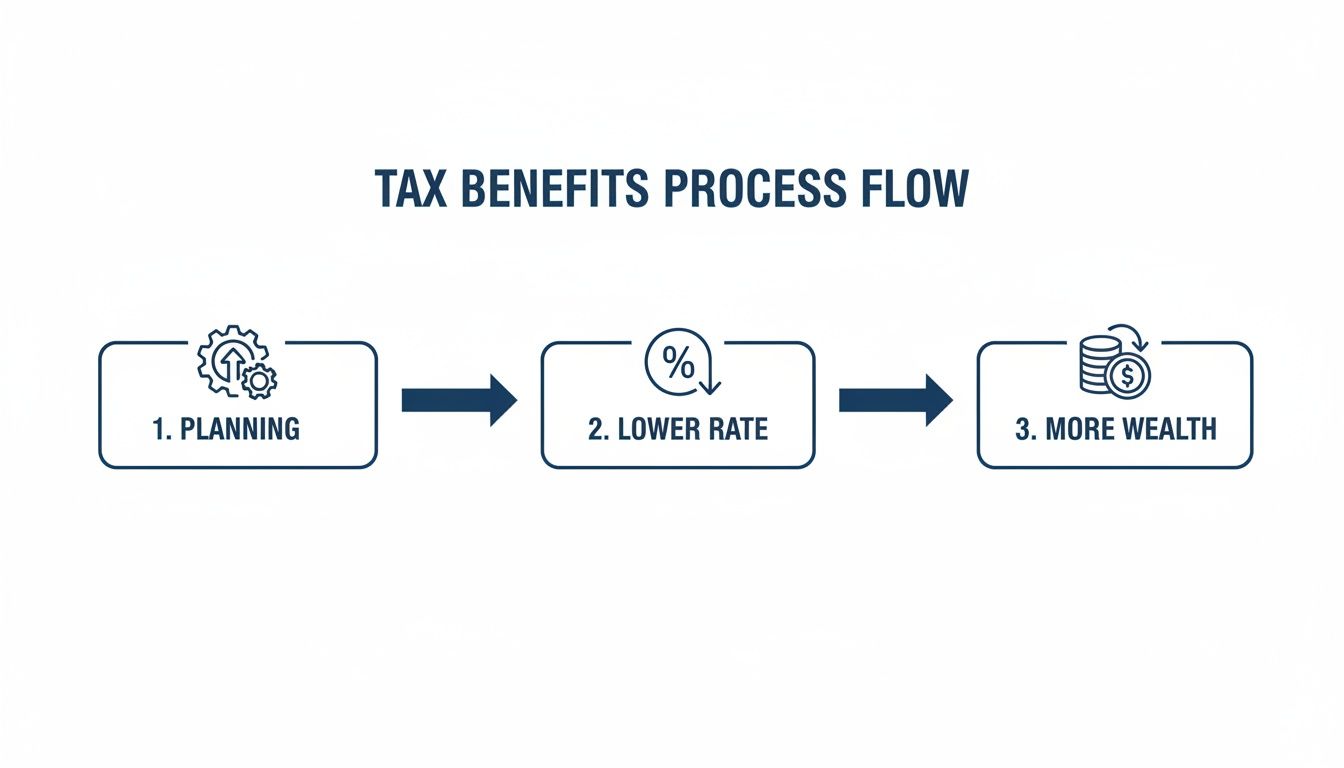
This visual really drives home the point: proactive planning isn't just about compliance; it's a powerful tool for building wealth.
Phase 3: Strategy Development and Delivery
Here’s where all that analysis becomes an actionable plan. Based on the scenario modeling and your goals, we build out a customized tax strategy. This isn't some dense, technical report full of jargon. It's a clear roadmap with specific, practical steps you can take to minimize your tax burden.
Typically, you'll walk away with:
- A Personalized Tax Projection: A multi-year forecast showing your estimated tax liability under various paths.
- An Implementation Checklist: A simple, step-by-step guide with actions and deadlines.
- Specific Recommendations: Clear advice on things like retirement contributions, investment tweaks, or the best timing for business expenses.
We go over this entire plan with you in a straightforward meeting. Our goal is to make sure you understand the "why" behind every single recommendation and feel completely confident in the path forward.
Phase 4: Ongoing Implementation and Adjustment
A great tax plan isn't a "set it and forget it" document. It’s a living strategy that needs to adapt as your life, your business, and the tax code itself evolve. This final phase is all about continuous implementation, monitoring, and fine-tuning.
The real value in tax planning comes from the ongoing relationship. It's the quarterly check-ins and year-end reviews that keep your strategy perfectly aligned with your changing financial reality, allowing us to jump on new opportunities as soon as they appear.
This need for constant, expert oversight is why the global tax management market, valued at USD 24.55 billion in 2025, is expected to more than double to USD 57.40 billion by 2033. As you can see in research from Data Bridge Market Research, this growth is driven by the increasing complexity of tax laws, especially in places like North America, where the businesses and family offices we serve in Queens operate.
We’ll schedule regular check-ins throughout the year to see how things are going, discuss any big life events—a new baby, a business sale, an inheritance—and make any necessary tweaks to the plan. This proactive approach ensures your tax strategy is always working for you, maximizing your savings and keeping you on track to meet your financial goals.
To give you a clearer picture, here’s a look at how a typical engagement unfolds over the course of a year.
Typical Tax Planning Engagement Timeline
This table outlines the key phases and activities in our year-round tax planning cycle.
| Phase | Key Activities | Timing |
|---|---|---|
| 1. Foundation | Initial discovery call, goal setting, data collection, and review of prior tax returns. | Q1 (Jan-Mar) |
| 2. Strategy | Scenario analysis, development of initial tax plan, and strategy presentation meeting. | Q2 (Apr-Jun) |
| 3. Mid-Year Check-In | Review progress against the plan, adjust for life/business changes, and update projections. | Q3 (Jul-Sep) |
| 4. Year-End Push | Finalize year-end transactions, confirm tax-loss harvesting, and make last-minute adjustments. | Q4 (Oct-Dec) |
| 5. Compliance & Review | Prepare and file annual tax returns and review results to inform next year's planning cycle. | Following Q1 |
This cycle ensures we're never just reacting at tax time; we're staying ahead of the game all year long.
How to Choose the Right Tax Planning Partner
Choosing a partner to help steer your financial future is one of the biggest decisions you’ll make. Not all tax planning services are the same, and the right advisor does far more than just file your annual return—they become a strategic ally invested in your long-term success. Finding that person requires a careful look at their expertise, how they communicate, and the tools they use.
You’re looking for a firm that feels like an extension of your own team. They should understand not just the numbers, but the story behind them: your goals, your industry's unique hurdles, and your vision for what’s next. A great relationship is built on proactive communication, not just a frantic phone call in April.
Look for Specialized Expertise
General tax knowledge is just the starting line; the real value comes from deep, specialized expertise. The tax code is a labyrinth of rules and opportunities that change dramatically from one industry to the next. An advisor who truly understands your field can spot savings and strategies a generalist would almost certainly miss.
For instance, a real estate investor needs a partner fluent in depreciation schedules, 1031 exchanges, and passive activity loss rules. A tech founder, on the other hand, needs an expert who lives and breathes R&D credits, qualified small business stock (QSBS) exclusions, and equity compensation planning.
When you’re talking to potential partners, ask pointed questions about their experience with clients just like you.
- For Business Owners: "Can you give me an example of how you helped a company in the [your industry] space solve a specific tax problem?"
- For Real Estate Investors: "What’s your approach to cost segregation studies and depreciation strategies for different types of properties?"
- For High-Net-Worth Families: "What’s your experience with complex estate and gift tax planning, including trusts and business succession?"
Their answers will tell you everything you need to know about the depth of their experience.
Assess Their Communication and Accessibility
The most brilliant tax strategy in the world is worthless if it isn't explained clearly or if your advisor is impossible to reach. The best partners are also great teachers who can break down complex ideas into simple, understandable terms, making sure you feel confident and informed every step of the way.
Your tax advisor should be a proactive partner, not a reactive preparer. This means they should be reaching out to you with new ideas and legislative updates, rather than just waiting for you to ask the right questions.
Think about your own communication style. Do you prefer scheduled quarterly meetings, or do you need someone who can hop on a quick call or answer an email on short notice? In your initial conversations, pay close attention to how responsive they are and how well they explain things. You’ve found a good fit when you feel comfortable asking any question, no matter how basic it might seem.
Evaluate Their Technological Toolkit
Modern tax planning services depend on more than just a calculator and a spreadsheet. The best firms use powerful modeling software to project the long-term impact of different financial moves. This technology allows them to run multiple "what-if" scenarios, giving you a clear, data-driven picture of your financial future.
Ask potential advisors about the tools they have in their arsenal.
- Modeling and Projection Software: How do they forecast your tax liability over the next five or ten years under different scenarios?
- Client Communication Portals: Do they have a secure online portal for sharing documents and messages safely?
- Staying Current: What systems do they use to track the constant stream of changes in federal, state, and local tax laws?
An advisor who invests in the right technology is simply better equipped to give you accurate, forward-looking advice. A commitment to modern tools is often a strong signal of their commitment to finding every last opportunity to improve your financial position.
Answering Your Tax Planning Questions
When you start looking into strategic tax planning, it’s natural to have a few questions. It’s a big step. To help you get a clearer picture, here are some straightforward answers to the questions we hear most often.
How Much Does Tax Planning Typically Cost?
There's no single price tag for tax planning, and that's actually a good thing. The cost is directly linked to how complex your financial life is and the scope of work needed. This means you only pay for the level of expertise you actually require.
You'll generally see a few common ways firms structure their fees:
- Annual Retainer: This is the go-to for year-round planning. Think of it as having an expert on call. It covers ongoing strategy sessions, help with implementation, and quick adjustments as things change. You’re typically billed monthly or quarterly.
- Project-Based Fee: If you have a specific, one-off need—like structuring the sale of your business or mapping out an estate plan—a flat fee is quoted upfront. No surprises.
- Hourly Rates: While less common for comprehensive planning, some advisors use hourly rates for smaller, well-defined tasks or consultations.
The right pricing model is transparent and focuses on the value you'll get back. Good tax planning is an investment, and the return should far outweigh the cost.
Is My Financial Situation Complex Enough for Tax Planning?
It’s easy to think your finances aren't "complex enough" for real tax planning, but that's a mistake that costs people thousands every year. You don't need a billion-dollar portfolio to see huge benefits. Certain triggers are clear signs it's time to call in a pro.
If your financial life involves more than just a W-2 and a standard deduction, there are almost certainly opportunities to improve your tax efficiency. Proactive planning becomes essential the moment you start managing multiple income streams, significant assets, or business operations.
It's probably time to seek professional help if you:
- Own a business or have substantial self-employment income.
- Manage a real estate portfolio, even with just one or two rental properties.
- Have multiple investment accounts where you're dealing with capital gains and losses.
- Do business across state lines or hold international assets.
- Are navigating a major life event, like selling a business, receiving an inheritance, or heading into retirement.
If you check any of these boxes, a custom tax plan can open up some serious financial advantages.
How Often Should I Review My Tax Plan?
A tax plan isn't a "set it and forget it" document. It’s a living strategy that needs to adapt. Tax laws change, your goals evolve, and life happens. An old plan isn't just outdated; it can become a liability.
At an absolute minimum, you should sit down for a deep review of your tax strategy once per year. This yearly check-up keeps the plan aligned with your goals and in sync with the latest regulations.
But that’s just the baseline. It is crucial to get in touch with your advisor right after any major life event. These moments can completely reshape your tax situation, creating new challenges but also new opportunities. Key events include:
- A marriage or divorce.
- The birth or adoption of a child.
- Starting a new business, selling one, or acquiring another.
- Receiving a significant inheritance or financial gift.
- Making a major shift in your investment strategy.
Regular reviews are what turn a static plan into a dynamic roadmap that actively builds your wealth over the long haul.
Ready to build a tax strategy that works as hard as you do? The team at Blue Sage Tax & Accounting Inc. is here to provide the clarity and proactive guidance you need to achieve your financial goals. Schedule a consultation with us today to discover how we can help you build a more secure and prosperous future.