When you're thinking about putting property into a trust, the biggest question from a tax perspective is what kind of trust you're using. If it's a revocable trust, the tax impact is usually zero upfront because the IRS still sees you as the owner. But moving property into an irrevocable trust is a whole different ballgame—it's a permanent gift that can trigger gift tax filings and pull the asset out of your taxable estate for good.
The Critical Difference Between Revocable and Irrevocable Trusts
To get a handle on the tax rules, you first need to answer one simple question: can you take the property back out of the trust? Your answer splits the trust world in two, with each side having its own set of tax consequences. This choice is really the cornerstone of your entire estate plan.
Revocable Trusts: You’re Still in the Driver's Seat
Think of a revocable trust (often called a "living trust") as an extension of your own pocket. You put assets into it, but you can pull them out, change the terms, or even scrap the whole thing whenever you want. You haven't really given anything away.
Because you keep complete control, the IRS basically looks right through the trust and sees you. While you're alive, there’s no gift tax to worry about when you fund it, your income taxes don't change, and you don't get any immediate estate tax breaks.
Irrevocable Trusts: You've Let Go for Good
An irrevocable trust is the opposite. Once you place an asset inside, it's no longer yours. You’ve locked it away for the benefit of others and can't get it back. From the IRS's point of view, you've just made a "completed gift."
This is a powerful move with serious and immediate tax effects. It's the go-to strategy for people who are serious about shrinking their future estate tax bill.
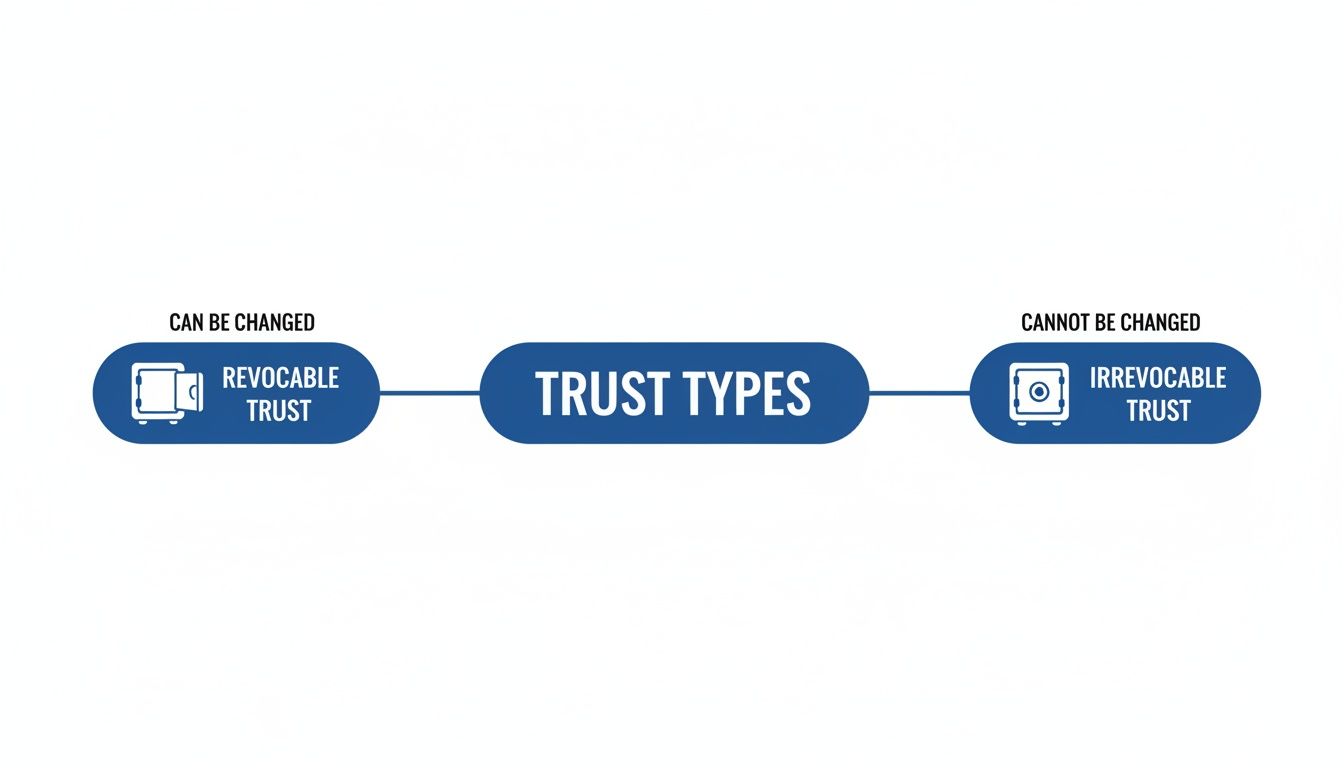
The difference is clear: revocable trusts are fantastic tools for avoiding the headaches of probate, but irrevocable trusts are built for sophisticated tax planning.
Revocable Trusts and Tax Transparency
For all their benefits in managing an estate, revocable trusts are pretty much a non-event for taxes during your lifetime. When you move property in, the trust is essentially invisible to the IRS.
The trust just uses your Social Security number as its tax ID. Any income, deductions, or credits from the trust’s assets flow directly onto your personal 1040 tax return. It's simple, but it also means the property is still 100% part of your taxable estate. You can learn more about the specifics of how trusts are taxed to see why this structure is so straightforward.
The bottom line is simple: control equals taxation. If you keep control (revocable), you also keep the tax liability. If you give up control (irrevocable), you shift the asset—and its future tax impact—away.
Irrevocable Trusts and Completed Gifts
Opting for an irrevocable trust is a major financial step. Since you're making a permanent gift, you'll likely need to file a federal gift tax return (Form 709).
This transfer uses up a piece of your lifetime gift and estate tax exemption. For 2024, that exemption is a whopping $13.61 million per person. The real payoff? Any future growth in the property's value happens outside of your estate, which could save your heirs a fortune in estate taxes down the road.
To make this even clearer, here's a quick side-by-side look at the immediate tax differences.
Quick Guide: Revocable vs. Irrevocable Trust Tax Implications
| Tax Consideration | Revocable Trust | Irrevocable Trust |
|---|---|---|
| Gift Tax on Transfer | No. The transfer is not a completed gift. | Yes. This is a completed gift and may require filing a gift tax return (Form 709). |
| Estate Tax | No change. Assets are still included in your taxable estate. | Yes. Assets (and future appreciation) are removed from your taxable estate. |
| Income Tax | No change. All income is reported on your personal tax return (Form 1040). | The trust files its own tax return (Form 1041). Tax rates can be much higher. |
| Control | You retain full control to amend or revoke the trust. | You give up control; the trust cannot be easily changed or revoked. |
This table highlights the fundamental trade-off: revocable trusts offer flexibility with no immediate tax benefit, while irrevocable trusts provide powerful tax advantages at the cost of control.
How Revocable Trusts Impact Your Taxes
When you start looking at trusts, the revocable trust is the most straightforward from a tax perspective. The easiest way to think about it is as a see-through box for your assets. You place property inside it, but for all tax purposes, the IRS looks right through that box and sees you, the original owner. This "tax transparency" is the whole game.
Because you keep complete control—you can change the trust, shut it down, or just pull the property back out whenever you want—the government doesn't see the transfer as a true gift. That’s a huge plus, as it means you don't have to worry about triggering a gift tax just for organizing your assets. It’s more like moving money from your left pocket to your right.
Your Tax Picture Stays the Same
On the income tax front, it’s business as usual. The trust simply uses your Social Security number for tax ID purposes, and any income, deductions, or other financial activity from the trust’s assets just flows right onto your personal Form 1040.
So, if you move a rental property in Queens into your revocable trust, you’ll keep reporting the rent checks and deducting the repairs on your own tax return, exactly like you did before. The trust itself doesn't need to file a separate tax return while you're alive.
What About Estate Taxes?
There’s a common myth that a revocable trust is a tool for dodging estate taxes. It's not. Since you still have your hands on the controls, the full value of the assets inside the trust is counted as part of your taxable estate when you pass away.
A revocable trust’s main job isn’t to save on taxes during your lifetime. Its real superpower kicks in after you’re gone: helping your estate sidestep the time-consuming, expensive, and very public process of probate.
But while it won't shrink your taxable estate, a revocable trust does pass on a massive, and often underappreciated, tax advantage to your heirs: the stepped-up basis.
The Power of a Stepped-Up Basis
Let's break down what this actually means. A property's "basis" is what you paid for it, and it's the starting point for calculating capital gains when you sell. A "stepped-up basis" effectively erases all the appreciation that happened during your lifetime by resetting the property's cost basis to whatever it was worth on your date of death.
Here’s how it plays out:
- Original Purchase: Let’s say you bought a Manhattan apartment years ago for $300,000.
- Value at Death: When you pass away, that same apartment is now valued at $2.5 million.
- Heir's New Basis: Because the apartment was in your revocable trust, your beneficiary inherits it with a new, "stepped-up" basis of $2.5 million.
This is a game-changer. If your heir turns around and sells that apartment for $2.5 million, they owe zero in capital gains tax. Without that step-up, they’d be on the hook for taxes on the $2.2 million gain—a staggering bill. This benefit alone can preserve a huge amount of wealth for your family, making revocable trusts a foundational piece of smart estate planning, even if they don't directly lower your estate tax bill.
Using Irrevocable Trusts for Tax Reduction
While revocable trusts are great for avoiding probate and managing your affairs, they don't do much for serious tax planning. For that, you have to step up to an irrevocable trust, which is a whole different ballgame. Moving property into one of these isn't just shuffling assets around—it's a final, permanent transfer with major tax implications.
The second you place an asset into an irrevocable trust, the IRS considers it a completed gift. This means you'll likely need to file a gift tax return (Form 709) and start chipping away at your lifetime gift and estate tax exemption. This isn't an accident; it's a deliberate, strategic move.
Removing Assets from Your Taxable Estate
So, why would anyone do this? The main reason is powerful: to get that property, and all its future growth, completely out of your taxable estate. For families with significant wealth, this is a cornerstone strategy.
By making a completed gift now, you ensure a much larger asset won't be hit with federal estate tax later on, which can climb as high as 40%.
Think about it this way: say you own a commercial building in NYC that's appreciating quickly. By moving it into an irrevocable trust, you essentially freeze its value for estate tax purposes. All the growth that happens from that day forward occurs outside your estate, safely shielded from the IRS. It's a fundamental way families preserve wealth for the next generation.
The Trust Becomes a Taxpayer
Of course, giving up control means you have to play by a new set of rules. Once property is inside an irrevocable trust, the trust becomes its own legal entity with its own tax obligations. It needs its own Taxpayer Identification Number (TIN) and has to file an annual income tax return, Form 1041.
This is where things get tricky. An irrevocable trust doesn't pay taxes like you or I do. It’s stuck with something called "compressed tax brackets," and they are not friendly.
An irrevocable trust is a powerful tool for estate tax reduction, but it introduces its own income tax complexities. The key is to manage the trust's income strategically to avoid its punishingly high tax rates.
Because of this structure, it's almost always a bad idea for the trust to hang onto its income. If the trust earns rental income from a property, for example, letting that cash build up inside the trust can trigger the highest tax rates almost immediately.
Understanding Compressed Tax Brackets
This idea of compressed tax brackets is probably the most critical income tax concept to grasp. Trusts hit the top federal income tax rate incredibly fast. For the current tax year, a trust will be taxed at the highest marginal rate after earning just over $15,000 in taxable income.
Compare that to an individual filing as single, who won't hit that same top bracket until their income tops $600,000. That massive difference creates a big tax-efficiency problem if a trust simply holds onto its earnings. You can learn more about how trusts are taxed to see the full picture.
This tax trap, however, points directly to the solution. Instead of letting income pile up inside the trust, the trustee can distribute it to the beneficiaries. The beneficiaries then report that income on their own personal returns, where it’s taxed at their individual rates—which are almost guaranteed to be lower. This process of passing out the trust's Distributable Net Income (DNI) is the essential playbook for managing the trust’s tax bill each year.
Understanding Capital Gains and Basis in Trusts
Beyond the world of estate and gift taxes, one of the most critical financial decisions you'll make when transferring property into a trust revolves around capital gains. How this is handled can be worlds apart depending on the trust structure you choose, and frankly, getting it wrong can cost your family a fortune.
It all boils down to two key concepts: carryover basis and stepped-up basis.

Knowing which one applies to your situation is the bedrock of smart tax planning. The difference can easily amount to hundreds of thousands, or even millions, of dollars in tax savings down the line.
Carryover Basis: The Rule for Irrevocable Trusts
When you make a lifetime gift of property to an irrevocable trust, the property doesn't get a fresh start on its value. Instead, the trust inherits your original cost basis—a concept known as carryover basis. Think of it like a relay race where the tax baton (your original purchase price) is passed directly to the trust.
Let's say you bought a Brooklyn brownstone for $100,000 back in the 1980s. Today, it’s worth a cool $2 million. If you transfer this property into an irrevocable trust, the trust’s cost basis for tax purposes is still just $100,000.
This has a massive downstream effect. If the trustee eventually sells that brownstone for $2 million, the trust or its beneficiaries will be staring down a capital gains tax bill on a whopping $1.9 million profit. The carryover basis essentially preserves that built-in gain, creating a significant future tax liability.
Stepped-Up Basis: The Advantage of Revocable Trusts
Now, let's flip the script. When property is held in a revocable trust, it remains part of your taxable estate. While that might sound like a bad thing, it unlocks a huge tax benefit for your heirs when you pass away: the stepped-up basis.
Instead of carrying over your old, low basis, the property's basis is "stepped up" to its fair market value on your date of death. In an instant, all the appreciation that occurred during your lifetime is completely erased for capital gains tax purposes.
With a stepped-up basis, decades of capital appreciation can be wiped away, allowing heirs to sell an inherited property with little to no capital gains tax. This is arguably one of the most powerful tax-saving tools in estate planning.
Using our same Brooklyn brownstone example, if it's in your revocable trust when you pass away and is worth $2 million, your beneficiaries inherit it with a new basis of $2 million. If they turn around and sell it the next day for that price, they owe precisely $0 in capital gains tax. That entire $1.9 million gain vanishes from a tax perspective.
A Practical Comparison
The power of the stepped-up basis can lead to some dramatic tax savings. Imagine a New York real estate investor bought a commercial property for $200,000 in 1995. At their death, it was worth $800,000. Their child, inheriting it through a trust, receives a new cost basis of $800,000. A subsequent sale at $805,000 would generate a taxable gain of only $5,000, not the $605,000 it would have been otherwise. That's a 99.2% reduction in taxable gains. You can find more insights on how heirs should handle taxes when inheriting a trust.
This brings us to a critical planning crossroad:
- Irrevocable Trust: The go-to tool for reducing estate taxes, but it can lock in substantial capital gains for your heirs.
- Revocable Trust: Offers no direct estate tax savings, but it provides that incredibly valuable step-up in basis.
Choosing the right path isn't a one-size-fits-all decision. It depends entirely on your financial picture, from the size of your estate to the appreciation of your assets. It’s a strategic trade-off that demands a careful conversation with your tax advisor.
Navigating New York State and NYC Tax Laws
While federal tax laws set the stage for trust planning, things get much more specific—and potentially expensive—when you get down to the state and local level. For property owners here in New York, that means grappling with a unique set of rules, namely the New York State Real Estate Transfer Tax (RETT) and the New York City Real Property Transfer Tax (RPTT).
Successfully moving real estate into a trust without getting hit with a huge tax bill requires a deep understanding of the local landscape. It's not just about knowing the rules; it's about knowing how to use the exemptions that are specifically designed for these kinds of transfers.

Avoiding Transfer Taxes When Funding a Trust
As a general rule, both New York State and NYC levy a transfer tax anytime real estate is sold or changes hands. But there's a critical exception that often applies when you're simply changing the form of ownership without actually changing who benefits from it.
This is the bread and butter of transfers to a revocable trust. Since you still have complete control and are considered the owner for all practical tax purposes, the government sees this as a "mere change of identity." You're just changing the name on the deed, not giving the property away. As long as no money changes hands, the transfer is almost always exempt from both RETT and RPTT. The same principle usually holds true if you later decide to transfer the property out of the revocable trust and back to yourself.
Irrevocable trusts, however, are a different story. The transfer might still be exempt if you, the original owner, are the only person who can benefit from the trust during your lifetime. But the moment you name other beneficiaries who can receive benefits now, the state might see it as a taxable gift, and you'll need a much closer look at the specific circumstances to see if an exemption applies.
Navigating the maze of New York’s transfer tax exemptions is absolutely critical. A well-structured, no-consideration transfer can save you thousands. A small misstep, on the other hand, can trigger a surprisingly large and entirely avoidable tax bill.
Don't Lose Your Property Tax Exemptions
Beyond the one-time transfer taxes, there’s a sneaky risk that can pop up on your annual property tax bill. New York offers some incredibly valuable tax exemptions for primary residences that can save homeowners a lot of money each year.
Two of the most common ones you'll see are:
- The School Tax Relief (STAR) exemption: This program gives most homeowners a valuable break on their school property taxes.
- The Senior Citizen Homeowners' Exemption (SCHE): For eligible seniors on a limited income, this can mean a significant reduction in their overall property tax bill.
Here's the catch: these programs are tied to the individual owner, not just the property itself. When you transfer your home into a trust—especially an irrevocable trust—you legally aren't the owner of record anymore. This simple act can accidentally disqualify you from these benefits, leading to an unexpected spike in your annual property taxes by hundreds or even thousands of dollars.
Smart Strategies for NYC Homeowners
So, how do you get the asset protection benefits of an irrevocable trust without losing your property tax breaks? Fortunately, there are proven strategies.
One of the most effective solutions is to retain specific rights for yourself within the trust agreement. A very common technique is for the grantor (the person creating the trust) to keep a life estate. By writing this into the trust, you legally reserve the right to live in and use the property for the rest of your life. For programs like STAR and SCHE, holding a life estate is often enough to still be considered the "owner" for eligibility purposes, allowing you to keep those crucial tax savings.
This is a perfect example of why working with professionals who live and breathe New York tax law is so important. Your trust needs to be drafted with a double-focus: accomplishing your long-term federal estate planning goals and sidestepping these local tax traps. A truly effective plan has to work on every level of government.
Your Pre-Transfer Strategy Checklist
Before you sign on the dotted line, taking a moment to map out your strategy is absolutely critical. Thinking through your goals and the potential ripple effects will set you up for a far more productive conversation with your legal and tax advisors. This checklist is designed to walk you through the key questions you need to answer for yourself, ensuring the tax implications of transferring property into a trust actually serve your long-term plan.
Think of these points as your guide to clarifying your intentions, understanding the trade-offs involved, and preparing for a detailed consultation with the professionals who will help bring your vision to life.
Define Your Primary Objective
First things first: what are you really trying to accomplish here? Your number one goal is the compass that will point you toward the right type of trust and the best way to get there. Are you hoping to:
-
Avoid Probate? If your main worry is sparing your heirs the hassle, expense, and public nature of the probate court process, a simple revocable trust is often the most straightforward answer.
-
Reduce Estate Taxes? For anyone with an estate that’s getting close to—or has already surpassed—the federal or New York State exemption limits, an irrevocable trust is the classic tool for moving assets out of your taxable estate.
-
Protect Assets from Creditors? Certain kinds of irrevocable trusts can build a protective wall around your assets, shielding them from future lawsuits or creditors. This is a huge consideration for many business owners and professionals.
Your answer to this core question—is it about probate avoidance or tax reduction?—is the foundation of your entire plan. Each path uses a different toolkit and leads to a completely different set of tax outcomes.
Assess the Property’s Tax Profile
Next, it’s time to put the property itself under the microscope, paying close attention to its basis. The gap between what you originally paid for the property and what it's worth today is one of the biggest factors in your planning.
Run through these questions:
-
Does the property have a low basis and high appreciation? If you bought a home or building decades ago for a sliver of its current value, holding onto it in a revocable trust to give your heirs that all-important stepped-up basis could save them a massive capital gains tax bill down the road.
-
Is this an income-producing asset? If the property generates rent, you have to think about the highly compressed tax brackets that apply to irrevocable trusts. You’ll need a solid plan for distributing that income out to beneficiaries; otherwise, the trust itself could get hit with unnecessarily high taxes.
-
How will this move impact my local property taxes? This is a big one for NYC residents. Are you currently receiving STAR, SCHE, or other valuable exemptions? Transferring your home into an irrevocable trust, especially without retaining a life estate, could accidentally disqualify you and trigger a sudden, painful spike in your annual tax bill.
Common Questions About Trusts and Property
When my clients start exploring trusts, the conversation quickly moves from the abstract to the practical. They want to know how this legal structure will actually affect their day-to-day life and their most valuable assets. Let's walk through some of the most frequent questions that come up.
Can I Sell Property That's in a Trust?
Yes, absolutely. But how you sell it depends entirely on whether the trust is revocable or irrevocable.
If you have a revocable trust, the process is straightforward. Since you, as the grantor, maintain control and are usually the trustee, you can sell the property just as you would if it were in your own name. You'll simply sign the closing documents as "John Doe, Trustee," and the proceeds can go right back to you.
Selling property from an irrevocable trust is a different ballgame. The trustee—who is someone other than you—is the only one with the authority to sell. Their legal duty is to act in the best interests of the beneficiaries, and the money from the sale must stay inside the trust to be managed according to its rules. This, of course, creates its own set of tax implications we'd need to plan for.
What Happens to My Mortgage If I Put My House in a Trust?
This is a big one. Nearly every mortgage has a "due-on-sale" clause, which gives the lender the right to call the entire loan due if the property is transferred. Understandably, this makes people nervous.
Thankfully, there's a federal law called the Garn-St Germain Depository Institutions Act of 1982 that provides a key protection. It prevents lenders from triggering that clause when you transfer your home into a revocable living trust, as long as you remain a beneficiary of that trust. So, for most common estate planning transfers, your mortgage is safe.
Will a Trust Protect My Home from Medicaid?
The answer here is a firm "it depends" and hinges on the type of trust.
A revocable trust offers zero protection from Medicaid. Because you haven't given up control, Medicaid views those assets as if they are still yours and will count them when determining your eligibility.
An irrevocable trust, however, can provide protection, but it's not a last-minute solution. You have to be strategic. Medicaid has a five-year look-back period, meaning they scrutinize any assets you transferred during the five years before you apply for benefits. If you move your home into an irrevocable trust and then apply for Medicaid two years later, that transfer will likely be flagged, and the home's value could be used to disqualify you.
How Often Should I Review My Trust?
Think of your trust as a living document, not something you sign and file away forever. Life changes, laws change, and your goals change.
A good rule of thumb is to sit down with your attorney and financial advisor to review your trust every three to five years. You should also trigger an immediate review after any major life event.
What counts as a major event?
- A marriage, divorce, or the death of a spouse
- The birth or adoption of a child or grandchild
- A significant swing in your financial situation, up or down
- Major shifts in federal or state tax law (which happens more often than you'd think)
Navigating the tax and legal details of a trust isn't something you should do alone. At Blue Sage Tax & Accounting Inc., we specialize in helping clients build sound financial strategies that align their personal goals with a smart, tax-efficient plan.