So, you're ready to sell your rental property. Beyond the closing table and realtor fees, there’s a major partner in this transaction you can't forget: the IRS. Selling an investment property isn't just a real estate deal; it's a significant tax event, and understanding your obligations is the first step to protecting your profit.
Your Core Tax Obligations When Selling a Rental
When you sell, you’re looking at two main tax hits: capital gains tax on the property's appreciation and a separate tax called depreciation recapture on the tax breaks you took over the years.
Most investors know about capital gains. If you've owned the property for more than a year, your profit is generally taxed at the more favorable long-term capital gains rates of 0%, 15%, or 20%, depending on your income. But for high-income earners, it doesn't stop there. You might also get hit with the 3.8% Net Investment Income Tax (NIIT) on top of that. It's wise to explore more about these tax implications to see exactly how they fit your financial picture.

The real surprise for many, however, is depreciation recapture. All those years you claimed depreciation as a deduction? The IRS wants a piece of that back. This recaptured amount is taxed at a special, ordinary income rate, capped at 25%—which can be a much steeper rate than for your capital gains.
The Two Pillars of Rental Property Tax
Think of your tax bill as having two separate components. It's a common and costly mistake to just lump everything together as "profit." They are calculated differently and taxed at different rates.
The two main taxes you'll face are:
- Capital Gains Tax: This is the tax on your actual profit—the difference between what you sold it for and your adjusted basis. The rate hinges on your income and how long you held the asset.
- Depreciation Recapture Tax: This is the IRS "clawing back" the tax benefit you got from depreciating the property. It’s a separate calculation and is often taxed at a higher rate than your long-term gains.
Your profit for tax purposes is not simply the sale price minus your original purchase price. It’s a more detailed calculation that accounts for improvements and depreciation, which is why understanding your "adjusted basis" is critical.
Why This Matters for Every Investor
Ignoring these two distinct taxes can leave you with a much smaller check than you budgeted for. When you understand the moving parts, you can start to plan strategically. Maybe you time the sale for a lower-income year, or perhaps you explore a powerful deferral tool like a 1031 exchange.
Before we get into the nitty-gritty of the math, let's get grounded in the core concepts.
Key Tax Concepts at a Glance
This table breaks down the fundamental terms you'll need to know. Getting these straight is the first step to mastering your tax strategy.
| Concept | What It Is | Why It Matters |
|---|---|---|
| Adjusted Basis | Your initial property cost plus capital improvements, minus all the depreciation you've claimed. | This is the starting point for calculating your gain or loss. A higher basis means a lower taxable gain. |
| Capital Gain | The profit you make, calculated as the sales price minus your adjusted basis and selling costs. | This is the amount that gets taxed, either at short-term or more favorable long-term rates. |
| Depreciation Recapture | The total amount of depreciation you've deducted over the years, which is then taxed upon sale. | It's taxed at a special rate up to 25%—often higher than your capital gains rate—and can be a surprisingly large part of your tax bill. |
Understanding these three pillars is non-negotiable. They form the foundation for every calculation and strategy we'll discuss next.
How to Calculate Your Real Profit for Tax Purposes

When you sell a rental property, the first thing you need to do is forget the everyday definition of "profit." The IRS couldn't care less about the simple math of sale price minus purchase price. They have their own rulebook, and it all revolves around calculating your taxable gain with a specific formula.
The entire calculation hinges on one crucial number: your adjusted basis. Think of it as your property's official financial story for tax purposes. It’s not a static figure; it’s a living number that changes throughout the time you own the property.
Your adjusted basis starts with what you originally paid, but it moves up and down from there based on your investments in the property and the tax benefits you've taken.
Building Your Adjusted Basis Step-by-Step
Figuring out your adjusted basis is a straightforward process of addition and subtraction. Getting this number right is absolutely critical, because a higher basis means a lower taxable gain when you finally sell.
- Start with Your Initial Cost Basis: This is your starting line. It includes the purchase price plus any closing costs you couldn't immediately deduct, like legal fees, title insurance, and recording fees.
- Add Capital Improvements: Next, you'll add the cost of any major upgrades that increase the property's value or extend its life. We're not talking about minor repairs like fixing a leaky faucet. This is for the big stuff: a new roof, a full kitchen remodel, or a brand-new HVAC system.
- Subtract All Claimed Depreciation: Finally, you must subtract the total amount of depreciation you've claimed (or were entitled to claim) over the years. This is a vital step that many investors miss, and it significantly lowers your basis, which in turn increases your potential taxable gain.
A common mistake I see is investors failing to track their capital improvements. Every receipt for a major upgrade increases your adjusted basis, which directly reduces the capital gains tax you'll owe down the road. Keep every single one.
Let's walk through a practical example to make this crystal clear.
A Practical Calculation Example
Imagine you bought a rental property ten years ago for $300,000. Five years into owning it, you spent $50,000 on a complete roof replacement—a classic capital improvement. Over that decade, you also claimed a total of $40,000 in depreciation deductions on your tax returns.
Here’s how to calculate your adjusted basis:
- Initial Cost Basis: $300,000
- Add Capital Improvements: + $50,000
- Subtract Depreciation: – $40,000
- Final Adjusted Basis: $310,000
Now, let's say you sell that property for $500,000. To find your total gain, you just subtract your adjusted basis from the sale price:
$500,000 (Sale Price) – $310,000 (Adjusted Basis) = $190,000 (Total Gain)
This $190,000 is your total taxable profit. But it's not all taxed the same way—it gets broken down into two parts: capital gains and depreciation recapture, which we'll get into next.
Long-Term vs Short-Term Capital Gains
The final piece of this puzzle is determining whether your gain is long-term or short-term. The difference can have a massive impact on your tax bill. Thankfully, the rule is simple: it all comes down to how long you held the property.
- Long-Term Capital Gain: If you owned the property for more than one year, your profit qualifies for the much friendlier long-term capital gains tax rates.
- Short-Term Capital Gain: If you owned it for one year or less, the profit is treated as ordinary income, which is almost always taxed at a significantly higher rate.
This holding period is precisely why most seasoned real estate investors aim to keep their properties for over a year. The tax savings are just too substantial to ignore.
This table really highlights how differently the federal government treats these two scenarios.
Long-Term vs Short-Term Capital Gains Tax Rates
| Holding Period | Tax Treatment | Typical Federal Tax Rates |
|---|---|---|
| More than one year | Long-Term Capital Gain | 0%, 15%, or 20% (based on your income) |
| One year or less | Short-Term Capital Gain | Taxed as ordinary income (rates up to 37%) |
As you can see, holding on for at least a year and a day can save you a fortune in taxes.
With a solid grasp of how to calculate your adjusted basis and determine your total gain, you're now ready to tackle the two distinct taxes that apply to that gain: capital gains tax and depreciation recapture.
Understanding Depreciation Recapture Tax
Depreciation is easily one of the best tax perks of owning rental property. It lets you write off a piece of your property's value each year, which directly lowers your taxable income. But here’s the catch: the IRS eventually wants its money back. When you sell, they collect on that benefit through something called depreciation recapture.
Think of it like an interest-free loan from Uncle Sam. Each year, you got a tax break for the property's supposed "wear and tear." When you sell, the IRS effectively calls in that loan by taxing all the depreciation you've taken over the years. This often comes as a nasty surprise to investors because it's a separate tax from capital gains and can hit at a higher rate.
How Recapture Tax Is Calculated
The most important thing to grasp is that depreciation recapture is taxed differently than your other profits. Your long-term capital gains from the property's appreciation might be taxed at 15% or 20%, but the part of your gain that comes from depreciation gets taxed as ordinary income, up to a maximum federal rate of 25%.
And here's the kicker: this tax applies to all the depreciation you were allowed to take, not just what you actually claimed on your returns. So, if you skipped taking depreciation deductions in prior years, the IRS doesn't care. They calculate your basis as if you did take it, meaning you still owe the recapture tax. It’s their way of making sure no one games the system by simply opting out of depreciation to avoid the tax later.
Depreciation recapture isn't optional. The IRS sees it as you simply repaying the tax savings you enjoyed over the years. It ensures that the tax benefit you received while holding the property is squared up when you finally sell.
A Practical Example of Depreciation Recapture
Let's jump back to our example. We figured out you have a total gain of $190,000 on the sale. We also know that over the decade you owned it, you claimed a total of $40,000 in depreciation.
For tax purposes, that $190,000 gain isn't one big number. It gets split into two buckets:
- Depreciation Recapture: The first $40,000 of your gain is all recapture. This slice is taxed at your ordinary income rate, with a ceiling of 25%.
- Long-Term Capital Gain: The rest of the profit, which is $150,000 ($190,000 total gain – $40,000 recapture), is your true long-term capital gain. This is the portion that gets the favorable 0%, 15%, or 20% tax rates, depending on your income level.
So, let's figure out the tax on just the recaptured part:
- Total Depreciation Claimed: $40,000
- Recapture Tax Rate: 25%
- Depreciation Recapture Tax Owed: $40,000 x 0.25 = $10,000
This $10,000 is the specific tax bill for the depreciation benefit you took. It gets tacked on to whatever capital gains tax you owe on the remaining $150,000 of profit.
Recapture Can Even Apply in a Loss
Here's where depreciation recapture can feel particularly brutal: you might have to pay it even if you sell your property for an overall loss. How? Imagine you sell the property for less than you originally paid, but more than your adjusted basis (which, remember, has been pushed down by years of depreciation).
In that situation, you wouldn't have a true capital gain. But you would still have a taxable gain equal to the amount of depreciation you took, and that gain is subject to the 25% recapture tax. This is why you absolutely have to factor in recapture in any sale scenario, not just the profitable ones. It's a critical piece of the puzzle for figuring out what you'll actually walk away with.
Powerful Strategies to Defer or Reduce Your Taxes
https://www.youtube.com/embed/DmF5Qv8GVnY
Knowing what you might owe in taxes is one thing; actively managing that bill is where you can make a real difference. Selling a rental property can trigger a major tax event, but smart investors have long used perfectly legal, IRS-approved strategies to postpone or even eliminate that tax hit.
These tools are powerful. They can help you keep your hard-earned equity working for you, rather than handing a huge chunk of it over to the government.
The most famous of these strategies is the Section 1031 exchange, often just called a "like-kind" exchange. Think of it as hitting the pause button on your tax bill. Instead of cashing out and paying capital gains and depreciation recapture taxes, you roll the entire proceeds from the sale directly into a new, similar investment property.
This maneuver lets you kick the tax can down the road, potentially for years, allowing your investment to compound without being interrupted by a massive tax bill. Be warned, though: the IRS has very strict rules, and you have to follow them to the letter.
Mastering the Section 1031 Exchange
A 1031 exchange isn't something you can decide to do casually at the last minute. It's a formal process governed by tight deadlines and rigid procedures. The single most important rule is that you, the seller, can never have access to the money from the sale, not even for a second. The funds must be held by a neutral third party called a Qualified Intermediary (QI).
The moment you close the sale on your old property, two clocks start ticking at the same time:
- The 45-Day Identification Period: You have exactly 45 calendar days to officially identify potential replacement properties. This has to be done in writing, with a signed and dated list submitted to your QI. Window shopping doesn't count.
- The 180-Day Closing Period: You have to close on one or more of the properties you identified within 180 calendar days from your original sale date. Critically, this 180-day clock includes the 45-day window—it doesn't start after it.
These deadlines are unforgiving. If you miss the 45-day identification deadline by a single day, the entire exchange is blown, and your sale becomes fully taxable. You absolutely must plan this out with a QI before you even put your property on the market.
To pull it off successfully, the property you buy must have an equal or greater value than the one you sold, and you have to reinvest all the net proceeds. Any cash you take out (which has the tax term "boot") or any reduction in your mortgage debt will be taxed.
Exploring Other Tax-Saving Tactics
While the 1031 exchange is a fantastic tool for deferring taxes, it's not your only option. Other strategies can help you manage the tax bite, especially if you're looking to get out of the landlord game entirely instead of just swapping properties.
This flowchart highlights a crucial concept that trips up many investors: whether you actually claimed depreciation or not, the IRS will calculate recapture tax as if you did.
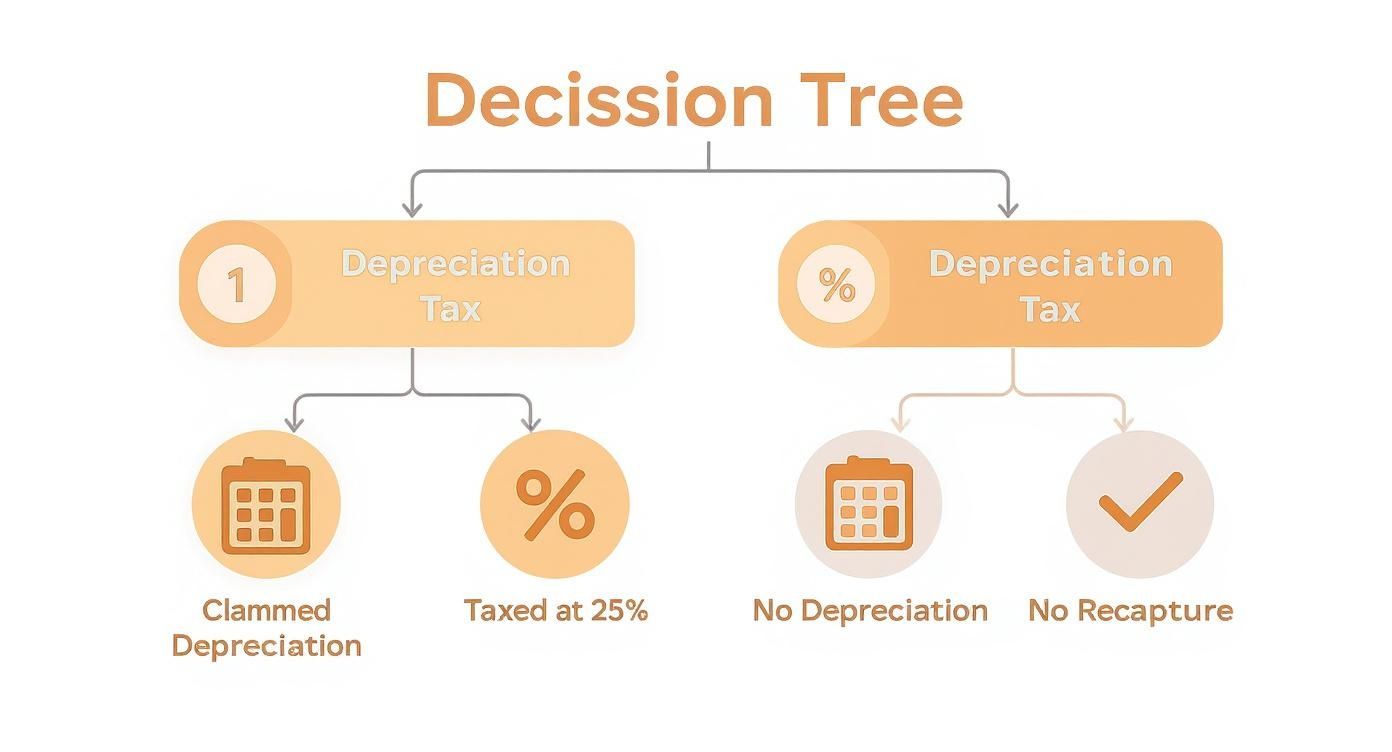
The takeaway here is that skipping your annual depreciation deduction doesn't get you out of paying recapture tax later—it just means you missed out on years of valuable tax benefits.
Convert Your Rental into a Primary Residence
One incredibly effective strategy, if your life plans allow for it, is to move into your rental property and make it your primary home. Thanks to Section 121 of the tax code, you can exclude a huge amount of the capital gain from your taxes.
- For single filers: You can exclude up to $250,000 of gain.
- For married couples filing jointly: That exclusion doubles to $500,000.
To qualify, you must have both owned the property and lived in it as your main residence for at least two of the five years right before you sell it. It's crucial to understand that this powerful exclusion only works on capital gains. You will still owe depreciation recapture tax on all the deductions you took while it was a rental. The exclusion might also be prorated depending on how long it was used as a rental versus a primary home.
Spread Out Your Tax Hit with an Installment Sale
What if you don't need a big pile of cash all at once and would rather smooth out your tax liability? An installment sale could be the perfect solution. With this approach, you sell the property but receive payments from the buyer over several years.
Instead of getting hit with one massive tax bill in the year of the sale, you pay taxes proportionally as you receive each payment. This is a great move if the full gain would push you into a much higher tax bracket. By spreading the income out, you can often keep your taxable income in a lower bracket each year, saving you a lot of money in the long run.
Each of these strategies is designed for a different goal and a different type of investor. The key is to think about your long-term financial picture and consult with a tax professional at Blue Sage Tax & Accounting Inc. to figure out which approach makes the most sense for you—long before you make any final decisions.
Don't Forget About State and Other Federal Taxes
Once you’ve wrestled with your federal capital gains and depreciation recapture, it’s easy to feel like you're done. But hold on—the biggest surprises often come from the taxes people forget to plan for.
Federal taxes are just the starting point. You also need to factor in other federal obligations and, critically, state and local taxes. These can take a huge bite out of your profit, sometimes even more than you expect.
The Net Investment Income Tax (NIIT)
One of the first things to look at is the Net Investment Income Tax (NIIT). Think of it as a 3.8% surtax that gets tacked onto investment income for higher earners.
The profit you make from selling your rental property counts as investment income, which means it could trigger the NIIT if your Modified Adjusted Gross Income (MAGI) crosses certain thresholds.
This isn't a replacement for your capital gains tax; it's in addition to it. You might have to pay this if your MAGI is over:
- $250,000 for married couples filing jointly
- $200,000 for single or head of household filers
- $125,000 for married individuals filing separately
If your income is above these levels, the 3.8% tax applies to the lesser of your net investment income or the amount your income exceeds the threshold. For investors with a significant gain, this can easily add thousands of dollars to an already painful tax bill.
State and Local Taxes: The Wild Card
Never, ever underestimate the impact of state and local taxes. They can range from zero in states like Florida and Texas to over 13% in California. Crucially, it’s the property’s physical location that dictates who gets to tax you, not where you live now.
Forgetting about state taxes is one of the most common—and costly—mistakes I see investors make. A sale in a high-tax state can completely change the financial outcome, leaving you with far less cash than you planned for.
Let's walk through an example in a place like New York City to see just how quickly it all adds up.
Example: The New York City Tax Bite
Let's say you sell a rental property in NYC and walk away with a $200,000 long-term capital gain.
- Federal Capital Gains Tax (20% bracket): $40,000
- Federal NIIT (3.8%): $7,600
- New York State Tax (at 6.85%): $13,700
- New York City Tax (at 3.876%): $7,752
- Total Combined Tax: $69,052
Your actual tax rate here isn't the 20% federal rate you might have been focused on—it's over 34.5%. The state and city taxes alone added nearly 15% to the total burden. This is why you have to do your homework on the specific state and local rules to truly understand what you'll pocket after the sale.
Creating Your Pre-Sale Action Plan

A tax-smart sale isn't something you stumble into. It’s the direct result of careful planning that should start months, if not years, before you ever think about listing the property. Being proactive is the single best thing you can do to keep more of your hard-earned equity and avoid a painful, unnecessarily large tax bill.
Think of it like preparing for a long road trip. You wouldn't just hop in the car and start driving. You’d map your route, check the oil, and pack properly. Selling a major asset like a rental property demands that same level of foresight to sidestep costly mistakes.
Strategic Timing and Documentation
One of the simplest yet most powerful strategies is all about timing. If you have the flexibility, try to sell your property in a year when your other income is lower. For example, selling after you retire or during a planned career break could potentially drop you into a lower capital gains tax bracket. That simple shift could save you thousands.
But before you even think about timing, you need to get your paperwork in order. This is the most critical pre-sale task. Having a meticulously organized file is absolutely essential for calculating your adjusted basis correctly and, just as importantly, for backing up your numbers if the IRS comes knocking.
Here’s what you need to start gathering:
- Original Closing Statement: This is the starting point for your cost basis.
- Receipts for All Capital Improvements: Every invoice for that new roof, the HVAC system you replaced, or the kitchen you remodeled. Dig them up.
- Past Tax Returns: These are your proof of the total depreciation you’ve claimed over the years.
- Records of Selling Expenses: Keep a running list of realtor commissions, legal fees, and any other costs tied to the sale.
Assembling Your Professional Team
Let’s be clear: navigating the tax rules for selling a rental property is not a DIY project. The web of capital gains, depreciation recapture, and state-specific laws is far too complex. Building a team of sharp advisors isn't an expense; it's an investment that can pay for itself many times over.
The most expensive advice is often the advice you didn't get. Trying to save a few dollars by skipping professional consultation can lead to mistakes that cost you tens of thousands in taxes.
Your core team should have three key players:
- A Certified Public Accountant (CPA): A good CPA can run tax projections to give you a clear estimate of your liability. They’ll help you pinpoint the best time to sell and see the entire financial picture.
- A Tax Attorney: If your situation is complicated—maybe you're selling multiple properties or it involves estate planning—a tax attorney adds a crucial layer of legal protection and strategic planning.
- A Qualified Intermediary (QI): This is non-negotiable. If you are even thinking about a 1031 exchange, you must have a QI in place before you close the sale. They are legally required to handle the funds and facilitate the exchange.
With a solid plan, organized documents, and the right team in your corner, you can walk into your sale with confidence, knowing you're making smart decisions to maximize your return.
Got Questions? We've Got Answers
Even with the best game plan, selling a rental property always brings up a few specific questions. Let's tackle some of the most common ones I hear from investors.
"Can I Just Reinvest the Money Myself and Skip the 1031 Exchange?"
I wish I could say yes, but this is a hard no. It's a common mistake that can cost you dearly. To legally defer your taxes, you must follow the strict rules of a Section 1031 exchange.
The law is crystal clear on this: a Qualified Intermediary has to hold your sale proceeds. If that cash touches your bank account—even for a second—before you buy the next property, the IRS considers it a fully taxable sale. Game over for the tax deferral.
"What if I Sell My Rental for a Loss? Am I in the Clear?"
Not necessarily. Selling at a loss feels like it should mean no taxes, but there's a catch: depreciation recapture. You're still on the hook for the 25% recapture tax on all the depreciation you've claimed over the years.
After accounting for that recapture, any leftover capital loss is usually a passive loss. You can typically use that to offset gains from other passive investments. If you don't have any, the rules get tricky, and it's time to bring in a tax pro to figure out your next move.
Selling in a down market can create a nasty surprise. You might sell for less than you paid, but still have a taxable gain. Why? Because years of depreciation deductions have hammered down your adjusted basis, creating a 'phantom' gain that the IRS absolutely expects you to pay tax on.
"How Long Do I Have to Live in My Old Rental to Avoid Taxes?"
If you're thinking about moving into your rental to get the home sale exclusion, you need to be patient. To qualify for the Section 121 exclusion, the rule is simple but non-negotiable.
You have to own the property and live in it as your primary home for at least two of the five years right before you sell it.
This is a fantastic tax break—it can let you exclude up to $250,000 in gains if you're single, or $500,000 if you're married. Just remember, this exclusion only covers the capital gain from the property's appreciation. You will still have to pay depreciation recapture tax for the time it was a rental.
Navigating these tax rules isn't something you should do alone. The team at Blue Sage Tax & Accounting Inc. lives and breathes real estate taxation. We help investors like you build smart strategies to keep more of your hard-earned equity. Schedule a consultation today and let's make sure your sale is a financial success.