
For decades, if you ran an innovative business, the tax rule for research and development was simple and sweet: spend a dollar on R&D, write off a dollar that same year. But that all changed in 2022. A major tax law shift now forces businesses to spread out, or amortize, those R&D costs over five years for work done in the U.S. and a whopping fifteen years for work done abroad.
This isn't just a minor tweak. It's a fundamental change that delays your tax benefits and can seriously mess with your company's cash flow.
The Big Shift in R&D Tax Rules Explained

Trying to get your head around the new Section 174 capitalization rules can feel a bit overwhelming at first. The old way of doing things was second nature for most businesses—it was a clear, direct incentive to innovate.
Think of it like buying pizza for your development team during a late-night coding session. Under the old rules, you expensed the entire cost of that pizza right away. You got the full tax deduction in the same year you bought the pie. Simple.
From Immediate Write-Off to a Slow Burn
The new mandate, which kicked in for tax years starting after December 31, 2021, threw that model out the window. Now, instead of expensing the pizza immediately, you have to treat it as a long-term asset. You capitalize its cost and then deduct it in tiny slices over a very long time.
This process is called amortization. For any research done stateside, you have to spread that deduction over five years. If your team is working overseas, that period stretches to a painful fifteen years. It’s easily one of the most jarring tax policy shifts for innovative companies in recent memory.
The bottom line is this: You can no longer take an immediate, full tax deduction for your R&D spending. The tax benefit is now dribbled out over many years, which often means a much bigger tax bill today.
Why This Change Matters to Your Business
This is far more than just a new line item on a tax return; it's a strategic curveball that hits your bottom line directly. Shifting from an immediate deduction to long-term amortization creates a few major headaches:
- Higher Taxable Income: Pushing deductions into the future makes your taxable income look higher right now, which means you owe more in taxes.
- Squeezed Cash Flow: A bigger tax bill leaves you with less cash for the important stuff—like making payroll, covering operating costs, or funding your next big idea. For startups and small businesses, this can be a killer.
- Compliance Nightmares: You're now on the hook for meticulously tracking every single research-related expense to prove you're following the new capitalization rules.
This guide is here to cut through the jargon and give you a clear, actionable game plan for handling Section 174. We'll break down exactly what costs you need to capitalize, how this interacts with things like the R&D tax credit, and what you can do to soften the financial blow to your company.
Identifying Your Section 174 Costs
Alright, now that we've covered the basics of amortization, let's get into the weeds. The million-dollar question is: which of your business expenses actually need to be capitalized under Section 174?
This isn't as simple as it sounds, and getting it wrong can cause some serious headaches. The scope of these rules is deliberately wide. You can't just tally up the payroll for your core engineering team and call it a day. The IRS is looking at a much broader range of costs tied to developing or improving a product, process, software, or invention.
Looking Beyond the Obvious Expenses
Think of your R&D work as a complete ecosystem. Section 174 requires you to capitalize the costs for the direct players—your engineers and scientists—but also for the essential support system that makes their work happen. This is where a lot of businesses stumble; they miss the indirect costs, but those are just as critical to track.
Here’s a practical look at the kinds of costs you need to pinpoint and capitalize:
- Salaries and Wages: This is usually the biggest bucket for most companies. It obviously includes pay for employees directly doing the research, like software developers or lab techs. But—and this is key—it also covers wages for anyone who directly supervises or supports that work, like a project manager running a development sprint.
- Materials and Supplies: Any tangible items used to build prototypes, run experiments, or test new products get looped in. This could be anything from chemicals for a new formula to the server space you use for staging a new software feature.
- Contractor and Freelancer Fees: If you're paying third-party contractors or freelancers to perform R&D activities on your behalf, those costs must be capitalized. This is a huge area for misclassification, so pay close attention to your 1099s.
- Overhead and Indirect Costs: Here's the real kicker. You have to allocate a portion of your general overhead expenses that support R&D. We’re talking about things like rent for the part of the office your engineers use, the utilities that power their gear, and even the depreciation on their laptops.
The real acid test is connecting the expense to the process of figuring something out. If you're spending money to eliminate uncertainty about how to create or improve something, it’s almost certainly a Section 174 cost.
Why Location Is a Game-Changer
One of the most significant—and frankly, most painful—parts of the new Section 174 rules is how it treats research based on where it happens. The location where the work gets done triggers a wildly different amortization schedule, which has major financial consequences for your business.
Getting this right isn't just a compliance chore; it's a strategic decision that could genuinely influence where you decide to build out your teams.
Domestic vs. Foreign R&D
The law draws a very clear line between work performed inside the United States and work done anywhere else. The old Section 174, which had been around since 1954, was a thing of beauty—it let you immediately deduct most research expenses, where salaries often made up 60-70% of the total cost. The new rules, effective after December 31, 2021, slammed the door on that, forcing capitalization over five years for domestic R&D and a much tougher fifteen-year period for foreign work. You can learn more about the history and details of these tax code changes and what they mean for businesses today.
This massive gap in amortization timelines can dramatically alter your company's tax bill and cash flow for years.
To really see what this means in the real world, let's put the numbers side-by-side.
Domestic vs. Foreign R&D Amortization Schedules
| Expense Location | Amortization Period | First-Year Deduction (Mid-Year Convention) |
|---|---|---|
| Domestic (U.S.) | 5 Years | 10% |
| Foreign (Outside U.S.) | 15 Years | 3.33% |
The table doesn't lie—the difference is stark. For every dollar you spend on research, you get a tiny fraction of the tax deduction in year one if that work happens overseas.
This policy is a powerful nudge for companies to keep their innovation happening here in the U.S. It makes categorizing your costs based on where the work is physically performed absolutely essential, not just for accurate books but for smart tax planning.
How Capitalization Crushes Your First-Year Tax Bill
The mandatory switch to Section 174 capitalization has been a real gut punch for innovative companies, especially in that first year. For decades, the rule was simple: you spent money on R&D, you deducted it right away. Now, there's a painful lag between when the cash goes out the door and when you actually get the tax benefit, causing your taxable income to balloon.
This immediate shock often catches business owners completely off guard. It can easily turn what looked like a profitable year on paper into a scramble to cover a huge, unexpected tax liability. Getting your head around this first-year effect is absolutely critical for managing cash flow and staying out of a financial bind.
The Mid-Year Convention Surprise
So, what's causing all this first-year pain? A big part of the problem comes from a quirky accounting rule called the mid-year convention. You might logically assume that with a five-year amortization period, you'd get to deduct 20% of your R&D costs in the first year. Unfortunately, the tax code isn't that straightforward.
The mid-year convention forces you to pretend that all your R&D assets were put into service exactly halfway through the year, no matter when you actually spent the money. This sneaky little rule effectively slices your first-year deduction in half. For domestic R&D, that means you can only write off a measly 10% of your total capitalized costs in year one, not the 20% you'd expect.
This seemingly minor accounting detail is the real villain behind the sudden spike in taxable income. It means a whopping 90% of your domestic R&D spending gives you zero tax relief in the year you spend it, directly pumping up your tax bill.
For any business that invests heavily in innovation, this can transform a year of exciting breakthroughs into a period of serious cash-flow anxiety.
This timeline really puts the change into perspective, showing the shift from immediate R&D expensing—a rule we've had since 1954—to the mandatory capitalization and amortization that kicked in for 2022.
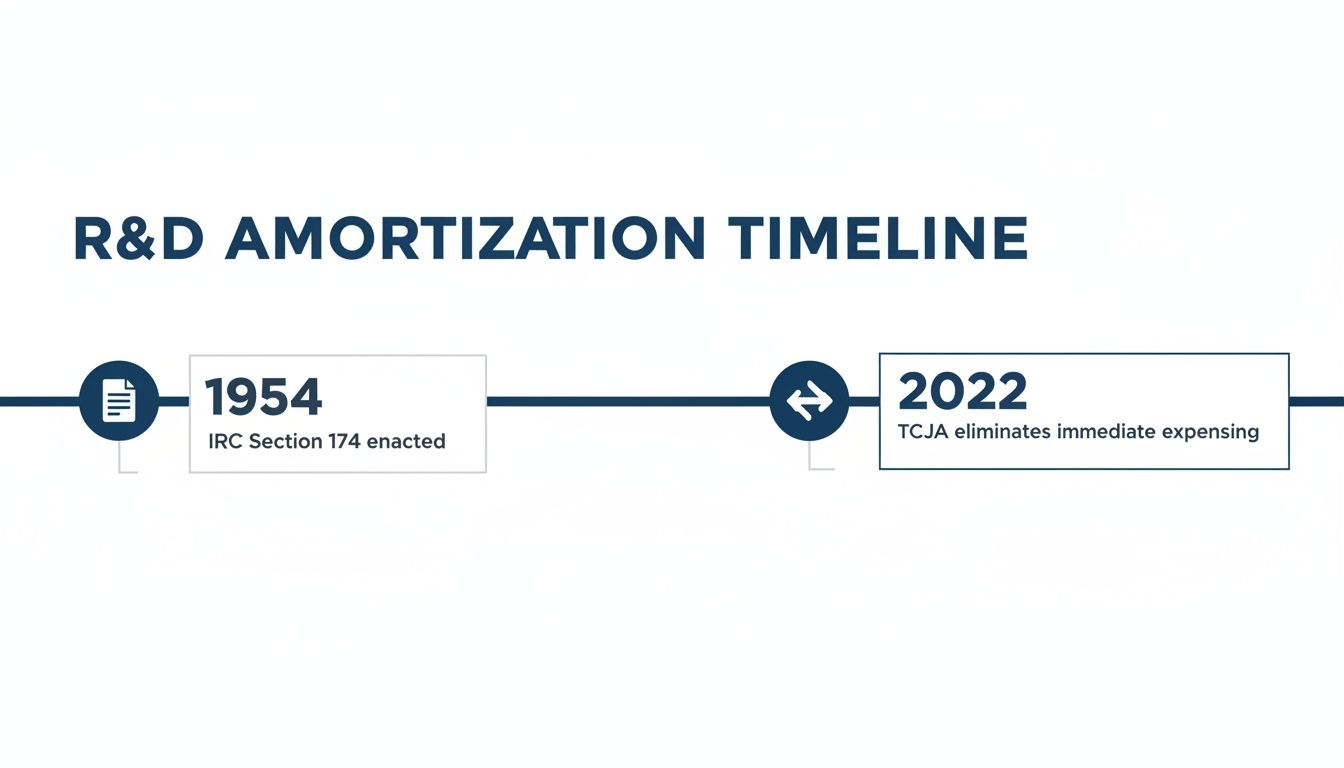
The visual drives home just how significant this is. We're talking about overturning nearly 70 years of tax policy that encouraged immediate investment in innovation, replacing it with a system that defers those benefits for years.
A Real-World Startup Example
Let's walk through how this plays out for a hypothetical software startup we'll call "Innovate Inc."
- Annual Revenue: $3 million
- Total R&D Spending (all domestic): $1 million
- Other Business Expenses: $1.5 million
Under the old, friendly rules, Innovate Inc. would deduct the full $1 million in R&D costs. That would leave them with a taxable income of $500,000. Simple. But with the new Section 174 rules, the math gets ugly, fast.
Now, only 10% of their R&D spending ($100,000) can be deducted in the first year. Suddenly, their taxable income skyrockets to $1.4 million ($3M revenue – $1.5M other expenses – $100K R&D deduction). That means a much, much bigger check to write to the IRS, pulling cash directly away from hiring new talent, growing the business, and funding the next big project.
Transitioning to the New Rules
Because this change came on so suddenly, it hit a lot of businesses like a ton of bricks. Surveys revealed that about 40% of affected companies watched their tax payments jump by 15-25% in 2022. Think about that: a company that spent $10 million on domestic research could only deduct $1 million (10%) in the first year, pushing $9 million in deductions down the road. You can learn more about the initial impact on manufacturers at GBQ.com.
The IRS did recognize what a headache this was from a compliance standpoint and offered a bit of procedural relief. They gave businesses a way to automatically adopt the new accounting method for the first tax year without having to file the notoriously complex Form 3115. While this made the paperwork easier for thousands of companies, it did nothing to soften the financial blow. The fundamental problem—delayed deductions and higher taxes now—remains.
Connecting Section 174 with R&D Tax Credits
When you're trying to wrap your head around the Section 174 capitalization rules, it’s really easy to mix them up with the Research and Development (R&D) tax credit, which falls under Section 41. They’re definitely related, but they do two completely different jobs and have their own rulebooks.
Here’s a simple way to think about it. Section 174 tells you how and when you get to deduct your R&D expenses. Section 41, on the other hand, is like a reward—a dollar-for-dollar credit the government gives you for investing in innovation in the first place.
The most important thing to remember is this: the new capitalization rules do not kill your ability to claim the R&D tax credit. This creates a weird but powerful situation for innovative companies. Your R&D costs are now spread out over several years for income tax purposes, but you can still use those same costs to generate tax credits right away.
A Powerful Combination for Cash Flow
This split treatment can really soften the financial sting of the mandatory amortization. Sure, your taxable income might look higher on paper in the short term because your deductions are delayed. But the R&D credit gives you an immediate cash benefit you can use to knock down your tax bill.
This interaction has completely changed the game for how companies think about innovation incentives. When the switch to Section 174 capitalization happened in 2022, it meant that all the costs you use for the R&D credit also had to be capitalized. But the credits themselves? Still available right away. That little detail was a lifesaver for many businesses. You can read more on the complex treatment of capitalized R&D costs at JD Supra.
This makes the R&D credit more critical than ever. It's not just a nice little perk anymore; it’s a core strategy for managing the cash flow headaches that Section 174 created.
The All-Important Link Between Sections
Here's a crucial detail that a lot of people miss: for any expense to even be considered for the Section 41 R&D tax credit, it has to first qualify as a research or experimental cost under Section 174. This makes your initial process for identifying and tracking these costs twice as important.
Think of it as a two-step process:
- Identify the Cost: First, you have to figure out if an expense—like salaries, supplies, or contractor fees—fits the broad definition of R&D under Section 174.
- Test for the Credit: Once you've confirmed it's a Section 174 cost, you then apply the tougher four-part test from Section 41 to see if it also qualifies for the credit.
This means that sloppy Section 174 accounting can put your R&D tax credit at risk. Solid documentation that clearly categorizes your research spending is the foundation for successfully claiming both the deduction (over time) and the credit (immediately).
A Lifeline for Startups: The Payroll Tax Offset
For young, innovative companies, the R&D credit offers a unique lifeline that wasn't touched by the new capitalization rules. Qualified small businesses can choose to apply up to $500,000 of their R&D credits directly against their payroll tax liability—specifically, the employer's share of Social Security taxes.
This is a game-changer for startups that aren't profitable yet and have no income tax to offset. Even without turning a profit, you can get an immediate cash benefit from your R&D work by cutting down your payroll tax bill. The Section 174 rules don't interfere with this at all. You can still claim the credit and use it against payroll taxes in the very same year you spent the money on R&D.
Solving the State Tax Conformity Puzzle
Just when you think you’ve got a handle on the federal Section 174 rules, a whole new headache pops up: state taxes. The federal government’s mandatory amortization change didn’t happen in a bubble. It sent ripples across the country, and now every state has its own take on the matter.
What we’re left with is a messy patchwork of tax laws that can be a real nightmare for any business operating in more than one state. Getting this right is crucial, because a state’s decision can swing your tax liability in a big way. Some states might give you a welcome break from the federal rules, while others could make the compliance burden even heavier. It all boils down to a concept called state tax conformity.
The Great Divide: Rolling vs. Static Conformity
State tax codes are almost always tied to the federal Internal Revenue Code (IRC), but how they’re tied is the million-dollar question. They generally fall into two main camps, and the difference is huge.
-
Rolling Conformity: Think of these states as having an active subscription to the federal tax code. They automatically adopt most federal changes as they happen. So, when Congress updated Section 174, these states automatically adopted the new capitalization and amortization rules right along with it.
-
Static Conformity: These states are more like buying a physical copy of software—they're stuck on a specific version. They pin their tax code to the IRC as it stood on a particular date. Unless their state legislature actively passes a new law to update it, they’re still following the old rules, the ones that let you immediately write off R&D expenses.
This split creates a pretty wild situation. You could be forced to capitalize R&D costs on your federal return but get to deduct them immediately on a state return. While that might sound like a good thing, it means you have to keep separate, detailed books for each jurisdiction.
For any business with a multi-state footprint, this isn't just an accounting detail—it's a major strategic challenge. The lack of uniformity means you absolutely need a state-by-state game plan to stay compliant and make sure you’re not overpaying.
A Patchwork of State Responses
Beyond the simple rolling vs. static split, some states have forged their own path by “decoupling” from the federal Section 174 rules altogether. These states passed specific laws to formally reject the federal capitalization mandate, allowing businesses to keep deducting R&D expenses just like they used to.
For example, states like California and Indiana saw the potential economic drag from the federal change and made legislative moves to keep immediate R&D expensing in place. This creates some fantastic planning opportunities if you’re located there, but it also adds another layer of rules to track. You could easily end up with one set of books for the IRS, another for your home state, and even more for other states where you do business.
All this complexity really highlights why you need to work with a tax pro who lives and breathes multi-state tax issues. A missed opportunity in one state or a simple compliance mistake in another can have serious financial blowback. The right advisor can help you map out your obligations, sniff out valuable state-level deductions, and build a tax strategy that works on both the federal and local levels.
Your Action Plan for Section 174 Compliance

Knowing the rules of Section 174 capitalization is one thing, but actually building a solid system to handle it is a completely different beast. The goal here is to move past the theory and create practical, repeatable steps that shield your business from painful mistakes and unexpected cash flow crunches.
This isn't just a tax-season fire drill. It’s about creating a sustainable process that makes tracking and reporting your R&D expenses a normal part of how you do business. Let’s walk through the steps you need to take to build a compliance framework you can count on.
Step 1: Put on Your Detective Hat and Track Every Cost
Your first task is to become an internal investigator. You need to meticulously hunt down every single expense that might fall under the Section 174 umbrella. This means looking far beyond the obvious stuff like developer salaries and payments to contractors.
Get granular and build a master list that includes:
- Direct labor costs for all employees and their immediate supervisors involved in R&D.
- Materials and supplies you’re using for prototypes, experiments, and testing.
- Payments to third-party contractors for any slice of development work.
- Allocated overhead, which means a portion of things like rent and utilities that support your R&D teams.
Getting this detailed tracking right is the bedrock of your entire strategy. If this foundation is shaky, the whole thing can come crashing down.
Step 2: Draw a Clear Line Between U.S. and Foreign Expenses
As we've discussed, where the R&D work actually happens dramatically changes your amortization timeline—it's five years for domestic costs but a much longer fifteen for foreign ones. This isn't a suggestion; it's a hard-and-fast rule that demands you keep these costs completely separate in your books.
The simplest way to do this is to set up specific project codes or dedicated accounts in your general ledger to tag expenses as either U.S.-based or foreign. This makes it crystal clear that you're applying the correct amortization period, which is exactly what the IRS wants to see.
A classic trip-up is thinking that paying a U.S.-based contractor automatically makes the expense domestic. What really matters is where the work is physically done, not where you mail the check. Good tracking is your best defense against this common mistake.
Step 3: Model the Financial Hit and Plan for It
The worst time to figure out the cash flow impact of Section 174 is when your tax bill is due. You need to be proactive here. Sit down with your tax advisor and run the numbers to see how these delayed deductions will bump up your taxable income and, in turn, your quarterly estimated tax payments.
This kind of foresight is incredibly powerful. It allows you to:
- Tweak your budgets to handle higher-than-expected tax liabilities.
- Manage your cash reserves with more confidence.
- Steer clear of nasty underpayment penalties.
By modeling a few different scenarios, you can transform a potential crisis into something you can actually manage. This strategic planning also helps you think through bigger questions, like where to hire your next R&D team and how to structure future innovation projects. It's a vital step in navigating the new world of Section 174 capitalization.
To help you get started, we've put together a checklist to guide you through the process. Think of it as your roadmap to getting Section 174 under control.
Your Section 174 Compliance Checklist
A step-by-step checklist to help businesses manage their Section 174 obligations effectively.
| Action Item | Key Consideration | Status (To-Do/In Progress/Complete) |
|---|---|---|
| Identify R&E Activities | Go beyond formal R&D departments. Review project descriptions and employee roles across the company. | |
| Categorize All Costs | Create a detailed chart of accounts to tag direct labor, materials, contractor fees, and overhead. | |
| Segregate Domestic vs. Foreign | Implement a system (e.g., project codes) to track where work is physically performed. Verify contractor locations. | |
| Review Software Development | Identify all costs related to software development, including planning, design, coding, testing, and deployment. | |
| Model Tax & Cash Flow Impact | Work with a CPA to project the effect on taxable income and quarterly estimated payments. | |
| Update Accounting Procedures | Document the new tracking and capitalization process for your accounting team. | |
| Analyze State Tax Conformity | Check if your state(s) follow the federal Section 174 rules and adjust state tax planning accordingly. | |
| Evaluate R&D Tax Credit | Determine how capitalization affects your R&D tax credit calculation and claiming strategy. | |
| Consult with Tax Advisors | Schedule regular check-ins with your advisors to review your process and adapt to any new guidance. |
Using this checklist will help ensure you're not missing any crucial steps. It's all about creating a clear, repeatable system that makes compliance a routine part of your financial management, not a yearly scramble.
Got Questions About Section 174? We've Got Answers.
When a tax law this big changes, it’s only natural for questions to pop up. Even after you get the big picture, the nitty-gritty details can be tricky. This is where the rubber meets the road for business owners and their advisors.
We've put together some quick, straightforward answers to the most common questions we hear from our clients. Think of it as your go-to guide for those "what if" scenarios.
Can I Still Deduct Software Development Costs Immediately?
The short answer is no. This is one of the biggest shifts. Before 2022, software development often got more flexible treatment. Now, the rules are airtight: all software development costs are officially classified as R&D expenses under Section 174.
That means every dollar you spend on designing, coding, testing, and getting software ready to go must be capitalized. From there, you'll amortize those costs over five years if the work was done in the U.S., or a much longer fifteen years if it was done abroad.
What Happens If We Scrap a Project Midway Through?
This happens all the time in R&D—not every bet pays off. But if you pull the plug on a research project, you can't just write off the unamortized costs in that year.
Instead, you have to keep amortizing the capitalized expenses over the rest of the original five- or fifteen-year period. The project failing doesn't speed up your deduction. This is a huge change from the old rules and a critical point to remember when you're budgeting for new, experimental ventures.
The takeaway is simple but crucial: once an expense is capitalized under Section 174, you are locked into its multi-year amortization schedule, regardless of whether the underlying project succeeds or fails.
What If My Business Is a Startup and Isn't Profitable Yet?
This is a tough one, but the Section 174 capitalization rules apply to everyone, regardless of size or profitability. Even if you're a pre-revenue startup or currently operating at a loss, you still have to capitalize your R&D expenses.
This will likely increase your net operating loss (NOL) on paper, but it pushes the tax benefit from your R&D spending further down the road. This is exactly why the R&D tax credit becomes a lifeline. For qualified small businesses, the ability to offset payroll taxes with the credit can provide an immediate cash benefit, even when you don't have any income tax to pay.
Navigating these rules requires a proactive strategy and a deep understanding of the tax code. At Blue Sage Tax & Accounting Inc., we specialize in helping businesses and individuals manage complex financial landscapes, from R&D capitalization to state tax planning. Let us help you build a clear, compliant, and confident path forward. Visit us at https://bluesage.tax to learn how we can support your goals.