If you're a business owner, the term sales tax nexus probably sounds like a bit of legal jargon. But it's one of the most important concepts you need to grasp for staying on the right side of the law. At its core, nexus is simply the connection between your business and a state that obligates you to collect and remit sales tax there.
Not too long ago, this was all pretty straightforward. The rule of thumb was physical presence. If you had a store, an office, or an employee in a state, you had nexus. Simple. But the game completely changed in 2018 with the Supreme Court's decision in South Dakota v. Wayfair, Inc. That ruling blew the old rules out of the water and created a whole new set of obligations for businesses, especially those selling online.
What Is Sales Tax Nexus and Why Does It Matter
Sales tax nexus is the legal link between a state (or another taxing jurisdiction) and your business. Once that link is established, you’re on the hook for registering for a sales tax permit and handling sales tax just like a local company. For decades, that link was purely physical—a warehouse, a salesperson, even a booth at a trade show could be enough.
The Wayfair ruling introduced what we now call economic nexus. This new standard means you don't need a physical footprint to have nexus. Instead, states can now require you to collect sales tax if you meet certain economic thresholds. The most common benchmark is $100,000 in sales or 200 separate transactions into a state over a 12-month period.
Why Nexus Is Critical for Your Business
Getting this wrong can be a costly mistake. States don't mess around when it comes to uncollected taxes. If they discover you had nexus but weren't collecting, you could be hit with back taxes, steep penalties, and interest charges that can pile up surprisingly fast.
Staying on top of your nexus footprint is essential for a few key reasons:
- Avoiding Penalties: Let's be honest, no one wants to pay fines. Proactive compliance is the only way to avoid them.
- Ensuring Legal Compliance: This is about keeping your business in good standing. It’s a fundamental part of operating legally across state lines.
- Accurate Financial Planning: Unexpected tax bills can wreck your cash flow. Knowing where you owe allows you to budget properly and avoid nasty surprises.
To give you a clearer picture, let's break down the main types of nexus you're likely to encounter.
Quick Guide to Key Nexus Concepts
This table summarizes the primary triggers for sales tax nexus. Think of it as a cheat sheet for understanding how your business activities might create a tax obligation in different states.
| Nexus Type | Triggering Activity | Common Example |
|---|---|---|
| Physical Presence Nexus | Having a physical connection to a state. | An office, warehouse, employee, or storing inventory in the state. |
| Economic Nexus | Exceeding a state-defined sales or transaction threshold. | Making over $100,000 in sales to customers in a state within a year. |
| Affiliate Nexus | Having in-state affiliates or partners refer customers. | Paying a commission to a blogger in another state for driving sales. |
| Click-Through Nexus | Generating sales from in-state referrers via online links. | An out-of-state retailer paying an in-state website for sales from clicks. |
| Marketplace Nexus | Selling through a marketplace facilitator that has nexus. | Listing products on a platform like Amazon, which collects tax on your behalf. |
Understanding these concepts is the first step. The real challenge is that the specific rules for sales tax nexus by state vary significantly. In the sections that follow, we’ll dive into the details for each state to help you figure out exactly where you stand.
The Core Triggers That Create Sales Tax Nexus
Getting a handle on what creates a sales tax obligation—what we call "nexus"—is the absolute starting point for compliance. It boils down to two main triggers: physical presence and economic nexus. Think of them as two different roads that lead to the same destination: a requirement to register, collect, and remit sales tax in a state.
For decades, the rules were simple. Physical presence was the only thing that mattered. If your business had any kind of tangible footprint in a state, you had nexus. That traditional trigger is still very much alive and a huge factor in determining where you owe tax.
This diagram helps visualize how different business activities can create nexus.
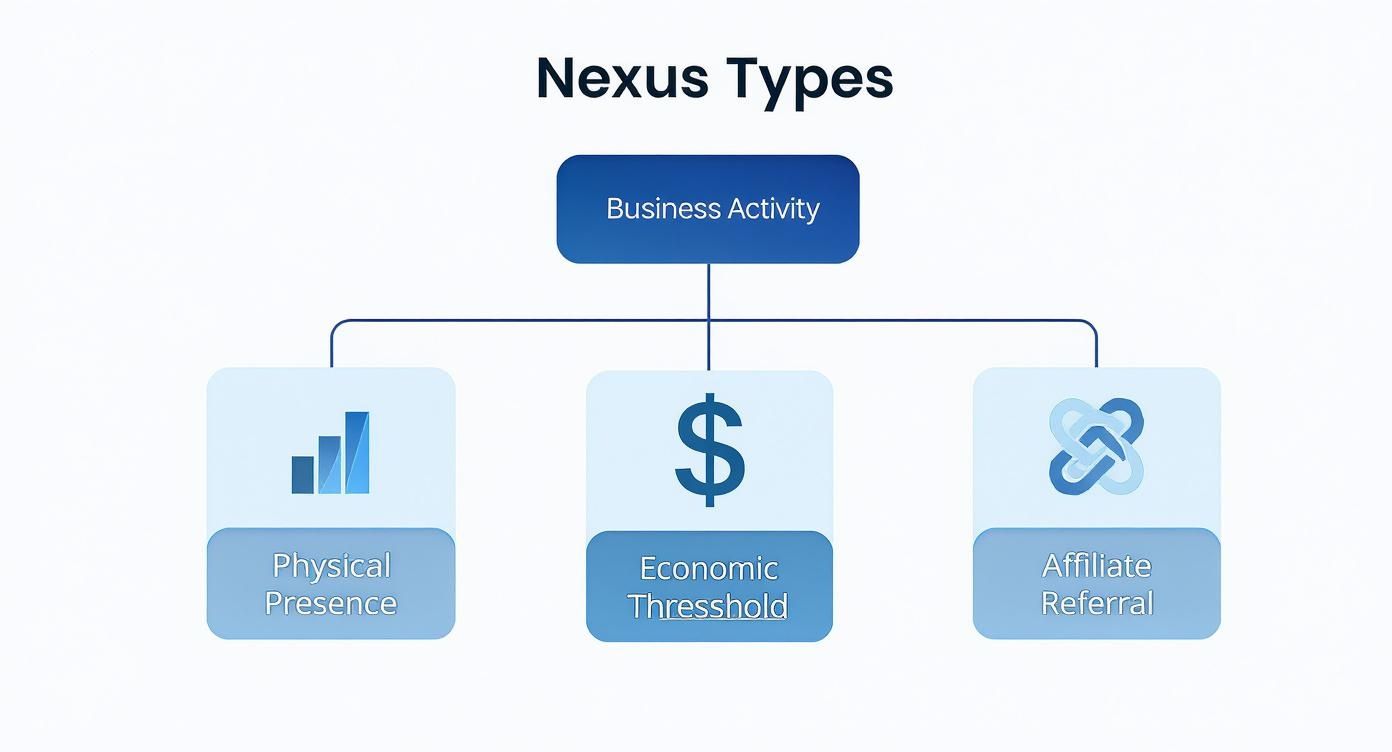
As you can see, both your physical and economic activities create clear pathways to establishing a sales tax obligation.
Understanding Physical Presence Nexus
Physical presence is just what it sounds like—having a tangible connection to a state. But this goes way beyond just having a brick-and-mortar store. Modern business operations mean all sorts of things can count as a physical link, and sometimes even temporary activities are enough to pull you in.
Here are some of the most common ways businesses create physical presence:
- Having Property: This is the obvious one. If you own or lease an office, storefront, or warehouse, you've got nexus.
- Employing People: Having employees in a state is a slam-dunk for nexus. This absolutely includes remote workers who live and work there.
- Storing Inventory: This is a big one for e-commerce. Using a third-party logistics (3PL) provider or an Amazon FBA warehouse to store your products in a state creates a definitive physical presence.
- Attending Trade Shows: Even just temporarily selling your products at a trade show or convention can trigger nexus. The specific rules on how long you have to be there or how much you sell vary by state, so you have to be careful.
Let's look at a quick example. Say you run an online store from your home in Oregon, which has no sales tax. If you use a fulfillment center in California to store your inventory, you now have physical presence nexus in California. That means you're on the hook to collect California sales tax from your California customers, no matter how much you sell.
A common blind spot for online sellers is inventory. Many are shocked to find out that using a service like Amazon FBA means they've likely established physical presence—and a tax obligation—in every single state where Amazon decides to store their products.
Demystifying Economic Nexus
The game completely changed when economic nexus came along. This is the modern standard, and it means a remote seller with zero physical footprint in a state can still have a sales tax obligation based purely on their sales. If you're an online or direct-to-consumer business selling nationwide, this rule is aimed squarely at you.
Every state that has a sales tax now sets its own economic nexus threshold. The most common one you'll see is $100,000 in gross sales or 200 separate transactions into the state over a 12-month period. The moment your business crosses that line, you have to register and start collecting sales tax. Keeping a detailed sales tax nexus by state reference handy is essential for tracking these specific requirements.
Economic Nexus Thresholds: A State-by-State Reference
Trying to keep up with economic nexus rules can feel like you're chasing a moving target.## Economic Nexus Thresholds: A State-by-State Reference
Trying to keep up with economic nexus rules can feel like you're chasing a moving target. After the Supreme Court's South Dakota v. Wayfair decision, every state with a sales tax set up its own rules for remote sellers. If your business crosses a state's specific threshold for sales revenue or number of transactions, you're legally on the hook to register, collect, and hand over sales tax.
Think of this section as your quick reference guide for economic nexus thresholds in every state. The table below is designed to help you quickly check where you stand, so you can stay compliant as your business grows.
The Standard Most States Follow
In the wake of the 2018 ruling, states acted fast, and a clear trend took shape. The $100,000 sales threshold quickly became the go-to standard for most of the country. Ever since South Carolina put this number on the books in late 2018, it's been adopted by the majority of states as the main trigger for remote seller nexus. For a deeper dive into the specifics, the Sales Tax Institute offers a fantastic state-by-state breakdown.
But don't assume that number applies everywhere. Some states also have a transaction count threshold (usually 200 transactions), while a handful have entirely different sales figures or ways of measuring them. It's the exceptions that can trip you up.
How States Calculate Their Thresholds
Before you jump into the table, you need to know how states count your sales. The little details here can make a huge difference in whether you have nexus or not.
-
Gross Sales vs. Taxable Sales: Most states look at your gross sales—that means every dollar you bring in, even from tax-exempt items. A few states, however, only count your taxable sales, which can be a big advantage.
-
Measurement Period: Typically, states check your sales activity over the previous or current calendar year. This isn't a "set it and forget it" task; you have to keep an eye on your numbers all year long to see if you're getting close to a threshold.
-
Marketplace Sales: Here's a common point of confusion. Do sales through platforms like Amazon or Etsy count toward your total? Some states say yes, you must include them in your calculation, even if the marketplace is already handling the tax. Other states say no.
Getting the calculation method wrong for a particular state is one of the easiest ways to fall out of compliance. Misjudging whether to include marketplace sales or looking at the wrong 12-month period can create a surprise tax bill you weren't expecting.
Economic Sales Tax Nexus Thresholds by State
Below is a comprehensive table laying out the current economic nexus thresholds for every U.S. state with a sales tax. Use it as your starting point to check your sales against each state’s rules.
Just remember, these laws can—and do—change. It's good practice to review your nexus footprint regularly to make sure you're still on solid ground.
| State | Sales Threshold | Transaction Threshold | Measurement Period | Notes |
|---|---|---|---|---|
| Alabama | $250,000 | None | Previous calendar year | Based on retail sales of tangible personal property. |
| California | $500,000 | None | Previous or current calendar year | Includes both taxable and exempt sales. |
| Florida | $100,000 | None | Previous calendar year | Applies to retail sales of tangible personal property delivered into Florida. |
| New York | $500,000 | AND 100 transactions | Previous four sales tax quarters | You have to meet both the sales and transaction thresholds to have nexus. |
| Texas | $500,000 | None | Previous 12 months | Based on gross revenue from sales of tangible personal property and services. |
| Various | $100,000 | 200 transactions | Previous or current calendar year | This is the most common setup, but always double-check the fine print for each state. |
(Note: This is a representative sample. A full guide should list all applicable states. Always consult official state resources for the most current information.)
The table above gives you a solid snapshot of what to look for, highlighting the most common standards and a few key outliers. Since this is just a sample, always be sure to confirm the exact rules with the Department of Revenue for any state where you do business.
How Marketplace Facilitator Laws Affect Your Business
If you sell through a platform like Amazon, Etsy, or eBay, you're dealing with what are known as marketplace facilitator laws. These rules were created to make sales tax collection simpler by putting the job on the big marketplaces that "facilitate" the sale, rather than on every individual seller.
In just about every state with a sales tax, the law now says the marketplace platform—not you, the third-party seller—is responsible for calculating, collecting, and sending in the sales tax on all transactions they handle. For many sellers, this feels like a huge relief, since the marketplace manages all the tricky tax rates and filing for sales made on their site.

But here’s the catch: this simplification has some critical details you can't ignore, especially when figuring out your own sales tax nexus by state. The biggest mistake you can make is thinking your marketplace sales have vanished from your tax picture entirely.
The Nuance of Nexus Thresholds
Even when Amazon or Etsy is remitting the tax for you, many states still require you to count the sales from those platforms toward your own economic nexus thresholds. This is exactly where businesses often get tripped up.
How states treat these facilitated sales is all over the map. Some states say you must include marketplace sales when you're calculating your total sales into the state, while others let you exclude them. You can find more detail on these varying ecommerce sales tax nexus rules on taxcloud.com.
This difference creates a tricky situation where your activity on a marketplace can trigger a direct tax obligation for your other sales channels, like your own website.
A Practical Example for Multi-Channel Sellers
Let's say you run a business selling handmade goods. You make $80,000 in sales on Etsy to customers in Illinois, and you also sell $30,000 worth of products directly from your own website to Illinois shoppers.
- Marketplace Sales (Etsy): $80,000
- Direct Sales (Your Website): $30,000
- Total Sales into Illinois: $110,000
Illinois is one of the states that requires you to count marketplace sales in your economic nexus calculation. Your total sales of $110,000 are over the state's $100,000 threshold, which means you now have economic nexus there.
So, while Etsy takes care of the tax on its $80,000 in sales, you are now on the hook for registering in Illinois and collecting sales tax on the $30,000 of sales from your own website.
Forgetting to track your gross sales across all channels is a common and expensive mistake. It's crucial to understand that marketplace facilitator laws don't give you a pass on monitoring your nexus footprint. You still have to keep a close eye on your total sales volume in every state to see if your direct sales create a duty to register and file on your own.
A Practical Guide to Sales Tax Registration and Filing
Figuring out you have sales tax nexus by state is the first big step. Now what? The next phase is all about getting compliant, which means officially registering with the state and setting up a system to handle your tax obligations moving forward.
Don't drag your feet on this. If you cross a nexus threshold and don't register, you can get hit with penalties and interest on any taxes you should have collected. It's best to tackle this head-on. The first move is to apply for a sales tax permit (sometimes called a seller's permit) in every state where you have nexus. This is how you formally tell the state you're ready to start collecting.
Registering for Your Sales Tax Permit
Most of the time, you can register online right through the state's Department of Revenue website. Each state’s process is a little different, but they all ask for the same basic business information.
Have this information handy before you start your application:
- Business Information: Your legal business name, any DBA ("doing business as") names, and your physical address.
- Federal Employer Identification Number (FEIN): This is the unique nine-digit number the IRS assigned to your business.
- Business Structure: Be ready to specify if you’re a sole proprietorship, LLC, S-Corp, or C-Corp.
- Nexus-Creating Date: This is a big one. It's the exact date your business activities first triggered nexus in that state.
- Personal Information: You'll likely need the names, addresses, and Social Security numbers of the business owners or key officers.
Once the state approves your application, you'll receive your official sales tax permit. They will also assign you a filing frequency—usually monthly, quarterly, or annually—based on how much you're expected to sell in that state.
Be really careful with your nexus start date. If you've had nexus for a while without knowing it, you might already owe back taxes. In that situation, it's a good idea to talk with a tax pro at a firm like Blue Sage Tax before you register. They can help you look into options like a Voluntary Disclosure Agreement (VDA) to potentially reduce penalties.
Ongoing Compliance Responsibilities
Getting the permit is just the starting line. Staying compliant requires consistent effort and attention to detail.
Here’s what you'll be responsible for from here on out:
- Tracking Sales Data: You need to keep meticulous records of all sales into the state and know which ones are taxable and which are exempt.
- Applying Correct Tax Rates: This gets tricky. Tax rates are often a mix of state, county, and local taxes. It’s on you to charge the right rate based on your customer’s exact location (this is called destination-based sourcing).
- Filing Timely Returns: You have to file a sales tax return for every single reporting period, even if you made $0 in sales (this is known as a "zero return").
- Remitting Collected Tax: Any sales tax you collect belongs to the state. You must send it to them by the deadline, no exceptions.
As your business grows and you establish nexus in more states, trying to manage all of this manually becomes a huge headache and a major risk. This is the point where many businesses start using automated sales tax compliance software. These tools can handle the rate calculations, prepare the filings, and manage payments, which saves an incredible amount of time and helps ensure you get it right.
Your Go-To Sales Tax Nexus Compliance Checklist
Let's get your sales tax house in order. This checklist is your starting point for a self-audit, helping you map out your company's nexus footprint and spot potential risks before they turn into bigger problems.
Think of this as a practical roadmap. Each step will help you assess where you stand, figure out where you might need to register, and build a solid plan for staying compliant. It’s the first step in a smart sales tax nexus by state review.
1. Dig Into Your Sales Data
First things first, you need to get familiar with your numbers. The only way to know if you've tripped an economic nexus wire is to see exactly where your sales are going and how much you're selling.
-
Review Gross Sales by State: Pull a report of your total revenue, state by state, for the last 12 to 18 months. The key here is gross sales—most states don't care if the sales were taxable or not when it comes to their thresholds.
-
Count Your Transactions: Some states have a transaction-count threshold, which is usually 200 transactions. You’ll need to run a separate report that counts every single sale, no matter how small, for each state.
-
Don't Forget Marketplace Sales: This one trips up a lot of businesses. You need to know if a state requires you to count sales made through platforms like Amazon or Etsy toward your own thresholds. It’s a common mistake that can easily push you over the limit.
2. Pinpoint All Physical Presence Triggers
Next, you have to look beyond the numbers and map out every single physical connection you have to a state. Physical presence is a much broader concept than just having an office.
-
Employee Locations: Do you have remote employees? What about independent contractors? If they're working for you from another state, their presence almost always creates nexus for your business.
-
Inventory Storage: Where do you keep your products? This isn't just about your own warehouse. It includes third-party logistics (3PL) facilities and, critically, Amazon FBA centers. You could have inventory in a dozen states without even realizing it, creating nexus in all of them.
-
Assets and Property: Make a list of any property you own or lease. Think offices, showrooms, or even equipment you have rented that's located in another state.
-
In-Person Activities: Have you or your team attended trade shows, made in-person sales calls, or done on-site installations? Even these temporary activities can be enough to establish a physical link to a state.
A thorough nexus review isn't a one-and-done job. Your business grows, and your sales patterns shift. We strongly recommend running through this self-audit at least quarterly to catch new tax obligations before they catch you. If you're growing fast, a monthly check-in is even better.
Common Questions About Sales Tax Nexus
Getting a handle on sales tax nexus always brings up a lot of "what if" scenarios. Let's walk through some of the most frequent questions we hear from business owners, breaking down the answers into practical steps.
What If I Realize I Have Nexus but Haven't Been Collecting Tax?
This is a really common situation, so don't panic. If you discover you have nexus in a state where you haven't been collecting sales tax, you've likely built up a liability for the uncollected tax, plus interest and potential penalties. The first thing you need to do is figure out your total exposure. Pinpoint when you first triggered nexus and calculate the tax you should have collected since then.
Next, you need to register for a sales tax permit in that state and start collecting immediately on all new sales. To handle the past liability, look into the state's Voluntary Disclosure Agreement (VDA) program. A VDA is a formal process where you come forward to pay what you owe. In return, states often agree to waive penalties and limit how far back they'll look for unpaid taxes. It's a good idea to work with a tax professional to guide you through this; they've been down this road many times.
Do Digital Products or SaaS Create Nexus?
Yes, they definitely can. How states treat digital goods, services, and Software-as-a-Service (SaaS) is all over the map, but one thing is consistent: these sales count toward a state's economic nexus threshold. More and more states are updating their laws to treat SaaS and digital downloads as either taxable services or the digital equivalent of tangible personal property.
This means if your sales of software or digital subscriptions into a state cross its economic threshold, like $100,000, you now have an obligation to register and collect sales tax there. This is true even if you have zero physical footprint in the state. You absolutely have to understand both the nexus rules and the product taxability rules for every state you sell into.
A huge mistake we see is businesses assuming that "no physical product" means "no sales tax." States are moving fast to close these loopholes, making this a critical compliance issue for any software or tech company.
Can I Just Ignore Nexus If I Only Sell on Amazon?
No, you can't. Even if you sell exclusively through a marketplace facilitator like Amazon, the sales activity is still attributed to your business. While it's true that Amazon is now required to collect and remit the tax for you in most states, that doesn't get you completely off the hook.
Here’s the catch: some states still require you to count those marketplace sales toward your own economic nexus threshold. If your combined sales (direct and through the marketplace) push you over a state's limit, you might still have to register for a sales tax permit. You might need it to file "zero-dollar" returns or to handle tax on sales you make through any other channel, like your own website.
How Often Should I Check My Nexus Status?
Think of it like a regular health checkup for your business. A good rule of thumb is to review your sales tax nexus footprint at least quarterly. Things can change in the blink of an eye—a new remote hire, a third-party warehouse you start using, or a sudden surge in sales to a new state can all trigger nexus.
A quarterly check-in helps you stay on top of your sales numbers against each state's thresholds and catch any new physical presence triggers before they turn into a major headache. If your business is growing fast, you might even want to bump that up to a monthly review. Many modern accounting and tax software platforms have nexus-tracking dashboards that can automate this and flag potential issues for you.
Staying on top of multi-state tax obligations requires a clear strategy and expert guidance. At Blue Sage Tax & Accounting Inc., we help businesses navigate complex issues like sales tax nexus, making sure you stay compliant without overcomplicating things. Find out more about our specialized advisory services at https://bluesage.tax.