The "One Big Beautiful Bill Act" is a massive piece of legislation set to dramatically reshape the U.S. tax code and how the federal government spends money. In simple terms, it’s designed to permanently slash taxes for individuals and businesses. To pay for these cuts, it proposes major changes to social safety net programs. It’s a huge financial overhaul for the country, and it will touch everything from the size of your paycheck to how you plan for retirement.
What Is the One Big Beautiful Bill Act?

Think of the One Big Beautiful Bill Act as a giant balancing act for the nation's finances. On one side of the scale, you have broad tax relief. On the other, you have spending cuts and policy shifts meant to cover the cost.
The main idea is to simplify taxes and kickstart the economy. A big part of that plan involves making several key tax cuts from the 2017 Tax Cuts and Jobs Act (TCJA) permanent, which would give everyone a much clearer and more stable picture for long-term financial planning.
One Big Beautiful Bill Act Key Components at a Glance
This table gives you a high-level summary of the act's main pillars, categorizing its major changes for easy understanding.
| Pillar | Key Changes | Primary Goal |
|---|---|---|
| Individual Tax Relief | Makes TCJA individual tax cuts permanent, eliminates federal tax on tips and overtime. | Increase take-home pay for workers and families. |
| Business Tax Cuts | Makes the 21% corporate tax rate permanent, allows immediate R&D expense write-offs. | Encourage business investment, innovation, and job creation. |
| Tax Simplification | Permanently increases the standard deduction, consolidates tax brackets. | Make filing taxes easier and more straightforward for millions. |
| Spending & Program Reform | Adjusts funding for social safety nets and discretionary spending programs. | Offset the cost of tax cuts and realign federal budget priorities. |
In short, the bill is built on a few core principles that aim to change how money moves through the economy and into American households.
Core Objectives of the Bill
The bill's goals are straightforward and built around a few central ideas:
- Lower the Tax Burden: The act wants to put more money in the pockets of families, workers, and businesses to boost spending and investment.
- Simplify the Tax Code: By making certain deductions permanent and getting rid of others, the bill hopes to make tax season less of a headache for everyone.
- Spur Economic Growth: Pro-business moves, like making R&D expensing permanent, are there to push companies to invest more in new equipment, fresh ideas, and ultimately, new jobs.
One of the clearest wins for workers comes from several consumer and worker tax reforms. The bill gets rid of all federal taxes on tips and overtime pay—a game-changer for millions of people in service and hourly jobs. This move directly pumps up the take-home pay for workers in industries like hospitality and retail. You can dive deeper into these consumer tax reforms and their goals in the official overview.
This legislative package fundamentally alters the financial rulebook. It introduces new opportunities for strategic tax planning but also requires a careful review of how its changes to federal programs might affect your long-term financial health.
Once you grasp these core pieces, you can start to see how this landmark bill could open up new doors while also presenting new challenges for your personal and business finances.
How the New Tax Changes Will Affect You and Your Family

The One Big Beautiful Bill Act isn't just a minor adjustment to the tax code; it makes some of the most direct changes to personal finances we’ve seen in years. The main goal here is pretty simple: put more money back into the pockets of everyday American workers and families.
Instead of getting bogged down in complicated credits and deductions, this legislation goes straight for the sources of income that millions of people rely on. The idea is to fundamentally change how you calculate your take-home pay, making it a much more straightforward and, for many, a much larger number.
More Money in Your Paycheck
Let's start with the change everyone is talking about: the complete elimination of federal income tax on tips and overtime pay. This is a huge deal for anyone working in service, hospitality, or skilled trades.
Think about a restaurant server who used to lose a big chunk of their hard-earned tips to federal withholding. Under this new law, every single dollar they make in tips is now theirs to keep, completely free from federal income tax. We're not talking about small change; this could easily add up to thousands of extra dollars a year.
It's the same story for an hourly worker picking up extra shifts. That overtime pay will no longer be taxed at the federal level. The message is clear: if you work more, you keep more. It’s a direct reward for putting in the extra effort.
The removal of federal taxes on tips and overtime isn't just a minor tweak; it's a fundamental shift that directly increases the disposable income of a huge segment of the workforce. This could have a noticeable impact on consumer spending and local economies.
Support for Retirees and Growing Families
The bill also has big implications for two other key groups: retirees and families with children. It's designed to provide financial security at both ends of the age spectrum.
For our seniors, the act makes all Social Security benefits completely tax-free at the federal level. This is a game-changer for anyone living on a fixed income. A retiree who once had to budget for taxes on their benefits will now get to keep that entire amount, which can make a real difference in their quality of life.
For families, the bill rolls out two major benefits:
- An Expanded Child Tax Credit: The credit is getting bigger and will be available to more families. This provides immediate relief to help offset the ever-rising costs of raising kids.
- New "Trump Accounts": This is a brand-new idea. These are tax-deferred savings accounts for children where parents can contribute up to $5,000 per year. The money grows tax-free, and once the child turns 18, it rolls over into a traditional IRA. It's a powerful way to give your kids a massive head start on saving for their own retirement.
By combining immediate tax cuts with long-term savings tools, the bill aims to create a more robust financial support system. The first step is just understanding what these changes mean for you and how you can make them work for your own family’s future.
How Business Owners and Investors Will Be Affected

While the changes for individual taxpayers are getting a lot of attention, the One Big Beautiful Bill Act saves some of its biggest moves for the business and investment world. It fundamentally shifts the ground rules for entrepreneurs, family offices, and anyone building long-term wealth by making key pro-business policies a permanent part of our tax code.
This is a huge deal. For years, we’ve been dealing with temporary tax provisions, making long-term planning a guessing game. By cementing these rules, the Act gives business owners the clarity they need to make strategic, multi-year decisions about hiring, expansion, and major capital investments.
The One Big Beautiful Bill Act, signed into law on July 4, 2025, is a massive piece of legislation—over 870 pages, to be exact. It permanently extends and expands several popular provisions from the 2017 Tax Cuts and Jobs Act (TCJA). A key example is the boost to the small business tax deduction, which jumps from 20% to 23% and is set to help roughly 26 million entrepreneurs every year. For a more detailed breakdown, you can find a solid analysis of these provisions for businesses at Stinson.com.
A Bigger Deduction for Small Businesses
One of the most immediate wins for entrepreneurs is the bump to the pass-through business income deduction. The bill permanently raises this deduction from 20% to a more generous 23%. This is a direct benefit for owners of sole proprietorships, partnerships, and S corporations, who can now shield a larger chunk of their business income from taxes.
Don't mistake this for a minor adjustment. That extra 3% deduction directly lowers the effective tax rate for millions of small and mid-sized businesses. It means more cash in hand to reinvest in the company, hire new team members, or simply take home.
Reviving a Powerful Investment Incentive
The Act also brings back 100% bonus depreciation for qualified business assets, and frankly, this is a game-changer. This powerful tool lets a business deduct the entire cost of new and used equipment in the year of purchase, instead of slowly writing it off over its useful life.
Here’s how that plays out in the real world:
- Imagine a real estate firm buys $500,000 worth of new appliances and fixtures for an apartment building.
- Instead of small annual deductions, the company can deduct the full $500,000 from its taxable income right away.
- This creates an immediate and substantial tax savings, freeing up capital that can be rolled into the next property acquisition or used to fund other renovations.
The goal here is simple: to get businesses spending and investing now on the equipment and property improvements that drive growth and modernization.
The permanence of the increased estate tax exemption is a cornerstone of this legislation for wealth transfer. It allows high-net-worth individuals and family offices to plan with confidence, securing legacies across generations without the threat of sudden policy shifts.
Game-Changing Rules for Estate Planning
For high-net-worth individuals and family offices, the decision to make the increased estate and gift tax exemption permanent is monumental. The bill locks in an inflation-adjusted exemption of $15 million per person, finally ending the frustrating uncertainty that has clouded multi-generational wealth planning for years.
This stability is everything. It allows families to implement thoughtful, long-term strategies for passing assets to the next generation with far less tax friction, completely changing the conversation around legacy planning.
Untangling the New Social Safety Net
To really understand what this bill means for the bottom line, you have to look at where the money for all these tax cuts is coming from. The short answer is, it's being offset by some huge changes to social safety net programs. We're not talking about minor adjustments here; this is a major shift in how the federal government prioritizes its spending.
At its core, the One Big Beautiful Bill Act is funding massive tax breaks for corporations and the ultra-wealthy by making some of the deepest cuts to social programs we've seen in American history. One of the biggest moves is on the healthcare front: starting January 1, 2027, a new 80-hour-per-month work requirement kicks in for many low-income adults on Medicaid. The NAACP LDF has a great, in-depth analysis of these changes to social safety nets if you want to dig deeper.
How the New Medicaid Work Requirement Works
Come 2027, certain able-bodied adults between 19 and 64 will have to prove they are meeting a new "community engagement" requirement to stay on Medicaid. This means they'll need to show they're working, in job training, or doing other approved activities for at least 80 hours a month.
The official line is that this will get more people into the workforce and off government assistance, hopefully transitioning them to health insurance through an employer. It's a critical piece of the financial puzzle in the broader one big beautiful bill act summary.
But a lot of people are sounding the alarm. Critics are worried about what this will do to the most vulnerable. They argue that many folks in this group have real hurdles to steady employment—things like unpredictable work schedules, caring for a sick family member, or dealing with chronic health issues that aren't severe enough for a formal disability exemption. The real risk is that people who need healthcare the most could lose it.
This new rule completely changes the game for public assistance. It adds a layer of red tape and paperwork that could easily cause people to lose their health coverage, even when they're doing their best to comply.
Who Is Affected and Who Is Exempt
These new rules don't apply to everyone, so it's really important to understand who is exempt to know who might be at risk.
The work requirement generally applies to:
- Able-bodied adults between 19 and 64.
- People who are not the main caregiver for a dependent child.
- Anyone not enrolled in a full-time school program.
Thankfully, there are several key exemptions built in to protect those who are most vulnerable from losing their health coverage.
Key exemptions from the work requirement include:
- People who are medically frail or have a recognized disability.
- Pregnant women.
- Primary caregivers for a child or an adult who can't care for themselves.
- Full-time students.
- Anyone in a certified drug or alcohol treatment program.
At the end of the day, these changes highlight a major trade-off in this legislation. The bill provides significant tax relief, but it pays for it by fundamentally altering access to essential social programs for millions. This is something that individuals, families, and the organizations that support them need to watch very closely.
Strategic Planning for the New Financial Landscape
Getting your head around the One Big Beautiful Bill Act is one thing, but figuring out what it means for your wallet is where the real work begins. This law isn't just a minor tweak; it's a major shift in the financial landscape, creating new paths to growth and a few potential traps to watch out for. To come out ahead, you'll need a solid game plan.
This isn't the time to wait and see. The new rules reward those who get in front of the changes. For some, that might mean pulling the trigger on investments to lock in new tax breaks. For others, it's about revisiting wealth transfer plans now that we have more certainty. The trick is to pinpoint exactly how these changes affect you and build your strategy from there.
Planning Opportunities for Businesses and Families
If you own a business, the return of 100% bonus depreciation is a huge green light for investment. Were you thinking about buying new equipment or upgrading your facilities? Now's the time. Being able to deduct the entire cost in the first year can dramatically lower your tax bill and free up cash flow.
On top of that, the small business deduction has been bumped up to 23%, putting more money directly back into the pockets of pass-through business owners. This makes your business structure more critical than ever.
For high-net-worth families, the new permanent $15 million per person estate and gift tax exemption is a game-changer. This finally gives you a stable foundation for planning your legacy. It’s a golden opportunity to transfer wealth to the next generation, perhaps using trusts to secure these high exemption amounts before any future laws change the rules again.
Key Risks to Monitor Closely
While the opportunities are compelling, you can't ignore the new risks. For one, expect a lot more paperwork. The IRS will be busy issuing guidance on everything from the new tax-free status of tips and overtime to other complex provisions. This will create a tricky new set of rules for employers to navigate.
This infographic lays out the new work requirements for Medicaid, a perfect example of a significant policy shift baked into the bill.
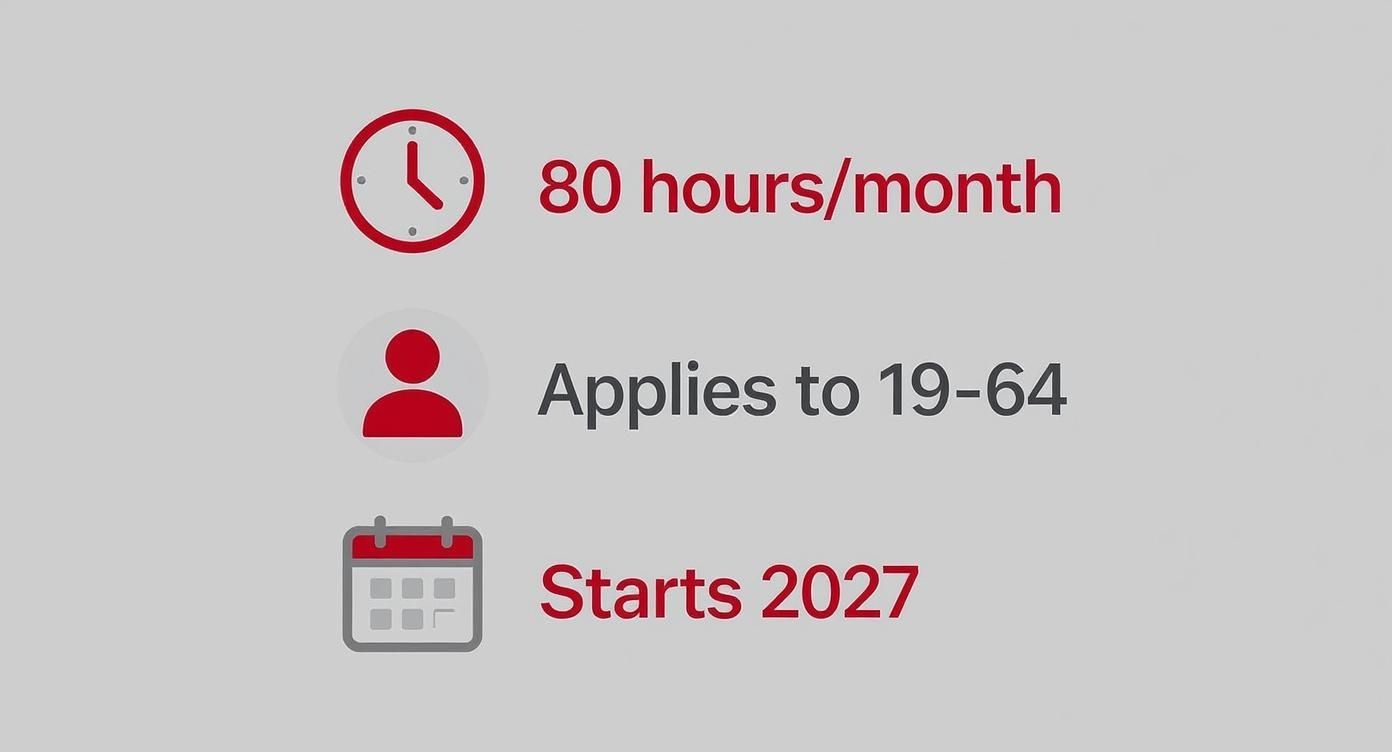
This change really highlights the bill's give-and-take nature—tax cuts are often balanced by new regulations elsewhere.
The other big wild card is the economy. No one knows for sure how this bill will ultimately affect inflation, interest rates, or the market as a whole. As a business owner or investor, you have to stay nimble and be ready to pivot as the economy reacts. The best defense is simply staying informed.
Planning Opportunities vs. Risks by Profile
To help you focus on what's most important for your situation, this table breaks down the key opportunities and risks for different types of clients we often work with.
| Profile | Key Opportunity | Potential Risk to Monitor |
|---|---|---|
| Business Owners | Maximize the 23% pass-through deduction and 100% bonus depreciation for immediate tax savings. | Increased compliance complexity and the need for updated payroll systems for new tax-free wage rules. |
| Family Offices | Utilize the permanent $15M estate tax exemption for definitive, long-term wealth transfer strategies. | Unforeseen economic shifts that could impact asset valuations and long-term financial forecasts. |
| Real Estate Entities | Leverage 100% bonus depreciation for capital improvements like appliances, HVAC, and fixtures. | Changes in state and local tax (SALT) deduction caps affecting property tax planning for investors. |
Ultimately, this table is a starting point. Your specific circumstances will determine the best course of action, but understanding these core dynamics is the first step toward building a successful strategy under the new law.
Got Questions? We’ve Got Answers.
A bill this massive is bound to stir up some questions. It’s one thing to read about the major changes, but it's another to figure out how they actually fit into your life and business.
Let's cut through the noise and get straight to the practical stuff. Think of this as your quick-reference guide to the most common questions we're hearing about the One Big Beautiful Bill Act. We’ll tackle timing, key deductions, and what this all means for your retirement.
When Do the New Tax Rules Actually Kick In?
Don't assume everything happens at once—the start dates are all over the map, and getting the timing right is critical.
Many of the changes for individuals, like making tips and overtime pay tax-free, are set to begin the tax year right after the bill becomes law. That means workers could see a difference in their paychecks fairly quickly.
But the really big policy shifts have a much longer runway. The new 80-hour-per-month work requirement for some Medicaid recipients, for instance, won't start until January 1, 2027. On the business side, tax perks like the return of 100% bonus depreciation will generally apply to assets bought after the bill is signed.
The bottom line? Never assume. Always double-check the effective date for any provision that affects you, or better yet, ask a tax pro. When it comes to planning, timing is everything.
How Exactly Does the Bigger Small Business Deduction Work?
This is a big one for entrepreneurs. The bill bumps up the pass-through business income deduction from 20% to a more generous 23%.
In simple terms, if you own a sole proprietorship, partnership, or S-corp, you can now deduct up to 23% of your qualified business income (QBI). This isn't a deduction on your total personal income; it's a direct reduction of your business profit before you calculate the tax you owe. It directly lowers your taxable income, which is a significant win.
Just remember, it's not a free-for-all. The old limitations based on your total income and the specific type of business you're in still apply. The first step is always to confirm you're eligible under the new, higher threshold.
Will This Bill Mess With My 401(k)?
You can breathe easy on this one. The One Big Beautiful Bill Act leaves traditional retirement accounts like 401(k)s and IRAs alone. The contribution limits, the rules for taking money out, and how they’re structured aren't changing.
The real impact on retirement planning comes from two other places in the bill. First, making Social Security benefits completely tax-free is a game-changer that will completely reshape retirement income projections for millions. Second, the bill creates a new tax-deferred savings account for minors, but that's a whole separate program, not an overhaul of the 401(k) system. Your core retirement strategy is safe.
Trying to piece together what the One Big Beautiful Bill Act means for you can feel overwhelming. At Blue Sage Tax & Accounting Inc., we specialize in year-round, proactive tax planning to help individuals and businesses across New York City turn these new rules into real opportunities. Let’s build a strategy that protects your financial future. Schedule a consultation with us today to get started.