
Owning investment property is a powerful way to build wealth, but the real magic happens when you master the tax code. Far from being just a list of expenses to track, investment property tax write-offs are strategic tools that can dramatically lower your taxable income, putting more money back in your pocket.
Think of it this way: every dollar you can legally deduct is a dollar you don't pay taxes on. This directly impacts your property's cash flow and your overall return on investment.
Your Blueprint for Maximizing Real Estate Deductions

For sharp real estate investors, especially in a high-stakes market like New York City, understanding these deductions isn't just about year-end paperwork—it's the core of a smart financial strategy. The tax code isn't just a rulebook; it's a blueprint for profit. Every legitimate expense, from a leaky faucet repair to the annual insurance premium, is an opportunity to reduce your tax burden and boost your bottom line.
This guide goes beyond the basics. We're laying out a clear, actionable roadmap, starting with the fundamentals and moving into sophisticated strategies that can give your NYC portfolio a serious competitive edge.
From Compliance to Strategic Advantage
What separates an average investor from a highly successful one? Often, it's their approach to taxes. Many investors simply collect receipts for the obvious stuff, like mortgage interest. The pros, however, see the bigger picture. They meticulously document everything because they understand how each individual write-off fits into their wealth-building plan.
This mindset shift turns tax planning from a once-a-year headache into a powerful offensive tool for growing your wealth.
A well-executed tax strategy does more than just save you money in April; it enhances your property's cash flow month after month, year after year, accelerating your ability to reinvest and expand your portfolio.
This guide is designed to help you make that shift. You won't just learn what you can deduct; you'll understand how these deductions work in concert to build a more profitable and resilient portfolio.
Key Investment Property Tax Write Offs at a Glance
Before we dive deep, let's get a high-level view of the most common and impactful deductions available to real estate investors. This table serves as a quick cheat sheet for the topics we'll be covering in detail.
| Deduction Category | What It Covers | Strategic Importance |
|---|---|---|
| Mortgage Interest | Interest paid on the loan used to acquire or improve the property. | Often the single largest deduction for leveraged investors, significantly reducing taxable income. |
| Repairs vs. Improvements | Distinguishing between immediate write-offs (repairs) and costs capitalized over time (improvements). | Crucial for timing deductions to maximize immediate tax savings vs. long-term value. |
| Depreciation | A non-cash deduction for the wear and tear on the building over 27.5 years (residential). | A powerful "phantom expense" that reduces taxes without affecting cash flow. |
| Insurance Premiums | Costs for landlord, hazard, flood, and liability insurance policies. | A necessary operating cost that provides a straightforward and valuable deduction. |
| Property Taxes | State and local taxes assessed on your investment property. | A major expense that is fully deductible against rental income, unlike the $10,000 SALT cap on personal residences. |
These deductions form the foundation of any savvy investor's tax strategy. Mastering them is the first and most critical step toward optimizing your financial returns.
The Foundational Deductions Every Investor Should Know
Think of your rental property as a business. Like any business, it has expenses—the costs of keeping the lights on and the operation running smoothly. The IRS gets this, and they allow you to deduct these "ordinary and necessary" costs from your rental income. This isn't about finding secret loopholes; it's about mastering the fundamental, accepted write-offs that form the bedrock of any smart real estate tax strategy.
Getting a handle on these deductions is the first and most important step. Every dollar you spend to maintain and operate your property needs to be tracked meticulously. A forgotten receipt here or a missed expense there might seem small, but those little oversights can snowball, leaving you with a much larger tax bill than necessary.
Mortgage Interest and Property Taxes
If you've financed your property, your mortgage interest deduction is likely going to be the heavyweight champion of your write-offs. The interest you pay on the loan you took out to buy or significantly improve the property is fully deductible against your rental income. For many investors, this is the single largest line item and, consequently, the most powerful deduction available.
Right alongside it is property tax. The taxes you pay to your local and state governments are a major operating expense. Here's a key distinction: you've probably heard about the $10,000 cap on State and Local Tax (SALT) deductions, but that limit only applies to your personal taxes. For your rental business, that cap doesn't exist. You can deduct the full, uncapped amount of property tax you pay for each investment property.
Insurance Premiums
You wouldn't run a business without insurance, and your rental property is no different. Protecting your asset is a fundamental cost of doing business, and thankfully, the IRS agrees. Any premiums you pay for insurance policies tied directly to your rental are fully deductible.
This isn't just one policy; it's a whole suite of protections. Be sure you're deducting the costs for all of them:
- Landlord Insurance: This is your core policy, covering property damage and liability.
- Hazard and Flood Insurance: Critical extra coverage for specific risks that your main policy might exclude.
- Liability Insurance: Often a separate umbrella policy to give you extra protection from lawsuits.
- Mortgage Insurance: If your lender requires it (like PMI), those premiums are also a deductible rental expense.
Every dollar you spend on these premiums works to directly lower your taxable income, so keep good records of every payment.
Repairs Versus Improvements: A Critical Distinction
This is the one area where I see new investors stumble most often. The IRS has a very specific way of looking at the money you spend on your property, and they split it into two buckets: repairs and improvements. Getting this right is crucial because it dictates when you get to take the deduction.
A simple way to think about it is to compare it to your car. Fixing a flat tire or getting an oil change is a repair—it just keeps the car in its current running condition. But dropping in a brand-new, more powerful engine? That’s an improvement—it makes the car better, more valuable, and extends its useful life.
Repairs are the things you do to keep the property in good working order. They’re maintenance. The great thing about repairs is that you can deduct the entire cost in the same year you pay for it.
Common examples of repairs include:
- Fixing a leaky faucet
- Patching a hole in the wall
- Replacing a single broken window
- Painting a room between tenants
Improvements, on the other hand, are bigger projects that add significant value, prolong the property's life, or adapt it for a new use. These are considered capital expenses, which means you can't deduct the full cost upfront. Instead, you have to depreciate the cost over several years.
Common examples of improvements include:
- Putting on a whole new roof
- Installing a new HVAC system
- A full kitchen or bathroom remodel
- Adding a deck or a new room
Classifying these costs correctly is non-negotiable. If you mistakenly write off a major renovation as a simple repair, you’re inviting IRS scrutiny. But if you treat a repair as an improvement, you're delaying a tax deduction you could have taken immediately. When in doubt, this is a perfect time to check in with your tax professional.
Depreciation: The Real Estate Investor's Ultimate Tax Shelter
Of all the write-offs in a real estate investor's toolkit, one rises above the rest in terms of sheer impact: depreciation. It's easily the most powerful deduction available, yet so many investors don't fully grasp how it works. Let's demystify it. Think of depreciation not as some arcane accounting rule, but as the IRS's allowance for the natural wear and tear your building experiences over the years.
Here's the magic: depreciation is a non-cash expense. This means you get to deduct a hefty sum from your taxable rental income every year without actually spending a dime. It's a "phantom" expense that directly lowers your tax bill while leaving your actual cash flow untouched. This is how savvy investors build wealth—even as their NYC property goes up in value, the IRS lets them write it down on paper.
How Depreciation Works in Practice
The IRS has established straightforward "recovery periods" for depreciating investment properties.
- Residential Real Estate: The recovery period is 27.5 years.
- Commercial Real Estate: The recovery period is 39 years.
This schedule allows you to deduct a piece of your property's value every single year for nearly three decades.
One crucial point: you can only depreciate the building itself and any subsequent improvements—never the land. In the eyes of the tax code, land doesn't wear out or lose value. So, your first step is always to separate the value of the structure from the value of the land it sits on.
While depreciation is a massive deduction, it works alongside other core write-offs.
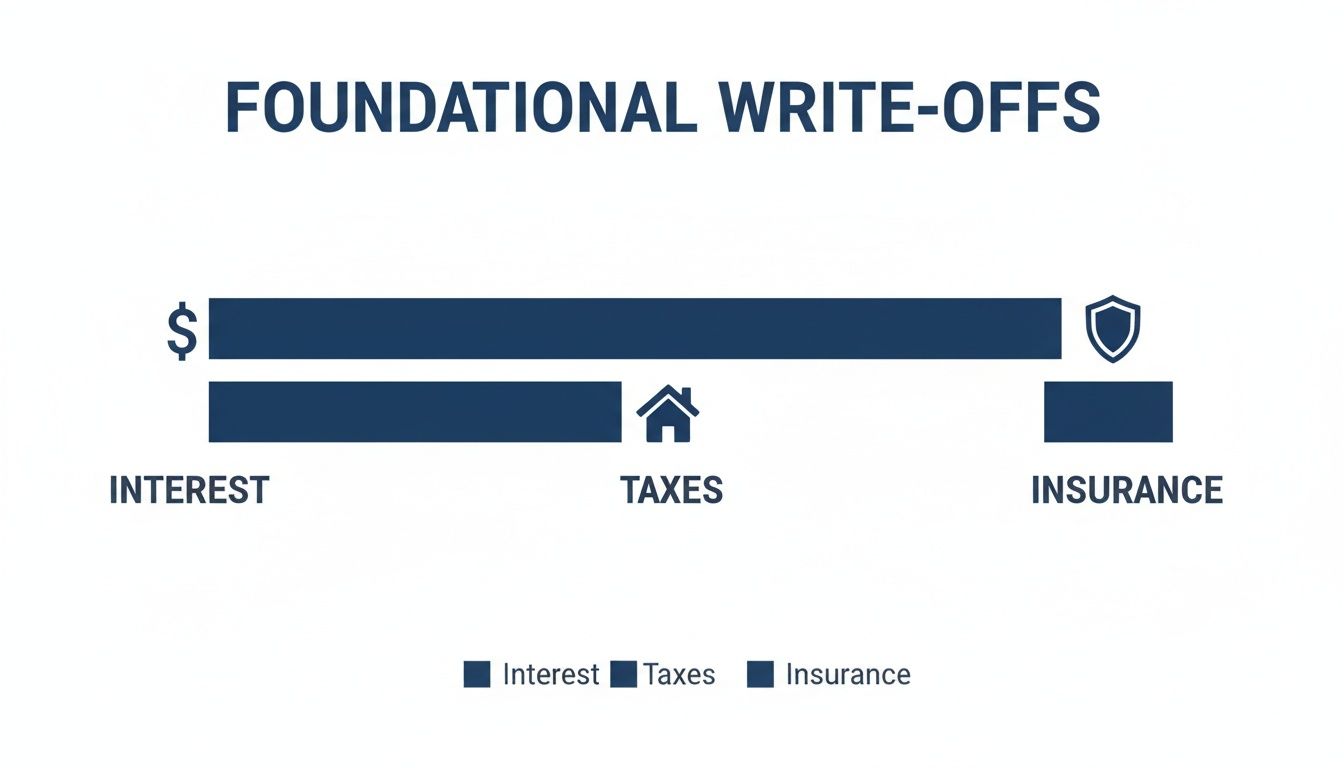
This chart shows how foundational expenses like mortgage interest, property taxes, and insurance create the base layer of your tax strategy. Depreciation then comes in as a powerful multiplier on top of these.
A Quick Example: Depreciation in NYC
Let's walk through a real-world scenario. Say you buy a multi-family building in Queens for $1,500,000.
Separate Land and Building Value: First, you need to allocate that purchase price. A qualified appraisal or your property tax assessment shows the land is valued at $400,000 and the building itself is worth $1,100,000. That $1.1 million figure for the building is what we call your "depreciable basis."
Calculate Your Annual Deduction: Now, you just divide the building's value by the IRS recovery period. Since this is a residential property, we'll use 27.5 years.
$1,100,000 (Building Value) / 27.5 years = $40,000 per year
Just like that, you've unlocked a $40,000 tax deduction you can take every single year. If your combined federal and state tax rate is 40%, this one deduction alone saves you $16,000 in cold, hard cash. That's money that goes right back into your pocket.
This non-cash deduction is what tax pros mean when they talk about a "tax shelter." For instance, a property with a building value of $275,000 can generate an annual depreciation deduction of $10,000. A property valued at $400,000 could yield a write-off of around $14,545 per year. You can learn more about how this powerful tax shelter works from the experts at Rentastic.io.
Getting a firm handle on depreciation is non-negotiable for any serious investor. It's a consistent, predictable, and massive deduction that dramatically improves your after-tax returns, turning a good investment into a truly great one.
Advanced Strategies to Supercharge Your Write-Offs

Once you’ve got the basics down, it’s time to move beyond standard deductions and give your tax strategy a real competitive edge. For serious investors, especially those with high-value portfolios in a market like New York City, sticking to the fundamentals just isn't enough. Advanced techniques are where you can seriously accelerate your write-offs and defer hefty tax bills, transforming your properties into powerful wealth-building machines.
Now, these strategies aren't push-button simple. They demand careful planning and usually a team of pros on your side, but the financial payoff can be massive. They're all about optimizing the timing and size of your deductions to pump up your cash flow and free up capital for that next deal. Let's dig into three of the most powerful tools in the savvy investor's toolbox.
Unleash Accelerated Depreciation with Cost Segregation
We’ve already covered how depreciation is a fantastic non-cash deduction. But the standard straight-line method, which spreads the write-off over 27.5 or 39 years, treats your entire building as one single, monolithic asset. That’s where a Cost Segregation Study comes in. This is an engineering-based analysis that dissects your property into its individual components, allowing you to reclassify them into much shorter depreciation schedules.
Think of it this way: instead of one big chunk of concrete and steel, your building is actually a collection of different systems, finishes, and fixtures. A cost segregation study meticulously identifies these parts and sorts them into their proper asset classes, each with a faster write-off period.
- 5-Year Property: Things like carpeting, certain appliances, and decorative lighting.
- 7-Year Property: This can include office furniture and fixtures.
- 15-Year Property: Land improvements fall here—think parking lots, sidewalks, and professional landscaping.
- 27.5/39-Year Property: This is left for the true structural shell of the building, like the foundation, walls, and roof.
By moving a significant portion of your property's value into these shorter-lived categories, you can claim much larger depreciation deductions in the first few years you own it. This effectively front-loads your tax savings, giving your cash flow a serious and immediate jolt.
Supercharge Deductions with Bonus Depreciation
If cost segregation is hitting the accelerator, bonus depreciation is like hitting the nitrous button. This incredible provision lets you deduct a massive percentage—sometimes up to 100%—of an eligible asset's cost in the very first year you put it into service. This is a game-changer for assets with a recovery period of 20 years or less, which, not coincidentally, includes most of the components you’d identify in a cost segregation study.
The rules for bonus depreciation have been a bit of a moving target, which creates both challenges and big opportunities. The 2017 Tax Cuts and Jobs Act initially set a 100% bonus depreciation rate, but it was scheduled to phase down over time, dropping to 60% in 2024 and 40% in 2025. In a major reversal, however, new legislation restored 100% bonus depreciation for qualified property placed in service on or after January 19, 2025. This lets you immediately write off the entire cost of things like new landscaping or interior upgrades, maximizing your upfront investment property tax write offs. You can get more details on these strategic shifts from the National Association of REALTORS®.
Example in Action: Let's say a cost segregation study on your NYC property identifies $200,000 worth of 15-year assets (like that new parking lot and landscaping). With 100% bonus depreciation, you could potentially deduct the entire $200,000 this year. That’s far better than spreading the deduction out thinly over the next 15 years.
Defer Taxes Indefinitely with a 1031 Exchange
As your property grows in value, so does the looming capital gains tax bill you'll face when you sell. Enter the 1031 Exchange. Named for Section 1031 of the Internal Revenue Code, this is an incredibly powerful tool that lets you kick that tax can down the road—potentially forever. The concept is simple: you sell one investment property and roll all the proceeds directly into a new, "like-kind" property.
This isn't just a one-time gimmick. You can keep "exchanging up" from one property to the next, allowing your entire portfolio to grow tax-deferred for your entire life. It's the absolute cornerstone of building generational wealth through real estate. Your capital stays invested and working for you, rather than getting chipped away by the IRS with every sale. The rules are notoriously strict, though. You have a tight 45-day window to identify a replacement property and just 180 days to close the deal, which makes having an expert guide you through the process absolutely essential.
Understanding the IRS Rules of the Road
Claiming a host of investment property tax write-offs feels great. But making sure they stick is what really matters. The IRS has a specific set of rules that dictate how, when, and if you can use your rental property deductions—especially when those deductions push you into a loss on paper.
Getting a handle on these limitations isn't just about staying compliant. It’s about building a tax strategy that won't crumble under scrutiny and protecting the assets you've worked so hard to acquire.
At the center of it all are the Passive Activity Loss (PAL) rules. For most people, the IRS views rental real estate as a "passive activity." This creates a crucial distinction: you generally can't use losses from your rental properties to offset your "active" income, like the salary from your day job or profits from a business you operate.
Think of your finances as having two separate buckets. Your W-2 income goes into the "active" bucket, while your rental income (or loss) goes into the "passive" bucket. The PAL rules essentially build a wall between them, stopping you from dipping into the passive bucket's losses to lower the taxable income in your active one.
So, What Happens to Those Losses?
Don't worry, those losses don't just vanish. The IRS lets you suspend them and carry them forward to future tax years. You can then use that bank of suspended losses to offset rental profits down the road.
Even better, when you eventually sell the property, all those accumulated losses are released and can be used to offset the gain from the sale, which can be a massive tax-saver.
There's also a pretty helpful exception for many investors. If your modified adjusted gross income (MAGI) is under $100,000, you can often deduct up to $25,000 in passive rental losses against your regular income each year. The catch? You have to actively participate in managing your property. This special allowance gradually phases out as your income climbs, disappearing completely once your MAGI exceeds $150,000.
The Holy Grail: Real Estate Professional Status
For investors who are truly all-in on real estate, the ultimate goal is to tear down that wall between passive and active income for good. The way to do that is by qualifying as a Real Estate Professional with the IRS. This designation is a true game-changer.
Achieving this status reclassifies your rental activities from passive to non-passive, allowing you to deduct your full rental losses against any other income you have, without the $25,000 cap.
But getting there is tough. You have to meet two very strict tests:
- More than half of all the personal services you perform during the year (across all your jobs and businesses) must be in real estate trades or businesses.
- You must spend more than 750 hours a year working on real estate activities where you materially participate.
This isn't a loophole for casual landlords; it’s designed for people whose primary career is in real estate. Be prepared to keep meticulous, contemporaneous logs—the IRS will expect proof.
Qualifying as a Real Estate Professional transforms your rental portfolio. It stops being a siloed investment and becomes a powerful tool fully integrated with your finances, allowing paper losses to generate immediate and significant tax savings against your primary income.
Don't Forget About Depreciation Recapture
Finally, let's talk about what happens when you sell. That fantastic depreciation deduction you've been taking year after year comes with a string attached, and it’s called depreciation recapture.
When you sell your property for a gain, the IRS essentially "recaptures" the portion of your profit that's attributable to the depreciation you claimed. They want back some of the tax benefit you enjoyed over the years.
This recaptured amount isn't taxed at the lower long-term capital gains rates. Instead, it’s hit with a special, higher rate, up to a maximum of 25%. If you're not ready for it, this can result in a surprise tax bill that takes a serious chunk out of your proceeds. Smart exit planning is absolutely critical to managing this liability and protecting your profit.
It's Time to Build Your Tax Strategy
So, you've seen what's possible. The key to unlocking the real tax advantages of investment property isn't about scrambling for receipts in April. It’s about a complete shift in how you think—moving from a once-a-year chore to a year-round strategic focus on building and protecting your wealth.
Think of your real estate portfolio as a business, because that's exactly what it is. The core strategies we've covered—nailing the basic deductions, mastering depreciation, and using advanced tools like cost segregation—aren't just separate tricks. They all work together, like gears in a machine, to boost your cash flow and build equity faster.
Moving Beyond Just Filing a Return
An effective tax plan isn't born from a flurry of activity right before the tax deadline. It's the result of a continuous cycle of sharp record-keeping, forward-thinking analysis, and making smart decisions that line up with your financial goals. You're not just filing a return; you're building a system.
Here are a few concrete steps to put this knowledge into action:
Systemize Your Records: Don't be the person with a shoebox full of crumpled receipts. Use dedicated software or a well-organized spreadsheet to track every expense as it happens. Real-time tracking is a game-changer.
Schedule Quarterly Check-Ins: Sit down with your tax advisor every quarter. These meetings are crucial for reviewing how your properties are performing and spotting tax-saving opportunities while there's still time to act.
Model Your Big Moves: Thinking about a major renovation or buying another property? Run the numbers first. Understanding how a big decision will affect your depreciation schedule and cash flow before you commit is non-negotiable.
A proactive tax plan is your best defense against changing tax laws and your most powerful tool for getting ahead. It ensures every move you make is a deliberate step toward your long-term wealth goals.
Don't Go It Alone
Especially in a market as complex as New York City, trying to navigate these rules by yourself is a huge gamble. The value of an expert who lives and breathes this stuff can't be overstated. You need a specialist who gets the fine print of federal law and knows the unique quirks of NYC and state tax codes.
Working with a professional from a firm like Blue Sage Tax & Accounting Inc. can flip the script entirely. Tax planning stops being a defensive headache and becomes an offensive tool, making sure you capture every last deduction and structure your investments for maximum growth.
Common Questions from NYC Real Estate Investors
When you're dealing with investment property taxes, the same questions tend to pop up again and again. Let's tackle some of the most common ones I hear from NYC investors to clear up any confusion and build on what we've already covered.
Can I Deduct Mortgage Points on an Investment Property?
Yes, you absolutely can, but not in the way you do for your own home. With a primary residence, you can often deduct points in the year you pay them. For an investment property, the rules are different: you have to amortize them.
This just means you spread the deduction out evenly over the entire life of the loan. So, if you paid points for a 30-year mortgage, you’d deduct 1/30th of the total cost each year. It’s a critical distinction for staying compliant and ensures you get the full benefit over the long haul.
How Does the Home Office Deduction Work for Real Estate Investors?
If you're hands-on with your properties and have a dedicated space in your home where you exclusively manage your real estate business, you can claim a home office deduction. It's a great way to write off a portion of your rent, utilities, insurance, and other home-related costs.
The key here is proving that the space is used regularly and exclusively for your real estate activities. The IRS can be strict about this, so meticulous records are non-negotiable.
You have two ways to calculate it. You can either use the actual expense method, which involves tracking the percentage of your home's total costs that correspond to your office space, or the simplified method. The simplified option is just a standard rate per square foot, capped at 300 square feet, but it can save a lot of bookkeeping headaches.
What if I Have Unusually High Repair Costs in One Year?
A sudden jump in repair expenses can sometimes raise a red flag with the IRS. Their main concern will be whether those expenses were truly repairs or if they should have been classified as capital improvements and depreciated over time.
This is where your record-keeping becomes your best defense. You need to be ready to justify every dollar. Your documentation should include:
- Detailed Invoices: Make sure they clearly describe the work that was done.
- Dated Receipts: These prove when you paid for the work.
- Photos: Before-and-after pictures are incredibly powerful. They visually prove you were restoring something to its original state (a repair) rather than making a significant upgrade (an improvement).
For any unusually large projects, it’s always a smart move to chat with your tax advisor beforehand. They can help you classify the expense correctly from the start and save you a lot of potential trouble down the road.
At Blue Sage Tax & Accounting Inc., we help NYC investors turn complex tax rules into a strategic advantage. Our proactive planning and deep real estate expertise ensure you capture every deduction and optimize your portfolio for long-term growth. Connect with us to build your financial future with confidence.