If you want to reduce your self-employment tax, you first have to get a handle on how it’s calculated. The game plan is simple, really: find every legitimate way to lower your net business income. Every dollar you can shave off through deductions, retirement contributions, or smarter business structures directly cuts the amount subject to that hefty 15.3% tax rate.
This isn't about shady loopholes. It’s about using IRS-approved strategies to keep more of the money you worked so hard to earn.
Your First Look at Self Employment Tax

Before you can attack your self-employment tax bill, you need to know your enemy. For many new freelancers and business owners, this tax is a nasty surprise on their first return, often much larger than they ever expected. It's your contribution to Social Security and Medicare—the same FICA taxes W-2 employees pay, but with a crucial twist.
When you're self-employed, you wear two hats. You're both the employee and the employer, which means you have to pay both halves of the tax.
The total self-employment tax rate is 15.3%. It's not just one number, though. It’s actually made up of two parts:
- Social Security: 12.4%
- Medicare: 2.9%
This distinction is important because the Social Security piece has a cap, and knowing how that works is the first key to understanding how your tax burden shifts as your income grows.
The Social Security Wage Base Limit
Here’s a critical detail: that 12.4% Social Security tax only applies up to a certain income level each year. For 2025, that magic number is $176,100. This is known as the Social Security Wage Base, and it’s a threshold you absolutely need to have on your radar for tax planning.
Once your net earnings from self-employment blow past this limit, you stop paying the 12.4% Social Security tax on any income earned beyond it. The 2.9% Medicare tax, however, keeps going. It applies to every single dollar you earn, with no upper limit. You can find more details about the latest 2025 self-employment tax rules on sorren.com.
And for high earners, there's one more layer. An additional 0.9% Medicare surtax kicks in once your earnings top $200,000 (for single filers) or $250,000 (for married couples filing jointly). This effectively bumps the Medicare rate to 3.8% on income above those amounts.
The First Calculation You Must Know
So, how do you actually figure out the taxable amount? It’s not as simple as slapping 15.3% on your total business profit. The IRS gives you a small but important adjustment because you're covering the employer's share.
The first step in your calculation is always to multiply your net business profit by 92.35% (or 0.9235). This gives you your "net earnings from self-employment"—the actual number used to calculate the tax.
Let's walk through a quick example. Imagine you're a freelance designer who netted $100,000 this year.
- Find Your Taxable Base:
$100,000 (Net Profit) x 0.9235 = $92,350 - Calculate the Tax:
$92,350 x 0.153 = $14,129.55
That $14,129.55 is what you owe in self-employment tax alone, completely separate from your regular income taxes.
To help you visualize the key components, here's a quick breakdown of how the self-employment tax calculation works.
Self-Employment Tax Calculation At-a-Glance
| Component | Tax Rate | Applicable Income Base | Example Calculation ($100k Net Profit) |
|---|---|---|---|
| Net Earnings Base | 92.35% | Your total net business profit | $100,000 x 0.9235 = $92,350 |
| Social Security | 12.4% | Up to $176,100 (2025 limit) | $92,350 x 0.124 = $11,451.40 |
| Medicare | 2.9% | All your net earnings from self-employment | $92,350 x 0.029 = $2,678.15 |
| Total SE Tax | 15.3% | The sum of the two tax components | $11,451.40 + $2,678.15 = $14,129.55 |
This table shows the straightforward calculation for someone under the Social Security limit. But what happens when you earn more?
Now, let's look at a higher-earning consultant with $250,000 in net profit. The math changes because of the Social Security cap.
- Find Your Taxable Base:
$250,000 x 0.9235 = $230,875 - Calculate Social Security Tax (on the limit):
$176,100 (2025 limit) x 0.124 = $21,836.40 - Calculate Medicare Tax (on the full amount):
$230,875 x 0.029 = $6,695.38 - Total Self-Employment Tax:
$21,836.40 + $6,695.38 = $28,531.78
See how that works? The Social Security tax maxed out, but the Medicare tax kept on climbing. Getting this fundamental calculation down is the bedrock for all the reduction strategies we’re about to dive into.
Lowering Your Taxable Income with Smart Business Deductions

The most straightforward way to slash your self-employment tax bill is to lower your net business income. It's a simple but powerful equation: every legitimate dollar you spend on your business is a dollar you don't have to pay that hefty 15.3% SE tax on.
Of course, you’re already writing off your inventory and office supplies. That’s Business 101. But the real savings come from digging deeper and claiming the deductions that many self-employed professionals miss. Let's get into the specifics.
Maximizing Your Home Office Deduction
If you work from home, this deduction is a non-negotiable. As long as you use a specific area of your home exclusively and regularly as your principal place of business, you can claim it. The IRS gives you two ways to do this.
The Simplified Method is the easy route. You get a flat $5 per square foot for your office space, capped at 300 square feet. This gives you a maximum deduction of $1,500. It requires minimal paperwork and is a great no-fuss option.
The Actual Expense Method, on the other hand, can be a game-changer, especially if you live in a high-cost area like NYC. It takes more work, but the payoff is often much larger. You calculate the percentage of your home's total square footage that your office occupies and then apply that percentage to all your home-related expenses.
- Direct Expenses: Costs that apply only to your office space, like a dedicated business phone line or painting the room, are 100% deductible.
- Indirect Expenses: These are your whole-home costs. You deduct a portion based on your business use percentage. Think of things like:
- Rent or mortgage interest
- Property taxes
- Homeowners insurance
- Utilities like electricity, gas, and water
- General repairs and maintenance
Let’s say your apartment is 1,500 square feet and your office is a 150-square-foot room. That’s 10% for business use. You can then write off 10% of your total rent, utilities, and insurance for the year. That adds up fast.
Tracking Vehicle and Travel Expenses
Business mileage is a goldmine for deductions, but only if you track it meticulously. Every trip to a client meeting, the post office, or the supply store counts. Again, you have two choices for calculation.
The Standard Mileage Rate is the most popular for its simplicity. For 2024, the IRS lets you deduct 67 cents for every business mile you drive. If you log 5,000 business miles, that's a straight $3,350 deduction. All you need is a reliable mileage log showing dates, miles, and the purpose of each trip.
Alternatively, the Actual Expense Method involves adding up all your car-related costs—gas, insurance, repairs, oil changes, depreciation—and deducting the percentage that corresponds to your business use. This can result in a bigger write-off if you have a newer car or one with high operating costs.
And don't forget about business travel. When you leave your local area for work, you can deduct airfare, hotels, 50% of your meal costs, and ground transportation like Ubers. Just keep every single receipt.
Unlocking the Qualified Business Income Deduction
This is one of the biggest tax breaks to come along for small businesses in years. The Qualified Business Income (QBI) deduction isn't a business expense, but rather a special deduction that lets you shield up to 20% of your business income from federal income tax.
The QBI deduction doesn't lower your self-employment tax directly. However, by slashing your Adjusted Gross Income (AGI), it dramatically reduces your overall tax burden, freeing up cash flow. It's a crucial part of any tax-saving strategy for the self-employed.
The rules can get tricky, with income thresholds and limitations based on your profession. But for most freelancers, consultants, and independent contractors, it's a massive opportunity. It’s well worth talking to a tax pro, like the team at Blue Sage Tax & Accounting Inc., to see if you qualify and how to make the most of it.
Often-Overlooked Business Deductions
Beyond the big-ticket items, dozens of smaller, everyday costs can chip away at your taxable income. It’s all about training yourself to think like a business owner. Are you missing any of these?
- Software and Subscriptions: Your QuickBooks subscription, Adobe Creative Cloud, project management tools—it's all deductible.
- Professional Development: Courses, workshops, industry conferences, and even trade publications that help you get better at what you do are valid expenses.
- Health Insurance Premiums: If you buy your own health insurance, you can deduct 100% of the premiums for yourself, your spouse, and your dependents.
- Business Meals: Taking a client out to lunch? 50% of that bill is deductible.
- Bank Fees: Those monthly service fees on your business checking account? Write them off.
- Professional Services: The money you pay your accountant, lawyer, or business coach is a fully deductible cost of doing business.
The secret to making all this work is diligent, organized record-keeping. Use an app, open a separate business bank account, and be religious about saving receipts. Every dollar you track is a dollar working for you, not for the IRS.
Using Retirement Accounts to Your Advantage
Putting money into a retirement plan when you're self-employed is one of the smartest things you can do. It's a fantastic two-for-one deal: you build your nest egg for the future while getting a juicy, immediate tax deduction that lowers your self-employment tax bill right now.
For most freelancers, consultants, and small business owners, two plans rise above the rest: the SEP IRA and the Solo 401(k). They're both great, but they have some key differences in how much you can contribute and how they operate. Depending on your income and savings goals, one is almost always a better fit than the other.
The SEP IRA: A Simple and Effective Choice
The Simplified Employee Pension, or SEP IRA, is often the go-to starting point for self-employed professionals. The biggest draw is its simplicity. You can open one in minutes at any major brokerage, and the ongoing paperwork is practically non-existent.
With a SEP, contributions are made by you, acting as the "employer." You can stash away up to 25% of your net adjusted self-employment income, up to an annual maximum that changes with inflation. Its straightforward nature makes it a perfect, no-fuss option for saving a significant portion of your income.
The Solo 401(k): A Powerhouse for High Earners
The Solo 401(k) is tailor-made for business owners with no employees (other than a spouse). While it takes a little more effort to set up and manage, it offers unmatched contribution power. This is precisely why it’s the top choice for high-income self-employed individuals.
A Solo 401(k) brilliantly lets you contribute in two distinct ways—as both the "employee" and the "employer" of your own business.
- As the 'employee,' you can contribute 100% of your compensation up to the annual limit.
- As the 'employer,' you can also contribute an additional 25% of your net adjusted self-employment income.
This dual-contribution setup is a total game-changer. For 2025, a SEP IRA lets you contribute up to $69,000, which is great. But the Solo 401(k) gives you more firepower at lower income levels. An 'employee' can put in up to $23,000 (or $30,500 if you're 50 or over), and the 'employer' can then add the 25% contribution on top, with the total capped at $69,000.
This often means you can save far more with a Solo 401(k) than a SEP IRA on the exact same income, dramatically cutting your tax bill. For the official details, you can always review the IRS guidelines on retirement plans for the self-employed.
Pro Tip: Many Solo 401(k) plans let you make Roth contributions on your 'employee' part. This means paying tax now so your money can grow and be withdrawn 100% tax-free in retirement. It's an incredible strategy if you think you'll be in a higher tax bracket later in life.
Real-World Savings: A Scenario
Let's see how this works with some real numbers. Picture a marketing consultant, working as a sole proprietor, who netted $150,000 after all their business expenses. They want to max out their retirement savings to slash their tax bill.
Scenario 1: With a SEP IRA
- Your maximum contribution is calculated to be about $27,870.
- That’s a solid deduction that will save you thousands in both income and self-employment taxes.
Scenario 2: With a Solo 401(k)
- Employee Contribution: You can put in the full $23,000 (assuming you're under 50).
- Employer Contribution: On top of that, you can add another $27,870.
- Total Contribution: That brings your total for the year to a whopping $50,870.
In this head-to-head comparison, the Solo 401(k) lets you shelter an extra $23,000 from taxes. That's a massive difference that provides immediate tax relief and turbocharges your retirement savings. While the SEP IRA is a great place to start, the Solo 401(k) is the clear winner for anyone serious about maximizing their savings and minimizing their tax burden.
Deciding if an S Corporation Is Right for You
Making the switch to an S Corporation is easily one of the most powerful tax-saving moves a self-employed person can make. I've seen it save clients tens of thousands of dollars. But it's also a major commitment that introduces a whole new level of complexity to your business life. This isn't a decision you should make lightly, so let’s get real about whether it’s the right move for you.
The magic of the S Corp lies in how it lets you split your income. Instead of every dollar of profit getting hammered by the full 15.3% self-employment tax, you divide your earnings into two buckets: a reasonable salary and shareholder distributions.
Only the salary part gets hit with FICA taxes (which is just the W-2 employee version of self-employment tax). Every dollar you take as a distribution bypasses that tax completely. That one distinction is where all the savings come from.
The Math Behind S Corp Savings
Let's walk through a real-world example. Imagine you're a freelance consultant, currently a sole proprietor, clearing $150,000 in net profit this year.
As a sole proprietor, that entire $150,000 (after a small adjustment) is subject to the 15.3% self-employment tax, which comes out to a painful $21,194.
Now, what if you elected S Corp status and set a reasonable salary for yourself at $70,000? The picture changes dramatically.
Here’s a quick table to break down the comparison.
Sole Proprietor vs. S Corporation Tax Comparison
| Tax Item | Sole Proprietor | S Corporation (with $70k Salary) | Tax Savings |
|---|---|---|---|
| Net Business Profit | $150,000 | $150,000 | |
| Reasonable Salary | N/A | $70,000 | |
| Shareholder Distribution | N/A | $80,000 | |
| Taxable SE/FICA Income | $138,518 (92.35% of profit) | $70,000 (Salary only) | |
| SE/FICA Tax Due | ~$21,194 | ~$10,710 | ~$10,484 |
The bottom line is clear. By simply changing your tax structure, you could pocket an extra $10,484 every single year.
It’s no surprise this strategy is so popular. As a business's profits climb, the S Corp provides a direct path to cutting your tax bill. For instance, a business netting $100,000 could set a $60,000 salary. The other $40,000 comes through as a distribution, instantly saving around $6,120 in taxes. For more in-depth examples, you can explore these S Corporation tax reduction strategies on thf.cpa.
The Reality Check: The Downsides of an S Corp
Before you get too excited and start filling out Form 2553, you need to understand the trade-offs. Those tax savings aren't free; they come with strings attached.
An S Corporation is not a passive, set-it-and-forget-it structure. It transforms you from a freelancer into a formal employee of your own company, bringing with it a host of new compliance requirements and costs.
Here's what you're signing up for:
- Running Payroll: You have to put yourself on a formal payroll. This means withholding taxes, filing quarterly reports, and making timely deposits. Most people hire a payroll service for this.
- More Tax Filings: Your business now has to file its own corporate tax return, Form 1120-S, on top of your personal 1040. This means more complexity and, frankly, higher accounting fees.
- Corporate Formalities: You must act like a real corporation. That means holding annual meetings (even if it's just you), keeping minutes, and maintaining a strict separation between business and personal finances.
- The "Reasonable Salary" Tightrope: This is the big one. The IRS insists that you pay yourself a fair market wage for the work you do. You can't just pay yourself a $10,000 salary on a $200,000 profit. Setting your salary too low is the fastest way to attract an audit.
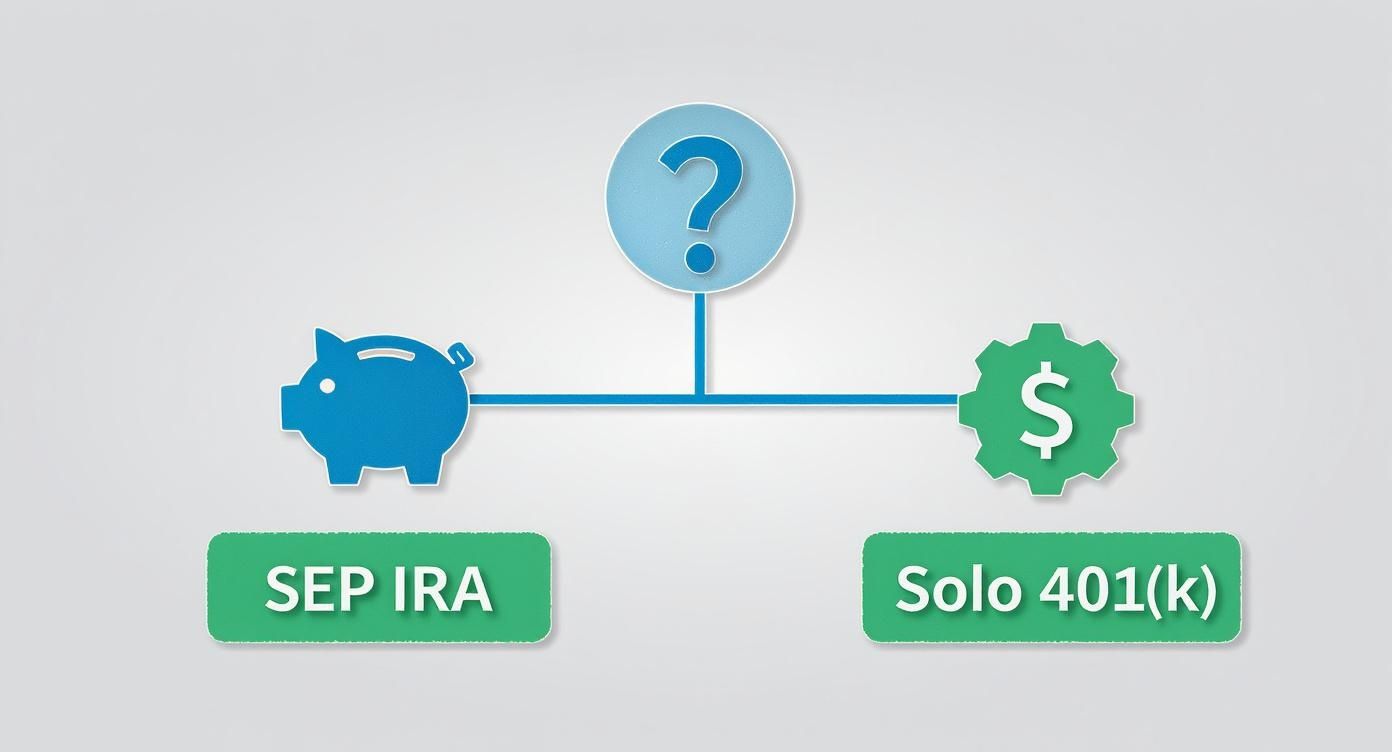
This diagram helps visualize the different paths to tax savings—whether through retirement plans or a structural change like an S Corp election. Each choice has its own set of rules and benefits you have to navigate.
Is Your Business Ready for the Switch?
So, who is the perfect candidate for an S Corp? It has less to do with your industry and more to do with your numbers and your tolerance for administrative work.
Ask yourself these four questions:
- Is your profit high enough? From my experience, the S Corp really starts to make financial sense once your annual net profit is consistently above $50,000 or $60,000. Below that, the extra costs of payroll and accounting can wipe out your tax savings.
- Is your income stable? Committing to a fixed salary is tough if your income swings wildly from month to month. This structure works best for businesses with predictable cash flow.
- Are you prepared for the admin? Be honest. Are you okay with paying for a payroll service and higher CPA fees? Do you have the discipline to keep clean records and separate your finances?
- Do you plan to reinvest profits? An S Corp is fantastic for business owners who want to leave money in the company for growth. Those retained earnings aren't subject to self-employment tax.
If you nodded "yes" to these, an S Corp could be a brilliant financial move for you. But if you value simplicity above all else or your business is still in its early growth stages, sticking with your current structure might be the smarter play for now.
Turning Healthcare Costs into Tax Savings
It's easy to look at your health insurance premiums as just another business expense, but they're actually a huge opportunity to slash your tax bill. When you know how to play your cards right, you can turn those costs into powerful deductions that lower your adjusted gross income (AGI) and, by extension, your self-employment taxes.
Two of the best tools for the job are the Health Savings Account (HSA) and the Self-Employed Health Insurance Deduction. Let's dig into how you can use them to keep more of your hard-earned money.
The Triple-Threat Power of a Health Savings Account (HSA)
If you're enrolled in a high-deductible health plan (HDHP), you’ve got access to what many experts consider the single best tax-advantaged account out there: the Health Savings Account. It's so good because it offers a rare triple tax benefit that’s almost impossible to find anywhere else.
Here’s the magic behind an HSA:
- Tax-Deductible Contributions: The money you put in is deductible right off the top, instantly lowering your taxable income for the year.
- Tax-Free Growth: Your money can be invested, and any interest, dividends, or capital gains it earns grow completely tax-free.
- Tax-Free Withdrawals: When you need to pay for qualified medical expenses, you can pull the money out without paying a dime in taxes.
This powerful trifecta makes an HSA an incredible tool not just for today's medical bills, but also as a stealth retirement account. A lot of savvy business owners max it out every year and let it grow for decades, creating a tax-free fund for healthcare in their later years.
Maxing Out Your HSA for Maximum Impact
To really make this strategy work, you want to get as close to the annual contribution limit as you can. For 2025, the IRS allows individuals with a qualifying HDHP to contribute up to $4,300 to an HSA. For families, that number jumps to $8,550. And if you're 55 or older, you can throw in an extra $1,000 "catch-up" contribution.
Just to be clear, your health plan is considered an eligible HDHP for 2025 if it has a minimum deductible of at least $1,650 for an individual or $3,300 for a family. You can find more details on the 2025 HSA contribution limits published by SHRM.
Think of it this way: if you're in the 24% federal tax bracket and manage to max out the family contribution of $8,550, you’ve just saved over $2,000 on your federal income tax bill—and that's before you even factor in the state and self-employment tax savings.
Best of all, this is an "above-the-line" deduction. That means you don’t need to itemize to claim it; it comes right off your AGI, which is the number that dictates so much of your final tax liability.
Don't Overlook the Self-Employed Health Insurance Deduction
On top of the HSA, there’s another incredibly valuable deduction built specifically for freelancers and business owners. It’s simple, powerful, and a total game-changer.
The Self-Employed Health Insurance Deduction lets you write off 100% of the premiums you pay for health, dental, and even qualified long-term care insurance.
This deduction isn't just for you. It covers premiums for:
- Yourself
- Your spouse
- Any dependents
Like the HSA, this is an "above-the-line" deduction claimed on Schedule 1 of your Form 1040. It directly reduces your AGI, so you get the benefit whether you itemize or take the standard deduction.
There are a couple of ground rules. Your business must show a net profit for the year to take this deduction. Also, you can't be eligible to get coverage from an employer-sponsored plan, like one from your spouse’s job. If you clear those hurdles, every dollar you spend on premiums becomes a tool to shrink both your income and self-employment tax bill. It's a foundational piece of any smart tax strategy.
Building Your Personal Tax Reduction Plan
Learning how to genuinely reduce self-employment tax isn't about finding a single magic bullet. It’s about building a consistent, year-round system that combines smart deductions, strategic planning, and flawless execution. The strategies we've covered are powerful, but they only work if you put them into practice with real diligence and foresight.
This whole process starts with a non-negotiable foundation: meticulous record-keeping. Every single deduction, from a software subscription to a retirement contribution, needs a digital or paper trail. Without solid documentation, even the most legitimate expense can be tossed out in an audit. Your financial records are your first line of defense and the key to unlocking every tax-saving opportunity.
Mastering Your Tax Timeline
In the world of taxes, timing is everything. For the self-employed, this means ditching the once-a-year scramble for a steady, quarterly rhythm. Waiting until April is just a recipe for overpaying and getting hit with penalties.
A huge part of this rhythm is making quarterly estimated tax payments. If you don't, you're setting yourself up for a nasty surprise. The penalty for underpayment is calculated as the federal short-term interest rate plus three percentage points—and it can add up fast. As a general rule, the IRS expects you to pay estimated taxes if you think you’ll owe $1,000 or more for the year. To stay on the right side of the rules, you have to pay at least 90% of your current year's tax liability or 100% of what you owed last year (110% for higher earners). You can get all the details directly from the IRS website about estimated taxes.
Strategic timing is also critical for major decisions. For instance, electing S Corp status isn't something you can do on a whim. You generally have a very narrow window at the beginning of the year—typically by March 15—to make the election for that tax year. Missing these deadlines can delay significant tax savings by a full year.
This proactive approach lets you adjust on the fly. If you land a huge project in July, you can bump up your next estimated payment and maybe make a larger contribution to your Solo 401(k) to offset that income spike.
When to Call a Professional
While you can manage a lot of this on your own, there’s a point where DIY tax planning costs you more than it saves. High income, complex deductions, operating in multiple states (especially with tricky SALT rules in places like NYC), or the decision to form an S Corp are all signals that it's time to bring in a professional.
A good Certified Public Accountant (CPA) doesn't just fill out forms; they act as your strategic partner. They provide personalized advice that goes far beyond what any blog post can offer. But not all tax pros are created equal. You need someone who truly gets the nuances of self-employment.
Before you hire anyone, be sure to ask these critical questions:
- How much experience do you have with clients in my industry and income bracket?
- Do you offer proactive, year-round tax planning, or just year-end compliance?
- What is your strategy for determining a "reasonable salary" for an S Corp?
- How do you help clients manage and document their quarterly estimated tax payments?
Their answers will tell you everything you need to know. You'll quickly see if they are simply a preparer or a true advisor who can help you build a robust and compliant plan to reduce your self-employment tax for years to come.
At Blue Sage Tax & Accounting Inc., we specialize in creating proactive tax strategies for self-employed professionals, entrepreneurs, and small businesses. We go beyond compliance to build a personalized plan that minimizes your tax burden and maximizes your financial health. Schedule a consultation with our team today to start building your long-term tax reduction strategy.