
When it comes to minimizing capital gains tax, it all boils down to smart timing and a bit of forethought. The most straightforward tactic? Hold onto an asset for more than one year before you sell. This simple act of patience can shift your profit from being taxed at high short-term rates to much friendlier long-term rates.
Understanding Your Capital Gains Tax Obligation

Before you can start chipping away at your capital gains tax, you need a clear picture of what you're up against. Think of it as learning the rules of the game before you play to win. The entire strategy hinges on one critical detail: how long you've owned the asset.
This "holding period" is just the amount of time that passes between when you buy an investment and when you sell it. That timeframe neatly splits your gains into two different buckets, each with its own tax implications. Getting this one concept down is the first real step toward keeping more of your money.
The Power of the Holding Period
The IRS draws a very clear line in the sand at the one-year mark. It's this distinction that determines whether your profit is a short-term or a long-term gain, which in turn dictates how much you'll owe.
- Short-Term Capital Gains: Sell an asset you’ve owned for a year or less, and the profit is taxed as ordinary income. That means it gets lumped in with your salary and taxed at the same high rates, which can climb all the way up to 37%.
- Long-Term Capital Gains: Hold that same asset for more than a year, and the profit gets special treatment. It qualifies for the much lower long-term capital gains rates of 0%, 15%, or 20%, depending on your income.
The difference between these two categories is where some of the biggest and easiest tax savings are found. To put it in perspective, a U.S. taxpayer with a $100,000 gain could save thousands just by waiting a few more days or weeks to sell. For a broader look at tax approaches, you can find more insights about global tax strategies on worldpopulationreview.com.
A quick comparison really brings the point home.
Short-Term vs Long-Term Capital Gains Tax Rates
Here’s a snapshot of how your holding period directly influences the tax rate you’ll pay on your investment profits.
| Attribute | Short-Term Capital Gains | Long-Term Capital Gains |
|---|---|---|
| Holding Period | One year or less | More than one year |
| Tax Treatment | Taxed as ordinary income | Taxed at preferential rates |
| Federal Tax Rates | 10% to 37% (matches your income tax bracket) | 0%, 15%, or 20% (based on income thresholds) |
| Best For | Not ideal for tax efficiency | Maximizing after-tax returns |
As you can see, the financial incentive to hold assets for the long term is significant. It's a foundational strategy for any serious investor.
The single most important question to ask before selling a profitable asset is: "Have I held this for more than 365 days?" A few days' difference can change your tax outcome dramatically.
Your Income Matters, Too
The tax rate you pay on capital gains isn't determined in a vacuum; it’s directly linked to your total taxable income for the year.
For 2024, a single filer with a taxable income under $47,025 could actually pay 0% on their long-term capital gains. This connection is huge—it shows why timing your sales to fall in a year when your income is lower can be an incredibly powerful move.
Once you have a solid grasp of these core ideas—the holding period and how your income bracket plays a role—you're ready to build on that foundation with more advanced tax-saving techniques. When it comes to investing, patience really does pay off.
Mastering the Art of Timing Your Asset Sales

Everyone knows the first rule of capital gains is to hold an asset for more than a year. That’s basic. But true mastery comes from thinking bigger and aligning your asset sales with the full picture of your financial life.
Patience is more than just crossing the 366-day finish line. It's about being deliberate and choosing the right year—and the right personal circumstances—to sell. The most effective way to minimize capital gains tax often comes down to selling appreciated assets when your overall income is lower. It's a simple concept, but this alignment can have a massive impact on your final tax bill. Your calendar can be just as powerful as your investment strategy.
Aligning Sales with Your Income Cycles
Your income isn’t a flat line; it has peaks and valleys. Maybe you have a slow year, take time off between jobs, retire, or make a large business investment that temporarily lowers your taxable income. These moments are golden opportunities.
Why? Because long-term capital gains tax rates are tied directly to your taxable income. For 2024, a married couple filing jointly with a taxable income under $94,050 pays a 0% federal rate on their long-term gains. Think about that. If you sell a profitable investment during a year when you fall into that bracket, you could owe absolutely nothing to the federal government on the profit.
Pro Tip: Look ahead. If you know retirement or a planned sabbatical is on the horizon, it might make sense to postpone any major asset sales until then. A few months of waiting could literally shift your tax rate from 15% or 20% all the way down to zero.
Let’s walk through a real-world scenario. Imagine you're a consultant who just had a banner year, pushing your income into a high tax bracket. You’re also sitting on a stock you've held for three years with a $50,000 long-term gain. Selling it this year would probably trigger a 15% tax, costing you $7,500.
But you’re planning to take a six-month break next year, which will drop your income significantly. By simply waiting to sell that stock, you could easily fall into the 0% bracket. That $7,500 tax bill? Gone.
Navigating the Wash-Sale Rule
Timing is also critical when you’re dealing with losses. While we’ll get deeper into tax-loss harvesting later, you need to be aware of a key timing trap: the wash-sale rule. This IRS rule says you can't claim a tax loss on a security if you buy a "substantially identical" one within 30 days before or after the sale.
That 61-day window is a hard-and-fast rule. If you violate it, the IRS disallows the loss for that year, and you won’t get the tax benefit until you eventually sell the new position.
Here’s how to avoid this common mistake:
- Wait it out. If you sell a stock for a loss but still believe in it long-term, just wait 31 days before buying it back. Simple as that.
- Find a similar alternative. You could sell an S&P 500 index fund and immediately buy a total stock market index fund. They aren't "substantially identical," so you can book the loss while staying invested in the broader market.
- Check all your accounts. The wash-sale rule is sneaky—it applies across all your accounts, including IRAs and even your spouse's accounts. Selling a stock at a loss in your brokerage account and buying it back the next day in your IRA will trigger the rule.
By getting strategic about when you realize both gains and losses, you can take back a surprising amount of control over your tax outcome. It’s all about shifting from a reactive to a proactive mindset, where every sale is a deliberate move in your larger financial game plan.
Using Investment Losses to Your Advantage
Let’s be honest, not every investment is a winner. Some will inevitably lose value. But there’s a silver lining here: those underperforming assets in your portfolio can become a valuable tool for smart tax planning. This is where a strategy known as tax-loss harvesting comes into play, turning market downturns into direct tax savings.
At its core, tax-loss harvesting means strategically selling investments at a loss. You're not just ditching a poor performer; you are deliberately "harvesting" that loss to systematically lower your tax bill. It’s a proactive way to find a financial upside even when an investment doesn't pan out.
This process turns a "paper" loss into a "realized" loss, which you can then use to offset the taxable gains from your more successful investments. It’s an essential technique for anyone looking at how to minimize capital gains tax, especially when the market gets choppy.
The Mechanics of Offsetting Gains
The rules here are pretty straightforward but incredibly powerful. The losses you harvest are first used to cancel out your capital gains on a dollar-for-dollar basis, making it one of the most direct ways to cut your tax liability.
You just have to follow a specific order:
- Short-term losses must first offset short-term gains.
- Long-term losses must first offset long-term gains.
If you have leftover losses in one category, you can then apply them to the other. For instance, if you have more short-term losses than short-term gains, that excess can be used against your long-term gains, and vice versa.
By systematically harvesting losses, you're not just playing defense. You're actively rebalancing your portfolio while creating tangible tax benefits—a disciplined approach that turns market fluctuations into opportunities.
Let’s walk through a quick example. Imagine you sold a stock and realized a $10,000 long-term capital gain. Later in the year, you decide to sell another investment that’s down $7,000 (a long-term loss). By harvesting that loss, you directly offset your gain. Your taxable long-term gain is suddenly just $3,000, potentially saving you hundreds, if not thousands, in taxes.
When Losses Exceed Your Gains
So, what happens if your losses are greater than your gains for the year? This is where tax-loss harvesting gets even more compelling. After you've wiped out all your capital gains, you can use any leftover net capital loss to reduce your other income.
You can deduct up to $3,000 of excess capital losses against your ordinary income—like your salary—each year. For a high-income earner, that $3,000 deduction can immediately translate into over $1,000 in tax savings. This makes tax-loss harvesting a smart move even in years when you don't have big gains to offset.
But it gets better. If your net loss for the year exceeds that $3,000 limit, the rest isn't wasted. The IRS allows you to carry forward those unused losses indefinitely. They can be used to offset gains or income in future tax years, creating a valuable tax asset you can deploy when you need it most.
For example, say you end the year with a net capital loss of $15,000:
- You’d use $3,000 to reduce your ordinary income this year.
- The remaining $12,000 gets carried forward to the next year.
This carryforward loss will be waiting to offset future gains, ensuring no part of the tax benefit goes to waste. In fact, research shows that consistent loss harvesting can make a huge difference over time. Over a 30-year period, this systematic approach can cut capital gains tax bills by an impressive 15-30%. Explore the full analysis of tax minimization opportunities from the OECD.
Advanced Strategies to Defer or Eliminate Gains
The basics, like holding assets for the long term and harvesting losses, are essential. They're your bread and butter. But what happens when you're dealing with significant gains from real estate or a business sale? That's when the standard playbook just won't cut it.
When the stakes are this high, you need to move into more specialized strategies designed to defer or, in some cases, completely wipe out a massive tax event. These moves require serious planning and almost always involve professional help, but the savings can be truly game-changing. Let’s dive into some of the most powerful tools in the tax-planning arsenal.
The Real Estate Investor's Secret Weapon: The 1031 Exchange
For anyone in real estate, the 1031 exchange is legendary for a reason. It's one of the most powerful wealth-building tools baked directly into the tax code. In simple terms, it lets you sell an investment property and roll all the proceeds into a new "like-kind" property, kicking the tax can way down the road.
Imagine you sell an apartment complex and walk away with a $500,000 profit. Normally, you’d be facing a hefty tax bill. But with a 1031, you can reinvest that entire gain into, say, an office building or a piece of land. Your tax obligation is deferred, allowing your money to keep working for you instead of going to the IRS.
Of course, the IRS has strict rules you have to follow to the letter:
- You must identify a potential replacement property within 45 days of selling your original one.
- You have to close on the new property within 180 days of that initial sale.
- The property you buy must be of equal or greater value to fully defer the tax.
This isn’t for your personal home—it’s strictly for investment and business properties. When done right, you can chain these exchanges together for decades, constantly trading up in value and compounding your wealth tax-free until you finally decide to cash out.
Investing in Qualified Opportunity Zones
Another powerful strategy for deferring and even reducing gains is investing in a Qualified Opportunity Zone (QOZ). This program, born out of the 2017 tax reform, was designed to spur investment in economically distressed areas by offering some incredible tax breaks.
Here’s how it works: you take the capital gains from a recent sale—it could be from stocks, a business, or real estate—and reinvest that money into a Qualified Opportunity Fund (QOF) within 180 days. That fund then puts the capital to work in a designated QOZ.
The benefits are layered, and they get better over time:
- Tax Deferral: You don’t pay taxes on the gain you rolled over until the end of 2026 or when you sell your QOF investment, whichever is sooner.
- Basis Step-Up: This one's a bit more complex, but if you hold the investment long enough, you could get a basis increase on your original gain, meaning less of it is eventually taxed.
- Tax-Free Growth: This is the home run. Hold the QOF investment for 10 years or more, and any appreciation on that new investment is 100% tax-free.
By funneling capital into areas that need it most, the QOZ program gives investors a rare opportunity to do well by doing good. You can turn a huge tax liability into a long-term, tax-free growth engine.
Strategic Gifting and Trust Planning
Sometimes, the best move isn't just about deferring your own taxes—it's about passing wealth to the next generation as efficiently as possible. This is where strategic gifting and trust planning come in.
Gifting appreciated assets, like a block of stock you bought years ago, can be a brilliant play. When you gift the asset, the recipient takes on your original cost basis. But here's the key: if they're in a much lower tax bracket, they can sell it and pay tax at a significantly lower rate, maybe even 0%. You've effectively shifted the tax burden to someone who will pay far less.
For more complex family wealth goals, trusts provide structure and protection. A Charitable Remainder Trust (CRT), for example, lets you place a highly appreciated asset into the trust. The trust sells it tax-free, you get an income stream for life (or a set term), and whatever is left goes to a charity you care about. As a bonus, you get a substantial charitable deduction right away to offset other income.
The flowchart below shows the thought process for tax-loss harvesting, a foundational tactic that often comes before you even consider these more advanced deferral strategies.
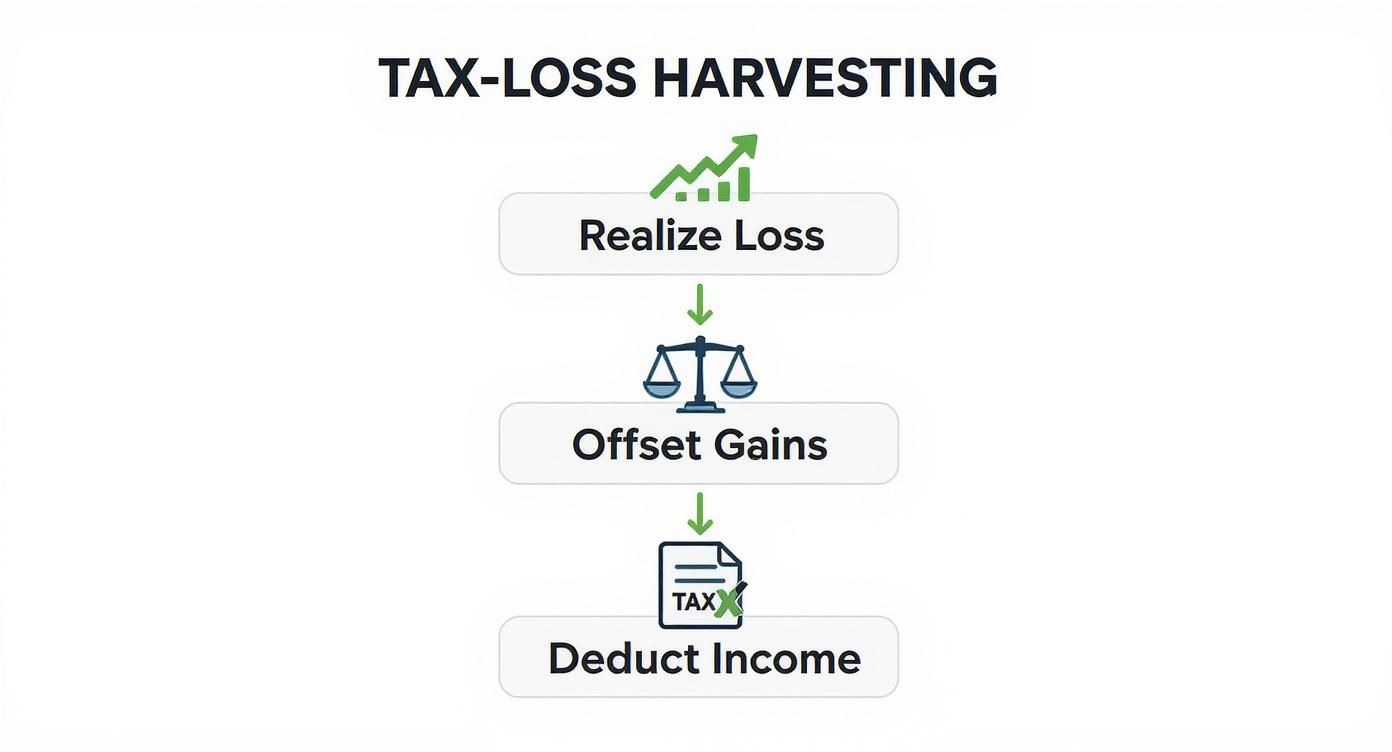
Think of this as the first layer of defense—selling your losers to cancel out your winners before you have to write a check to the government.
These high-level strategies are powerful, but they are not DIY projects. They require careful planning and a deep understanding of ever-changing tax laws. At Blue Sage Tax & Accounting Inc., we live and breathe this stuff, helping clients navigate these complexities to build and protect their wealth for the long haul.
Fine-Tuning Your Tax Bill with Cost Basis

Most people fixate on the selling price of an asset, but honestly, that’s only half the story. The real secret to calculating—and often shrinking—your taxable gain is hidden in a detail many investors completely gloss over: your cost basis.
This isn't just the price tag on the day you bought it; it's the total capital you've sunk into that asset. Overlooking the full picture here is one of the most common ways people hand over more to the IRS than they need to. Think of your basis as the starting line. The higher it is, the smaller your taxable gain. Getting it right is a cornerstone of any serious plan for how to minimize capital gains tax.
Building Your Adjusted Cost Basis
Here's the good news: your true cost basis is often higher than you think. The IRS lets you "adjust" your basis upward by including a variety of costs tied to buying, holding, and improving the asset. Forgetting these is like leaving money on the table.
Some key adjustments you can’t afford to miss are:
- Transaction Fees and Commissions: Those brokerage fees you paid to buy a stock or the commissions on a real estate deal? They're part of your investment and should be added to your basis.
- Reinvested Dividends: If you’re in a dividend reinvestment plan (DRIP), every reinvested dividend buys more shares. Since you already paid income tax on that dividend, it absolutely increases your cost basis.
- Capital Improvements: For real estate, the money you spent on major upgrades—think a new roof or a kitchen remodel—gets added to your basis. Just remember, routine repairs don't count.
Tracking these expenses makes a real difference. A $5,000 commission on a property or $1,000 in reinvested dividends over the years directly shaves that same amount off your taxable profit.
Your cost basis isn't a static number. It's a living record of your total investment in an asset. Every commission, fee, and reinvested dividend is a tool you can use to reduce your future tax bill.
Picking the Right Accounting Method
So, what happens when you sell just a portion of a stock or mutual fund you’ve been buying over time at different prices? The accounting method you use to identify which shares you sold can dramatically change your tax bill.
Most brokerage firms will default to FIFO (First-In, First-Out). This method assumes you're selling your oldest shares first. If the asset has gone up in value, these are usually the shares with the lowest cost basis, triggering the biggest possible gain.
But you're not stuck with FIFO. You can instruct your broker—before the sale—to use Specific Share Identification. This gives you the power to cherry-pick which lots to sell. To keep taxes low, you'd tell them to sell the shares you bought at the highest price, since they'll have the smallest gain.
| Accounting Method | How It Works | Best Used When… |
|---|---|---|
| FIFO (First-In, First-Out) | Assumes you sell your oldest shares first. | You want simplicity. It's the default for most brokerages and requires no action. |
| Specific Share ID | You tell your broker exactly which shares to sell (e.g., "sell the 100 shares I bought on May 1, 2022"). | You want to strategically slash your taxable gain by offloading your highest-cost shares first. |
The impact can be massive. Using specific ID to sell high-cost shares could even turn what looks like a gain into a small loss, perfect for tax-loss harvesting.
Watch Out for the Net Investment Income Tax
Finally, high earners have one more tax to keep on their radar: the Net Investment Income Tax (NIIT). This is a 3.8% surtax that kicks in on investment income for anyone with a modified adjusted gross income (MAGI) over a certain level.
For 2024, those thresholds are:
- $250,000 for married couples filing jointly
- $200,000 for single filers
The NIIT is calculated on the lesser of your total net investment income or the amount your MAGI is over that threshold. A big capital gain can easily push you into NIIT territory, effectively turning a 20% long-term capital gains rate into 23.8% at the federal level. Any strategy that lowers your capital gain also helps you steer clear of this surtax.
Knowing When to Call in the Pros
Look, while you can handle a lot of these tax-saving strategies on your own, the real skill is knowing your limits. Deciding when to step back and let an expert take the wheel is probably the smartest financial move you can make, especially when the numbers get big. Certain life events are basically giant, flashing signs telling you it’s time to call a professional.
Investing in expert advice isn't giving up; it's a strategic play to protect and grow your wealth. The tax code is a maze, plain and simple. A seasoned guide helps you get through it without stumbling into expensive pitfalls. Trying to navigate a complex sale or investment on your own can easily lead to mistakes that cost way more than a professional's fee.
Red Flags That Mean You Need an Expert
Some financial moves are just too complicated to DIY. If you're facing any of these situations, it's a no-brainer—get a tax pro on your team.
- Selling a Business: This is a minefield of tax issues, from how you allocate the sale price to recapturing depreciation. A good Certified Public Accountant (CPA) can structure the deal to save you potentially hundreds of thousands, if not more.
- Major Real Estate Deals: Planning a 1031 exchange? Selling a valuable property that has tax implications in multiple states? You need professional guidance to make sure you're compliant and deferring every penny you legally can.
- Complex Gifting and Estate Plans: If you're thinking about using trusts or gifting significant, appreciated assets to your family, an estate attorney and a CPA are non-negotiable. They'll make sure your wealth transfer is done right and is legally solid.
- Large, Sophisticated Portfolios: For those with high-value investments, a Certified Financial Planner (CFP) can weave advanced strategies like tax-loss harvesting directly into your overall financial plan, making sure tax efficiency is always a priority.
Think of a tax professional as an investment, not an expense. The return comes from direct tax savings, avoiding costly errors, and the peace of mind that comes with knowing you've got it right.
At the end of the day, if a transaction feels over your head or involves a sum of money that could seriously affect your financial future, it’s time to make the call. Planning ahead with an expert is the real key to successfully keeping your capital gains tax bill down over the long haul.
Common Questions About Capital Gains Tax
Even with a solid grasp of the main strategies, certain questions always seem to come up. Let's walk through a few of the most common ones I hear from clients to clear up how these rules work in the real world.
Will a Large Capital Gain Push Me Into a Higher Tax Bracket?
Yes, it absolutely can. This is one of the most common surprises people run into, and it's crucial to plan for. A big capital gain gets added to your other income, increasing your adjusted gross income (AGI).
When your AGI goes up, it can easily push your regular income—your salary, for instance—into a higher tax bracket. Suddenly, you're not just paying tax on the gain itself, but you're also paying a higher rate on your normal earnings.
On top of that, a higher AGI can mean you no longer qualify for certain deductions and credits you were counting on. This is exactly why timing the sale or spreading a large gain over several years with an installment sale can be such a powerful move.
A capital gain doesn't exist in a vacuum. It ripples across your entire tax return for the year, potentially triggering higher taxes on your salary and wiping out valuable tax breaks.
How Are Inherited Assets Taxed?
This is one area where the tax code offers a massive advantage. When you inherit property, you benefit from what's called a "stepped-up basis."
Instead of you inheriting the original purchase price (the basis) of the asset, its basis gets "stepped up" to whatever its fair market value was on the date the original owner passed away.
Let's say you inherit a stock portfolio worth $500,000 that your parents originally bought for just $50,000. Your new basis isn't $50,000; it's $500,000. You could turn around and sell it the next day for that exact amount and owe absolutely zero capital gains tax. It's easily one of the most powerful wealth transfer tools in the entire tax code.
What About Selling My Primary Home?
For homeowners, the IRS provides a fantastic tax break when you sell your main home. As long as you meet the "ownership and use tests"—meaning you've owned the home and lived in it as your primary residence for at least two of the five years leading up to the sale—you can exclude a huge chunk of your profit from taxes.
- If you're a single filer, you can exclude up to $250,000 of the gain.
- For married couples filing jointly, that exclusion doubles to $500,000.
Think about that for a moment. A married couple could sell their long-time home, walk away with a half-million-dollar profit, and potentially not owe a single dime in federal capital gains tax.
Handling the details of capital gains requires more than just knowing the rules; it demands a forward-looking strategy. At Blue Sage Tax & Accounting Inc., we work with you to build clear, effective tax plans that fit your financial life. Discover how our strategic guidance can help you keep more of what you earn.