Getting your annual Form 990 filing right is non-negotiable for keeping your tax-exempt status. But before you dive into the details, the very first—and most important—step is picking the correct version of the form. It all boils down to two key numbers: your organization's gross receipts and total assets.
Choosing between the 990-N, 990-EZ, and the full Form 990 isn't just a suggestion from the IRS; it's a requirement. Filing the wrong one can get your return rejected and even lead to penalties. Let's break down which form is the right fit for your nonprofit.
Form 990-N: The "e-Postcard" for Small Nonprofits
If you're running a smaller, community-focused organization, the IRS makes things easy with the Form 990-N, often called the "e-Postcard."
This super-simple option is for nonprofits whose gross receipts are normally $50,000 or less. It's not a full tax return but a quick, eight-question online notice that basically tells the IRS, "Hey, we're still here and operating." It’s designed to be a light lift for new or volunteer-run groups.
Form 990-EZ: The "Short Form" for Growing Organizations
Once your nonprofit starts to bring in more revenue, your reporting duties get a bit more involved. The next step up is the Form 990-EZ, which is a shorter, more manageable version of the full return.
You can use the Form 990-EZ if you meet both of these financial thresholds:
- Your gross receipts are less than $200,000.
- Your total assets are less than $500,000.
At four pages, it asks for more financial information than the e-Postcard but is far less intimidating than the full Form 990. It’s the perfect middle ground for established organizations that haven’t hit the big leagues just yet.
A Quick Tip from Experience: When looking at the asset threshold, always use your organization's total assets, not net assets. This is a common mix-up. Total assets will always be the bigger number and it's the one the IRS cares about for this calculation.
Form 990: The Full Return for Large Nonprofits
For larger, more financially complex organizations, there’s no way around it—you have to file the full Form 990. This is the most detailed of the returns, requiring a comprehensive look at your finances, governance, and program accomplishments.
You're required to file the full Form 990 if you meet either of these conditions:
- Your gross receipts are $200,000 or more.
- Your total assets are $500,000 or more.
This 12-page return is all about public transparency. The IRS requires all 501(c)(3) tax-exempt organizations to file some version of the 990 each year to ensure they're sticking to the rules for their status. If you're curious about the bigger picture, the Library of Congress offers more information on Form 990 requirements.
To make this even clearer, here’s a quick comparison table.
Quick Guide to Choosing Your Form 990
Use this table to quickly identify the correct Form 990 for your nonprofit based on its annual gross receipts and total assets.
| Form Variant | Gross Receipts Threshold | Total Assets Threshold | Best For |
|---|---|---|---|
| Form 990-N | Normally $50,000 or less | N/A | Small, volunteer-run, or new nonprofits. |
| Form 990-EZ | Less than $200,000 | Less than $500,000 | Mid-sized organizations with established operations. |
| Form 990 | $200,000 or more | $500,000 or more | Large, complex nonprofits with significant revenue/assets. |
Think of these thresholds as clear signposts. Once you know your gross receipts and total assets, finding the right form is straightforward.
Still not sure? This flowchart can help you visualize the decision-making process.
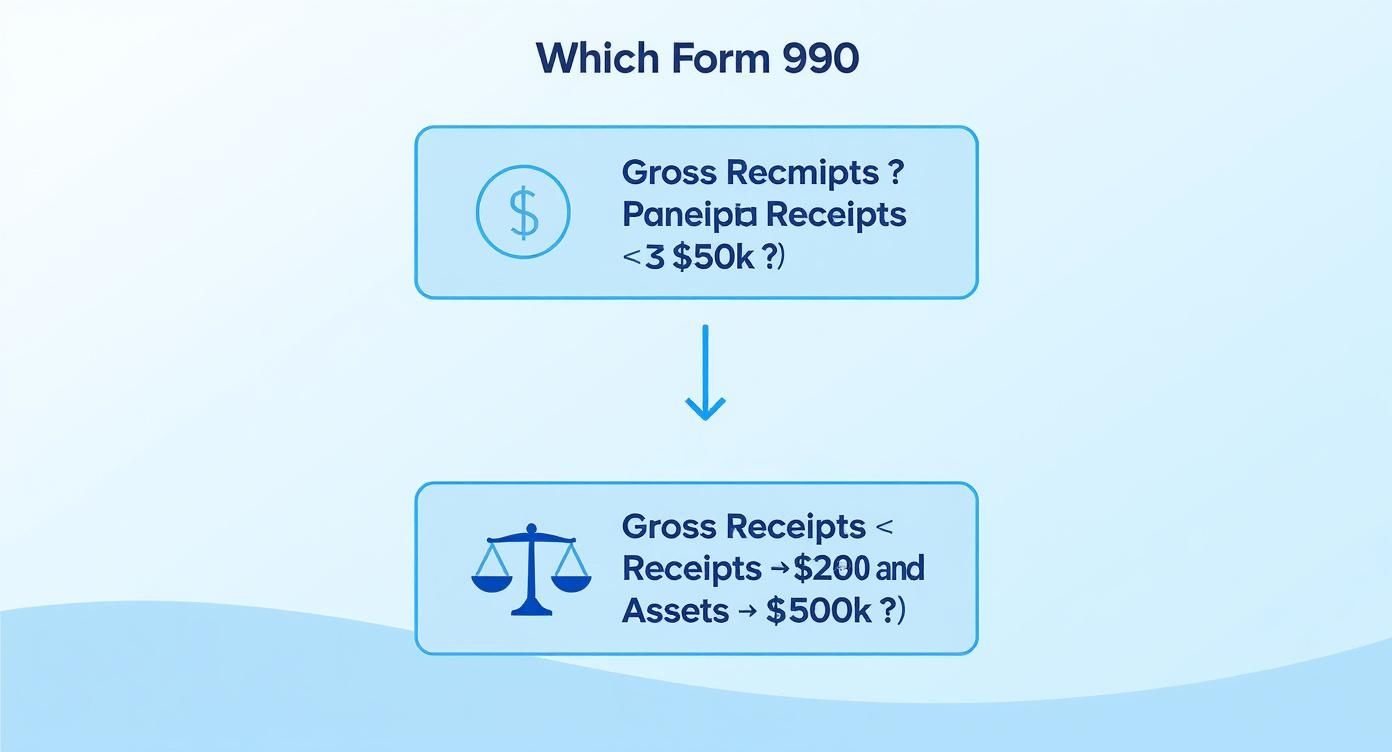
As the chart shows, your financials are the key. They guide you directly to the correct form—whether it's the simple 990-N, the mid-level 990-EZ, or the comprehensive full Form 990.
Get Your Ducks in a Row Before You File
The secret to a stress-free Form 990 filing isn't some magic trick—it’s just plain old preparation. If you wait until the last minute to start digging for documents, you’re setting yourself up for a world of pain. The smart move is to gather everything you need before you even log into the filing software.
Think of it like building a compliance toolkit for your fiscal year. The Form 990 digs deep into your organization's finances, governance, and programs, so having everything in one place is the only way to go. A frantic search for data is exactly how costly mistakes get made.

Let's walk through exactly what you'll need to pull together.
The Financial Foundation
This is the bedrock of your return. All the numbers should come directly from your accounting system, so having clean, finalized reports is non-negotiable.
Here’s your financial checklist:
- Statement of Financial Position (Balance Sheet): This report gives a snapshot of your assets, liabilities, and net assets on the very last day of your fiscal year.
- Statement of Activities (Income Statement): This one tells the story of your revenue and expenses over the full twelve months.
- Detailed General Ledger: Why this? It’s your secret weapon for classifying expenses correctly. You'll need it to confidently separate your program service costs from management and fundraising expenses—a critical part of the 990.
- Payroll Reports: Get your hands on the total salary figures, employer tax contributions, and any benefit expenses.
Before you go any further, make sure these documents have been reviewed and signed off on by your board or finance committee. The numbers you report need to be the official, final version.
Pro Tip: Create a dedicated digital folder for each tax year (e.g., "Tax Year 2023"). Every time a key document is finalized—board meeting minutes, financial reports, grant agreements—drop a PDF copy in there. This simple habit will save you a massive headache down the line.
Who's in Charge Here? Governance and People
The Form 990 is very interested in who runs your nonprofit and how they're compensated. This is all about transparency. You'll need a complete roster of every officer, director, and trustee who served at any point during the tax year.
For each person on that list, you’ll need to track down:
- Full legal name and current mailing address.
- Their title and a good-faith estimate of the average hours they worked per week. Yes, even for your volunteer board members.
- All compensation details, including salary, bonuses, and benefits paid by your organization and any related entities.
And don't forget, you also have to identify your five highest-compensated employees (who aren't already on the director list) that earned over $100,000 for the year. The same detailed compensation info is required for them.
Telling Your Story: Donors and Programs
Beyond the numbers, the IRS wants to know where your money comes from and what you're doing with it. This is your chance to showcase your impact and prove you have public support.
Be ready with this information:
- Major Donor List: If you're required to file Schedule B, you'll need the name, address, and total donation amount for anyone who gave more than $5,000 during the year. This part is kept confidential by the IRS and isn't shown on the public version of your 990.
- Program Service Accomplishments: This is where you get to brag a little. Write clear, compelling descriptions of your top three mission-related achievements for the year. Use hard numbers whenever you can—think "served 1,500 meals to seniors" instead of the vague "provided food."
- Revenue Breakdowns: You can't just list a single "income" number. Be prepared to categorize it. You'll need to separate government grants from private foundation grants, individual contributions, and revenue from your programs.
By pulling together this full package of information—financial, personnel, and programmatic—you’re setting the stage for a smooth and accurate filing. Honestly, this prep work is the most important step in the entire process.
Navigating the IRS E-Filing Mandate
The days of printing out your nonprofit's annual return, signing it, and dropping it in a mailbox are long gone. The IRS now requires all organizations filing Form 990 or Form 990-EZ to do it electronically. This isn't just a minor procedural change; it’s a fundamental shift designed to make nonprofit data more accessible and processing more efficient.
For many organizations, this is a good thing—it means less paper, faster confirmation, and fewer chances for mail to get lost. But it also means you have to get comfortable with the digital process. You can't just fill out a PDF anymore.

Finding an IRS-Approved E-File Provider
Here’s the first thing to know: you don’t file your Form 990 directly on the main IRS website. You have to go through an IRS-authorized e-file provider. These are third-party software companies that have met the IRS's strict standards for security and data transmission.
Picking the right one really depends on your organization's budget, complexity, and who you have on your team.
- DIY Tax Software: If you have straightforward finances and a team member who is pretty savvy with taxes, software like TurboTax Business or other nonprofit-specific programs can be a great, cost-effective choice.
- Guided Online Platforms: These services walk you through the form and its schedules step-by-step. They're a solid middle ground if you need more support than basic software offers but aren't quite ready to hire a dedicated accountant.
- Professional Tax Preparers: For complex organizations or those who just want total peace of mind, hiring an accountant or firm is the way to go. A firm like ours uses professional-grade software to prepare and file everything for you, ensuring it’s done right.
When you’re comparing providers, don't just look at the price. Make sure they support all the schedules you need, can handle your state's filing requirements, and have good customer reviews.
The Special Case: Form 990-N
There’s one important exception to this rule: the Form 990-N, also known as the e-Postcard.
This is a much simpler filing for the smallest nonprofits—specifically, those with gross receipts that are typically under $50,000. If that’s you, you’re in luck. You can file the 990-N directly on the IRS website for free. It’s a simple eight-question form that usually takes less than 15 minutes to complete.
Even if your organization had zero income for the year, you still have to file. The 990-N is the simplest way for small nonprofits to stay compliant and protect their tax-exempt status.
A New Era of Digital Transparency
This mandatory e-filing rule has completely changed the game for nonprofit transparency. The trend was already building for years. Back in 2009, only 33,311 organizations e-filed the standard Form 990. By 2019, that number had exploded by 854% to 284,515.
Once the mandate kicked in, e-filing became the standard. In 2023, there were 329,042 electronic Form 990s filed, plus 198,731 Form 990-EZs and 121,156 for private foundations. This flood of digital data is now publicly accessible for researchers and watchdog groups, with resources like the Urban Institute's e-file dataset making it easy to analyze. It’s a powerful reminder that your filed return is a public document, making accuracy more important than ever.
Getting to Grips with Form 990 Schedules
When you sit down to tackle your Form 990, it’s a common misconception to think of it as a single, 12-page document. In reality, the main form is more like the cover of a book; the real story is often told in the schedules.
These schedules are mandatory attachments that dive deep into specific financial activities and governance details. Think of the main form as the high-level summary. The schedules are the detailed chapters that provide the necessary context. If your nonprofit did certain things during the year—like hold a big fundraiser or receive a large donation—the IRS wants you to attach a specific schedule to explain it. Getting this right is a huge part of filing your 990 correctly.

Let's walk through some of the most common schedules you'll probably run into.
Schedule A: Public Charity Status and Public Support
For any 501(c)(3) organization, this is one of the most important schedules you'll file. Schedule A is where you prove to the IRS that you are, in fact, a public charity and not a private foundation. It’s all about showing that your support comes from a broad base of the public.
To do this, you’ll have to complete a "public support test," which is essentially a five-year lookback at where your money came from. The calculation determines what percentage of your income is from public sources (like small individual gifts and government grants) versus support from just a handful of major donors.
Passing this test is absolutely critical for keeping your public charity status, so this schedule is a non-negotiable part of your annual filing.
Schedule B: Schedule of Contributors
Schedule B is probably the most frequently misunderstood—and worried about—attachment. It’s where you have to list every single donor who gave $5,000 or more to your organization during the tax year. This applies to contributions of all kinds, whether it's cash, stock, or a non-cash gift.
I see a lot of nonprofit leaders get nervous about donor privacy here, but there's good news. While you absolutely must submit this list to the IRS, Schedule B is not a public document. When your Form 990 is posted online for public viewing, this schedule is kept confidential to protect your donors' information.
For example, let's say a local business donates $10,000 to your animal shelter. You're required to list their name, address, and the donation amount on Schedule B. However, that information will never be seen by the public—it stays between you and the IRS.
It’s an IRS compliance tool, not a public directory.
Schedule G: Diving into Fundraising Details
If your nonprofit raises funds, Schedule G will almost certainly be part of your filing. You'll need to fill this one out if you brought in more than $15,000 in gross income from fundraising events or used professional fundraising services.
Schedule G really zeros in on two main things:
- Special Events: For things like galas, auctions, or charity golf tournaments, you have to report the total money brought in and the direct expenses. This helps the IRS see how much you actually cleared after paying for the venue, food, and entertainment.
- Professional Fundraisers: If you paid an outside firm to manage a fundraising campaign, you need to disclose who you hired, how much they collected on your behalf, and how much they were paid for their services.
So, if you held a fundraising dinner that grossed $25,000 but cost $10,000 to put on, you’d lay all that out on Schedule G. It’s all about transparency.
Other Schedules to Keep on Your Radar
While A, B, and G are the big ones for many organizations, your specific activities might trigger others. Here are a few more you should know about:
- Schedule D: Required if your organization holds donor-advised funds or deals with conservation easements.
- Schedule F: You'll need this if your nonprofit conducts any activities outside of the United States.
- Schedule I: This gets triggered if you provide grants or other assistance to individuals or organizations in the U.S. that total more than $5,000.
- Schedule O: This is the "catch-all" schedule. It's where you provide narrative explanations and additional details for answers on the main Form 990. Honestly, almost everyone filing the full Form 990 will need to attach Schedule O for something.
Figuring out which schedules you need is a fundamental step. The best approach is to carefully review your year's activities and see what boxes they tick. And if you're ever unsure, this is the perfect time to check in with a tax professional who lives and breathes nonprofit accounting. It’s the best way to make sure nothing slips through the cracks.
Deadlines, Extensions, and Sidestepping Common Mistakes
Getting your Form 990 filed is more than just paperwork—it’s about hitting your deadlines and steering clear of simple mistakes that can turn into major headaches. A little bit of planning goes a long way in making sure your filing season is smooth and successful.
The All-Important Due Date
Let’s get the big one out of the way first. Your Form 990 is due by the 15th day of the 5th month after your organization's fiscal year wraps up.
Most nonprofits run on a calendar year, which makes the magic date May 15th. If your fiscal year is different, say it ends June 30, then your return isn't due until November 15. Mark this on your calendar, because missing it comes with a price.
The IRS penalties can stack up fast. For smaller organizations, it starts at $20 per day the return is late. But if your gross receipts are over $1,208,500, that penalty skyrockets to $120 per day.
When You Just Need a Little More Time
We've all been there. Sometimes, getting everything together by the deadline just isn't in the cards. Luckily, the IRS gets it.
You can get an automatic six-month extension by filing Form 8868, Application for Extension of Time To File an Exempt Organization Return. The key is to file it before your original due date. There’s no need for a dramatic explanation—as long as you submit the form on time, the extension is yours.
This simple step can push a May 15th deadline all the way to November 15th, giving you the breathing room you need to get your return right.
One crucial point: An extension to file is not an extension to pay. If your organization owes unrelated business income tax (UBIT) and has to file a Form 990-T, you still need to pay what you owe by the original deadline. Don't let interest and penalties catch you off guard.
Staying Out of Trouble: Common Errors and How to Prevent Them
Even with plenty of time, it’s surprisingly easy to make small mistakes that can cause big problems. A simple error can trigger an IRS notice, slow down processing, or even tarnish your nonprofit’s reputation. Remember, your Form 990 is a public document that anyone can look up.
Speaking of which, the data from Form 990s is more accessible than ever. Watchdog groups and charity evaluators like ProPublica and GuideStar make these filings searchable for donors, journalists, and researchers. You can even discover more about how Form 990 data is used by various groups. It’s a great reminder that getting the details right really matters for public transparency.
To help you put your best foot forward, here are some of the most common mistakes I see year after year, along with some simple ways to avoid them.
| Common Error | Potential Consequence | Prevention Tip |
|---|---|---|
| Missing Schedules | Your return will be considered incomplete and rejected, potentially leading to late filing penalties. | Use the IRS checklist in the Form 990 instructions. As you answer the "yes/no" questions in Part IV, you’ll be directed to the exact schedules you need. |
| Math Errors on Schedule A | Miscalculating your public support percentage could put your public charity status at risk. | Use a spreadsheet to double-check your math. It’s also wise to have a second person, like a board treasurer, review the figures before filing. |
| Vague Program Descriptions | Donors and grantmakers won’t understand your impact, potentially costing you funding opportunities. | Be specific! Instead of "community outreach," write "Provided 3,000 hot meals to homebound seniors through our Meals on Wheels program." |
| Forgetting State Requirements | You could lose your state-level tax exemption or face fines. | Check with your state's charity registration office. For example, New York requires the CHAR500. Don't assume your federal filing covers it all. |
At the end of the day, filing your Form 990 is a core part of maintaining your nonprofit's health and credibility. The most serious consequence of all is having your tax-exempt status automatically revoked for failing to file for three consecutive years. Bringing a nonprofit back from that is a long, expensive road.
By staying on top of your deadlines and double-checking for these common errors, you can file with confidence and keep your organization in good standing.
Got Questions About Your Form 990? We've Got Answers.
Even with the best plan, filing your Form 990 can bring up some tricky questions. It’s completely normal to hit a snag or run into a situation that the standard instructions don't quite cover. Let's walk through a few of the most common issues that nonprofit leaders run into during tax season.
"I Found a Mistake on a Return I Already Filed. What Now?"
First off, don't panic. Discovering an error on a past Form 990 is far more common than you might think. What really matters is that you fix it proactively instead of letting it slide. The IRS has a straightforward process for this: filing an amended return.
You’ll need to fill out a new Form 990 for the same tax year, this time with all the correct information. The crucial step is to check the box for "Amended Return" on the first page. This tells the IRS you're correcting an old submission, not filing for the first time.
You'll also need to attach a Schedule O (Supplemental Information). This is where you explain, clearly and concisely, what was wrong on the original return and what you've corrected.
For example, say you accidentally misclassified a $50,000 grant as program service revenue. On Schedule O, you’d simply write something like: "This amended return corrects Part VIII, Line 1b. A $50,000 grant from the ABC Foundation, previously reported as program revenue, has been reclassified as a contribution." Taking this step shows good faith and your commitment to accurate reporting.
"We Didn't Have Any Income This Year. Do We Still Have to File?"
This is a big one, especially for new or temporarily inactive organizations. The answer is almost always a hard yes. Your annual filing requirement is tied directly to your tax-exempt status, not your income for any given year.
If you fail to file for three consecutive years, the IRS will automatically revoke your 501(c)(3) status. It's a harsh penalty that can be incredibly difficult and expensive to undo.
So, what should you file if your gross receipts were zero?
- If you normally bring in $50,000 or less, you can file the quick and easy Form 990-N (e-Postcard). It only takes a few minutes online and keeps your nonprofit in good standing.
- If you typically file a 990-EZ or the full 990, you still have to file that same form. You'll just report zeroes for your revenue and expenses. The act of filing is what counts.
Here's the bottom line: The IRS doesn't see a failure to file as a sign of no activity—they see it as a failure to comply. Filing every single year, regardless of your income, is essential to keeping your tax-exempt status.
"Who Can Actually See Our Form 990?"
Once the IRS processes your Form 990, it becomes a public document. This is a core tenet of nonprofit transparency in the U.S. From potential donors and journalists to any curious member of your community, anyone can look up your return.
They can find it through a few key channels:
- The IRS Tax Exempt Organization Search: The IRS provides its own online tool for the public to look up organizations and view their filings.
- ProPublica's Nonprofit Explorer: This is a popular and very user-friendly database that makes it easy to search for and analyze Form 990 data.
- Candid (formerly GuideStar): This is a go-to resource for grantmakers and donors doing their homework. A missing or sloppy Form 990 on this platform can be a major red flag.
Because your Form 990 is essentially your organization's public report card, getting it right is about more than just compliance. It’s a powerful tool for telling your story and building trust. A clean, accurate return gives your supporters confidence and proves you're a responsible steward of the funds they've entrusted to you.
Navigating Form 990—from picking the right schedules to understanding public transparency—can feel like a lot to handle. At Blue Sage Tax & Accounting Inc., we specialize in helping nonprofits stay compliant and tell their financial story with clarity. If you need an expert in your corner for your annual filing, reach out to us for a consultation at https://bluesages.tax.