For real estate investors, estate planning isn't just about what happens when you're gone. Think of it as the architectural blueprint for your entire legacy. It’s an active, ongoing strategy to protect your hard-won wealth and ensure your portfolio continues to thrive for generations to come.
This isn't just a box to check; it’s essential for shielding your properties from the notoriously expensive probate process and sidestepping a massive tax bill.
Your Blueprint for a Lasting Real Estate Legacy
You've spent years, maybe even decades, building your real estate empire. It’s like constructing a skyscraper, one carefully chosen property at a time. But what good is a towering achievement if it’s built on a shaky foundation? That foundation, for a real estate investor, is your estate plan. Without it, the whole structure is at risk of collapsing under the weight of taxes, legal battles, or family infighting.
All that hard work can unravel in a heartbeat without a clear plan for what comes next. The real goal here is a seamless transition—one that preserves the value of your assets, minimizes chaos, and makes sure your wishes are followed to the letter. This turns estate planning from a task you put off into a core part of your overall wealth strategy.
Why Proactive Planning Is Non-Negotiable
If you don't have a plan, you’re essentially letting the courts and the IRS make one for you. Believe me, you won't like their version. The fallout can be devastating.
- Costly Probate: Without a trust, every single property you own could get dragged into the probate process. It’s public, it’s slow, and it’s expensive.
- Forced Sales: Estate taxes can trigger a sudden need for cash, forcing your heirs to sell off prime properties at fire-sale prices just to cover the bill.
- Loss of Control: Your vision for the portfolio’s future gets tossed aside. Instead, state intestacy laws take over, and they almost certainly won't align with what you wanted.
- Family Conflict: When there's no clear direction on who gets what or who's in charge, you're setting the stage for bitter disputes that can tear a family—and a portfolio—apart.
Demand for sound advice is booming. The U.S. Trusts & Estates industry has swelled to an incredible $290.1 billion in revenue, and it’s still climbing. But here’s a startling reality check: in 2025, only 24% of U.S. adults actually have a will. That leaves an enormous amount of real estate wealth completely exposed. You can read more about these critical estate planning industry trends to see the full picture.
A well-designed estate plan does more than just distribute assets. It preserves the operational integrity and growth potential of your real estate portfolio. It ensures the engine you built keeps running smoothly for the next generation.
At the end of the day, your estate plan is the final and most critical investment you'll ever make. It's the one that protects your properties, provides for your loved ones, and secures your legacy for decades to come.
Core Structures for Holding Real Estate Assets
How you hold title to your investment properties is one of the most critical decisions you'll make as a real estate investor. It's not just a line on a deed; it’s the very foundation of your entire estate plan. Think of your portfolio as a kingdom you’ve built. The legal structures you choose—like LLCs, trusts, and partnerships—are the fortress walls that protect it.
Each structure serves a specific purpose, working in concert to shield your wealth from lawsuits, sidestep the headaches of probate, and ensure a smooth transition to the next generation. Getting this right isn't about ticking a legal box; it's about creating a resilient framework that secures your legacy.
This is the bedrock upon which your entire plan rests.
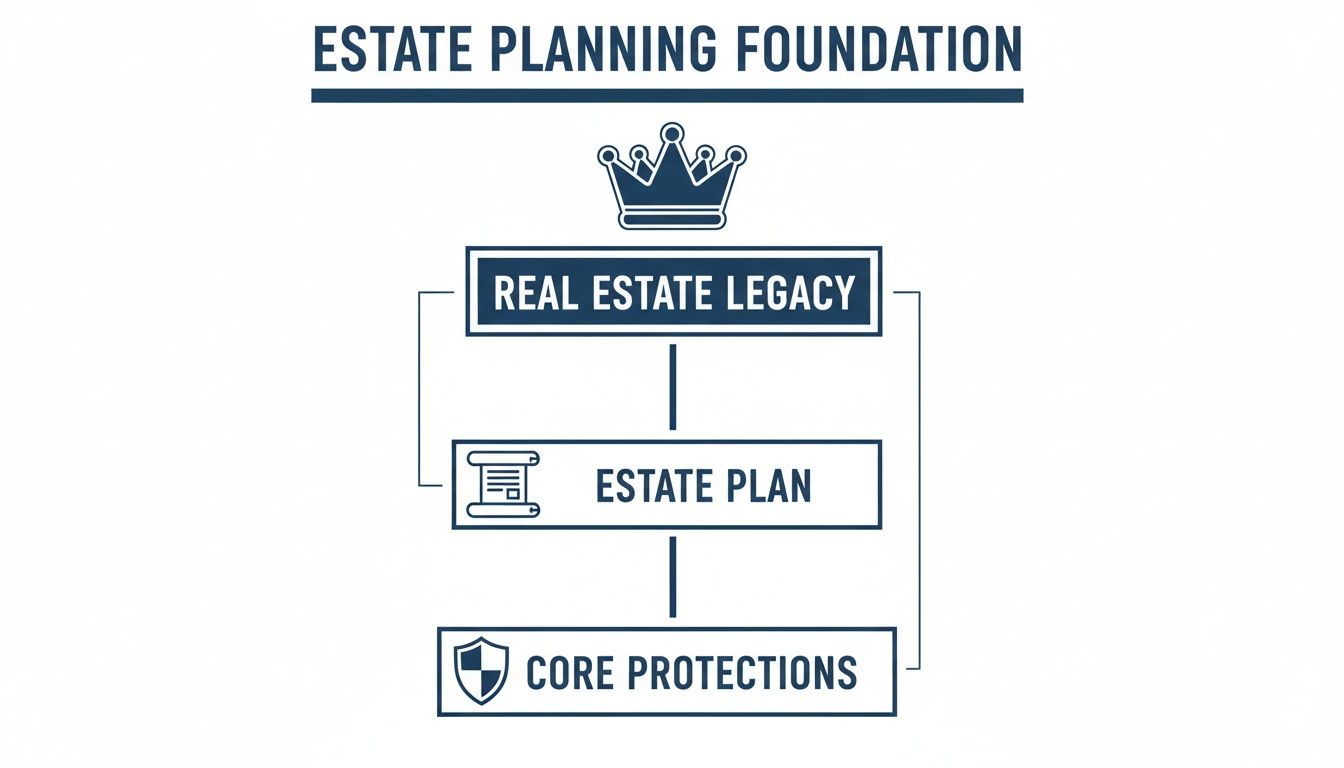
As you can see, without these core protections in place, the rest of the plan becomes vulnerable, putting your hard-earned real estate legacy at risk.
The Power of the Limited Liability Company
For most investors, the Limited Liability Company (LLC) is the first line of defense. Its main job is simple but powerful: to build a legal wall separating your business assets (your properties) from your personal assets (your home, car, and bank accounts).
Here’s a real-world scenario: a tenant slips on an icy patch at one of your rentals and sues. If that property is held in an LLC, the lawsuit is generally confined to the assets within that specific LLC. Your personal savings, your family home, and your other properties—ideally held in their own separate LLCs—are safely behind the wall. This containment strategy is fundamental to smart risk management.
Beyond protection, LLCs also make succession planning much cleaner. It's far easier to transfer membership interests in an LLC to your heirs than it is to re-deed a physical property. This keeps the process private and out of the courts.
Understanding Trusts as Your Command Center
If an LLC is the outer wall, think of a trust as the command center inside your fortress. A trust is a legal arrangement where a "trustee" manages assets for your chosen "beneficiaries." As an investor, two types are indispensable.
Revocable Living Trusts: This is your primary tool for avoiding probate. When you transfer your LLCs and other assets into a revocable trust, they are no longer legally part of your personal estate when you pass away. This means they can be distributed to your heirs directly, skipping the public, expensive, and often lengthy probate court process.
Irrevocable Trusts: These are more advanced structures, often used for tax planning and bulletproof asset protection. By moving assets into an irrevocable trust, you typically give up direct control. The trade-off? Those assets are often completely shielded from future creditors and, crucially, are removed from your taxable estate, which can save your family a fortune in estate taxes.
An unfunded trust is like an empty vault; it exists, but it protects nothing. The critical step is "funding" the trust by formally transferring your assets—including the membership interests of your LLCs—into it.
Choosing the right ownership entity is a strategic decision that balances liability protection, tax efficiency, and succession goals. The table below compares the most common structures side-by-side to help clarify which might be the best fit for different investor needs.
Comparing Key Real Estate Ownership Structures
| Structure | Primary Benefit | Probate Avoidance | Tax Flexibility | Best For |
|---|---|---|---|---|
| LLC (Limited Liability Company) | Asset & liability protection | No (unless owned by a trust) | High (pass-through taxation) | Investors seeking to isolate risk for each property and maintain operational control. |
| Revocable Living Trust | Probate avoidance | Excellent | Neutral (pass-through taxation) | Investors focused on seamless succession and avoiding court processes for their entire portfolio. |
| Irrevocable Trust | Estate tax reduction & creditor protection | Excellent | Varies (can be complex) | High-net-worth investors aiming to minimize estate taxes and shield assets long-term. |
| Partnership (LP/LLP) | Shared ownership & capital pooling | No (unless interests are in a trust) | High (pass-through taxation) | Multiple investors pooling resources for larger deals, with defined roles for management and liability. |
Ultimately, the best structure—or combination of structures—depends entirely on your specific financial situation, risk tolerance, and long-term legacy objectives.
Layering Structures for Maximum Protection
The savviest investors don't just pick one structure; they layer them. A powerful and common strategy is to hold each investment property in its own separate LLC. This compartmentalizes risk, ensuring a problem at one property can't bring down your entire portfolio.
Then, you take it one step further. The ownership of all these individual LLCs is transferred into one master Revocable Living Trust.
This two-part structure achieves two essential goals at once:
- The LLCs provide robust, day-to-day liability protection from tenants, vendors, and other property-specific claims.
- The trust acts as the master controller, allowing your entire portfolio to bypass probate and pass seamlessly to your heirs according to your exact wishes.
Navigating Critical Tax Planning Strategies
While structures like LLCs and trusts are fantastic for protecting your properties, a savvy tax strategy is what truly protects the wealth your portfolio generates. For real estate investors, taxes aren’t just an annual headache. They are a critical piece of the estate planning puzzle that can mean the difference between leaving a lasting legacy and handing a huge slice of it over to Uncle Sam.
Understanding how estate, gift, and capital gains taxes work together is the key. It lets you shift from a defensive, compliance-focused mindset to an offensive one where you're actively shaping your financial future. It’s about more than just filing returns; it’s about strategically minimizing your tax bill to maximize what you pass on.
The Federal Estate Tax Exemption
At its core, the federal estate tax is simply a tax on your right to transfer property when you die. The good news is, not every estate has to pay it. The government gives everyone a lifetime exemption—a set amount of assets you can pass on completely tax-free.
For 2025, that exemption is a very generous $13.99 million per person. That means a married couple can shield nearly $28 million from federal estate taxes. This number gets adjusted for inflation, but it's also highly sensitive to legislative winds.
This high number might make you feel a little too comfortable, but a massive change is just around the corner. A staggering $124 trillion wealth transfer is expected in the coming years, and with the federal estate tax rate at a steep 40%, the rules are getting a hard look. If Congress doesn't act, the current exemption is scheduled to be cut by roughly half in 2026, dropping to around $7 million per person. You can get a deeper dive into these urgent 2025 trust and estate planning trends and what they mean for you. This "sunset" provision creates a real fire under investors to get their planning in order, and soon.
Strategic Gifting to Shrink Your Taxable Estate
One of the most effective tools for managing the size of your estate is, ironically, the gift tax. It might sound backward to use a tax to save money, but it all comes down to smart timing and strategy. The gift tax and estate tax are two sides of the same coin, linked by that single lifetime exemption. Any taxable gifts you make during your life simply chip away at the amount you can pass on tax-free at death.
The real magic, however, lies in the annual gift tax exclusion. In 2025, you can give up to $19,000 to as many people as you want, every single year, without filing a gift tax return or even touching your lifetime exemption.
Let's see how this plays out for a real estate investor:
- The Asset: You own a commercial property inside an LLC.
- The Goal: You want to gradually transfer ownership to your two children without burning through your lifetime exemption.
- The Strategy: Every year, you and your spouse can each gift $19,000 worth of membership shares in the LLC to each child.
- The Total Annual Gift: This simple move lets you transfer $76,000 ($19,000 x 2 parents x 2 children) of the property's value out of your estate, tax-free, each and every year.
Do that for a decade, and you've just moved $760,000 in assets out of your taxable estate. All the while, that property's value is growing in your children's hands, not yours.
Proactive gifting is like systematically draining water from a tub that's about to overflow. It’s a controlled, tax-efficient way to reduce your final taxable estate before it becomes a problem for your heirs.
The Game-Changing Power of the Step-Up in Basis
When it comes to inheriting real estate, one of the most powerful tax benefits your heirs will receive is the step-up in basis. Every investor needs to understand this concept inside and out.
An asset's "basis" is basically what you paid for it. When you sell that asset, you pay capital gains tax on the difference between your sales price and your basis.
For instance, say you bought a rental property years ago for $200,000. If you sell it today for $800,000, you’re looking at a $600,000 profit and a hefty capital gains tax bill.
But the step-up in basis rule changes the entire equation for your heirs. When they inherit that same property, its cost basis is "stepped up" to its fair market value on the date of your death.
Let's look at that example again:
- Your Original Basis: $200,000.
- Value at Your Death: The property is now worth $800,000.
- Your Heir's New Basis: Their basis is automatically reset to $800,000.
If your heir turns around and sells the property for $800,000, their taxable capital gain is zero. That’s right, $0. This single rule can literally save a family hundreds of thousands of dollars in taxes, making it a cornerstone of smart estate planning for anyone holding real estate. It allows wealth to be passed from one generation to the next with incredible tax efficiency, effectively erasing decades of built-up appreciation and underscoring the value of holding appreciating assets for the long haul.
Dodging the Probate Bullet and Multistate Headaches
For a real estate investor, probate isn’t just an inconvenience; it's a portfolio killer. Picture probate as a mandatory, court-supervised teardown of your entire estate after you pass away. It’s public, it’s expensive, and it’s agonizingly slow. This process can lock up your assets, torpedo pending deals, and drain the value from the very empire you spent a lifetime building.
The real danger is the total loss of control. Imagine a court-appointed administrator who doesn’t get your investment strategy or know the local market now managing your carefully curated properties. Deals get stuck, maintenance gets deferred, and prime opportunities vanish while your family is stuck on the sidelines, waiting for the legal gears to grind.

The Ancillary Probate Nightmare
Things get exponentially worse when you own property in more than one state. If you hold title in your own name to properties in New York, Florida, and Texas, your family doesn't just go through probate once. They have to open a separate, full-blown probate case in each of those states.
This multistate disaster is called ancillary probate. It’s a logistical and financial train wreck. Your executor will have to hire lawyers in multiple states, each with their own unique rules, fee structures, and timelines. What you get is a domino effect of legal bills that can gut the inheritance you intended to leave.
I've seen it happen. One investor's portfolio of rentals across three states was tied up for nearly two years. Legal fees piled up in each jurisdiction, a golden opportunity to sell one building was missed, and his heirs could only watch as the portfolio’s value withered while the lawyers got paid.
Your Best Defense: A Revocable Living Trust
Thankfully, there’s a powerful and proven way to sidestep this entire mess: a properly funded Revocable Living Trust. This isn't just a piece of paper; it's a private vehicle that lets you keep control of your assets while you're alive and then pass them on to your beneficiaries without ever setting foot in a courtroom.
The mechanics are simple, but the execution has to be perfect:
- Create the Trust: First, you work with an estate planning attorney to draft the trust document. It will name you as the trustee (the manager) and specify who takes over for you.
- Fund the Trust: This is the most critical part. You must retitle your assets—from your personal residence to the membership interests of your property-holding LLCs—into the name of the trust.
- Bypass Probate: Once the trust legally "owns" the assets, they're no longer part of your personal estate. When you pass, your successor trustee simply steps in and distributes everything according to your private instructions. No court approval needed.
By titling all your real estate holdings under a single trust, you create a unified command structure. This eliminates the need for ancillary probate, ensuring your entire multistate portfolio can be managed and transferred efficiently, privately, and according to your exact wishes.
This strategic move is absolutely vital, yet a surprising number of property owners are unprepared. A stark preparedness gap exists where suburbanites lead with 35% having wills, while rural areas lag with only 8% trust ownership. For investors with properties scattered across the country, this disparity highlights a major risk, as unplanned estates can lose 10-15% of their value to lengthy probate processes in each state. You can find more on this demographic breakdown in estate planning.
Properly funding a trust is the single most effective action an investor can take to preserve their legacy and protect their family from the costly chaos of the probate system.
Designing a Practical Succession Plan
You've spent a lifetime building a real estate empire. But all that hard work can unravel in a single generation without a solid plan for what comes next. A real succession plan isn’t just a stack of legal documents; it’s a strategic roadmap—one that ensures the portfolio you built not only survives but continues to thrive. It’s about preparing both your assets and your heirs for the inevitable transition.
Think of it as a two-lane highway. One lane is all about the people—getting brutally honest about family dynamics, skills, and personalities. The other lane is the mechanical side, which involves putting the right legal and financial structures in place to make your vision a reality.

Assessing Your Heirs and Defining Roles
Let's be blunt: not everyone is cut out to manage a real estate portfolio. Forcing a square peg into a round hole here is a recipe for disaster. The very first step is to take a candid look at your potential successors. Who has a knack for negotiation and finance? Who is great with people and could handle tenant relations?
Ignoring these natural inclinations is a fast track to mismanagement and bitter family feuds. A smart plan plays to everyone’s strengths.
- The Operator (Property Manager): If one heir has great operational chops, they could be perfect for overseeing the day-to-day grind of management, maintenance, and keeping tenants happy.
- The Strategist (Financial Manager): Another successor with a head for numbers could take the lead on acquisitions, financing, and big-picture portfolio strategy.
- The Beneficiary (Passive Heir): It’s also perfectly fine if an heir wants nothing to do with the business. Their inheritance can be structured through a trust, giving them the financial benefits without the headaches of management.
Once you’ve got the roles figured out, you need to make them official. For properties held in LLCs, this means hammering out a crystal-clear operating agreement that details the succession provisions. This document is your rulebook; it spells out exactly how control is transferred, leaving no room for ambiguity or power grabs later on.
Solving the Critical Liquidity Problem
Here’s one of the biggest threats to any real estate legacy: a lack of cash. Property is inherently illiquid. You can’t just slice off a corner of an apartment building to pay an unexpected tax bill. When estate taxes and other final expenses come due, an estate that’s property-rich but cash-poor is in serious trouble.
This is what forces a fire sale. Heirs are backed into a corner, forced to dump valuable assets at bargain-basement prices just to raise cash. Decades of careful investment can be wiped out in a few frantic months.
An estate filled with illiquid real estate can be its own worst enemy. Without a source of immediate cash, heirs may be forced to dismantle the very portfolio you worked so hard to build simply to satisfy creditors and the IRS.
Fortunately, there’s a powerful tool designed to solve this exact problem.
The Power of an Irrevocable Life Insurance Trust
An Irrevocable Life Insurance Trust (ILIT) is a sophisticated strategy used to inject tax-free liquidity into your estate at the precise moment it’s needed. For serious real estate investors, it’s a cornerstone of smart estate planning.
Here’s the basic playbook:
- Create the Trust: First, you work with an attorney to establish an irrevocable trust. This creates a separate legal entity that is completely distinct from you and your estate.
- Fund the Policy: The trust then buys a life insurance policy on your life. You can make annual gifts to the trust to pay the premiums, often using your annual gift tax exclusion to do so tax-free.
- Receive the Payout: When you pass away, the insurance policy’s death benefit is paid directly to the trust—completely free from both income and estate taxes.
The result? A substantial pool of cash sitting outside of your taxable estate, ready to be deployed. Your successor trustee can use this money to pay estate taxes, clear debts, or even buy properties from the estate to give it the cash it needs. This simple but powerful move prevents a forced sale, protecting your portfolio and securing your legacy for the next generation.
Assembling Your Professional Advisory Team
Trying to go it alone with estate planning is one of the biggest—and most common—mistakes investors make. This isn't a DIY project. The web of legal, tax, and financial rules is just too tangled, and one wrong move could jeopardize everything you’ve worked so hard to build.
Think of it this way: you are the CEO of your real estate empire. You set the vision. But no successful CEO runs a company single-handedly. You need a trusted board of advisors—a legal counsel, a CFO, an operations chief—to execute that vision, manage risk, and ensure the business thrives long after you're gone.
Your Core Advisory Circle
Building a bulletproof estate plan requires a team of specialists. And I don’t mean generalists. You need professionals who live and breathe real estate, who can talk about depreciation recapture, 1031 exchanges, and multi-state tax issues in their sleep.
Here are the four non-negotiable players you need on your team:
The Estate Planning Attorney: This is your legal architect. They’re the one drafting the foundational documents—the trusts, wills, and LLC operating agreements that serve as the legal skeleton for your entire plan. Their job is to make sure your wishes are airtight and legally enforceable.
The Tax Advisor (CPA): Your financial strategist. A great CPA does more than just file your taxes; they model the financial impact of every single decision. From gifting strategies to the timing of a sale, their focus is on maximizing tax efficiency and protecting your wealth from unnecessary tax hits.
The Financial Planner: This is your holistic guide. They look at the 30,000-foot view, making sure your real estate plans mesh seamlessly with your other life goals, like retirement, insurance, and your overall investment portfolio. They connect all the dots.
The Property Manager: Your on-the-ground anchor. A reliable property manager is crucial for a smooth transition. They keep the portfolio humming, dealing with tenants and maintenance so your heirs aren’t suddenly saddled with a massive operational headache they aren't prepared for.
Your team creates a powerful system of checks and balances. The attorney ensures it’s legal, the CPA makes sure it’s tax-smart, and the financial planner confirms it actually serves your life's goals.
Vetting Your Professional Team
Choosing your advisors is a critical step. You're not just hiring someone for a one-off task; you're building a long-term partnership with people you'll trust with your legacy. When you sit down with potential team members, look past the fee schedule. You need to dig into their specific experience with real estate investors.
Get specific with your questions. Ask things like:
- "What percentage of your clients are real estate investors like me?"
- "Walk me through a complex succession plan you've built for a client with properties in multiple states."
- "How do you typically collaborate with a client's CPA or property manager?"
Their answers will tell you everything you need to know about their real-world expertise. Assembling this team is an upfront investment, but it's one that pays for itself many times over by creating a resilient estate planning for real estate investors framework that protects your assets and your family’s future.
Your Questions, Answered
As you start putting these pieces together, some common questions naturally come up. Let's tackle a few of the most frequent ones I hear from investors.
Should I Put My Primary Residence in an LLC?
For most people, the answer is a firm no. While LLCs are fantastic for investment properties, putting your personal home into one can be a big mistake.
Doing so could disqualify you from major tax breaks, like the $250,000/$500,000 capital gains exclusion when you sell. Your mortgage lender might not be too happy either—it could even trigger a "due-on-sale" clause. A Revocable Living Trust is almost always a better vehicle for your primary home.
How Often Should I Review My Estate Plan?
Think of your estate plan as a living document, not a stone tablet. You'll want to dust it off for a review every three to five years at a minimum.
You should also review it immediately after any major life event. These include:
- A big jump (or drop) in your net worth
- Buying or selling a significant property
- Major family changes like a marriage, divorce, or new baby
- Tax laws get an overhaul (which happens more than you'd think)
Staying on top of it ensures your plan actually reflects your life and your goals today, not five years ago.
An estate plan isn't a "set it and forget it" task. Treat it like a property inspection—regular check-ups are essential to spot issues before they become serious problems, keeping your legacy secure and up-to-date.
Can I Be the Trustee of My Own Revocable Living Trust?
Absolutely. In fact, that's how it's usually done. When you set up a revocable living trust, you'll almost always be the initial trustee. This means you retain complete control over all the assets you place in it—you can buy, sell, and manage them just as you did before.
The real magic happens with the successor trustee. This is the person or institution you name to take the reins if you can no longer manage things yourself, whether due to incapacity or death. It's this feature that ensures a seamless transition without court interference.
Putting together the right structure for your real estate portfolio requires more than just legal documents—it demands a strategic partner who understands both tax law and investment reality. At Blue Sage Tax & Accounting Inc., we specialize in helping investors protect their assets and minimize their tax hit.
Schedule a consultation to build your strategic financial future and let's make sure your legacy is built on a solid foundation.