Think about everything you've built here in Queens. Maybe it's a house in Bayside, a thriving business in Long Island City, or a nest egg you've carefully grown for your kids' education. An estate plan is the legal blueprint that safeguards all of it, and a good Queens estate planning attorney is the architect who brings it to life. This isn't some luxury service for the ultra-rich; it's a core financial tool for every family.
Why Your Queens Family Needs a Strategic Estate Plan
A solid estate plan is much more than a simple document saying who gets your stuff. It's a complete game plan for protecting your assets, shielding your family from chaos, and making sure your wishes are followed to the letter. It's your voice when you can no longer speak for yourself.
Without that voice, the decisions about your property, your money, and even who cares for your children fall to the New York courts. That process can be a long, public, and painful ordeal for the people you love most.
This is a very real issue right here in our borough. A recent report showed that nearly 60% of adults in Queens don't have even a basic will—a rate that's actually a bit worse than the national average. That gap leaves the majority of local families wide open to messy legal fights, avoidable taxes, and the heartbreaking possibility that their hard-earned assets won't end up where they intended. You can dig into more of the numbers and local trends in this detailed analysis of Queens County legal matters.
It’s More Than Just a Will
Lots of people think, "I have a will, I'm all set." But a will is just one piece of the puzzle. A truly effective estate plan, built with an experienced estate planning attorney in Queens NY, covers a lot more ground to protect you and your family.
Here’s what a well-crafted plan actually accomplishes:
- Protects Your Heirs: It ensures your assets go to the right people, in the right way. This might mean setting up a trust so a young child doesn't inherit a large sum of money before they're ready to manage it.
- Keeps You Out of Court: It helps you structure your assets to avoid the Queens Surrogate's Court probate process, which can be incredibly slow, expensive, and public.
- Lowers the Tax Bill: A smart plan uses legal strategies to minimize or even eliminate federal and New York State estate taxes, keeping more of your wealth in the family.
- Prepares for the Unexpected: It lets you appoint people you trust to handle your finances (Power of Attorney) and make medical decisions (Health Care Proxy) if you ever become unable to do so yourself.
One of the biggest myths is that estate planning is just for seniors. The truth is, it's for everyone. Life is unpredictable. A proper plan is the only way to be sure that you and your family are protected, no matter what happens.
Putting off planning is really just handing over your family's future to the government and a set of generic state laws. A great attorney doesn't just fill out forms; they act as your guide, helping you work through complex family dynamics and financial details to create a plan that truly secures your legacy.
The Four Pillars of New York Estate Planning
Think of your estate plan as a custom-built house designed to shelter your life's work. Just like any sturdy building, your plan needs a solid foundation and strong supports to hold up against legal challenges, family disagreements, or a sudden turn in your health. A seasoned estate planning attorney in Queens NY acts as your architect, making sure each of these core pillars is built correctly for your family’s unique circumstances.
If even one pillar is missing or weak, the whole structure becomes vulnerable. Let's walk through what these foundational documents are and what they actually do for you as a resident of Queens.
Pillar 1: The Last Will and Testament
Most people have heard of a Last Will and Testament. It's the classic instruction manual for what happens to your property after you pass away. Its main job is to name an Executor—the person or institution you trust to wrap up your affairs, pay your final bills, and distribute your assets exactly as you've laid out.
A will is absolutely crucial if you have minor children. This is the only place you can legally name a guardian to raise them. If you don't, a judge in Queens Surrogate's Court will make that life-altering decision for you, and their choice might not be who you'd want.
Keep in mind, though, a will only kicks in after death and has to go through the public court process called probate. It offers zero protection if you become incapacitated during your lifetime.
Pillar 2: Trusts for Asset Protection and Control
If a will is a simple blueprint, a trust is a sophisticated financial tool for managing and protecting assets while you're alive and long after. Picture a trust as a secure legal container you create. You then place your assets inside—your home in Forest Hills, your investment portfolio, or the family business in Astoria.
You name a Trustee to manage everything in the container for your chosen Beneficiaries. This simple structure unlocks some powerful benefits:
- Avoiding Probate: Assets held in a trust (especially a Revocable Living Trust) get to skip the time-consuming and public probate process in Queens. This saves your loved ones a tremendous amount of time, money, and hassle.
- Incapacity Planning: Should you become unable to handle your own affairs, your chosen successor trustee can step in immediately to manage the trust's assets. No court intervention is needed.
- Control Over Distribution: You can set the rules. You can specify that inheritance funds be used for college, or distributed in stages as a child matures, preventing a young adult from receiving a large sum all at once.
"A common myth is that trusts are only for the super-rich. The reality is, for countless Queens homeowners, a Revocable Trust is the single best way to protect their largest asset—their home—from the delays and high costs of probate court."
From simple revocable trusts to more complex irrevocable ones, a skilled attorney will help you figure out which type is the right fit for your goals.
The infographic below highlights the core reasons for building a complete estate plan—it's about much more than just distributing money.
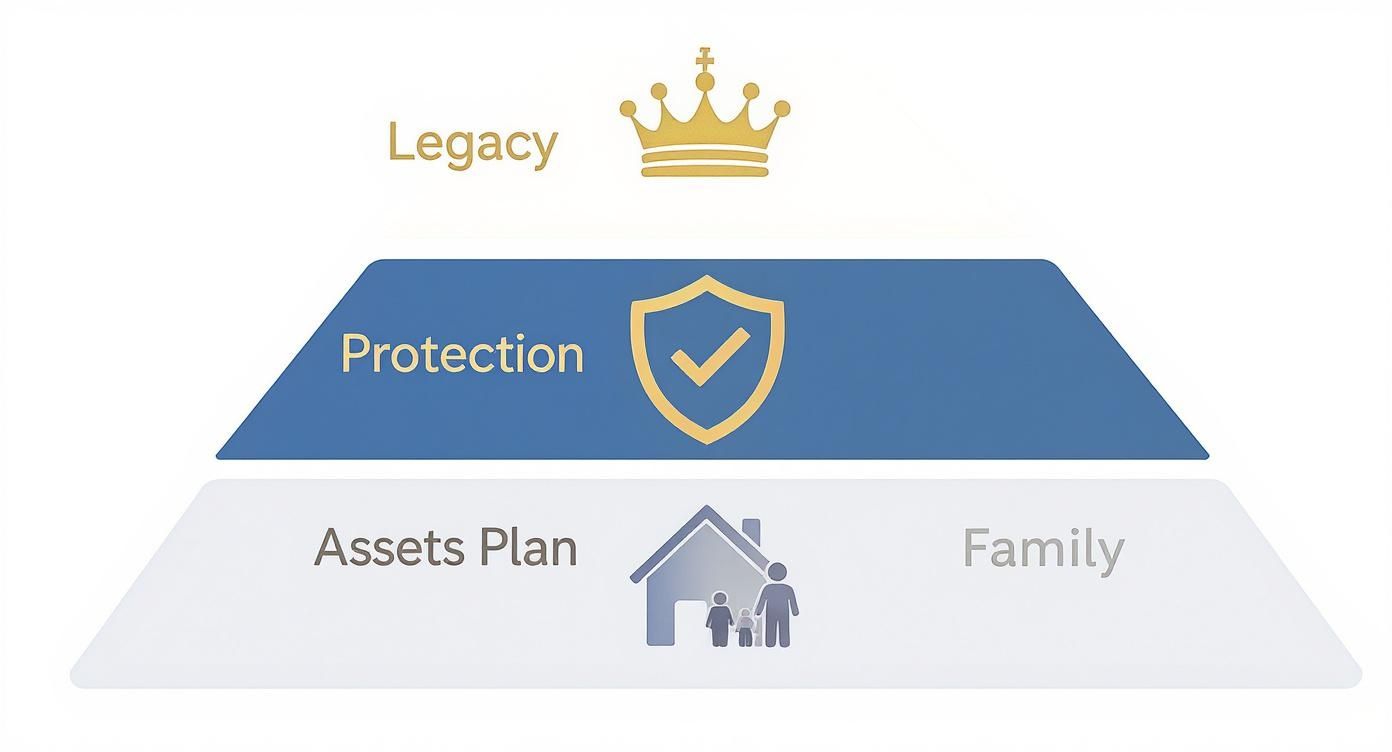
As you can see, a well-designed plan is about safeguarding your family, your assets, and the legacy you've spent a lifetime creating.
To make these concepts clearer, here's a simple breakdown of how these essential documents compare.
Key Estate Planning Documents at a Glance
| Document | Primary Purpose | Key Benefit in Queens |
|---|---|---|
| Last Will & Testament | To distribute property after death and name guardians for minor children. | Ensures your chosen guardian raises your kids, not a court-appointed one. |
| Revocable Living Trust | To manage assets during your lifetime and distribute them after death. | Avoids the public, lengthy, and often expensive probate process in Queens Surrogate's Court. |
| Durable Power of Attorney | To appoint an agent to manage your financial affairs if you become incapacitated. | Prevents the need for a costly and public court guardianship proceeding. |
| Health Care Proxy | To appoint an agent to make medical decisions for you if you cannot. | Empowers a trusted person to advocate for your health wishes, avoiding family disputes. |
Each document serves a distinct and vital role. Together, they create a comprehensive shield for you and your family.
Pillar 3: The Durable Power of Attorney
What happens if you're alive but a sudden illness or accident leaves you unable to manage your finances? This is where the Durable Power of Attorney (POA) proves its worth. It’s your pillar for lifetime financial protection.
A POA lets you appoint someone you trust—your agent or attorney-in-fact—to handle your financial and legal matters. This person can step in to:
- Pay your mortgage and bills
- Manage your bank accounts
- File your tax returns
- Oversee your real estate and investments
Without a valid POA, your family’s only option is to go to court in Queens and ask a judge to appoint a guardian for you. That process, known as a guardianship proceeding, is expensive, slow, and emotionally draining. A POA keeps control in the hands of the people you choose, not the court system.
Pillar 4: The Health Care Proxy
The fourth and final pillar deals with your medical care and end-of-life wishes. In New York, a Health Care Proxy is the document where you name a trusted agent to make healthcare decisions for you only if you lose the ability to make them yourself.
This is a world away from a simple Living Will, which is just a statement of your wishes about life-sustaining treatment. The Health Care Proxy is more powerful because it empowers a real person to interpret your values, talk to doctors, and advocate for you in complex medical situations.
For a family in Flushing caring for an elderly parent, having that Health Care Proxy is a godsend. It prevents painful disagreements between siblings during a crisis and ensures the person who knows you best is making the calls. It provides clarity and authority right when they are needed most.
Navigating Probate in Queens Surrogate's Court
The word "probate" can make anyone uneasy, often bringing to mind drawn-out court battles and mountains of paperwork. For many families right here in Queens, that's not too far from the truth.
Probate is simply the court-supervised process of validating a will, settling any outstanding debts, and officially passing assets on to the rightful heirs. It all happens at the Queens Surrogate's Court. If you die without a will, the court still gets involved in a process called "administration," where a judge divides your property based on a rigid New York State formula.
Think about it this way: say you've worked your whole life and now own a nice two-family home in Astoria. Without the right plan, that home, your savings, and everything else you've built gets tangled up in the court system. And it's not a private affair—it becomes a public record.
That’s a huge sticking point for many. Every document filed, from the will itself to a detailed list of your assets, is accessible to anyone who asks. For a family in mourning, that lack of privacy can feel like a serious intrusion.
The Pitfalls of a Probate-Dependent Plan
When a simple will is the only tool in your estate plan, you're essentially forcing your loved ones into a legal process they can't avoid. While an estate planning attorney in Queens NY is there to guide them, the system itself has some serious drawbacks.
Here are the most common hurdles families run into:
- Significant Delays: Probate moves at a crawl. Even for a relatively simple estate in Queens, the process can easily drag on for a year, sometimes much longer. During that time, assets are essentially frozen, which can create real financial strain for family members who were depending on them.
- Mounting Costs: The court process isn't cheap. You have court filing fees, executor commissions, and attorney's fees—all of which are paid directly out of the estate. Every dollar spent on the process is a dollar your beneficiaries won't receive.
- Increased Potential for Conflict: Because probate is public and formal, it can unfortunately become a stage for family drama. It gives any disgruntled relatives or even creditors a formal opportunity to contest the will, kicking off expensive and emotionally draining litigation.
The core issue with probate is the loss of control. Your final wishes are in the hands of a judge who must follow the letter of the law. A well-designed estate plan, on the other hand, keeps that control exactly where it belongs: with you and the people you trust.
The Alternative: Bypassing Court Altogether
The good news is that probate isn't mandatory. With smart, proactive planning, you can set things up so your assets pass directly to your loved ones, completely outside the court's reach. This is one of the most powerful things an estate planning attorney in Queens can do for you.
The most effective tool for this job is the Revocable Living Trust. Think of a trust as a private rulebook for your assets, written by you. You start by transferring ownership of your major assets—like your house or investment accounts—into the name of the trust.
Don't worry, you're still in charge. As the trustee, you can manage, use, or sell those assets just like you always did. The magic happens when you pass away. Your chosen "successor trustee" simply steps in and follows the private instructions you left in the trust document to distribute everything. No court, no public record, no year-long wait.
A Tale of Two Families
Let’s look at two almost identical families in Jackson Heights. Both have a family home valued at $950,000 and a similar amount in other assets.
- The Miller Family: Mr. Miller relied on a basic will. When he died, his kids had to hire a lawyer and file a probate petition in Queens. The entire process took 14 months, and they couldn't touch or sell the house during that time. By the end, legal and court fees had eaten up over $40,000 of the estate, and all of the family's financial details were on public record.
- The Garcia Family: Mrs. Garcia worked with an attorney years ago to place her home into a Revocable Living Trust. When she passed away, her daughter, as the successor trustee, was able to settle final expenses and distribute the assets—including selling the house—in just a few months. The whole process was private, fast, and saved the family tens of thousands of dollars.
These two stories show the night-and-day difference that planning can make. The Garcias were able to grieve without the added burden of a court case, saving precious time, money, and stress. A good attorney can help you find the right strategy to make sure your legacy is a blessing, not a burden.
The Real Cost of Estate Planning in Queens
Let's get right to it. One of the first things on everyone's mind is, "What's this actually going to cost me?" It's a fair question, especially when you're looking for an estate planning attorney in Queens NY. But I encourage my clients to think of it less as a cost and more as a one-time investment in their family's future security.
The truth is, there’s no single price tag. The fee for an estate plan depends entirely on your life's moving parts—the complexity of your finances, your family dynamics, and what you're trying to achieve. A simple plan for someone with a straightforward financial picture will look very different from a plan for a business owner with real estate across state lines.
To give you a realistic idea of what to expect, let's break down how lawyers typically charge for this work.
How Attorneys Bill for Estate Plans
Most experienced estate planning lawyers in Queens use one of two billing structures. Each has its place, depending on what you need.
-
Flat-Fee Packages: This is, by far, the most common and preferred method for creating a core estate plan. Your attorney quotes you a single, upfront price that covers a bundle of essential documents—think a will, power of attorney, and health care proxy. The beauty of this is its predictability; you know the exact cost from day one. No surprises.
-
Hourly Rates: You'll usually see hourly billing for more complicated or ongoing legal needs. This could be anything from managing a complex trust over many years to navigating a heated family dispute in court. It makes sense for situations where the total time needed is impossible to predict.
For the vast majority of people putting their first plan in place, a flat-fee package is the way to go. It keeps things simple and transparent.
Typical Cost Ranges in Queens
While every firm is different, there's a general ballpark for what you can expect to pay in the Queens market. Based on recent data, a foundational estate plan—which includes your will, power of attorney, and healthcare directive—will typically run between $1,000 to $3,000.
If your situation calls for a more sophisticated strategy, like using a trust to sidestep probate or shield assets, you're likely looking at an investment in the range of $3,000 to $8,500. The final figure really hinges on the complexity of the trust and the size of your estate. For a deeper dive, you can read more about the factors influencing these costs in New York.
Before you sign anything, make sure you get a detailed quote in writing. A good attorney will have no problem being completely upfront about their fees and exactly what's included.
The real cost isn’t the price of the plan. It's what your family stands to lose without one. The legal fees for a contested will or a drawn-out probate battle in Queens Surrogate's Court can easily soar into the tens of thousands, dwarfing what you would have spent on planning ahead.
An Investment, Not an Expense
Seeing estate planning as just another bill is a shortsighted view. In reality, it’s one of the smartest investments you can make to safeguard everything you’ve spent a lifetime building.
Think about it this way: you have car insurance for the possibility of an accident. An estate plan protects your family against the certainty that you will eventually pass away or be unable to make your own decisions. It's the ultimate proactive step, ensuring your loved ones aren't left with a legal and financial nightmare during their time of grief. That kind of peace of mind is truly priceless.
How to Find the Right Attorney in Queens
Let's be honest, choosing the person to handle your family’s future is a big deal. The relationship you have with your estate planning attorney in Queens NY is built on trust. This isn't just another transaction; it's a partnership to safeguard everything you've worked for. Finding the right fit means looking beyond a quick Google search to find someone with the right skills, the right personality, and a genuine focus on your family's specific situation.
You're not just hiring a lawyer. You're looking for a long-term advisor who truly gets the ins and outs of practicing in Queens and New York State. Here’s a straightforward guide to help you make a choice you can feel good about.
Start with Credentials and Specialization
First things first: you need to make sure any attorney you consider is legitimate and knows their stuff. It's a common mistake to assume any lawyer can draft a solid will.
- Check Their License: Before you even book a call, verify the attorney is licensed to practice in New York and is in good standing. You can do this in two minutes on the New York State Bar Association's attorney search tool. No excuses for skipping this step.
- Find a Specialist, Not a Generalist: Think of it this way: you wouldn't go to your family doctor for heart surgery. The same logic applies here. You want an attorney whose practice is primarily dedicated to estate planning. A general lawyer who dabbles in wills on the side might miss crucial tax-saving strategies or create documents that cause headaches later in Queens Surrogate's Court.
Vet Their Reputation and Client Experience
Once you've confirmed their credentials, it's time to see what past clients have to say. You’re looking for proof that they not only have the technical expertise but also provide great service.
Head to sites like Avvo, Google, and Yelp to read online reviews. A single bad review isn't necessarily a dealbreaker—sometimes things just don't work out. But a pattern of complaints about poor communication, blown deadlines, or surprise bills? That's a huge red flag. Look for testimonials that mention the attorney's knack for explaining complex ideas in simple terms and making people feel comfortable.
"A great estate planning attorney acts as both a legal technician and a family counselor. They should make you feel heard and understood, translating your personal wishes into legally sound documents without overwhelming you with jargon."
That human element is everything. The best attorneys are excellent listeners who invest time in understanding your family dynamics, your worries, and your ultimate goals before they even start talking about legal documents.
Schedule a Consultation and Ask the Right Questions
Most reputable estate planning attorneys offer an initial consultation, and you should take full advantage of it. This meeting is your chance to interview them. You're sizing them up just as much as they're learning about your needs. Come prepared with a list of smart questions.
Key Questions to Ask a Potential Attorney:
- What percentage of your practice is focused on estate planning?
- How do you keep your clients in the loop? What's your typical response time?
- Do you charge a flat fee or by the hour? What, exactly, does that fee cover?
- Will I be working directly with you, or primarily with a paralegal or associate?
- From what you've heard so far, what are the biggest challenges or opportunities you see for my plan?
Listen carefully to how they respond. Do they give you straight answers in plain English? Or do they hide behind a wall of legal jargon? Most importantly, ask yourself if you feel comfortable opening up to them about your family and finances. Trust your gut. If the chemistry feels off, they aren't the right fit, no matter how impressive their credentials are.
Red Flags to Watch For
Knowing what to look for is only half the battle; you also need to know what to avoid. Keep an eye out for these warning signs.
- High-Pressure Sales Tactics: A good advisor educates you on your options, they don't push you into a corner. If you feel like you're being rushed into a decision or sold a generic "package," it's time to leave.
- Vague or Evasive Answers: If an attorney can't clearly explain their process, their fees, or their strategy for your estate, it could signal disorganization or a lack of experience. You deserve clarity.
- Lack of Personal Attention: Did the attorney seem distracted during your call? Did they rush your questions or immediately try to pass you off to a junior staff member? If so, they probably won't give your plan the focus it requires.
Taking the time to choose the right estate planning attorney in Queens NY is the single most important thing you can do in this process. A little due diligence now will buy you an incredible amount of peace of mind for years to come.
Advanced Strategies for Asset Protection

For many folks in Queens—especially small business owners, real estate investors, and professionals—a basic will just isn't enough. When you’ve worked hard to build significant wealth, you need to think beyond the fundamentals. This is where an expert estate planning attorney in Queens NY shifts the conversation to more advanced strategies built for serious asset protection and tax minimization.
Think of these tools as a legal fortress. They're designed to shield your wealth from potential creditors, messy lawsuits, and the heavy bite of estate taxes, creating a solid barrier around your most important assets. It's about making sure your family's future is secure, no matter what life throws your way.
Irrevocable Trusts: A Deeper Look
Now, unlike a revocable trust that you can tweak on a whim, an irrevocable trust is a far more permanent arrangement. Once you transfer assets into it, you generally can't just take them back out. That might sound a little scary—giving up direct control—but that's exactly where the power lies.
By legally removing assets from your personal name and placing them in the trust, they're typically protected from future financial threats. It's like moving a priceless family heirloom out of your house and into a high-security bank vault. You haven't sold it, but it’s no longer vulnerable to everyday risks.
Here’s why people do it:
- Creditor Protection: Assets held within the trust are usually untouchable by creditors or legal judgments that might come after you personally.
- Estate Tax Reduction: Since the assets are no longer officially part of your estate, this move can dramatically reduce—or even completely eliminate—New York and federal estate taxes.
- Medicaid Planning: For anyone thinking about long-term care costs, these trusts can be a crucial tool for qualifying for benefits without having to spend down your life savings.
An irrevocable trust is a definitive statement about your legacy. It’s a proactive measure to ensure the wealth you’ve built is securely passed on, protected from external threats and optimized for the next generation.
Advanced Tools in Action
So, what does this look like in the real world? Let's break down two powerful strategies that a skilled attorney might use for a family in Queens.
Irrevocable Life Insurance Trust (ILIT)
An ILIT is a special-purpose trust created for one reason: to own your life insurance policy. When you pass away, the insurance company pays the death benefit directly to the trust, not to your estate. The result? The entire payout, which could be millions of dollars, is completely free from estate taxes. This gives your heirs a vital source of tax-free cash right when they need it most.
Qualified Personal Residence Trust (QPRT)
Picture a family in Bayside who wants to pass their beloved home to their children without a massive tax bill. With a QPRT, they can transfer the house into a trust, effectively making a "gift" to their kids at a fraction of its current market value for tax purposes. They get to continue living in the home for a predetermined number of years. Once that term is up, the house officially passes to the children, completely outside of the parents' taxable estate.
Common Questions About Queens Estate Planning
As you start thinking about this process, it's natural for a few practical questions to pop up. Let's tackle some of the most common ones I hear from clients, which should give you the clarity to move forward with confidence.
"I'm Not Rich. Do I Really Need an Estate Plan?"
Yes, absolutely. This is probably the biggest misconception out there. Estate planning isn't just about wealth; it's about control.
A solid plan lets you decide who manages your finances (Power of Attorney) and makes medical decisions for you (Health Care Proxy) if you can't. If you have young kids, it's the only way to legally name who you want as their guardian. Without these documents, a judge in Queens will make these incredibly personal decisions for you, and their choices might be the last thing you would have wanted.
The most significant mistake is assuming you don't own enough to need a plan. For most Queens residents, their home alone is a substantial asset that warrants protection from the probate process.
"How Often Should I Update My Plan?"
A good rule of thumb is to sit down with your attorney for a review every 3-5 years. But honestly, the real answer is: you need to update it whenever life happens.
Certain events should be an immediate trigger to call your lawyer:
- Getting married or divorced
- A new child or grandchild arriving (birth or adoption)
- The death of anyone named in your plan, like a beneficiary or executor
- A big shift in your finances, up or down
- Moving to a different state (New York laws are unique)
Laws change, too. A quick check-in ensures your plan still works the way you intended and doesn't have any outdated legal language that could cause problems later on.
"Can't I Just Use an Online Template for My Will?"
I know it’s tempting—it seems so much cheaper and faster. But using a generic online form is one of the riskiest things you can do. These one-size-fits-all documents rarely account for the specific legal details required in New York.
The result? Your will could easily be challenged and thrown out by the Queens Surrogate's Court. Working with a local attorney who knows the borough and the state's laws is the only way to be sure your documents are ironclad and truly reflect your wishes.
Navigating the complexities of estate and tax law requires a dedicated partner. At Blue Sage Tax & Accounting Inc., we work with you and your legal counsel to create a cohesive financial strategy that protects your legacy and minimizes tax burdens. To see how our proactive planning can benefit your family, visit us at https://bluesage.tax.