At its core, a Delaware Statutory Trust (DST) is a legal structure that lets a group of investors pool their money to collectively own large, professionally managed real estate assets. For anyone navigating a 1031 exchange, a DST offers a way to maintain real estate ownership and defer capital gains taxes, but without the headaches of being a landlord.
Demystifying the Delaware Statutory Trust
Let’s say you want to own a piece of a high-end commercial property in Manhattan or a large apartment complex in a booming Sun Belt city. Buying it yourself might be out of reach, and managing it would be a full-time job. This is where the Delaware Statutory Trust comes in.
Think of it like a mutual fund, but for real estate. Instead of buying shares of stock, you purchase a "beneficial interest" in a trust that holds the legal title to the property. It's a brilliant way to separate the benefits of ownership from the burdens of management. As an investor, you become a beneficiary, while a professional real estate firm—the sponsor—acts as the trustee and handles everything.
The Core Components of a DST
Breaking down a DST is simple once you understand the two main players:
- The Sponsor (Trustee): This is the seasoned real estate company that finds the property, arranges financing, and manages it from top to bottom. They're responsible for everything from leasing and maintenance to financial reporting and eventually selling the asset.
- The Investor (Beneficiary): This is you. You hold a passive ownership stake and are entitled to your proportional share of the property's income and any appreciation. You have zero day-to-day management duties.
This clean separation of responsibilities is what makes a DST a truly passive investment. You get the potential economic rewards of owning institutional-quality real estate without ever having to worry about a leaky roof or a late rent payment.

Why It Qualifies for 1031 Exchanges
The real game-changer for DSTs in tax planning came directly from the IRS. Back in 2004, the agency released Revenue Ruling 2004-86, which clarified that an interest in a properly structured DST could be treated as a direct interest in real estate for federal tax purposes.
This ruling is the very foundation of the modern DST market. It gives 1031 exchange investors the green light to sell a property and reinvest the proceeds into a DST, satisfying the crucial "like-kind" requirement and successfully deferring their capital gains tax.
Without this specific guidance, an interest in a DST would likely be viewed as a security—like a stock or a partnership interest—which is strictly prohibited in a 1031 exchange. This legal blessing transformed the DST from just another investment vehicle into a powerful strategy for wealth preservation, making it an indispensable tool for investors looking to shift from active property management to passive ownership.
DSTs and 1031 Exchanges: A Strategic Pairing
For a New York City investor sitting on a highly appreciated property, a 1031 exchange is more than just a smart tax move—it's essential for preserving wealth. But let's be honest, the process itself can be a nightmare, especially with its unforgiving timelines. This is precisely where a Delaware Statutory Trust comes in, turning a frantic race against the clock into a calm, strategic maneuver.
The biggest pressure point in any 1031 exchange is the 45-day identification period. Anyone who's been through it knows the stress of finding, vetting, and locking in a replacement property under that deadline. One wrong move, and the whole exchange collapses, leaving you with a staggering tax bill.
This is the first problem DSTs solve, and they solve it brilliantly. Sponsors have already done the heavy lifting, creating a menu of pre-vetted, institutional-grade properties ready to go. The frantic search is over. You can simply review a curated list of quality assets and confidently meet your deadline without breaking a sweat.
Unlocking True Diversification
Beyond just beating the clock, a DST offers a strategic benefit that’s almost impossible to replicate in a typical one-for-one exchange: instant diversification. Instead of trading one large NYC property for another single, large property, you can slice your exchange funds across multiple DST offerings.
Think about what that means for your portfolio. You can spread your investment across:
- Different Asset Classes: Imagine owning a piece of a multifamily complex in Texas, a medical office building in Florida, and an industrial warehouse in Arizona—all from a single 1031 transaction.
- Multiple Geographic Regions: This immediately reduces your concentration risk. If you've been heavily invested in the New York market, you can now hedge against the ups and downs of a single regional economy.
- Various Sponsors: By investing with different best-in-class management teams, you're not putting all your eggs in one operator's basket. It's another layer of smart risk mitigation.
This isn't just a minor tweak; it’s a fundamental upgrade to your risk management. A single-tenant commercial building is a huge liability if that one tenant vacates. Owning fractional interests in a dozen properties with hundreds of tenants? That's a much more resilient and stable foundation for generating income.
The Shift to Truly Passive Ownership
For many of our clients who have spent decades in the trenches of property management, this might be the most attractive benefit of all: the transition from active landlord to passive investor. The daily headaches—tenants, toilets, and trash—are gone. A professional, third-party management team handles every operational detail within the DST structure.
This frees up the one asset you can't buy more of: your time. You're no longer a landlord; you're an investor. You can now focus on big-picture wealth strategy, work on your estate plan, or simply enjoy the income your portfolio generates without the day-to-day grind.
A Delaware Statutory Trust essentially converts the active, hands-on work of real estate management into a passive, professionally managed investment, similar to holding a high-quality stock or bond portfolio that generates regular income.
It's no surprise this model has caught on. The DST market has seen incredible growth, cementing its place as a go-to tool for 1031 exchanges. Recent industry data shows DST offerings raised nearly $5.66 billion, a jump of 10.2% from the previous month. That kind of capital flow shows just how much confidence investors have in the DST structure for deferring taxes, diversifying, and securing passive income. You can learn more about the 2025 outlook for DSTs and their market growth.
By using a Delaware Statutory Trust, you’re not just solving the logistical puzzle of a 1031 exchange. You’re fundamentally upgrading your investment strategy, building a more diversified, passive, and scalable real estate portfolio for the long term.
How DSTs Stack Up Against Other Investment Structures
When you're looking to invest in real estate, the structure you choose is just as important as the property itself. Think of it as picking the right tool for a specific job. For investors who prioritize passive income, tax deferral, and freedom from management headaches, it's crucial to see how a Delaware Statutory Trust compares to more traditional options like direct ownership, Tenancy-in-Common (TIC), and Limited Liability Companies (LLCs). Each path has its own set of trade-offs, and what's right for one investor might be completely wrong for another.
A DST is engineered to solve many of the common pain points that come with other real estate investment vehicles. It's designed for people who want the financial benefits of owning institutional-grade properties without the day-to-day burdens of being a landlord.
This flowchart illustrates just how smoothly a DST can integrate into a 1031 exchange strategy, turning a single property sale into a diversified, professionally managed portfolio.
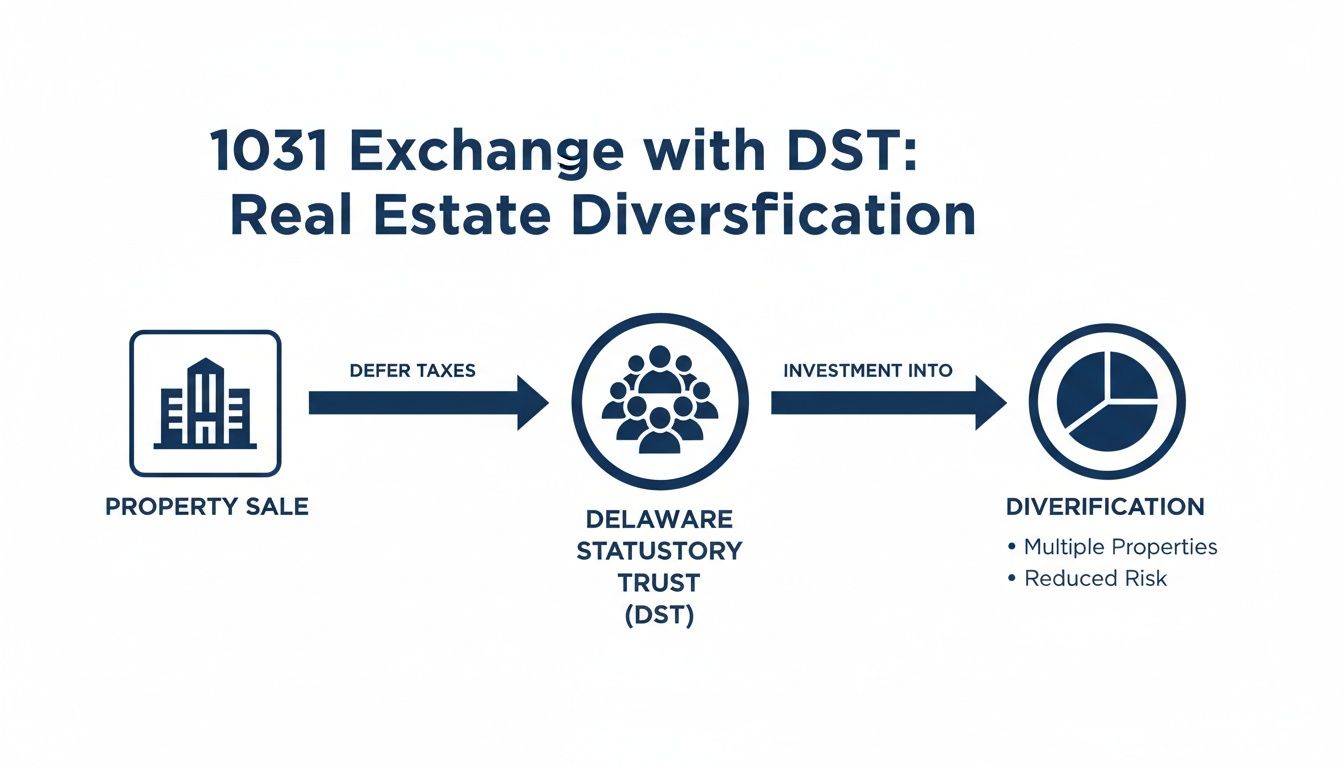
The real magic here is in the transition: you go from a single asset to a collection of high-quality properties, all while pushing capital gains taxes down the road.
Delaware Statutory Trust vs. Direct Ownership
The biggest fork in the road between a DST and direct ownership is your level of personal involvement. When you own a property directly, you're the one in charge. Period. You’re the landlord, the property manager, and the chief problem-solver, handling everything from leaky faucets and tenant disputes to property taxes and insurance. It gives you ultimate control, but it's a job that demands constant attention.
A DST, on the other hand, is a genuinely passive investment. The sponsor takes on all the management responsibilities, leaving you free to focus on your broader financial goals instead of clogged drains.
- Management: Direct ownership is hands-on and demanding. A DST is completely hands-off.
- Liability: As a direct owner, your personal assets are on the line. A DST insulates you from this, offering liability protection much like a corporation.
- 1031 Exchange: Finding a suitable replacement property on your own within the tight 45-day identification window is a high-pressure race against the clock. DSTs offer a menu of pre-vetted options, making the process far more manageable.
DST vs. Tenancy-in-Common (TIC)
For a while, the Tenancy-in-Common structure was a go-to solution for 1031 exchanges, allowing up to 35 investors to pool their money and co-own a single large property. But experience has shown this model has some fundamental flaws—flaws that the DST was specifically designed to fix.
With a TIC, every major decision requires unanimous consent from all co-owners. Need to sell the property or refinance? One person saying "no" can grind the entire process to a halt. This potential for gridlock is a major risk. On top of that, lenders are often wary of underwriting a loan for dozens of individual borrowers tied to one asset.
The DST structure elegantly sidesteps these problems. As a beneficiary, you delegate decision-making power to the professional sponsor. This creates a centralized, efficient management system that lenders prefer, as they only have to deal with a single borrowing entity: the trust itself.
The core advantage of a DST over a TIC is its centralized management structure. It eliminates the risk of co-owner disputes and simplifies the financing process, making it a more stable and predictable investment vehicle for 1031 exchanges.
DST vs. Limited Liability Company (LLC)
An LLC is an incredibly popular way to hold real estate, primarily because it provides a strong liability shield. But for investors looking to execute a 1031 exchange, there's a critical catch: an interest in an LLC is legally considered personal property, not real property. This means it does not qualify as "like-kind" property under the strict rules of Section 1031.
You simply cannot sell your investment property and exchange the proceeds for a stake in an LLC that owns real estate. This is where the DST truly shines. Thanks to IRS Revenue Ruling 2004-86, a DST gives you the best of both worlds. It provides the robust liability protection you'd get from an LLC, but your beneficial interest is still treated as a direct interest in real estate for tax purposes.
This unique blend of passivity, protection, and 1031 compatibility is what makes the DST a powerful tool for investors focused on preserving wealth and simplifying their financial lives.
To help clarify the differences, let's break down how these structures compare on key features.
Investment Structure Comparison: DST vs. TIC vs. Direct Ownership
| Feature | Delaware Statutory Trust (DST) | Tenancy-in-Common (TIC) | Direct Ownership |
|---|---|---|---|
| Management | Passive; professionally managed by sponsor | Active; requires unanimous consent from all co-owners | Active; owner handles all management duties |
| Investor Limit | Up to 499 investors | Up to 35 investors | 1 or a few partners |
| 1031 Exchange | Yes, qualifies as like-kind real property | Yes, qualifies as like-kind real property | Yes, but finding property can be difficult |
| Decision-Making | Centralized; trustee/sponsor makes all decisions | Decentralized; all co-owners must agree on major decisions | Owner has complete control |
| Liability | Limited to the amount of investment | Unlimited personal liability for each co-owner's share | Unlimited personal liability |
| Financing | Simpler; lender deals with a single entity (the trust) | Complex; lender underwrites up to 35 individual borrowers | Straightforward; single borrower |
| Minimum Investment | Typically $100,000 or lower | Generally higher due to fewer investors | The full price of the property |
Each of these structures serves a purpose, but as you can see, the DST is specifically tailored for investors who want the benefits of large-scale real estate ownership without the typical operational burdens and risks.
How to Perform Due Diligence on DST Offerings
Investing in a Delaware Statutory Trust isn’t like buying a stock. Think of it more like choosing a business partner who will manage a major real estate asset for you over the next five to ten years. A glossy brochure is just the starting line. The real work—and the secret to a successful outcome—is rolling up your sleeves and doing some serious, methodical due diligence before you commit a single dollar.
This process is all about looking under the hood. You need to understand the quality of the asset, the integrity of the sponsor, and whether the deal structure is fair. Remember, DSTs are inherently illiquid. You can't just click "sell" if things go south. Getting it right from the very beginning is the only way to protect your capital and ensure the investment aligns with your long-term goals.

Scrutinizing the Sponsor's Track Record
The single most important factor in any DST offering is the sponsor. This is the firm that finds, manages, and ultimately sells the property. Their expertise, history, and transparency will make or break your returns, so vetting them is your absolute first priority.
Don't get dazzled by projected returns. Instead, laser-focus on their full-cycle history. That means digging into past deals they've taken from acquisition all the way through to a sale. How many properties have they successfully sold? More importantly, how did the actual, realized returns stack up against their initial projections? A sponsor with a long history of meeting or exceeding their forecasts is a sponsor you can trust.
On the other hand, a sponsor with a spotty track record or a history of underperformance is a giant red flag. While the DST structure has been a fantastic tool for investors, not all operators are created equal. The industry has seen its share of sponsor mismanagement leading to court intervention and painful investor losses, which hammers home just how critical this step is. You can learn more about how market conditions and sponsor quality affect DST performance to see why this matters so much.
Analyzing the Underlying Real Estate Asset
Once you have confidence in the sponsor, it’s time to put the property itself under the microscope. Just because an asset is wrapped in a DST doesn’t automatically make it a good investment. You have to evaluate it with the same sharp eye you’d use if you were buying it directly.
Here are the key areas to investigate:
- Property Type and Market: Is the asset in a hot sector like multifamily or industrial, or a more challenged one like office space? Is it located in a geographic market with real population and job growth?
- Tenant Quality and Lease Terms: Who’s paying the rent? Are they creditworthy national brands or small local businesses? Dive into the lease terms—how long are they, and are there built-in rent escalations? High-quality tenants on long-term leases are the bedrock of stable income.
- Physical Condition: Get your hands on the property condition report. Are there major deferred maintenance issues lurking that could trigger an unexpected capital call down the road? A well-maintained property is a sure sign of a professional, diligent sponsor.
A great sponsor can't fix a bad property, and a great property can't survive a bad sponsor. Successful DST investing requires confirming that both elements—the operator and the asset—are of institutional quality.
Deconstructing the Financials and Fee Structure
The final piece of the due diligence puzzle is the numbers. This means a deep dive into the offering's Private Placement Memorandum (PPM), which is the legal document that spells out every last detail of the investment.
First, look at the debt. What are the loan terms, interest rate, and maturity date? Aggressive, high-leverage financing might juice up cash flow in the short term, but it adds a ton of risk if the market sours or refinancing becomes tough. Conservative leverage is often the mark of a prudent sponsor who prioritizes capital preservation.
Next, you need to meticulously pick apart the fee structure. Sponsors deserve to be paid for their work, but the fees have to be transparent and reasonable. Look for these three things:
- Upfront Fees: These are the costs for acquiring the property and setting up the trust, which often range from 8% to 12% of the total equity raised.
- Ongoing Management Fees: These are annual fees paid to the sponsor for managing the asset, typically a percentage of the gross rental income.
- Back-End Promote/Waterfall: This is the sponsor's cut of the profits when the property is sold. The structure here is crucial—it should align their interests with yours, meaning they only get a big payout after you’ve gotten your initial capital back plus a preferred return.
By thoroughly investigating the sponsor, the property, and the financials, you shift from being a passive recipient of a sales pitch to an active, informed investor. This diligence is your best defense against risk and your clearest path to a successful Delaware Statutory Trust investment.
Tax and Estate Planning for New York Investors
For investors here in New York, the appeal of a Delaware Statutory Trust isn't just about deferring federal taxes with a 1031 exchange. That’s a huge part of it, of course. But a well-thought-out DST strategy also cuts through the weeds of state and local tax (SALT) complexities and offers some powerful estate planning benefits.
It’s all about creating a smoother path to preserving and transferring your wealth. While a 1031 exchange handles the federal capital gains, you still have New York State and New York City taxes to think about. Navigating that landscape, especially when a DST diversifies your holdings across the country, requires a careful hand.
Navigating State and Local Tax Implications
When you invest in a DST, you’re often buying into a portfolio of properties spread across several states. That’s fantastic for diversifying your investment, but it also means you're generating income in multiple jurisdictions. This is where tax compliance gets a little more involved.
Let's say your DST holds commercial properties in Florida, Texas, and Arizona. As a New York resident, the income from those properties flows back to you. This typically means you'll need to:
- File non-resident tax returns in states that have an income tax where the DST properties are located.
- Report all that income on your New York State and NYC resident tax returns, as you're taxed on your worldwide income.
- Claim a credit for taxes paid to those other states. This is the crucial step to avoid being double-taxed on the same earnings.
Yes, this adds a few more forms to the annual filing process. But with a tax advisor who knows the ins and outs of SALT issues, it becomes a manageable part of the strategy. The administrative work is a small price to pay for the kind of geographic risk reduction that a multi-state DST offers.
Streamlining Your Estate and Legacy Plan
This is where the DST structure really shines for long-term planning. It provides an elegant solution to a notoriously difficult and expensive problem: ancillary probate.
If you own real estate directly in several different states, your heirs will be forced to open separate probate proceedings in every single one of those states. It’s a logistical nightmare—slow, costly, and a huge administrative burden that can eat away at the value of your estate.
A Delaware Statutory Trust transforms your multi-state real estate holdings into a single, intangible personal property interest. This simple change in legal form allows your entire beneficial interest to pass to your heirs through the probate process in your home state of New York, completely avoiding ancillary probate.
This consolidation is a game-changer, particularly for high-net-worth families. Instead of your loved ones dealing with multiple courts and lawyers across the country, your estate can be settled through one unified process right here at home.
On top of that, DST interests are incredibly easy to divide. You can gift fractional shares to your children or transfer them into trusts, all without the headaches of re-deeding physical properties. It makes passing down your real estate portfolio to the next generation significantly simpler. For New York investors, a DST is more than a tax tool—it's a cornerstone of an efficient, forward-thinking legacy plan.
Evaluating DST Sponsors and Performance Metrics
When you invest in a Delaware Statutory Trust, you're not just buying a piece of real estate. You're handing your capital over to the sponsor who will manage that asset for years to come. That’s why the quality of the sponsor is, without a doubt, the single biggest predictor of your investment’s success. It’s crucial to look past the glossy brochures and dig into the sponsor’s history and the offering's core numbers.
Your due diligence should start with the sponsor’s history. You need to put on an analyst’s hat and focus intently on their full-cycle track record. This isn’t just about the deals they’ve bought; it’s about the investments they have guided from acquisition all the way through to a final, profitable sale. A sponsor with a long, transparent history of completed deals is showing you they know how to navigate the entire lifecycle of an investment.

Key Metrics to Analyze
As you review a sponsor’s past performance and a new offering, a couple of key metrics will tell you most of what you need to know about its potential. Getting a firm grip on these is essential for comparing different opportunities apples-to-apples.
- Internal Rate of Return (IRR): Think of this as the investment's annualized rate of return. Unlike a simple cash-on-cash calculation, the IRR is more sophisticated because it accounts for the time value of money. It gives you a much clearer picture of a project’s total profitability over its entire lifespan.
- Equity Multiple: This one is more straightforward—it tells you how much cash you get back for every dollar you put in. For example, an equity multiple of 1.8x means you received $1.80 for every $1.00 invested. It's a clean, simple measure of your total return.
The historical data for the DST market shows just how powerful a well-chosen investment can be. Looking at realized offerings across major platforms, DSTs have delivered an average annual internal rate of return (IRR) of 19.22%. When you pair that with an average equity multiple of 1.84x and a typical holding period of just 4.34 years, you can see the impressive results that high-quality sponsors can achieve. You can dive deeper into this historical DST performance data on baker1031.com.
Comparing Projections to Reality
Here’s where the rubber really meets the road: comparing a sponsor's past projections to what they actually delivered. Anyone can assemble a proforma with rosy assumptions. The truly great sponsors, however, have a documented history of meeting or, even better, beating their own projections time and time again.
When you vet a sponsor, you’re looking for a track record of disciplined execution. Insist on seeing the original offering documents from their past full-cycle deals. Then, compare the projected IRR and equity multiple from those documents to the final numbers investors actually walked away with. A tight-to-nonexistent gap between promise and performance is the ultimate sign of an operator you can trust.
This simple comparison tells you everything about a sponsor’s ability to underwrite deals conservatively, manage properties well, and exit at the right time. A long history of keeping their word to investors is the gold standard. In the end, choosing the right sponsor isn’t just part of the strategy—it is the strategy.
Your Top DST Questions, Answered
When you're digging into the details of a Delaware Statutory Trust, a few practical questions always seem to pop up. Let's walk through some of the most common ones we hear from clients, giving you the straight answers you need to see if a DST fits into your plans.
What Happens When the DST Sells a Property?
This is the big one. When the sponsor sells the property held by the trust, the trust itself usually winds down. At that moment, you’re at a crossroads with two main paths.
First, you can take your share of the proceeds in cash. Keep in mind, this will trigger the capital gains tax you’ve been deferring all this time. The second option is to roll those funds directly into a new 1031 exchange, either by investing in another Delaware Statutory Trust or by buying a different "like-kind" property on your own. A good sponsor will give you plenty of notice about their exit plan so you have time to prepare for your next move.
Can I Use Retirement Funds to Invest in a DST?
Tread very carefully here. If you’re thinking about using a self-directed IRA, you need to know about a potential tax trap called Unrelated Business Taxable Income (UBTI). This can happen if the DST uses a mortgage or any other debt to buy its property. If UBTI is generated, it can create a surprise tax bill inside your tax-sheltered IRA, which defeats the whole purpose of the account.
That said, some sponsors offer all-cash, debt-free DSTs designed specifically for retirement accounts. It is absolutely crucial to speak with us before making a move, so we can verify the offering is truly a good fit for your IRA.
A Word of Caution: Using retirement funds for a leveraged DST is almost always a bad idea because of the UBTI tax risk. If you're considering this route, stick to all-cash, debt-free offerings and get professional advice first.
What's the Typical Minimum Investment?
For investors coming out of a 1031 exchange, the standard minimum investment for a DST is usually $100,000. This amount is set to help investors properly place their exchange funds.
However, some DSTs will also accept regular cash investments (not part of an exchange) with minimums sometimes as low as $25,000. This lower barrier to entry is a great feature, as it lets investors with larger exchange amounts spread their money across several different DSTs—diversifying by property type, location, and sponsor.
How Liquid Is a Delaware Statutory Trust Investment?
Think of a DST investment as being locked in for the long haul. DSTs are highly illiquid. There’s no public market where you can just click a button and sell your share. You need to go into it with the expectation that you'll hold the investment for the full projected timeline, which is typically 5 to 10 years.
Getting out early is rare and certainly not something you should count on. Because of this, a DST is really only appropriate for capital you’ve earmarked for long-term growth—money you won’t need to touch for years to come.
Getting a handle on these details is the first step to making a smart investment decision. At Blue Sage Tax & Accounting Inc., our job is to help you see the complete picture, figuring out if and how a DST aligns with your overall tax and wealth strategy. Schedule a consultation with us today to make sure your real estate investments are working as hard as you are.