
Cost segregation is a sophisticated, IRS-approved tax planning strategy that essentially puts depreciation on fast-forward for commercial and residential rental property owners. It works by dissecting a building into its various components and reclassifying them into shorter depreciation periods. The result? A significant reduction in your current tax burden and a major boost to your cash flow.
What Are Cost Segregation Services?
Think of your building as one giant asset that the IRS says you have to depreciate slowly over 39 years (for commercial property) or 27.5 years (for residential rental). That's a long time to wait for your tax deductions. Cost segregation services perform an in-depth, engineering-based study to break that single asset down into its individual parts.
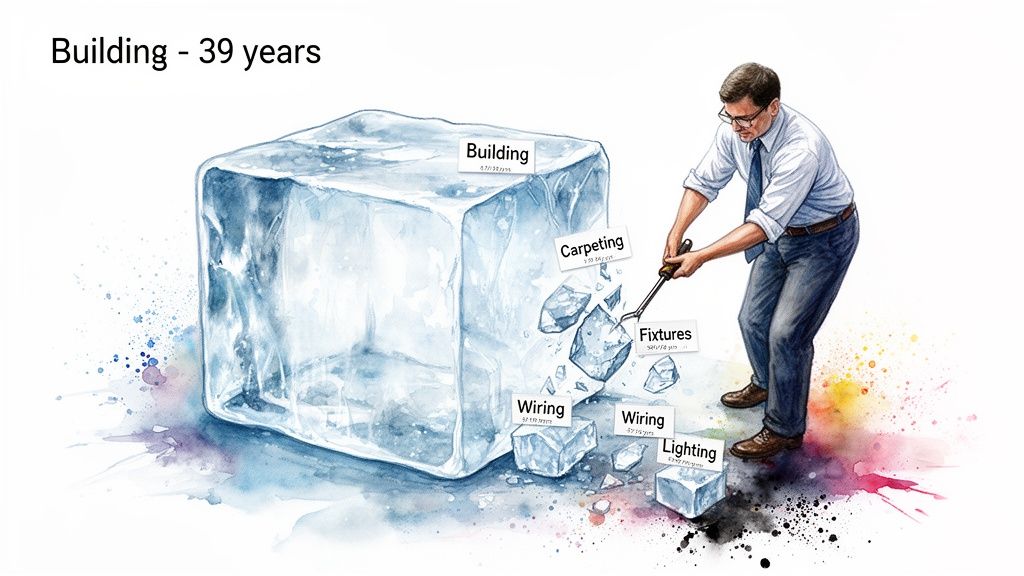
It’s a meticulous process. Without a study, everything from the concrete foundation to the carpet in the hallways gets lumped together into that long depreciation schedule. A cost segregation study properly identifies and separates the shorter-lived assets from the building's structural shell.
Reclassifying Assets for Faster Deductions
The core of the study is to move assets out of that long-term bucket and into categories with much faster write-off periods.
Here’s what that looks like in practice:
- 5-Year Property: This bucket often includes items like carpeting, specialty electrical wiring, decorative lighting, and certain cabinetry.
- 7-Year Property: Think office furniture, fixtures, and some types of equipment.
- 15-Year Property: This category is for land improvements—things outside the building's foundation, like parking lots, sidewalks, fencing, and landscaping.
By shifting a portion of your property’s total cost into these shorter-life categories, you can accelerate your depreciation deductions, taking much larger write-offs in the first few years of owning the property.
A cost segregation study isn't about creating new deductions. It's about timing. You get to take tax deductions now that you would otherwise have to wait decades to claim, unlocking the powerful time-value-of-money advantage.
The Financial Impact for Investors
For a real estate investor, family office, or any business that owns its facility, this is a game-changer. It directly lowers your tax bill, which means more cash in your pocket today.
That capital, which would have been tied up in your building's basis for years, is now freed up. You can use it to fund renovations, acquire another property, pay down debt, or simply strengthen your financial position. It’s no surprise that the global market for these services, valued at around USD 0.61 billion in 2025, is expected to skyrocket to USD 1.567 billion by 2034. You can explore the full market research about cost segregation growth trends to see just how essential this has become. This strategy truly turns a static real estate asset into a dynamic financial tool.
How Cost Segregation Boosts Your Bottom Line
At its core, the biggest win from a cost segregation study is the immediate boost to your cash flow. Think of it less as a tax "trick" and more as a powerful financial lever that corrects the timing of your depreciation deductions, pulling them from the distant future into right now. This creates a serious time-value-of-money advantage.
Imagine the government has agreed to let you write off your property, but they’ve spread those deductions out over nearly four decades. A cost segregation study is like a time machine for your tax savings. It identifies parts of your building that will wear out much faster than the structure itself and lets you claim those deductions in the first few years of ownership. This isn't a loophole; it's an IRS-sanctioned method for accurately classifying assets based on their real-world lifespan.
By carving out components from the standard 27.5-year (residential) or 39-year (commercial) depreciation schedules and moving them into much shorter 5, 7, or 15-year categories, you can generate significant "paper losses" upfront. These aren't real losses, of course, but they directly offset your taxable income and slash your current tax bill.
Unlocking Immediate Capital
The end result? A sudden infusion of cash that you would have otherwise handed over to the IRS. This is the real, tangible ROI of a cost segregation study.
Instead of having that capital tied up in your property's basis for decades, you can put it to work today. We see clients use these tax savings to:
- Acquire More Properties: That tax refund can become the down payment on your next acquisition, letting you scale your portfolio much faster.
- Fund Renovations: Upgrade your existing property to boost its value, attract higher-quality tenants, and increase your rental income.
- Improve Liquidity: Pay down expensive debt, build up your cash reserves for the next opportunity, or simply strengthen your overall financial position.
In essence, this strategic tax deferral acts like an interest-free loan from the government on taxes you’d eventually have to pay anyway. It gives you the capital to grow your wealth today, not thirty years from now.
A Tale of Two Depreciation Schedules
To really see the difference, let’s look at a straightforward comparison. Take a commercial property with a depreciable basis of $5 million. The default IRS method requires you to write this off slowly over 39 years.
But what if a cost segregation study finds that 30% of the property’s value ($1.5 million) is actually tied up in shorter-life assets like specialty electrical systems, dedicated plumbing, or decorative fixtures? These components can be depreciated much faster—and even better, many qualify for bonus depreciation, which allows for a massive write-off in year one.
The principle here is simple: A dollar in tax savings today is worth far more than a dollar saved a decade from now. By accelerating your deductions, you get to put that cash to work immediately, letting it compound for years.
The table below paints a clear picture of the dramatic difference in deductions during the first few years of owning the property.
Standard vs. Accelerated Depreciation: A Five-Year Outlook
Here's how the first five years of depreciation deductions stack up for that $5 million property. We'll compare the standard 39-year straight-line method against a cost segregation study that reclassifies 30% of the assets into shorter-life categories.
| Year | Standard Depreciation (39-Year) | Accelerated Depreciation (Cost Segregation) | Additional First-Year Deduction |
|---|---|---|---|
| Year 1 | $128,205 | $980,769 | +$852,564 |
| Year 2 | $128,205 | $115,385 | -$12,820 |
| Year 3 | $128,205 | $115,385 | -$12,820 |
| Year 4 | $128,205 | $115,385 | -$12,820 |
| Year 5 | $128,205 | $115,385 | -$12,820 |
Note: This accelerated calculation assumes 60% bonus depreciation on the $1.5M of reclassified assets, with the rest depreciated over its class life. The massive front-loaded benefit is obvious.
The numbers don't lie. The study generates an extra $852,564 in tax deductions in the very first year. For an investor in a high tax bracket, that can mean hundreds of thousands of dollars in real, spendable cash savings—money that goes right back into their pocket. This is precisely why cost segregation services have become an indispensable tool for any serious real estate investor.
Identifying Prime Properties for Cost Segregation
So, while the benefits of cost segregation sound great, it's not a silver bullet for every single property. The real magic happens when you identify buildings packed with specialized components that can be broken out from the main structure for tax purposes. Finding these gems in your portfolio is the first step to seriously boosting your cash flow.
The best candidates usually fall into one of three buckets: brand-new construction, properties you've just bought, or buildings you've recently poured a lot of money into for renovations. In every one of these scenarios, a detailed, engineering-based study can uncover a ton of value that would otherwise be locked away for 27.5 or 39 years.
High-Potential Property Types
It’s pretty simple: some buildings are just better suited for cost segregation than others. Properties with more complex, specialized guts—from the wiring and plumbing to the fancy finishes and site work—are where you'll find the biggest opportunities.
Here are a few property types that consistently deliver the best results:
- Commercial Offices: Think about all the extras—decorative lighting, high-end millwork, dedicated wiring for server rooms, and elaborate landscaping.
- Manufacturing Plants: These are full of reclassifiable assets. We're talking about heavy-duty electrical and plumbing tied to specific machinery, reinforced concrete pads for equipment, and specialized ventilation systems.
- Multifamily Apartments: It's all about the details—cabinets, appliances, flooring, and all the amenities like pools, clubhouses, and fences.
- Hotels and Hospitality: These are practically gold mines for 5- and 7-year assets. From the grand fixtures in the lobby to the commercial kitchen equipment and all the furniture, it adds up quickly.
- Healthcare Facilities: Medical buildings contain dedicated plumbing in exam rooms, special surgical lighting, hookups for lab equipment, and high-end interior finishes that can all be depreciated faster.
For larger businesses or family offices with significant real estate holdings, cost segregation is less of a "nice-to-have" and more of a necessity. We've seen these studies free up 20-30% of a property's depreciable basis in the first few years alone. It's a critical tool for managing a complex tax picture, a trend supported by market analysis you can read more about here.
The Power of a Look-Back Study
A lot of people think cost segregation is only for properties you just bought. That’s a huge misconception. In fact, one of the most impactful tools we have is the look-back study, which we can perform on a property you’ve held for years.
This is a game-changer for investors who didn't know about this strategy when they first bought their property. The best part? You don't have to go back and amend a pile of old tax returns.
Instead, a look-back study lets you catch up on all the missed depreciation from prior years and take it as a massive, one-time deduction on your current year's tax return. This is done by filing an IRS Form 3115, "Application for Change in Accounting Method."
The result is a huge, immediate injection of cash. Imagine you've owned a building for five years. With a look-back study, you can suddenly claim five years' worth of accelerated depreciation all at once. For many of our clients, this has unlocked hundreds of thousands of dollars in capital they could put to work right away.
When to Consider a Study
Timing is everything. While a study is valuable at almost any point, there are a few key moments when you should absolutely be thinking about it.
Give it serious consideration if you have:
- Constructed a New Building: The perfect time is right when the property is placed in service. All the construction blueprints and costs are fresh and easy to access.
- Acquired an Existing Property: Getting a study done right after you close allows you to start reaping the benefits of accelerated depreciation from day one.
- Completed Major Renovations: If you've done a significant capital improvement project—like a big tenant build-out or major HVAC upgrade—you’ve created a whole new batch of assets to segregate.
Even if your situation doesn't fit perfectly into one of these boxes, a quick, preliminary analysis can usually tell us if the potential tax savings will be worth the cost of a full study. It's all about strategically identifying the right properties and the right timing to turn your real estate into a much more efficient wealth-building machine.
The Cost Segregation Study Process Explained
A cost segregation study might sound intimidating, but a quality provider follows a clear, structured path. It’s an engineering-based analysis that moves methodically from a high-level "does this make sense for me?" to a detailed, audit-ready final report.
Think of it as building a meticulously documented case file for your property's tax treatment. Each step adds another layer of evidence and justification, ensuring the final outcome is not only valuable but also defensible if the IRS ever comes knocking. The whole journey starts with one simple question: is a study financially worthwhile for you?
Phase 1: Initial Feasibility Analysis
Before you commit to a full study, the first move is always a preliminary analysis. A reputable firm will offer a no-cost or low-cost initial review to see if the potential tax savings even justify the professional fees. This isn't a guess; it's a data-driven estimate.
To get this done, the provider will gather some basic information about your property:
- Property type (e.g., multifamily, office, industrial)
- Total depreciable basis (your purchase price minus the land value)
- The placed-in-service date (when it was ready to be used)
- Any construction or renovation cost data you have on hand
Using this info and their own industry models, they can project the likely percentage of assets that can be reclassified into shorter-lived categories and give you a solid estimate of your first-year tax savings. If the return on investment looks compelling, you can move forward with confidence.
Phase 2: Detailed Information Gathering and Site Visit
Once you give the green light, the deep dive begins. This phase is all about collecting the documents needed to build an accurate picture of the property’s construction and costs. The team will ask for and review architectural blueprints, construction invoices, appraisals, and any other relevant financial records you've got.
But documents alone are never enough for a high-quality study. This is where the on-site physical inspection becomes absolutely critical. An engineer or construction professional will physically walk through your property, meticulously identifying and documenting every single component. They're taking photos of assets, measuring square footage, and noting the specific materials and systems used—from the type of flooring under your feet to the gauge of the electrical wiring in the walls. This hands-on verification is the gold standard for IRS compliance.
A study that skips the site visit is a major red flag. The IRS's own Audit Techniques Guide emphasizes the importance of a physical inspection to back up an engineering-based approach, making it a non-negotiable part of any defensible study.
This methodical process is essential for properties at any stage, whether they're newly built, recently acquired, or undergoing a major renovation.
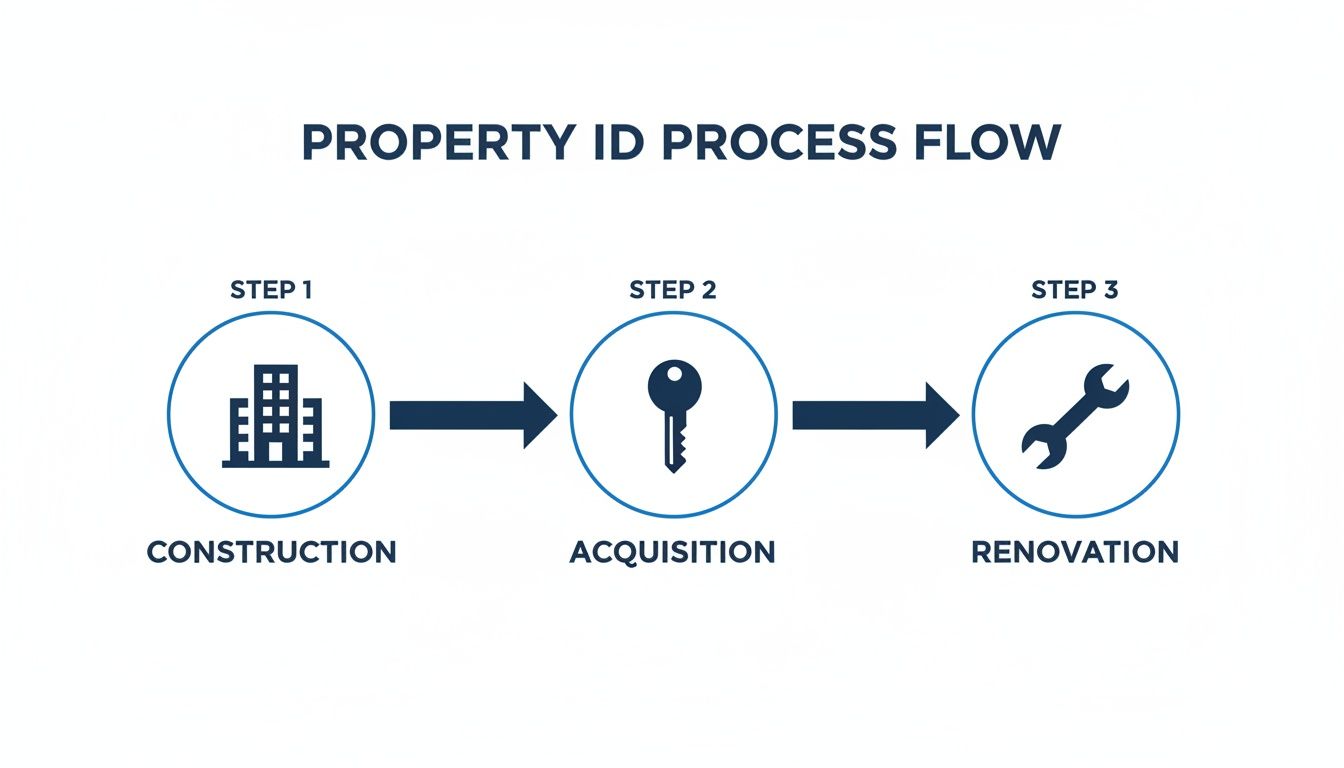
As the infographic shows, the timing of a study can align perfectly with key property events—construction, acquisition, or renovation—to squeeze out the maximum tax benefits. It just reinforces that a study’s value is highest when all the costs and components are fresh and well-documented.
Phase 3: Cost Allocation and The Final Report
With all the data in hand, the engineering team gets to the heart of the matter: cost allocation. Using established costing manuals and their own construction expertise, they assign a value to every component they identified during the site visit. This is where assets are formally segregated into their correct tax buckets: 39-year or 27.5-year real property, and the much faster 15-, 7-, and 5-year personal property and land improvements.
The culmination of all this work is the final deliverable: a comprehensive cost segregation report. This isn’t just a summary. It's a detailed, audit-ready document that includes:
- A narrative explaining the methodology used.
- A complete breakdown of all reclassified assets.
- The legal and regulatory basis for the classifications.
- Detailed cost schedules ready for your CPA to implement.
This report is your official substantiation for your new, accelerated depreciation schedule. For high-net-worth individuals and developers in markets like NYC, reallocating 30-50% of costs can generate immediate tax savings of 10-20% on taxable income. A robust report is your key to unlocking these benefits while ensuring you’re playing by the rules. You can discover more market insights about cost segregation services to see just how important this strategy has become.
Choosing the Right Cost Segregation Provider
Picking the right firm for your cost segregation study isn't just about getting a report—it's about getting the right report. This decision directly affects how much you save in taxes and, crucially, whether those savings will hold up if the IRS comes knocking.
Think of it like this: you wouldn't hire a general contractor to do the complex electrical wiring in a skyscraper. You need a specialist. A cheap, cookie-cutter study might look good on the surface, but it can crumble under scrutiny, creating a huge risk. The right provider delivers a meticulously engineered, audit-proof document that maximizes your benefits and gives you peace of mind.
The Power of a Multi-Disciplinary Team
The best cost segregation studies are never a one-person show. They’re a team effort, blending deep expertise from several distinct fields. Look for a firm that brings a full, multi-disciplinary team to the table.
This team absolutely must include:
- Engineers: These are the people who get their boots on the ground. They walk your property, understand the construction methods and building systems, and can spot assets a tax professional looking at a spreadsheet would never see.
- Construction Cost Estimators: They bring the financial rigor. These pros are experts at putting a solid, defensible number on every single reclassified component—from the custom lighting fixtures to the high-tech security system—using recognized industry cost data.
- Tax Specialists: They’re the final, critical piece of the puzzle. The tax experts make sure every classification and calculation is perfectly aligned with the latest IRS guidelines, relevant court cases, and your specific financial picture.
When these three disciplines work together, you get a study that’s sound from every angle—from the physical nuts and bolts of the building to the intricate details of the tax code.
The Gold Standard: Engineering-Based Studies
When you're talking to potential providers, the most important question you can ask is about their process. There are a couple of ways to do a cost segregation study, and frankly, they are worlds apart in terms of quality.
An engineering-based study, complete with a physical site visit, is the undisputed gold standard. It’s the only approach that gives the IRS the detailed, on-the-ground evidence needed to back up your depreciation claims and withstand a serious audit.
Some firms will offer a cheaper, faster "modeling" or "residual" approach. This is usually done from a desk, using software and industry averages without anyone ever stepping foot on your property. While it costs less upfront, it’s far less accurate and carries a much higher risk of being thrown out by an auditor. An engineering-based study is your best defense.
Navigating State-Specific Tax Rules
Your tax strategy can't stop at the federal level. A truly savvy provider knows that state tax laws add a whole other layer of complexity, especially for anyone with property in New York.
New York is a "decoupling" state. In simple terms, this means New York’s tax rules do not automatically follow federal changes, particularly when it comes to bonus depreciation. So, while you might get a huge federal deduction in the first year, New York has its own depreciation schedule you need to follow.
A top-tier firm won't just hand you a federal study and call it a day. They’ll have the expertise to handle these state-level differences, preparing separate depreciation schedules for both your federal and state tax returns. This ensures you're compliant everywhere and squeezing every last dollar of savings out of your property—avoiding the costly mistakes a less experienced firm might make. For any serious investor in the NYC area, this dual-focus approach is non-negotiable.
Real-World Examples of Cost Segregation Success
Theory is one thing, but seeing cost segregation services in action is where the rubber really meets the road. The numbers tell a powerful story, showing just how dramatically this strategy can shift a property's tax profile and unlock capital you can put back to work immediately.
Let's walk through a couple of distinct scenarios to illustrate the tangible results. I've broken them down into a simple "Problem, Solution, Result" format to highlight the direct impact on the bottom line.
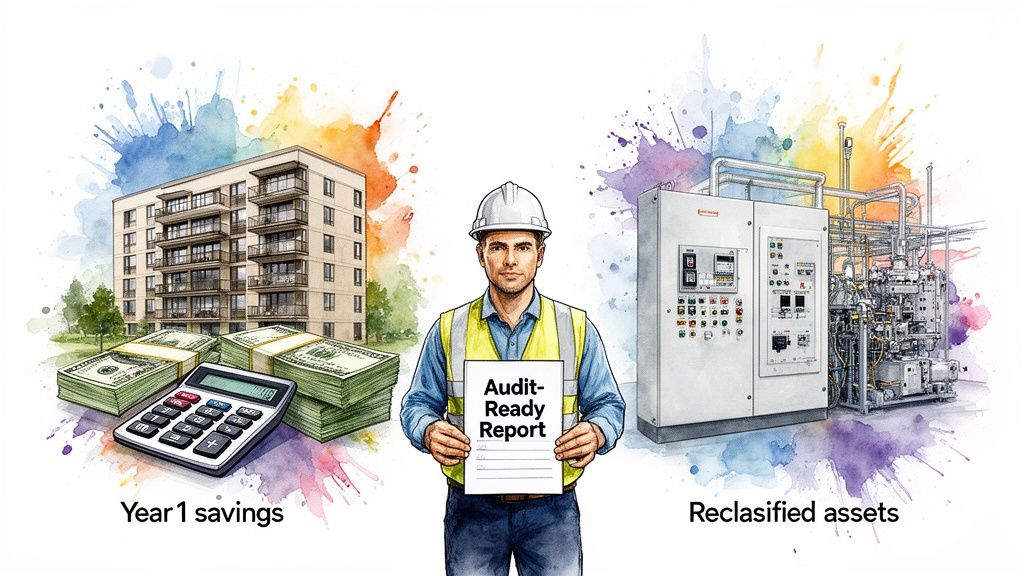
Case Study 1: The Multifamily Acquisition
The Problem: A real estate investment group just closed on a mid-sized apartment complex. They had a depreciable basis of $7.2 million, and under the standard 27.5-year straight-line method, their first-year deduction was a meager $261,818. It was a decent write-off, but they knew a huge amount of capital was just sitting there, locked up in the property's long-term basis.
The Solution: The group brought in a team to conduct a full, engineering-based cost segregation study. The specialists went through the property with a fine-toothed comb, identifying all the assets that could be depreciated much faster—things like landscaping, parking lots, carpeting, cabinetry, and site lighting.
The Result: The study reclassified a massive 28% of the property’s cost basis—that's $2,016,000—into 5- and 15-year asset classes. This single move generated over $560,000 in additional first-year depreciation deductions, translating into more than $300,000 in actual tax savings. What did they do with that cash? They immediately rolled it into a down payment for their next acquisition.
Case Study 2: The New Industrial Facility
The Problem: A business owner finished construction on a new $4 million light industrial facility for their manufacturing operations. Under the default 39-year commercial depreciation schedule, their annual deduction was just over $102,000. That wasn't nearly enough to free up the cash flow they desperately needed to buy new, essential equipment for their production line.
The Solution: Right after the facility was placed in service, they commissioned a cost segregation study. Engineers were on-site, poring over blueprints to pinpoint every asset that wasn't strictly part of the building's core structure but was instead tied to the manufacturing process.
The Result: The study identified specialized electrical systems, reinforced concrete pads for machinery, and dedicated plumbing lines, reclassifying them as 5- and 7-year personal property. This shift, supercharged by bonus depreciation, created an additional first-year deduction of $950,000. The tax savings gave the owner the working capital they needed to purchase the new equipment without taking on more debt, directly fueling their business growth.
Frequently Asked Questions About Cost Segregation
When you first hear about cost segregation services, it's natural for a few key questions to pop into your head. Let's walk through some of the most common ones we hear from property owners, so you can get a clear picture of how this strategy works in the real world.
Is a Study Worth It for My Smaller Property?
This is probably the most frequent question we get. While it’s easy to see the appeal for a massive commercial complex, many investors wonder if the juice is worth the squeeze for a smaller building.
The short answer is often a resounding yes. We’ve seen incredible returns on investment for properties valued as low as $500,000. The real deciding factor isn't the total purchase price, but the type of property it is. A small, high-end medical clinic or a restaurant, for instance, is packed with specialized plumbing, wiring, and equipment that can be reclassified. It might actually have a higher percentage of short-life assets than a simple, sprawling warehouse of the same value.
A good firm will offer a quick, no-strings-attached preliminary analysis. This will give you a solid estimate of your potential tax savings, allowing you to see if the fee makes financial sense.
Does a Cost Segregation Study Increase My Audit Risk?
It's a smart question, but the fear is largely unfounded. A properly executed, high-quality cost segregation study does not raise a red flag for the IRS. In fact, a well-documented study can actually reduce your audit risk.
The IRS even published an Audit Techniques Guide specifically for cost segregation. This tells us they have a clear, established roadmap for what they consider a credible study.
The risk doesn't come from using the strategy itself; it comes from cutting corners. Cheap, software-based "studies" that skip the physical site visit and engineering legwork are the ones that get challenged. A detailed, engineering-based report with on-the-ground verification is your best defense because it gives the IRS exactly the documentation they expect to see.
What Happens When I Sell the Property?
Thinking about the exit is crucial. When you sell a property after doing a cost segregation study, you have to deal with something called depreciation recapture. It’s a concept that sounds more intimidating than it is.
Here’s the simple breakdown:
- The Benefit Upfront: For years, you've deferred a significant amount of tax. That cash wasn't sent to the government; it was working for you—reinvested, paying down debt, or funding your next deal.
- The Recapture at Sale: When you sell, the IRS "recaptures" the accelerated depreciation you took on the short-life assets (the 5, 7, and 15-year property). This portion of your gain is typically taxed at your ordinary income rate, not the lower capital gains rate.
But here’s the key takeaway: for almost every investor, the time-value of money is a powerful force. The financial benefit of having that extra cash flow for years almost always outweighs the tax bill from recapture when you finally sell. It’s about putting your money to work today instead of giving it away.
At Blue Sage Tax & Accounting Inc., we guide real estate investors and family offices to make sure powerful tax strategies like cost segregation are a perfect fit for their goals. We're here to provide the clarity and confidence you need to get the most out of your portfolio. Contact us today to explore your options.