If you own commercial real estate, there's a good chance you're leaving a significant amount of money on the table. The culprit? Standard depreciation. Cost segregation is a powerful, IRS-sanctioned tax strategy designed to fix that, dramatically accelerating your depreciation deductions to free up cash and lower your current tax liability.
Instead of slowly writing off your entire building over 39 years, this service lets you reclassify parts of your property into much shorter 5, 7, or 15-year lifespans. This front-loads your deductions, giving you a powerful financial advantage right now, not decades from now.
What Are Cost Segregation Services and How Do They Work?

Think of your building like a brand-new car. Under standard tax rules, the entire car—frame, engine, seats, tires, everything—is depreciated at the same slow rate. But that doesn't make sense in the real world. The tires will wear out long before the steel frame ever does.
Cost segregation services take a much more realistic, engineering-based approach. We essentially take your property apart on paper, meticulously identifying and separating every component based on its actual useful life. The structural shell remains on the 39-year schedule, but all the other "parts" get reclassified for faster write-offs.
Reclassifying Assets for Maximum Benefit
A detailed cost segregation study sorts a building’s components into specific categories, allowing you to maximize deductions in the early years of ownership.
Here’s a look at what that often includes:
- 5-Year Property: Think carpeting, specialty lighting, dedicated electrical wiring, and decorative fixtures.
- 7-Year Property: This typically covers office furniture or other fixtures included in the property purchase.
- 15-Year Property: These are your land improvements—things like parking lots, sidewalks, retaining walls, and landscaping.
This reclassification can be a game-changer. Let's look at a simple comparison.
Standard vs Accelerated Depreciation At a Glance
The table below highlights just how different the depreciation timelines are for various assets once a cost segregation study is performed. It’s all about moving assets into the correct, faster categories.
| Asset Type | Standard Depreciation (Without Cost Seg) | Accelerated Depreciation (With Cost Seg) |
|---|---|---|
| Building Structure | 39 Years | 39 Years |
| Landscaping/Parking Lot | 39 Years | 15 Years |
| Office Furniture | 39 Years | 7 Years |
| Carpeting | 39 Years | 5 Years |
By moving a significant portion of the building's cost basis from the 39-year column into the faster buckets, you can claim much larger deductions immediately. The goal isn't to get more depreciation over the life of the asset, but to get it sooner, when the cash has a much greater impact on your business.
The core principle is simple: A dollar saved on taxes today is more valuable than a dollar saved 20 years from now. It’s about leveraging the time value of money to fuel immediate growth and investment.
The Growing Demand for Cost Segregation
This isn't some obscure loophole; it's a mainstream strategy that savvy investors are increasingly using to their advantage. The global market for cost segregation services was valued at $950 million in 2023 and is on track to hit roughly $3.5 billion by 2033.
This explosive growth is driven by property owners who realize the immense value locked away in their buildings. For a typical $10 million property, a study can often reclassify 20-40% of its cost basis into these shorter depreciation lives, generating substantial first-year tax savings. You can explore more data on this market trend at DataIns Market.
The True Financial Impact of a Cost Segregation Study

Let's get past the technical jargon for a moment. At its core, cost segregation is about creating financial momentum. By accelerating your depreciation deductions, you're not avoiding taxes—you're strategically deferring them. This directly translates into more cash in your pocket, right now.
Think of it this way: a dollar saved on taxes today is infinitely more valuable than a dollar you might save a decade down the road. Why? Because you can put today's dollar to work immediately. It can be reinvested to generate fresh returns, fund a major renovation, or even become the down payment on your next property, all without having to chase down external financing. It’s the difference between waiting for a benefit and actively using it to build wealth.
And when you layer in current tax laws like bonus depreciation, the impact gets even bigger. These rules can let you write off 100% of the cost of certain assets in the very first year, essentially turbocharging your savings.
Unlocking Capital Through Tax Deferral
Here’s a practical example. Imagine you just bought a multifamily property in Queens for $3 million. After allocating $600,000 to the land, you have a $2.4 million building basis. Without cost segregation, you'd depreciate that amount over 39 years, giving you a standard deduction of about $61,538 annually.
Now, let’s bring in a qualified engineering team. They might find that 25% of the building's cost basis—or $600,000—can be reclassified into components with much shorter useful lives.
Suddenly, the breakdown looks more like this:
- 5-Year Assets: $240,000 (think carpeting, cabinetry, appliances)
- 15-Year Assets: $360,000 (things like the parking lot, sidewalks, and landscaping)
- 39-Year Structure: $1,800,000 (the remaining building shell)
The difference in your first-year deduction is staggering. By front-loading these write-offs, especially with bonus depreciation in play, you could potentially deduct hundreds of thousands of dollars in year one. That's a massive jump from the standard $61,538.
This isn't just a paper gain. It's real capital that was destined for the IRS but is now back in your bank account, ready to be deployed for your next strategic move.
From Theory to Tangible ROI
That immediate influx of cash is where the real value lies. For our Queens property owner, this could mean having the funds for a down payment on another building, upgrading units to justify higher rents, or simply padding their financial reserves. The study effectively transforms a slow, passive tax benefit into a powerful, active financial tool.
Think about the doors this opens:
- Fueling Portfolio Growth: Use the tax savings as capital to acquire more income-producing assets, compounding your returns over time.
- Funding Property Improvements: Renovate kitchens, update common areas, or improve curb appeal to boost property value and attract better tenants.
- Reducing Debt Service: Pay down higher-interest loans, which improves your property’s net operating income and overall financial health.
Ultimately, the impact of cost segregation goes far beyond a single tax return. It’s about fundamentally altering your investment timeline, giving you the resources you need to hit your long-term goals much faster. This strategic tax planning shifts you from a defensive position—simply paying your tax bill—to an offensive one, where you actively manage your liabilities to create new opportunities. For any serious real estate investor, that shift is a true competitive advantage.
Is Your Property a Good Candidate for a Cost Segregation Study?
The tax savings from cost seg services can be massive, but it’s not the right tool for every single property. The real magic happens when you apply it to the right building at the right time. Think of it less as a blanket solution and more as a precision instrument for specific situations.
Figuring out if your property qualifies is the first critical step. By looking at a few key factors—like when you acquired it, its value, and what kind of building it is—you can get a pretty clear idea of whether the payoff will be worth the upfront cost of the study. The goal is simple: make sure the tax savings you unlock are far greater than the fee for the study itself.
The Best Time to Act for Maximum Savings
Timing is everything. While you can technically run a cost segregation study on a building you've owned for ages, the financial punch is much stronger in certain scenarios.
You'll get the most bang for your buck if your property was:
- Newly Built: Getting a study done right after construction is the gold standard. Engineers have direct access to construction costs, making it easier to precisely categorize every single component and maximize your accelerated depreciation from the very beginning.
- Acquired in the Last 15 Years: The IRS gives you a mulligan. Through a "look-back" study, you can go back in time and correct the depreciation on a property you've held for years. The best part? You get to claim all those years of missed depreciation in one lump sum, which can lead to a huge tax refund.
- Recently Renovated: Did you just put on a new roof, overhaul the HVAC system, or complete a major interior fit-out? These capital improvements are packed with assets that have shorter lifespans. A study can carve out these costs and start depreciating them much faster.
Prime Property Types and The Million-Dollar Question
Just about any commercial building can benefit, but some are simply better candidates than others. Properties with a rich mix of specialized equipment, intricate electrical and plumbing systems, and significant land improvements offer the most opportunities to reclassify assets.
We consistently see the biggest returns from property types like:
- Multifamily Apartment Buildings
- Industrial Warehouses and Manufacturing Plants
- Hotels and Hospitality Venues
- Retail Centers and Shopping Malls
- Self-Storage Facilities
- Medical Offices and Healthcare Facilities
- Restaurants and Car Washes
Ultimately, it all boils down to scale. A cost segregation study is an investment, and like any investment, it needs to generate a solid return. The tax deferral has to be large enough to make the fee a no-brainer.
That’s why this strategy delivers the most value for properties with a higher cost basis. As a rule of thumb, properties with a depreciable basis (your purchase price minus the value of the land) of $1 million or more are prime candidates. At that level, the tax savings are almost always significant enough to deliver an incredible ROI, often covering the cost of the study many times over in the first year alone.
Even for properties with a basis as low as $200,000, a study can still make financial sense. But the impact becomes exponentially more powerful as the property's value climbs, turning a smart tax move into a game-changing financial strategy.
A Step-by-Step Look at the Cost Segregation Process
Getting started with a cost segregation study might seem daunting, but any good firm will have a clear, straightforward process. It’s a journey designed to be transparent and collaborative, turning a complex engineering and tax strategy into a manageable project with a clear outcome.
The whole point is to give you a predictable path from start to finish. From the initial, complimentary look at your property to the delivery of the final, audit-ready report, every step is built to maximize your savings and minimize any hassle for you. Let's walk through the five key phases.
Phase 1: The Initial Feasibility Check
It all begins with a no-cost, no-obligation preliminary analysis. Think of it as a quick financial health check for your property to see if there's significant tax savings on the table. We'll ask for some basic details—your property's address, its purchase price, and when you placed it in service.
Using that information, combined with our own modeling software and industry data, we can generate a pretty reliable estimate of your potential tax benefits. This initial projection is key. It gives you a solid idea of the return on your investment before you commit a single dollar to a full study.
Phase 2: Kicking Things Off and Gathering Documents
Once you see the numbers and decide to move forward, we officially kick off the project. This phase is all about collecting the documents needed to build a comprehensive and defensible report. Your provider will send over a specific list of what they need to get started.
This usually includes things like:
- Architectural Blueprints: These are the foundation, showing us the building's layout and structural details.
- Cost and Purchase Documents: We're talking settlement statements, purchase agreements, and any invoices for major renovations or improvements.
- Appraisal Reports: If you have one, an appraisal can provide great insights into the land value and the cost of different components.
A dedicated project manager will work right alongside you or your team to make sure gathering this info is as painless as possible. This lays the groundwork for the most important part of the process.
Phase 3: The On-Site Engineering Visit
This is where the real magic happens and where a quality cost segregation firm earns its stripes. A team of specialists, typically engineers and construction pros, will come out to conduct a detailed physical inspection of your property. This isn’t just a quick walkthrough; it's a meticulous survey to identify, photograph, and document every single component of the building.
During this site visit, the team is on the hunt for everything from specialized electrical and plumbing systems to flooring, cabinetry, and even exterior improvements like parking lots and landscaping. This hands-on, physical verification is what makes an engineering-based study the gold standard for the IRS. It’s absolutely essential for creating a report that will stand up to scrutiny.
The on-site inspection is the cornerstone of a credible cost segregation study. It ensures that asset classifications are based on direct physical evidence and engineering principles, not just accounting estimates, providing the highest level of substantiation.
Phase 4: Classifying Assets and Building the Report
With the site visit done and all the documents in hand, our engineering and tax teams get to work. They begin synthesizing all that data, painstakingly classifying each asset into its proper depreciation bucket—5-year, 7-year, 15-year, or the standard 39-year structural life.
This is an incredibly detailed analysis where costs are allocated to thousands of individual components, from a light fixture to a retaining wall. The final result is a comprehensive report, often hundreds of pages long, that breaks down your entire property and provides clear justification for every single reclassification. This document is your proof, containing all the details needed to support your new depreciation deductions.
Phase 5: Delivering the Final Report and Supporting Your Tax Filing
In the last stage, you receive the completed cost segregation study. A good partner won't just email you the PDF and disappear. They'll walk you and your CPA through the findings, making sure you both understand exactly how to apply the results to your tax return.
The report provides the precise figures your tax preparer needs to file IRS Form 3115, "Application for Change in Accounting Method," which is required for any look-back study. Furthermore, a top-tier firm provides ongoing audit support. They stand behind their work and will be there to help if the IRS ever has questions. This final step is what turns the study's findings into real, tangible cash flow for you.
Is a Cost Segregation Study Worth the Investment?
When you hear that a professional cost segregation study comes with an upfront fee, it's natural to ask the million-dollar question: is it really worth it? The simple answer is almost always a resounding yes. Think of the study not as an expense, but as a high-yield investment that often pays for itself many times over, usually within the very first year.
So, how do the fees work? Most experienced firms, including Blue Sage, don't use a one-size-fits-all model. Instead, we provide a fixed fee based on the specifics of your property—its size, complexity, and total cost basis. This quote comes after a complimentary initial analysis, so you know the exact cost and the potential tax savings before you ever sign on the dotted line. This transparency takes the guesswork out of the equation and lets you see the financial upside from day one.
A Concrete Example in NYC
Let's walk through a real-world scenario to see how the numbers play out. Imagine an investor just purchased a mixed-use commercial building in Brooklyn for $5 million.
After we account for the land value (which you can't depreciate), the building itself has a depreciable basis of $4 million. Without a cost segregation study, the IRS requires you to depreciate that entire $4 million on a straight-line basis over 39 years. This gives you an annual tax deduction of about $102,564. It's something, but it's slow.
Now, let's bring in a cost segregation study. Our engineers get to work, performing a detailed analysis and identifying that 30% of the building’s cost, or $1.2 million, can be legally reclassified into assets with much shorter recovery periods.
- 5-Year Assets: $400,000 (think carpeting, specialty lighting, and decorative fixtures)
- 15-Year Assets: $800,000 (this covers land improvements like the parking lot, landscaping, and sidewalks)
- 39-Year Assets: $2,800,000 (what’s left—the core structural components)
The process to arrive at these numbers is methodical and well-documented, ensuring it stands up to IRS scrutiny.
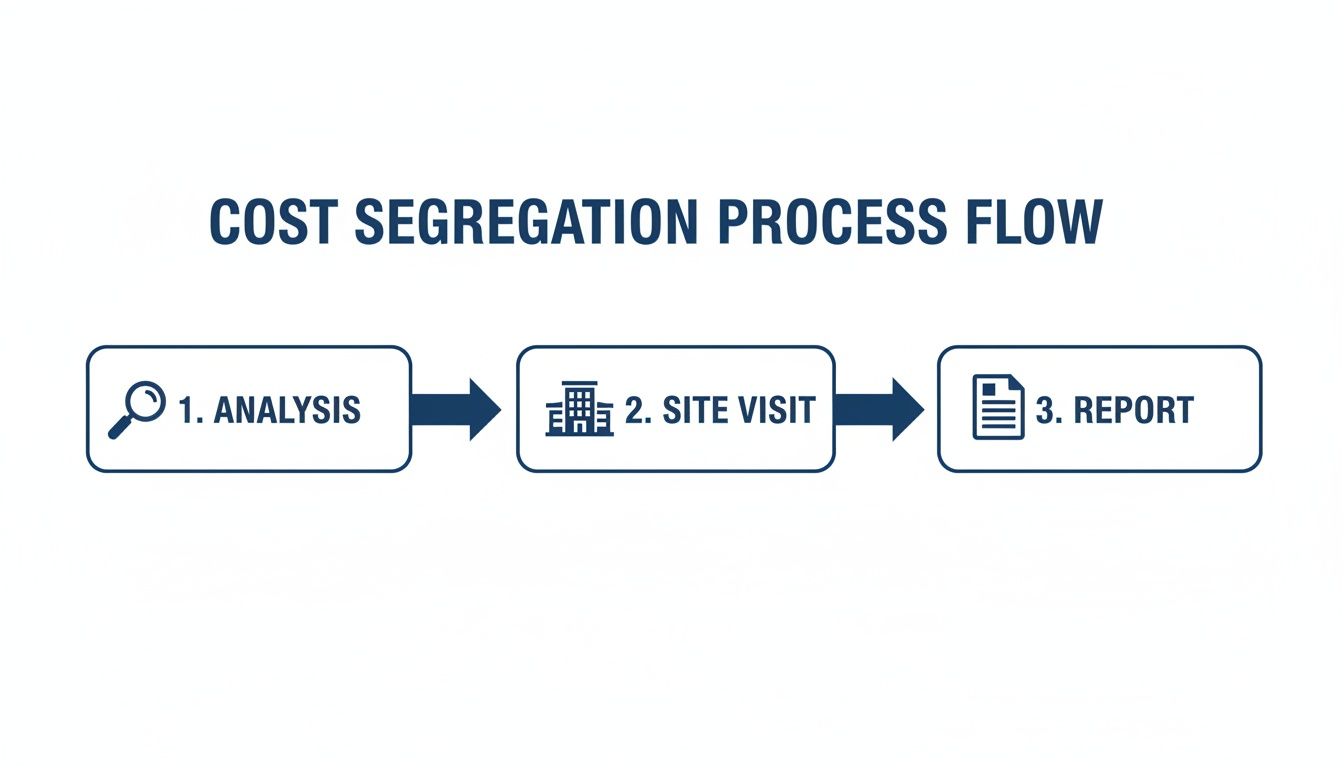
As you can see, a proper study involves in-depth analysis, a physical site visit, and a comprehensive final report to justify every reclassification.
What This Means for Your Bottom Line
The impact on your tax return is immediate and significant. Thanks to bonus depreciation rules, you can potentially write off 100% of the newly identified 5-year and 15-year assets in the first year.
Suddenly, your standard $102,564 deduction transforms into a first-year deduction of over $1.27 million—that's the $1.2 million from bonus depreciation plus the regular depreciation on the remaining 39-year structure. This huge deduction drastically slashes your taxable income for the year.
The real power here isn't just about saving on taxes for one year. It's about the time value of money. You're unlocking a significant amount of capital today that you can reinvest to grow your portfolio, instead of letting it sit locked away in a slow, 39-year depreciation schedule.
To really bring this home, let’s look at a simple breakdown of the return on investment.
Hypothetical ROI for a $5M NYC Commercial Property
This table illustrates the dramatic financial difference a cost segregation study makes in our hypothetical $5 million Brooklyn property scenario. We'll assume the study fee was $15,000 and the investor has a combined 40% federal and state tax rate.
| Metric | Without Cost Seg Study | With Cost Seg Study | Net Benefit |
|---|---|---|---|
| Year 1 Depreciation | $102,564 | $1,271,795 | +$1,169,231 |
| Year 1 Tax Savings | $41,025 | $508,718 | +$467,693 |
| Study Fee (Cost) | $0 | -$15,000 | -$15,000 |
| Net Cash Flow Benefit | $41,025 | $493,718 | +$452,718 |
The results speak for themselves. After subtracting the $15,000 fee, the investor walks away with an additional $452,718 in cash flow in the first year alone. That's a return of more than 30 times the initial investment in under 12 months. This is the tangible power that a well-executed cost segregation study delivers.
Choosing the Right Firm for Your Cost Seg Study
Let’s be clear: not all cost seg services are created equal. The quality of the study you receive is directly tied to the expertise of the firm you hire, and a subpar report can easily create more problems than it solves.
Choosing the right partner is the single most important decision in this process. It’s what ensures you not only maximize your tax savings but also have a rock-solid, defensible position if the IRS ever comes knocking. A credible study isn't just about moving numbers on a spreadsheet; it's a detailed, engineering-driven process. The IRS has very specific guidelines and heavily favors a methodical, engineering-based approach over simple accounting estimates. A firm that cuts corners is putting you at risk.
The Gold Standard: Engineering-Based Studies
The most critical factor to look for is a provider that performs engineering-based cost segregation studies. This is the gold standard recognized by the IRS and tax courts, and for good reason. It means a team of qualified engineers and construction professionals will physically inspect your property to identify, measure, and document every single component.
This hands-on approach is what provides the necessary proof to justify reclassifying assets. It shifts the study from a theoretical accounting exercise into a verifiable, evidence-based analysis. Any firm that relies solely on models or estimations without a site visit is producing a report with a weak foundation, making it extremely vulnerable during an audit.
Essential Qualifications of a Top-Tier Provider
When you're vetting potential firms, treat it like hiring a key member of your investment team. Their work will have a direct and lasting impact on your cash flow and risk exposure.
Here are the non-negotiable criteria to look for:
- A Blended Team of Experts: The best firms bring a multidisciplinary team to the table. You need engineers who genuinely understand construction methods and materials, alongside tax specialists who are fluent in current IRS regulations and relevant court cases.
- A Proven Track Record: Don't be shy about asking for case studies and references. A reputable provider will have a long history of successful, audit-proof studies across various property types, including ones just like yours.
- Guaranteed Audit Support: This is absolutely essential. A firm must stand behind its work. If the IRS questions your study, your provider should be there to defend their findings at no extra cost. This kind of guarantee is a clear signal of confidence in their methodology.
A quality cost segregation study should be a fortress of documentation. Its purpose is not just to find savings but to provide an irrefutable, engineering-backed report that satisfies the highest level of IRS scrutiny.
Red Flags to Watch Out For
Just as important as knowing what to look for is knowing what to avoid. Be wary of providers who dangle unusually low fees or promise incredibly fast turnaround times. A thorough, engineering-based study requires time and specialized expertise, and an offer that seems "too good to be true" almost always is.
Another major red flag is a lack of transparency. Your provider should be able to clearly walk you through their entire process, from the initial analysis to the final report delivery. If they get vague about their methodology or their team's qualifications, it’s best to walk away. Your financial strategy deserves a partner committed to precision, defensibility, and long-term value.
Common Questions About Cost Segregation
Even after seeing the numbers, it's smart to have a few questions before diving in. We get it. Here are some of the most common things property owners ask us, along with straightforward answers to help you see the full picture.
What if I've Owned the Property for Years? Can I Still Do This?
Absolutely. In fact, this is one of the most powerful applications of cost segregation. It's called a “look-back” study.
The IRS gives you a fantastic opportunity to go back and claim all the depreciation you should have been taking since you first acquired the property. You don't have to go through the headache of amending old tax returns, either. Instead, you capture all those missed deductions in a single year by filing IRS Form 3115, Application for Change in Accounting Method. The result is often a massive, immediate tax deduction.
Is This Going to Put Me on the IRS's Radar for an Audit?
This is a common concern, but the short answer is no—as long as it’s done right. A properly executed, engineering-based cost segregation study doesn’t raise a red flag with the IRS. In fact, they’ve laid out their expectations in a detailed Audit Techniques Guide.
Think of a high-quality study as your audit protection. It’s built on solid engineering principles and provides the exact documentation an agent would need to see, defending the asset reclassifications before they're ever questioned.
What Happens Down the Road When I Sell the Property?
When you sell, you'll deal with something called "depreciation recapture." Essentially, the accelerated depreciation you claimed over the years gets taxed, and some of it will be at your ordinary income tax rate instead of the lower capital gains rate.
But here's the key: the time value of money is incredibly powerful. Having that extra cash flow today—money you can reinvest, expand your portfolio, or improve your properties with—almost always creates far more wealth than the eventual tax bill from recapture. It's a trade-off that savvy investors make every day because the math just works. A good advisor can model this out for you, showing you the net benefit in black and white.
Ready to see how much you can save? The team at Blue Sage Tax & Accounting Inc. specializes in identifying opportunities to reduce your tax burden through strategic planning. Contact us today for a complimentary analysis.