When you run a small business, you quickly learn that profit on your P&L statement doesn't always mean money in the bank. Effective cash flow management is the day-in, day-out practice of tracking and steering the money moving through your company. It’s less about accounting theory and more about practical survival and growth.
This isn't just about bookkeeping. It’s about having the liquidity to meet your obligations, jump on opportunities, and keep the lights on without a single hiccup.
Why Cash Flow Is the Lifeblood of Your Business
Profitability is great, but it won't cover next Friday's payroll. That simple truth is where so many business owners, especially those navigating the high costs of a city like New York, run into trouble. Cash flow is the operational heartbeat of your company. It dictates whether you can pay your team, your suppliers, and invest in the next big thing.
Getting this wrong stings, and it stings fast. Late payments can damage relationships you've spent years building with vendors. A lack of ready funds means you might have to pass on a game-changing opportunity. And when an emergency hits—like a critical piece of equipment failing—a cash crunch can turn a problem into a catastrophe. A business can look great on paper and still go under.
The Real-World Impact on Small Firms
Think about an owner-managed construction firm right here in NYC. They land a huge contract, and the future profit looks fantastic. The catch? They have to shell out cash for materials and labor today, but the client's payment might not arrive for another 60 or 90 days. Without a solid cash position, they can't front those costs and might have to turn down the very project that could define their year.
This isn't a rare occurrence. Managing cash flow is a constant battle for many. In fact, recent studies show that 29% of small businesses cite it as their second-biggest operational challenge. Digging deeper, 51% say they're grappling with uneven or unpredictable cash flows, which makes any kind of financial planning feel like guesswork. You can find more of these small business trends in OnDeck's latest report.
Cash isn’t just king; it’s the oxygen your business needs to breathe. Without a steady supply, even the most promising ventures can suffocate from a lack of liquidity, regardless of how profitable their income statement appears.
Moving from Survival to Strategic Agility
Once you get a handle on your finances, everything changes. You stop just surviving and start making strategic moves. Having a firm grip on your cash position empowers you to make smarter, more confident decisions that drive real growth.
Here’s what you can do once your cash flow is under control:
- Negotiate Better Terms: Cash on hand gives you leverage. You can pay suppliers early to snag discounts, directly lowering your cost of goods sold.
- Invest in Growth: You have the capital and the confidence to pour money into a new marketing campaign, hire that A-player you've been eyeing, or buy equipment that makes your team more efficient.
- Build a Financial Cushion: Consistent, healthy cash flow is how you build a war chest. This reserve acts as a buffer against economic slumps or surprise expenses, letting you weather storms without resorting to high-interest debt.
Ultimately, mastering your cash flow turns it from a constant source of stress into your most powerful strategic tool. This playbook will show you exactly how to take control.
Building a Reliable Cash Flow Forecast
A solid cash flow forecast is your financial early warning system. It’s the difference between reacting to a sudden cash crunch and being able to see it coming weeks, or even months, in advance. To get a real handle on your cash flow, you have to shift from a reactive mindset to a proactive one. That journey starts right here.
Forget about intimidating financial modeling for a moment. At its core, a forecast is simply a detailed log of the cash you expect to come in versus the cash you expect to go out. The goal is to create a living, breathing document that gives you a clear, forward-looking view of your cash position at all times.
This isn't just about avoiding disaster; it's about building a financially resilient business that can move from just getting by to truly growing.
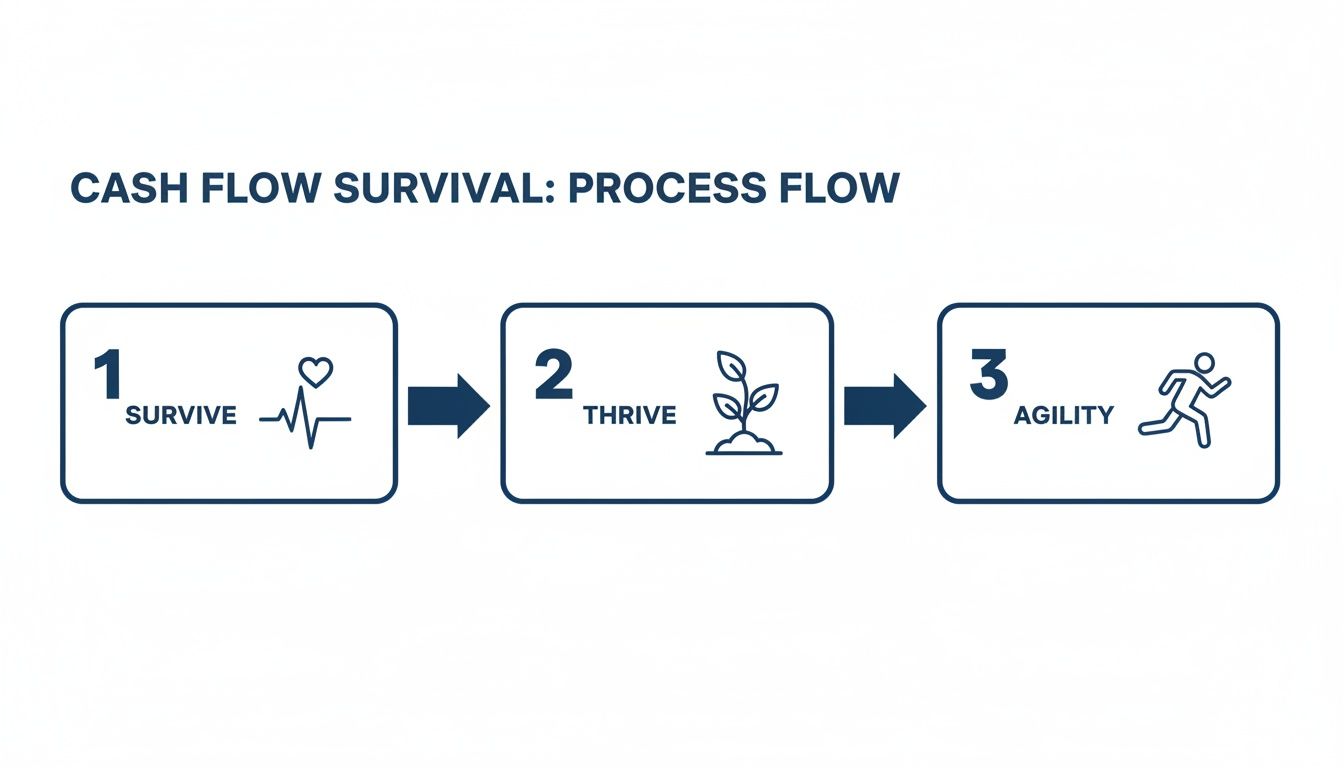
As you can see, forecasting is the tool that lets you stabilize your finances (Survive), gives you the confidence to invest in your future (Thrive), and ultimately provides the flexibility to navigate any market condition (Agility).
The Power of the 13-Week Rolling Forecast
Annual forecasts are great for high-level planning, but for the day-to-day reality of running a business, they’re practically useless. They're just too broad. The real secret weapon for tactical cash flow management is the 13-week rolling forecast.
Why 13 weeks? It's the sweet spot. It gives you a detailed, quarter-long view of your liquidity, which is exactly what you need to make smart, timely decisions. It's long enough to spot developing trends and prepare for big payments like quarterly taxes, but short enough that your projections remain reasonably accurate.
A rolling forecast isn't a "set it and forget it" task. It’s a dynamic tool you update every single week. As one week ends, you drop it off and add a new week to the end, always maintaining that critical three-month window into your financial future.
This weekly rhythm forces you to stay connected to your business's financial pulse. It turns forecasting from a dreaded annual chore into a powerful weekly strategic habit.
Gathering Your Cash Inflow Data
First things first, let's map out all the cash you have coming in. This is purely about cash in the bank, not revenue on the books. Be brutally honest with yourself here—base your projections on historical payment patterns and confirmed future work, not wishful thinking.
Your cash inflows will mostly come from a few key places:
- Sales & Client Payments: Dig into your sales pipeline and payment history. If a major client in your portfolio always pays in 45 days, don't kid yourself and forecast that cash arriving in 30. For our real estate clients in NYC, this means mapping out projected rent collections and confirmed property sale closing dates.
- Loan Proceeds: If you're drawing from a line of credit or expecting funds from a new loan, pencil that cash injection into the specific week you know it will hit your account.
- Other Income: Don't forget other one-off sources. This could be anything from the sale of an old asset to an expected tax refund.
Tracking Your Cash Outflow Data
Next, you have to get granular with every dollar going out the door. The outflow side is often more predictable, which is good, but you have to be exhaustive. A surprise expense is one of the fastest ways to derail an otherwise healthy business.
I recommend breaking your outflows into clear categories. It makes tracking much easier.
- Operating Expenses: These are the regular costs of keeping the lights on. Think payroll, rent or mortgage payments, utilities, software subscriptions (QuickBooks, CRMs, etc.), and marketing spend.
- Cost of Goods Sold (COGS) / Direct Costs: For a property management firm, this could be payments to key contractors and vendors. For anyone selling physical products, it’s what you pay your suppliers for inventory.
- Debt Repayments: You have to account for both principal and interest payments for any business loans, credit cards, or lines of credit.
- Taxes: This is a big one that people often forget to plan for. Factor in your quarterly estimated tax payments, payroll taxes, and any sales tax you need to remit. These are huge, predictable outflows that can cause serious trouble if you’re not prepared.
By consistently building and updating this forecast, you turn cash flow from a source of constant anxiety into your greatest strategic advantage. You gain the clarity to make confident decisions, knowing exactly what's coming down the road.
Getting a Grip on Day-to-Day Invoicing and Payments
While a solid cash flow forecast gives you the big picture, true cash flow mastery is won in the daily grind. It’s the small, tactical decisions you make every single day—how you invoice, when you pay your bills—that truly move the needle on your cash conversion cycle and overall liquidity.
This is a game of days, not months. The faster you can turn your hard work into cash in the bank (Accounts Receivable) and the smarter you are about managing your outgoing payments (Accounts Payable), the healthier your business will be.
Speeding Up Your Accounts Receivable
Getting paid faster is the single most powerful lever you can pull to improve your cash flow. I've seen countless business owners stress over late payments, but the truth is, you have more control than you think. It all boils down to setting clear expectations from day one.
Don't wait until an invoice is 30 days overdue to start your collections process. You need to build speed and efficiency right into your invoicing system from the get-go.
Sharpen Your Invoicing Strategy
Think of your invoice as more than just a bill—it’s a direct call to action. Your goal is to make it incredibly simple for your clients to pay you the moment they receive it.
- Invoice Immediately: Don't batch your invoices for the end of the month. Send it the second a project is done or a milestone is hit. Every day you wait is a day you're giving the client an interest-free loan.
- Offer Every Payment Option: Make it easy. Accept credit cards, ACH transfers, and online portals like Stripe or PayPal. The fewer hoops a client has to jump through, the faster you'll see the money.
- Set Crystal-Clear Terms: Vague terms like "Net 30" are an invitation for delay. For smaller jobs, switch to "Due Upon Receipt." For larger projects, requiring a 50% upfront deposit is standard practice and protects your initial cash outlay for materials and labor.
A tiny tweak in wording can have a huge impact. An invoice that clearly states, "Payment is due within 15 days," is much more effective than a passive "Net 15." Direct language removes any room for interpretation and nudges clients to act.
Build a Systematic Follow-Up Machine
Hoping clients will pay on time isn't a strategy. You need a consistent, professional, and largely automated follow-up system for any invoice that goes past its due date. This isn’t about being aggressive; it’s about professional persistence.
Here’s a simple, proven cadence you can adapt:
- The Gentle Nudge (3 Days Before Due): A short, automated email reminding the client of the upcoming payment. Keep it light and friendly.
- The Polite "Past Due" (1 Day After Due): A firm but professional email confirming they received the invoice and noting that it's now overdue.
- The Personal Check-In (7 Days Past Due): This is where a phone call works wonders. It's much harder to ignore a person than an email. Your goal is to understand the reason for the delay and get a firm commitment on a payment date.
- The Final Notice (30 Days Past Due): A more formal communication that clearly states the consequences if payment isn't received promptly.
A system like this takes the emotion out of collecting money and ensures nothing falls through the cracks. It also signals to your clients that you're serious about your payment terms.
Playing Smart with Accounts Payable
Getting paid quickly is one half of the equation; strategically managing your own payments is the other. The objective here is to hold onto your cash for as long as is reasonable without hurting your relationships with vendors or racking up late fees. This is all about timing, not avoidance.
You’re essentially trying to sync your cash outflow with your inflow. If you know most of your clients pay you in 30 days, it makes sense to negotiate similar terms with your own suppliers to keep your cash balance stable.
Know Your Payment Tiers
Not all bills are created equal. When cash gets tight, you absolutely must have a clear hierarchy for who gets paid and when.
Tier 1: The Non-Negotiables (Pay on time, every time)
- Payroll & Payroll Taxes: This is sacred ground. Messing this up has serious legal and morale-crushing consequences.
- Rent/Mortgage: You have to keep the lights on and the doors open.
- Mission-Critical Suppliers: These are the vendors whose services you absolutely cannot operate without.
Tier 2: The Important Bills (Pay within terms, but there might be wiggle room)
- Utilities & Software Subscriptions: Essential for operations, but you often have a small grace period before service is cut off.
- Loan Repayments: Crucial for maintaining your credit, but it's worth checking your loan agreement for any built-in flexibility.
Tier 3: The "Can-Wait" Expenses (Strategically delay if necessary)
- Some Marketing Spend: Ad campaigns that can be paused without immediate harm.
- Non-Essential Office Supplies: That extra case of paper can probably wait until next month.
By actively managing both sides of the cash flow ledger—accelerating what comes in and carefully timing what goes out—you take firm control of your company's financial pulse. This daily discipline is the bedrock of a cash-healthy business.
Optimizing Working Capital and Strategic Financing
Once you've got a handle on the day-to-day tactics, it's time to zoom out. True strategic cash flow management isn't just about paying bills on time; it’s about optimizing the core financial engine of your company—your working capital. This is where you make your money work harder for you, ensuring you have the liquidity to operate smoothly, handle surprises, and jump on growth opportunities without a second thought.
This means taking a hard look at every part of your business where cash is either trapped or could be put to better use. From the inventory gathering dust on your shelves to the credit lines you have (or don't have), every single element affects your financial agility.

Fine-Tuning Your Working Capital
Think of working capital—the difference between your current assets and current liabilities—as your business's short-term financial pulse. The goal is to keep this balance lean but healthy, making sure cash isn't needlessly tied up where it's not generating value.
For many businesses, the biggest cash trap is inventory. Every single item on the shelf represents money that isn't sitting in your bank account, ready to be deployed.
- Adopt a Just-in-Time (JIT) approach if it fits your model. This dramatically reduces the cash you spend on stock before it's actually needed for a sale.
- Aggressively liquidate slow-moving items. Don't let pride get in the way. Run a promotion, create a product bundle, or just mark it down to convert that stagnant inventory back into cash.
- Use your sales data to get better at forecasting. The more accurately you can predict demand, the less you'll over-order, keeping your cash position much stronger.
For a real estate developer in NYC, the "inventory" is the carrying cost of an unsold property. Every month a condo sits empty is a direct hit to working capital. A strategic pricing adjustment or a targeted marketing blitz becomes crucial to turn that asset back into liquid cash.
Navigating Strategic Financing Options
Let's be realistic: at some point, nearly every business needs an injection of outside capital. Maybe it's to survive a seasonal downturn, fund a major expansion, or just bridge the gap while waiting on a huge client payment. The trick is choosing the right tool for the job.
Financing is not a one-size-fits-all solution. The choice you make between a short-term fix and a long-term commitment depends entirely on your specific need and timeline. Picking the wrong one can easily create more financial stress, not less.
Think of financing like a toolbox. You wouldn't use a sledgehammer to hang a picture frame. In the same way, you shouldn't use a 10-year term loan to cover a 30-day payroll gap.
Understanding the purpose and structure of each option is the first step toward making a confident, strategic decision that actually supports your business goals.
Short-Term Solutions for Immediate Needs
Short-term financing is all about solving temporary cash flow crunches, usually within a year. These are your go-to tools for plugging operational gaps, not for funding massive growth.
- Business Line of Credit: This is probably the most flexible tool you can have. You get access to a pool of capital you can draw from as needed and repay over time. It’s perfect for managing unpredictable expenses or smoothing out a lumpy revenue cycle.
- Invoice Factoring or Financing: If your biggest headache is waiting 30, 60, or even 90 days for clients to pay, this can be a game-changer. A factoring company essentially buys your unpaid invoices at a small discount, giving you cash almost immediately.
- Short-Term Loans: These are exactly what they sound like—traditional loans with a repayment window of three to 18 months. They deliver a lump sum of cash upfront, making them great for specific, time-sensitive needs like grabbing a good deal on a piece of equipment.
Long-Term Financing for Strategic Growth
When you’re thinking bigger—making a significant, lasting investment in your business—you need a financing structure that matches that long-term vision. These options are built to fund expansions, major asset purchases, and other foundational moves.
- SBA Loans: Backed by the Small Business Administration, these loans often come with great terms, lower interest rates, and longer repayment periods. The application can be a beast, but for buying commercial real estate or funding a major build-out, they're tough to beat.
- Term Loans: Your classic bank or online lender loan. You get a large sum of capital that you repay with interest over a set period, usually from one to ten years. This is the standard choice for planned, large-scale projects where you know exactly how much you need.
- Equipment Financing: Need to buy pricey machinery, vehicles, or tech? This loan uses the equipment itself as collateral. This often makes it easier to qualify for and keeps your other cash and assets free for daily operations.
Deciding between these options can feel overwhelming, so here’s a quick way to compare them based on what you’re trying to achieve.
Comparing Short-Term vs. Long-Term Financing Options
| Financing Option | Best For | Typical Term | Key Consideration |
|---|---|---|---|
| Business Line of Credit | Managing unpredictable expenses & cash flow gaps | Revolving (ongoing) | Flexible access to funds, but variable interest rates can be a risk. |
| Invoice Factoring | Unlocking cash from unpaid customer invoices | 30-90 days | Provides immediate cash but at a discount to the invoice's full value. |
| Short-Term Loan | Specific, one-time needs like inventory purchase | 3-18 months | Quick funding, but comes with higher interest rates and frequent payments. |
| SBA Loan | Major expansions, real estate, or acquiring a business | 7-25 years | Excellent terms and low rates, but the application process is long and complex. |
| Bank Term Loan | Large, planned capital projects and investments | 1-10 years | Predictable payments and structure, but requires strong credit and financials. |
| Equipment Financing | Purchasing machinery, vehicles, or technology | 2-7 years | The asset secures the loan, making it easier to obtain; preserves other capital. |
This table should help clarify which path makes the most sense. A short-term solution is a patch for a leak, while a long-term loan is part of the blueprint for building a bigger house.
By getting a firm grip on your internal working capital and then strategically choosing the right external financing, you shift from simply managing your business day-to-day to truly architecting its financial future.
Advanced Strategies: Tax Planning and Scenario Modeling
Once you have a solid handle on the day-to-day mechanics of cash flow, it's time to shift from being reactive to proactive. Mastering your finances means looking ahead, building resilience, and finding every possible competitive edge. This is where the real strategic work begins.
Two of the most powerful levers you can pull are smart tax planning and disciplined scenario modeling. Think of them as offense and defense: one protects your cash from predictable drains, while the other prepares you for whatever surprises the market throws your way.
Use Proactive Tax Planning to Keep Your Cash
For most successful businesses, taxes are one of the biggest cash expenses. They’re predictable, yet they still manage to create a ton of stress for owners who treat tax prep as a year-end fire drill.
The trick is to view tax planning as a year-round component of your cash flow management for small business. A thoughtful tax strategy isn't just about compliance; it's a powerful tool for freeing up cash and timing major investments. For instance, making your estimated tax payments on time, every quarter, is non-negotiable. Falling behind creates a double hit: a huge liability down the road, plus steep penalties and interest—a completely avoidable leak in your cash reserves.
How Smart Deductions Impact Cash Flow Timing
Certain parts of the tax code are practically designed to help businesses manage their cash when making big purchases. If you know how to use them, the impact on your liquidity can be huge.
The Section 179 deduction is a perfect example. This lets you deduct the full purchase price of qualifying equipment in the year you buy it, instead of slowly depreciating it over many years.
Let's say a design firm here in NYC needs $50,000 worth of new computers. Normally, they’d only write off a small fraction of that cost each year. By taking the Section 179 deduction, they can write off the entire $50,000 from their taxable income right away. This slashes their tax bill for the year, keeping a significant chunk of cash in the bank.
Proactive tax planning isn't about tax avoidance. It’s about managing the timing of when cash leaves your business. By legally deferring or lowering your current tax liability, you hold onto more cash to run and grow the company today.
This is a classic strategic move. By planning a major purchase for late in the year, a business can generate a large, immediate deduction that directly improves its year-end cash position.
Build Resilience with "What If?" Scenario Planning
Tax planning helps you manage the knowns. Scenario planning prepares you for the unknowns. It's essentially a financial stress test for your business—a way of modeling different futures to see how your cash flow would hold up.
This isn’t about gazing into a crystal ball. It’s about identifying your financial weak spots before they turn into a full-blown crisis. By running the numbers on a few key scenarios, you can build smarter contingency plans and make better decisions when you're under pressure.
You don't need fancy software to get started. A simple spreadsheet is all it takes to map out what could happen.
The goal is to create three core financial projections based on different assumptions:
- The Best-Case: You land that huge client you've been after. Great, right? But this model might show you that you'll need a line of credit before you sign the contract just to cover the initial ramp-up costs.
- The Worst-Case: Your biggest client, who makes up 30% of your revenue, decides to leave. This forces you to get real, fast. Which costs could you cut immediately? How many months of cash do you have to survive?
- The Baseline: This is your most realistic forecast, based on your current pipeline and past performance. It’s your anchor, the starting point for modeling the other two extremes.
The point of this exercise isn't to be perfectly right. It's to build financial muscle memory. When a real challenge—or a huge opportunity—comes along, you've already done the hard thinking. You can act decisively instead of panicking.
For any owner-managed firm navigating the volatile NYC market, this kind of planning is invaluable. It converts that nagging anxiety about the future into a concrete, structured plan, giving you the confidence to lead through anything.
Here's the rewritten section, designed to sound like it's from an experienced human expert.
From Plan to Action: Making Your Cash Flow Strategy a Reality
A plan on paper is just that—a plan. The real magic happens when you turn those forecasts and strategies into consistent, daily habits. This is where you roll up your sleeves and make it happen.
Effective cash flow management isn't about a single heroic effort; it’s about building a rhythm. To keep it from feeling overwhelming, I always tell clients to break it down into what they can do right now, this month, and this quarter.
Let's walk through a practical implementation checklist.
The Action Checklist
Here’s a simple roadmap to get you started, focusing on immediate wins first.
This Week: Quick Wins
- Get on the phone. Pull up your accounts receivable aging report and identify the top three largest, oldest overdue invoices. Don't just send another email—call them. A personal conversation is a lot harder to ignore, and your goal is to get a firm, verbal commitment on a payment date.
- Triage your payables. Go through every single upcoming bill and sort them into three piles: Tier 1 (must-pay, like payroll and rent), Tier 2 (important but with some flexibility), and Tier 3 (can be deferred if needed). This simple exercise gives you immediate control if cash suddenly gets tight.
This Month: Building the Foundation
- Create your first 13-week cash flow forecast. Don't get paralyzed by the need for perfection. The goal of your first forecast is simply to get a baseline down—to see your financial runway and identify potential shortfalls before they become emergencies. You can refine it as you go.
- Tighten up your invoice terms. For all new clients, start with stricter terms. I often recommend switching to "Due Upon Receipt" or requiring a 50% upfront deposit for any project over a certain dollar amount. This immediately improves your cash cycle.
This Quarter: Strategic Moves
- Meet with your financial pros. Now that you have a handle on the day-to-day, it's time for bigger-picture thinking. Schedule a dedicated meeting with your accountant or a trusted financial advisor. Come prepared to discuss proactive tax strategies and explore the right financing options—like a line of credit—before you actually need it.
Your Top Cash Flow Questions, Answered
Even with a solid plan, real-world questions always pop up. I get these all the time from business owners trying to get a better handle on their cash flow. Here are some of the most common ones, along with my straight-to-the-point answers.
What’s the Best Software to Use?
Honestly, the best software is the one you’ll actually use every day. For most small and closely held businesses, QuickBooks Online is the perfect place to start. It keeps your accounting and invoicing in one place, which makes forecasting a whole lot simpler.
Once your business starts getting more complex, you might need something with a bit more muscle. Tools like Float give you fantastic visual forecasts, while platforms like Bill.com can automate your entire accounts payable process. The specific brand doesn't matter as much as finding a tool that gives you a clear picture of your future cash position without a ton of manual work.
How Much Cash Should I Keep in Reserve?
A good rule of thumb is to have enough cash on hand to cover three to six months of your essential operating expenses. Think rent, payroll, insurance, and utilities—everything you absolutely have to pay even if sales suddenly stopped.
I always tell my clients to think of this as the business’s emergency fund. It’s not money for expansion; it's a safety net that lets you make calm, strategic decisions during a downturn instead of desperate ones.
If you’re in a seasonal business or a more volatile industry like real estate development, you should definitely aim for the higher end of that range, maybe even more.
How Do I Handle a Sudden Cash Shortage?
When you see a shortfall coming, you need to act fast but stay calm. The first thing to do is pull up your accounts receivable aging report. Start calling your biggest and most overdue accounts immediately. Be polite but firm.
At the same time, look at what you owe. Who can you pay a little later without damaging a critical relationship? Pushing a few vendor payments back a week or two can make a huge difference.
This one-two punch of speeding up incoming cash while slowing down outgoing payments is your immediate triage. If you have a line of credit, now is the time to tap it to cover absolute must-pays like payroll. The goal is to survive the crunch without burning any important bridges.
At Blue Sage Tax & Accounting Inc., we do more than just crunch the numbers. We give you the strategic insights needed to build a financially resilient business. Our proactive planning and advisory services are built to help you master your cash flow, reduce your tax liability, and hit your long-term goals.
If you’re ready to bring this kind of clarity and confidence to your business, schedule a consultation with our team.