For real estate investors, picking the "best" accounting software really depends on where you are in your journey. If you're just starting out and need simple, free rental tracking, Stessa is a fantastic choice. But for investors who need property management features baked right in, platforms like Buildium or AppFolio are often the go-to. The right tool isn't just a preference; it’s a critical piece of infrastructure for building a scalable and financially sound real estate business.
Building Your Financial Foundation in Real Estate
Here’s the thing about generic accounting software: it just wasn't built for the unique headaches of real estate. Trying to make a standard platform track property-specific P&Ls, manage a web of different LLCs, or correctly tag capital expenditures versus repairs is an exercise in frustration. You end up creating messy manual workarounds that are not only inefficient but also ripe for costly errors come tax time.
A specialized solution is essential if you want to maintain financial clarity and actually support your growth. These platforms are designed from the ground up to handle the specific challenges investors face, making it infinitely easier to manage your portfolio and make decisions based on solid data, not guesswork.
Why Specialized Software Is a Necessity
Choosing the right financial tool is one of the most foundational decisions you'll make. A purpose-built platform gives you immediate, tangible advantages that generic software simply can't offer.
- Property-Specific Reporting: You can instantly pull a P&L for a single property to see exactly which assets are your winners and which are dragging you down.
- Entity Management: As you grow, you'll likely have multiple LLCs or other legal entities. A good system lets you manage all their books from one dashboard—a must-have for scaling.
- Accurate Depreciation Tracking: This is a huge one. The software helps you correctly track asset depreciation, simplifying tax season and maximizing a core component of your real estate tax strategy.
- Clear Expense Categorization: It knows the difference between a deductible repair (like fixing a leaky faucet) and a capital improvement (like a new roof) and has the workflows to prove it.
The core benefit of dedicated real estate accounting software is its ability to provide granular, actionable insights at the property level. It transforms your bookkeeping from a compliance chore into a strategic tool for portfolio optimization.
Market Growth Reflects Investor Needs
The rapid shift toward digital solutions shows that investors are catching on. The global real estate software market, valued at a hefty $10.29 billion in 2023, is on a steep growth curve, which tells you everything you need to know about the industry's demand for better financial tools. This boom means more companies are developing solutions specifically for investors, tackling everything from tax optimization to consolidating finances across multiple properties. You can find more data on this market expansion from Coherent Market Insights.
Ultimately, the right software for you hinges entirely on your portfolio's size, its complexity, and your long-term goals. Here’s a quick breakdown to frame the key differences between the most popular starting points.
| Feature Focus | Stessa | Buildium | AppFolio |
|---|---|---|---|
| Primary Use Case | Free rental income & expense tracking for residential investors. | All-in-one property management and accounting for growing portfolios. | Comprehensive property management with robust accounting for larger portfolios. |
| Ideal Investor | New investors with 1-10 residential units. | Investors and managers with 10-200+ units. | Professional property managers and large-scale investors. |
| Pricing Model | Free core platform with optional paid services. | Subscription-based, tiered pricing. | Subscription-based, often with minimum portfolio sizes. |
Key Criteria for Evaluating Investor Accounting Software

Choosing the right accounting software for your real estate portfolio is about so much more than fancy dashboards or a cheap price tag. You're not just picking a bookkeeping tool; you're selecting the financial command center for your entire operation. A generic, off-the-shelf program will inevitably lead to clunky workarounds and wasted hours. The right one, however, brings clarity to your numbers and actually supports your growth.
Before we jump into a head-to-head comparison, we need to lay down some ground rules—a clear set of benchmarks. Think of these as the non-negotiables. They’re what separate a basic ledger from a true real estate investment platform. Having this framework will help you cut through the marketing fluff and focus on what will genuinely make a difference for your business.
Foundational Property and Entity Management
First things first: can the software track your finances property-by-property? You absolutely must be able to pull a clean Profit & Loss (P&L) statement for each individual asset. Without that granular view, you're flying blind. It's the only way to honestly evaluate what's working, spot the properties that are dragging you down, and decide where your next dollar should go.
Just as critical is robust entity management. Most serious investors don't hold a dozen properties in their personal name. You create separate LLCs for liability protection, and your software has to keep up. It must let you manage and report on all these distinct legal entities from one consolidated dashboard.
If you find yourself constantly logging in and out of different accounts for each LLC, you’ve got the wrong system. It simply won't scale. Look for software that lets you:
- Link specific bank accounts to each distinct entity.
- Run consolidated reports that give you a birds-eye view of your entire portfolio.
- Easily track inter-company loans and capital transfers without a massive headache.
Without this, managing a growing portfolio turns into an administrative nightmare. You’ll increase the risk of costly errors and start blurring the financial lines between your assets, which is a big no-no.
The true test of any real estate accounting software is its ability to provide both a microscopic view of a single property's performance and a macroscopic, portfolio-wide financial picture. If it can't do both seamlessly, it fails the first and most important test.
Integrations and Reporting Capabilities
Manual data entry is the enemy. It's tedious, it's slow, and it's where mistakes happen. The best accounting software for real estate investors has to play nicely with the other tools in your tech stack. Direct bank and credit card feeds are non-negotiable. They automatically pull in transactions, cutting your bookkeeping time down dramatically.
Even better is a solid integration with your property management software. This creates a single source of truth where rent payments, maintenance costs, and management fees flow directly into your accounting records. No more double entry. Everything stays synchronized and up-to-date.
Another make-or-break function is lender-ready reporting. When it's time to refinance or buy your next property, your lender is going to want to see professional, easy-to-read financials. Your software should be able to spit these out in minutes:
- Schedule E Report: A summary of income and expenses, ready for your tax filings.
- Balance Sheet: A clear snapshot of your assets, liabilities, and equity.
- Net Operating Income (NOI) Statement: The gold standard for property valuation.
Advanced Needs for Sophisticated Investors
As your portfolio gets bigger and more complex, so will your accounting needs. You need to think ahead. Does a platform support the kinds of transactions you'll be doing in the future? This means having specific features for things like 1031 exchanges, which demand meticulous tracking of every dollar and deadline to maintain that all-important tax-deferred status.
Operating in multiple states adds another layer of complexity. If you own properties across state lines, your software should help you stay on top of state-specific tax rules and compliance. This isn't just a convenience; it's about preventing nasty surprises at the end of the year.
Finally, if your deals involve complex ownership structures—like partnerships, family offices, or syndications—your software has to be up to the task. The ability to manage sophisticated equity waterfalls and automate partner distributions is a hallmark of a platform built for serious professionals, not hobbyists.
A Side-by-Side Look at Top Accounting Software for Investors
Alright, now that we know what to look for, let's put the leading accounting software options under the microscope. The real test isn't a simple feature checklist; it's about how each platform actually performs in the messy reality of real estate investing. The "best" software is the one that fits your portfolio like a glove, not just some generic business tool.
We're going to focus on three heavyweights that each represent a different approach: Stessa, the purpose-built tool for landlords; Buildium, the all-in-one property management suite; and QuickBooks Online, the powerful but general-purpose accounting giant.
Stessa: The Focused Tool for Residential Landlords
Stessa has absolutely cornered the market for residential rental owners, and for good reason. Their entire platform is built around one core idea: make income and expense tracking as automatic and painless as possible. It’s not trying to be an all-in-one property management system, and that focus is its greatest strength.
The heart of Stessa is its dashboard, which gives you an immediate, high-level picture of your portfolio's health. It automatically calculates the metrics that matter most to investors—net cash flow, appreciation, and NOI. This is a dream for buy-and-hold investors who prioritize performance tracking and need clean, simple financials for their CPA at tax time.
Where Stessa really shines:
- Set-it-and-forget-it tracking: You link your bank accounts, mortgages, and credit cards once, and it automatically pulls in and categorizes your transactions.
- Investor-centric reports: It generates reports like the Schedule E and net cash flow statements that are exactly what you and your accountant need to see.
- Free core platform: You can get started and manage your portfolio with its essential features for free, which is a huge advantage for new investors.
But Stessa's laser focus is also its main limitation. It's just not built for commercial properties, fix-and-flips, or complex multi-partner LLCs. And while it has some basic property management features, it's not designed to handle tenant communication or maintenance coordination.
Buildium: The Integrated Property Management Powerhouse
Buildium is a serious step up, weaving comprehensive property management tools directly into a robust accounting system. This is the solution for hands-on investors and property managers who need a single command center for everything from finding tenants to closing the books.
Unlike Stessa, Buildium is designed to be the central nervous system of your rental business. It handles tenant ledgers, processes online rent payments, tracks maintenance tickets, and pays vendors. The accounting isn't an add-on; it's deeply integrated. When a tenant pays rent online, that transaction flows automatically into the correct property's ledger.
For an investor planning to scale, Buildium's operational integration is the game-changer. It stops you from juggling separate systems for property management and accounting, which is where data gets lost and you end up doing double the work.
This all-in-one power comes with a higher price tag and a steeper learning curve. It’s likely overkill if you just have a duplex and need to track your income and expenses. Also, while its accounting is fantastic for property management, it doesn't have the same depth for general business accounting as a dedicated platform like QuickBooks.
QuickBooks Online: The Flexible Generalist
QuickBooks Online dominates the small business accounting world, and it's easy to see why. It's incredibly powerful and can be bent and shaped to fit almost any industry—real estate included. The catch? You're the one who has to do the bending and shaping.
Out of the box, QuickBooks has no idea what a "property" is. To make it work for real estate, you have to get your hands dirty. This means manually setting up your Chart of Accounts and using features like "Classes" or "Locations" to tag every single transaction to the right property. It takes a solid grasp of accounting principles and a good bit of upfront effort.
Once you’ve got it configured, QuickBooks offers unmatched accounting depth. You can run payroll, handle complex 1031 exchanges, and manage intricate financial reports that specialized tools just can't touch. Plus, its integration marketplace is massive, connecting to thousands of other apps.
Real-World Scenario: QuickBooks vs. Stessa
Let's say you own five single-family rentals, each in its own LLC.
- With Stessa: You'd connect the bank account for each LLC. Stessa would automatically import and categorize the transactions, giving you a clean P&L for each property and a consolidated dashboard view of your whole portfolio.
- With QuickBooks: You'd probably set up each LLC as a "Class." Then, you’d have to create manual rules for transactions or spend time every month assigning each expense to the correct property. It’s absolutely doable, but it demands more discipline and hands-on time.
The demand for better tools is clear. The real estate accounting software niche, valued at USD 110 million in 2024, is expected to more than double by 2031. This growth is fueled by investors tired of spreadsheets and manual entry. In North America, which accounts for 34.08% of the total real estate software market, the push for automation and accuracy is driving innovation. You can dig deeper into these market dynamics in this detailed industry report.
Feature Comparison of Leading Real Estate Accounting Software
To cut to the chase, let's break down how these platforms stack up against the key criteria we established for real estate investors. This table offers a quick, at-a-glance view of their core strengths and weaknesses.
| Feature | Stessa | Buildium | QuickBooks Online |
|---|---|---|---|
| Property-Level P&L | Excellent: This is its core function and it's fully automated. | Very Good: Tightly integrated with property management ledgers. | Good (with setup): Requires manual Class or Location tracking. |
| Entity Management | Good: Easily connect multiple bank accounts for different LLCs. | Very Good: Built to manage portfolios with multiple properties. | Excellent: The most robust features for managing separate companies. |
| Integrations | Limited: Focuses on bank feeds and property data services. | Good: Integrates well within its own ecosystem and key partners. | Excellent: A massive app marketplace for endless connections. |
| Ease of Use for REI | Excellent: Purpose-built and incredibly intuitive for investors. | Good: Steeper learning curve due to its comprehensive nature. | Fair: Demands significant customization and accounting know-how. |
| Primary Focus | Financial performance monitoring for residential rentals. | All-in-one property management and accounting. | General small business accounting. |
Ultimately, your choice boils down to a single question: what is your primary job-to-be-done?
If your main goal is effortless financial tracking and portfolio analysis for your residential rentals, Stessa is an incredibly smart, efficient, and cost-effective choice. If you need a single system to run your entire operation—managing tenants, maintenance, and money—Buildium is the clear winner. And for those with complex business structures or deep accounting needs who don't mind a DIY setup, QuickBooks remains the most powerful and flexible option on the table.
Choosing the Right Software for Your Investor Profile
Let's be clear: there is no single "best" accounting software for every real estate investor. The right choice for someone with two rental houses would be a nightmare for a syndicator managing a 50-unit complex. It all comes down to matching the tool to your specific operational needs, portfolio size, and growth plans.
Instead of just listing features, let's look at this through the lens of real-world investor profiles. Figure out where you fit, and you'll have a much clearer idea of which platform will solve today's headaches while also paving the way for future growth.
This decision tree gives you a quick visual starting point, breaking things down by the size and complexity of your real estate holdings.
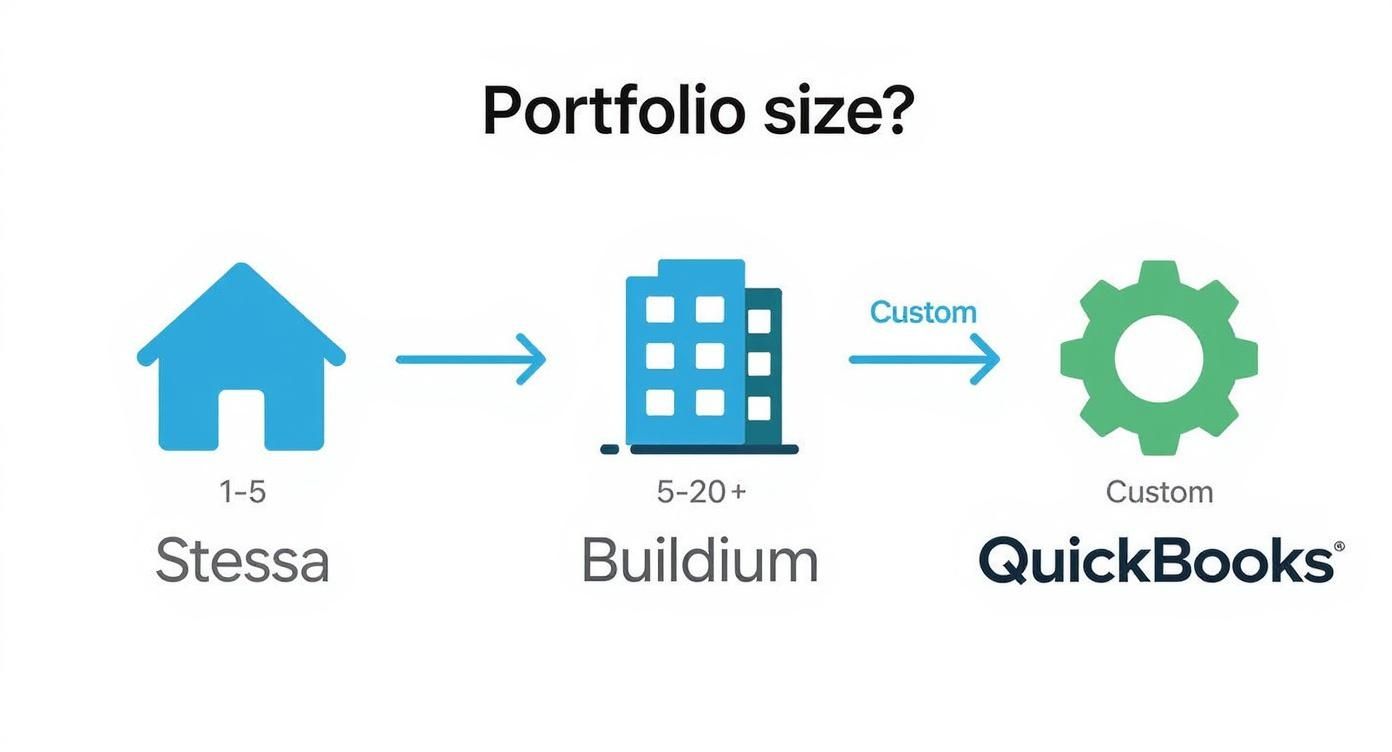
As you can see, the journey from a few single-family homes to large, multi-unit properties demands a shift from simple financial tracking to fully integrated management systems.
The New Investor with 1 to 5 Properties
If you're just getting started, your top priorities are simplicity and automation. You've got a handful of properties, probably under a single LLC, and the main goal is just to keep clean records of income and expenses without becoming a part-time bookkeeper. You need something that does the heavy lifting for you and gives you a clear snapshot of how your properties are performing.
For this exact scenario, Stessa is really the undisputed champion.
The platform was built from the ground up for this type of investor. You link your bank accounts, and it automatically pulls in and categorizes your transactions, feeding a live dashboard with essential metrics like net cash flow. When tax time rolls around, it generates the reports your CPA needs, saving you from spreadsheet hell. The fact that its core features are free makes it an absolute no-brainer to get your financial tracking started correctly.
The Growth-Focused Investor Scaling Past 10 Units
Once you cross that threshold of a few properties, everything changes. You're likely juggling multiple LLCs, the transaction volume is way up, and you might even be bringing on help. Basic expense tracking just doesn't cut it anymore. You now need a system that marries your accounting with the actual day-to-day operations of property management—things like tenant communication, maintenance tickets, and online rent payments.
This is exactly where a platform like Buildium steps in and becomes essential.
Buildium merges robust, property-specific accounting with a complete suite of management tools. For example, when a tenant clicks "pay rent" online, that money is instantly recorded in their tenant ledger and flows through to the correct property's P&L statement. That kind of operational integration is what keeps your books accurate as you scale. It has a monthly cost and a bigger learning curve than Stessa, but it provides the unified command center you need to run a growing portfolio like a real business.
As an investor transitions from a passive portfolio to an active business, their software must also transition from a simple ledger to an operational command center. This is the fundamental shift from tracking finances to managing a rental operation.
The Syndicator and Fund Manager
For those of us who pool capital from others to go after bigger assets, the accounting complexity jumps to another level entirely. Your software has to handle multiple partners, calculate complicated equity waterfalls, and produce professional-grade reports that give your investors total transparency. Standard property management software simply can't keep up.
The go-to solution for this advanced profile is a highly customized QuickBooks Online setup, often paired with specialized syndication software.
QuickBooks provides the powerful, flexible accounting engine needed for complex entity structures and detailed financial reporting. Using its "Class" tracking feature, you can meticulously segment financials by property and even by individual investment partner. It definitely requires a significant upfront investment in time and expertise to configure properly, but its flexibility is what allows you to create the custom, institutional-quality reports that lenders and investors expect on large commercial deals. This is how you achieve the financial control required when you're managing other people's money.
Making the Switch: A Practical Guide to Implementation and Migration

Choosing the right accounting software is a huge step, but the real work begins with implementation. A botched transition can corrupt your financial data, leading to months of headaches and cleanup. It completely undermines the efficiency you were trying to achieve in the first place.
This guide will give you a clear, actionable framework for moving your books. The goal is to get your new system running on a solid, accurate foundation from day one. Remember the old saying, "garbage in, garbage out"—it’s especially true here. A little planning upfront will save you a world of hurt later.
First Things First: Build Your Real Estate Chart of Accounts
Before you even think about importing a single transaction, you need to build the right financial framework. This all starts with a customized Chart of Accounts (COA). The generic COA that comes out of the box with most software is useless for a real estate investor. Yours needs to be structured to give you clear, property-level insights.
For example, your income accounts need to be broken down so you can see exactly where your money is coming from.
- Rental Income: You should have sub-accounts for each property, like "Rental Income – 123 Main St."
- Other Income: Create specific accounts for things like late fees, pet fees, or coin-operated laundry revenue.
The same logic applies to your expenses. You need granularity. Create parent accounts for big categories like "Repairs & Maintenance" and then use sub-accounts for specific trades ("Plumbing," "Electrical") at each property. This is the only way you'll be able to generate the property-specific P&L reports that actually help you make smart decisions.
Tackling the Data Migration
Moving your old financial data is probably the most daunting part of this process. The key is to be methodical. Don't try to dump years of messy records into your new system all at once. The goal is to bring over clean, essential data to establish a firm starting point.
Here's a straightforward way to approach it:
- Pick a "Cut-Over" Date: Choose a clean break, like the first day of a new quarter or year. This is your line in the sand. All transactions before this date stay in the old system; everything after goes into the new one.
- Export Key Reports: Pull your Balance Sheet and P&L statement from your old system, dated as of your cut-over date. These reports hold the opening balances you'll need.
- Clean Your Data: This is your golden opportunity to fix past mistakes. Before importing anything, go through those exported files. Standardize vendor names, re-categorize old errors, and get rid of duplicate entries.
- Import Opening Balances: Use that clean Balance Sheet to manually enter the opening balances for all your asset, liability, and equity accounts in the new software. This ensures your financial position is spot-on from the very beginning.
Your goal here isn’t to clone every old transaction into the new system, mistakes and all. It’s a chance for a fresh start. Focus on getting the opening balances right, not on importing a messy transaction history.
Avoiding Common Implementation Traps
Even with a good plan, it's easy to stumble. One of the most common mistakes I see is investors failing to properly distinguish between capital improvements and repairs. Fixing a leaky faucet is a repair—an immediate expense. Replacing the entire plumbing system is a capital improvement that must be capitalized and depreciated. Your new software must have separate accounts for each to avoid serious tax issues.
Another huge pitfall is skipping the initial reconciliation. As soon as you’re set up, you must connect your bank and credit card feeds and reconcile every single account. This is how you verify that the numbers in your software match the numbers at the bank. It confirms your data migration was successful. And this isn't a one-and-done task; make it a core part of your monthly routine to maintain accuracy and catch problems before they snowball.
Frequently Asked Questions
It's natural to have questions when you're wading through real estate accounting software options. Picking the right tool isn't just a small decision; it can save you a ton of time and prevent some seriously expensive financial mistakes down the road. Let's get you some clear, direct answers to the things investors ask most.
We'll cover the real differences between general and specialized software, show you how it actually helps come tax time, and give you some solid advice on when to ditch the spreadsheets for good.
Can I Use Standard Accounting Software for My Rentals?
You absolutely can, but be prepared for a lot of manual labor. Using a generic tool like QuickBooks for rental properties means you're on the hook for customizing everything yourself. You’ll have to build a chart of accounts from scratch, create custom reports, and lean heavily on workarounds like the 'Classes' feature just to track financials by property.
Honestly, once you get past your first one or two properties, this DIY approach becomes a massive time sink. It also opens the door to costly errors. Specialized software like Stessa or Buildium comes with all the essential real estate features baked right in, saving you a headache and giving you much cleaner books.
How Does This Software Help with Tax Preparation?
This is where good software really shines. The best platforms for real estate investors make tax prep almost painless by automatically categorizing your income and expenses all year long. More importantly, they know the difference between a deductible repair and a capital improvement that needs to be depreciated—a distinction that’s critical for your taxes.
Come tax season, you can generate tax-ready reports, like a Schedule E summary or a detailed Profit & Loss statement, and hand them straight to your CPA. This isn't just about being organized; it's about making sure you’re maximizing every possible deduction, from depreciation to mortgage interest, with a solid audit trail to back it all up.
The real value during tax season is not just organization, but optimization. Good software transforms a year's worth of transactions into a concise, actionable summary that highlights every potential deduction, turning a stressful compliance task into a strategic financial review.
When Should I Switch from Spreadsheets to Software?
Talk to any seasoned investor, and they'll likely tell you the same thing: make the switch after you buy your first or second property. A spreadsheet feels fine when you're starting out, but it gets messy fast. As your portfolio grows, it becomes incredibly difficult to manage and is wide open to formula errors.
Not sure if you're there yet? Here are a few telltale signs it’s time to upgrade:
- Time Sink: You’re spending more than a couple of hours every month just trying to keep your books straight.
- Lack of Clarity: Pulling a clean, accurate P&L for a single property feels like a major chore.
- Structural Complexity: You're holding properties in different LLCs, and getting a consolidated view is practically impossible with spreadsheets.
- Financing Needs: A lender asks for professional financial statements like a balance sheet, and you don't have a quick way to produce them.
Getting started with a scalable software early on builds the right financial habits from day one. It means that as your portfolio gets bigger, your back office won't hold you back. Think of it as laying a solid foundation for a real, sustainable business.
Navigating complex real estate tax scenarios and optimizing your financial structure requires expert guidance. At Blue Sage Tax & Accounting Inc., we specialize in providing proactive tax planning and full-service accounting for real estate investors. Discover how our strategic insights can help you build a stronger portfolio by visiting https://bluesage.tax.