
When you've built significant wealth, effective tax strategy is less about finding a few extra deductions and more about designing a comprehensive financial blueprint. It's a proactive game that weaves together smart income tax planning, thoughtful estate management, and meaningful charitable giving. The real aim is to protect what you've built and make sure every financial move you make lines up with your vision for the future.
The Blueprint for Proactive Wealth Preservation

For high-net-worth individuals, managing your assets goes far beyond just chasing investment returns. It’s about building a financial structure that can stand the test of time, where tax planning isn't just a year-end chore but the very foundation of your strategy. Once you're dealing with significant wealth, the standard advice—maxing out your 401(k) and itemizing deductions—just doesn't cut it anymore.
The financial landscape you navigate is uniquely complex. You’re dealing with everything from substantial capital gains and the Alternative Minimum Tax (AMT) to ever-changing estate tax laws. This environment demands a much more sophisticated level of planning.
Core Pillars of Wealth Preservation
This guide is designed to take you beyond the basics and into the core pillars that support a truly resilient financial structure. We’ll look at how these elements work in concert—not in silos—to create a unified, powerful strategy. You’ll get a clear picture of:
- Sophisticated Income Tax Management: We're talking about actionable tactics that directly lower your annual tax bill, like tax-loss harvesting, strategic asset location, and deferring income.
- Forward-Thinking Estate Planning: Learn how tools like irrevocable trusts and well-timed gifting can transfer wealth efficiently, protecting your legacy for generations while minimizing transfer taxes.
- Impactful Charitable Giving: Discover how you can use vehicles like Donor-Advised Funds and Charitable Remainder Trusts to amplify your generosity and receive significant tax benefits in return.
The most common—and costly—mistake we see is a lack of proactivity. The best strategies require careful planning and implementation over time. A reactive approach almost always leaves money on the table.
Think of this guide as the framework for shifting into that proactive mindset. The goal is simple: to use every tool at your disposal to strategically minimize your tax liability, ensuring your financial decisions serve your legacy and your family’s future. Making that shift is the first, most critical step toward true wealth preservation.
Mastering Your Income Tax and Investment Game
When you've built significant wealth, thinking about taxes can't be a once-a-year event. It has to be woven into the very fabric of how you manage your money. Your portfolio isn't just a vehicle for growth; it's a powerful tool for tax efficiency. The real magic happens when you start making deliberate, year-round decisions designed to minimize your tax bill and maximize what you keep.
The first step is getting a firm grip on how your investment returns are actually taxed. The difference between short-term and long-term capital gains is a perfect example and, frankly, it’s a foundational concept. Any profit you make on an asset you’ve held for a year or less gets hit with your ordinary income tax rate, which can climb as high as 37%.
Hold that same asset for more than a year, though, and the game changes. Those profits are now considered long-term capital gains, and the top tax rate drops to 20%. That massive gap is a huge strategic opportunity. Just by being patient and timing your sales, you can fundamentally change the tax outcome.
The Art of Strategic Capital Gains Management
Managing your capital gains isn't just about crunching numbers; it’s an art form that balances your long-term investment goals with smart tax tactics. One of the most powerful techniques in our playbook is tax-loss harvesting.
Think of your portfolio like a garden. Tax-loss harvesting is simply the process of pruning the investments that aren't doing well to give the healthy ones more room to grow.
The mechanics are simple: you sell investments that have dropped in value to realize a capital loss. You can then use that loss to wipe out capital gains you’ve taken elsewhere in your portfolio, essentially canceling them out for tax purposes. If your losses are bigger than your gains, you can even use up to $3,000 of that excess loss to reduce your regular income each year, and carry the rest forward to use in future years.
Tax-loss harvesting is how you turn a down market into a strategic advantage. By systematically capturing losses, you create a valuable tax asset that lowers the cost of rebalancing and boosts your real, after-tax returns.
Of course, you have to be careful of the "wash-sale rule." The IRS won't let you claim a loss if you buy back the same or a very similar investment within 30 days of selling it. A good advisor helps you navigate these rules, harvesting losses effectively without messing up your overall investment strategy.
Powerful Ways to Defer Income
Another pillar of smart tax planning is income deferral. It’s all about postponing when you have to recognize income, ideally pushing it into a future year when you might be in a lower tax bracket. The longer you can put off paying the tax, the longer that money stays in your pocket, working for you.
For most people, this starts with maxing out tax-deferred retirement accounts.
- 401(k) and 403(b) Plans: Every dollar you contribute here reduces your taxable income for the year.
- Traditional IRAs: Contributions might be deductible, depending on your income and whether you have a retirement plan at work.
- SEP IRAs and Solo 401(k)s: These are game-changers for business owners and the self-employed, allowing for significantly larger tax-deferred contributions.
But it doesn't stop there. High-income earners, particularly key executives, often have access to non-qualified deferred compensation (NQDC) plans. These arrangements let you defer a chunk of your salary or bonus until a later date, like after you retire.
Exploring Tax-Advantaged Investments
For those looking to take things a step further, certain investments are specifically designed to defer or even eliminate capital gains taxes. The Qualified Opportunity Zone (QOZ) program is one of the most interesting. Created to spur investment in economically distressed areas, it offers some truly unique tax breaks.
Here’s how it works: you take the capital gains from a sale (say, of stock or real estate) and roll them into a Qualified Opportunity Fund. This unlocks a few powerful benefits:
- Defer the Original Gain: You don't pay tax on the gain you just realized until you sell your QOZ investment or the end of 2026, whichever comes first.
- Potentially Reduce the Gain: Holding the investment for at least five years gives you a step-up in basis, which reduces the taxable amount of that original gain.
- Eliminate Future Gains: This is the big one. If you hold the QOZ investment for 10 years or more, any and all appreciation on the new investment is completely tax-free.
These strategies—from managing gains and harvesting losses to deferring income and using specialized vehicles like QOZs—are the essential building blocks of a sophisticated, tax-efficient financial plan. They shift taxes from being a passive chore to an active part of your wealth-creation strategy.
Advanced Estate and Gifting Strategies for Your Legacy
When your focus shifts from simply managing annual income to securing your family’s future for generations, you’ve entered the world of legacy planning. This is more than just writing a will; it's about architecting the seamless and intentional transfer of your life's work. With tax laws and exemption amounts constantly in flux, a sophisticated estate plan isn't just a good idea—it's essential.
The core principle behind many powerful tax strategies for high-net-worth individuals is moving assets out of your taxable estate. This isn't some shady loophole. It’s about using established, legal structures to minimize the future estate tax bite and allow those assets to grow in a protected environment for your heirs.
Using Irrevocable Trusts as a Foundation
The workhorse for this type of planning is the irrevocable trust. Think of it as a secure vault for your assets. Once you place assets into this vault and appoint a trustee to manage them for your beneficiaries, you officially give up control.
That legal separation is the key. It means those assets—and all the appreciation they generate from that point forward—are no longer considered part of your estate when it comes time to calculate taxes. This single move accomplishes several critical goals at once: it shrinks your future estate tax bill, shields assets from potential creditors, and ensures the wealth is professionally managed and distributed according to your wishes.
Exploring Advanced Trust Vehicles
Beyond the basic irrevocable trust, there are more specialized tools that can offer incredible tax efficiency when used in the right circumstances. These aren't cookie-cutter solutions, but in the hands of a skilled advisor, they can be game-changers.
A Grantor Retained Annuity Trust (GRAT) is a fantastic strategy for transferring the upside of rapidly appreciating assets. Let's say you have pre-IPO stock you expect to soar. You can place it in a GRAT and, in return, receive a fixed annual payment (an annuity) for a set number of years. Any growth the asset achieves above a specific IRS-set interest rate passes to your beneficiaries completely free of gift tax. You've effectively frozen the asset's current value in your estate and gifted away all the future growth.
Another powerful option, particularly for married couples, is the Spousal Lifetime Access Trust (SLAT). This allows one spouse to make a significant gift into a trust that benefits the other spouse, using up their lifetime gift tax exemption. This pulls the assets out of both of their estates, but because the beneficiary spouse can still receive distributions, the couple maintains indirect access to the funds if a need ever arises.
Estate planning is not a "set it and forget it" activity. The most effective strategies are dynamic, adapting to changes in your family, your assets, and the tax code itself to ensure your legacy is secure.
The Critical Window for Gifting Exemptions
A major theme in modern estate planning is the smart use of the federal gift and estate tax exemption. This is the amount you can give away—either during your life or at death—before the hefty 40% federal transfer tax kicks in. Using this exemption proactively is one of the most impactful things you can do.
The tax code is anything but static, which creates windows of opportunity we have to be ready for. For instance, the Omnibus Budget Reconciliation Act of 2021 (OBBBA) is slated to permanently double the exemption to $15 million per individual (that’s $30 million for a married couple) beginning in 2026. This is a massive leap from the 2025 amounts and really underscores why timing your planning is so crucial. You can find more details on how these legislative shifts impact year-end tax strategies for high-net-worth individuals.
To help you navigate some of the most common options, here’s a quick comparison of key estate planning trusts.
Comparison of Key Estate Planning Trusts
| Trust Type | Primary Purpose | Key Tax Benefit | Best For |
|---|---|---|---|
| SLAT | Use gift exemption while maintaining indirect access to funds for a spouse. | Removes assets and appreciation from both spouses' estates. | Married couples who want to use their exemptions without losing all access to the gifted capital. |
| GRAT | Transfer future appreciation of an asset to heirs without gift tax. | "Freezes" the asset's current value in the estate; only appreciation passes. | Individuals holding assets with high growth potential, like pre-IPO stock or real estate. |
| Irrevocable Trust | General-purpose vehicle to remove assets from the taxable estate. | Assets and future growth are outside the estate, reducing estate tax liability. | Foundational planning for asset protection and controlled, tax-efficient wealth transfer. |
As the table shows, the right trust depends entirely on your specific assets, family situation, and long-term goals.
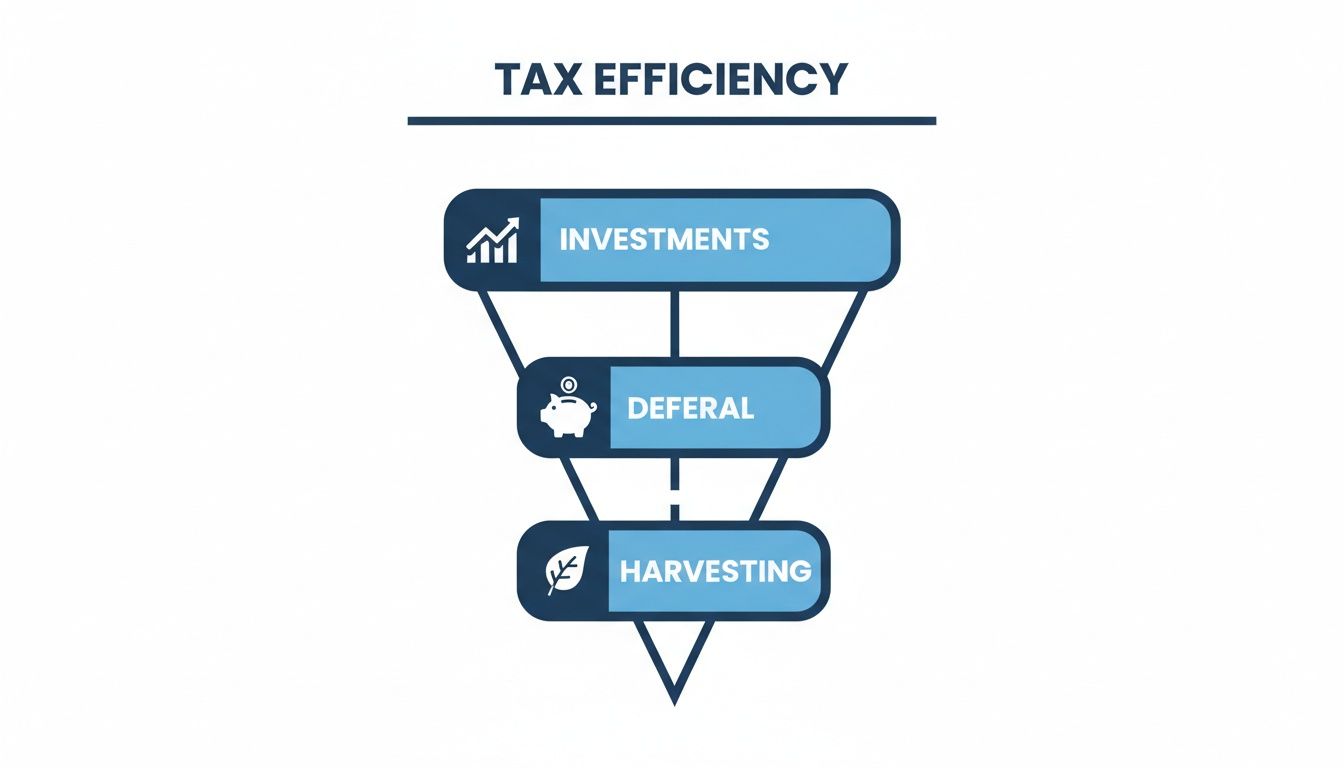
This image illustrates how a holistic approach to tax efficiency builds on itself—from smart investment choices to more complex strategies like income deferral and loss harvesting.
By gifting assets now, you lock in today’s more favorable rules and permanently remove those assets (and their future growth) from your taxable estate. Waiting could mean contending with a lower exemption down the road, leaving your heirs with a much larger tax bill. Ultimately, being proactive with your estate and gift planning is the definitive way to preserve what you’ve built and ensure your legacy endures.
Making a Difference: A Smarter Approach to Philanthropy

For many of the families we work with, giving back isn't an afterthought—it’s a driving force, a core part of the legacy they want to build. But effective philanthropy is about more than just good intentions. By being strategic, you can merge your passion for a cause with sophisticated tax planning, allowing you to give far more to the organizations you believe in while also improving your own financial picture.
Moving beyond simply writing a check opens up a world of more powerful, tax-efficient giving vehicles. These tools are specifically designed to amplify your impact in ways a simple cash donation never could.
The Power of Donor-Advised Funds
One of the most accessible and popular tools in the modern philanthropist's toolkit is the Donor-Advised Fund (DAF). The simplest way to think about a DAF is as your own personal charitable investment account. You make a contribution, get an immediate and full tax deduction for that year, and then the funds can be invested to grow tax-free.
This structure brilliantly decouples the timing of your tax deduction from your actual giving. You can, for example, make a large contribution in a particularly high-income year to maximize your tax savings. From there, you can recommend grants to your favorite charities over several months or even years, giving you time to be thoughtful and deliberate with your support.
The key advantages of a Donor-Advised Fund are clear:
- Immediate Tax Deduction: You get the full deduction in the year you contribute. This is perfect for "bunching" several years' worth of donations into a single year to easily surpass the standard deduction threshold.
- Tax-Free Growth: Once inside the DAF, your contribution can be invested. Any growth is tax-free, meaning your charitable dollars have the potential to become even more impactful over time.
- Simplicity and Privacy: All your giving is managed from one centralized account. You can also choose to make grants anonymously, which many of our clients appreciate.
Creating an Income Stream with Charitable Remainder Trusts
For those with more complex balance sheets, a Charitable Remainder Trust (CRT) offers a remarkable way to support a cause while creating an income stream for yourself. It’s a sophisticated tool that truly benefits both you and your chosen charity.
Here’s the basic idea: You transfer an appreciated asset—like company stock or a piece of real estate—into an irrevocable trust. The trust then pays you (or your chosen beneficiaries) an income for a set number of years or for the rest of your life. When the trust term ends, whatever is left over—the “remainder”—goes to the charity you designated.
A Charitable Remainder Trust is a classic win-win. It lets you turn a highly appreciated, non-income-producing asset into a reliable income stream, lock in a current tax deduction, and set up a major future gift to a cause you love.
This strategy is especially powerful for assets with a very low cost basis. Why? Because the trust can sell the asset without immediately triggering a massive capital gains tax bill, preserving more of the value for both your income stream and the final charitable gift.
The "Double" Tax Benefit of Giving Appreciated Assets
Perhaps the most potent philanthropic strategy has less to do with how much you give and more to do with what you give. Donating highly appreciated assets that you've held for more than a year—think stocks, mutual funds, or real estate—directly to a charity or into a DAF unlocks a powerful double tax benefit.
- You bypass capital gains tax. By donating the asset directly, you completely avoid the capital gains tax you would have owed if you had sold it first.
- You get a fair market value deduction. You can still claim a charitable deduction for the asset's full, fair market value on the day you donate it.
This one-two punch is a game-changer. It allows you to give significantly more to the causes you care about while simultaneously and substantially reducing your own tax burden. It’s one of the single most efficient tax strategies available for making your philanthropic dollars go further.
Navigating the Maze of State and Local Taxes
For high-net-worth families, your federal tax return is just one piece of the puzzle. The web of state and local taxes—often called SALT—can be just as draining on your wealth, if not more so. This is especially true if you own property, run a business, or spend significant time in more than one state. With the federal cap on SALT deductions still in place, smart state-level planning isn't just a good idea; it's essential.
The pull to relocate from high-tax states like New York or California to a no-income-tax haven like Florida or Texas is stronger than ever. But be warned: making the move isn't as simple as buying a condo and forwarding your mail. States are more aggressive than ever in pursuing residency audits, and they will fight to keep you on their tax rolls.
Domicile vs. Statutory Residency: It's Not Just Semantics
To have any chance of successfully managing your state tax bill, you have to get comfortable with two core concepts that auditors live and breathe: domicile and statutory residency.
- Domicile: Think of this as your forever home, the one place you intend to return to no matter where you travel. You can only have one domicile. Changing it is a major undertaking that requires you to prove you've truly severed ties with your old state and put down permanent roots in a new one.
- Statutory Residency: This is a much more black-and-white test based on a simple day count. Even if your official domicile is in Florida, New York can still tax you as a resident if you keep a home there and spend more than 183 days of the year within its borders.
Winning the state tax game means you have to solve for both. You need to formally establish a new domicile and meticulously count your days to avoid falling into the statutory residency trap in your old state.
Establishing a new domicile isn't about one single document; it's about the weight of the evidence. An auditor will look at the totality of your life—your "facts and circumstances"—to see where your true center of gravity lies.
How to Survive a Residency Audit
If you claim you've moved out of a high-tax state, assume you'll have to prove it. These states don't let high-earners go without a fight, and a residency audit is their primary weapon. The auditor's job is to poke holes in your story, and they'll dig into every aspect of your life.
Your job is to build an ironclad case. This means taking deliberate, concrete steps that show your intent:
- Switch Your Official Life: Get a new driver's license. Register to vote. Re-title your cars in the new state. These are the basics.
- Move What Matters: Where are the things you truly cherish? Auditors know that people don't leave family heirlooms, valuable art, or beloved pets behind. Make sure they are physically in your new home.
- Follow the Money: Every bank statement, credit card bill, and brokerage account should be updated with your new address. Your financial life needs to move with you.
- Put Down Community Roots: Don't just live there; belong there. Join a local country club, find a new doctor and dentist, and get involved with a local charity or religious organization.
Meticulous, almost obsessive, record-keeping is your best defense. A detailed travel calendar is non-negotiable. Keep receipts from local shops, save utility bills from your new home, and document your new social ties. You're building a body of evidence that proves your new state isn't just a tax strategy—it's home.
For business owners, the complexity multiplies. You also have to navigate a labyrinth of income sourcing rules and entity structuring to minimize exposure across multiple states, which is where expert guidance becomes indispensable.
Your Essential Year-End Tax Planning Checklist
As the year winds down, it’s easy to get caught up in the holiday rush. But for high-net-worth individuals, the fourth quarter is the final, critical window to make moves that can dramatically lower your tax bill for the entire year. A little proactive planning now can turn abstract tax strategies into very real savings.
This checklist isn’t just a list of tasks; it’s a roadmap for a smart, tax-efficient finish to the year. By tackling these items early in Q4, you give yourself—and your advisory team—the breathing room needed to execute them properly, avoiding that last-minute scramble that so often leads to missed opportunities.
Investment and Portfolio Adjustments
Your investment portfolio is one of the most powerful levers you can pull for year-end tax planning. A deep dive before December 31st is simply non-negotiable if you want to lock in tax efficiency.
Look for Tax-Loss Harvesting Opportunities: Go through your portfolio with a fine-tooth comb, looking for assets that are in the red. Selling these positions creates capital losses, which can then be used to wipe out capital gains you've realized elsewhere. It's a fantastic way to rebalance your portfolio while simultaneously creating a valuable tax shield.
Mind Your Capital Gains Timing: If you're thinking of selling an asset that's gone up in value, check the calendar. Holding it for just over a year before selling means your profit gets taxed at the much friendlier long-term capital gains rate. This simple act of patience could save you up to 17% in federal taxes.
Max Out Your Retirement Accounts: Before the ball drops, make sure you've contributed the absolute maximum to your 401(k), SEP IRA, or solo 401(k). Every dollar you put in is a direct reduction of your adjusted gross income (AGI) for the year. It's one of the easiest wins available.
The end of the year is a hard deadline for many of the most effective tax-saving maneuvers. Procrastination is the enemy of tax efficiency; starting your review in October or November is crucial for thoughtful execution.
Gifting and Estate Planning Moves
The end of the year is also the perfect time to make gifting moves that can shrink your future taxable estate. These strategies are straightforward, but they are governed by strict annual deadlines you can't miss.
Use Your Annual Gift Tax Exclusion: Each year, you can give a certain amount to anyone you like without having to file a gift tax return or eat into your lifetime exemption. For 2024, that amount is $18,000 per person. If you're married, you can double that, collectively giving $36,000 to each child, grandchild, or other heir, moving significant wealth out of your estate, completely tax-free.
Pay Medical or Tuition Bills Directly: Here’s a lesser-known but powerful strategy: any money you pay directly to a medical facility or educational institution on someone else's behalf doesn't count as a gift. There's no limit. It’s an incredibly effective way to provide meaningful support while trimming down your estate.
Strategic Charitable Giving
You can align your philanthropic goals with smart tax planning, and year-end is prime time to do it. The trick is to give in the most tax-advantaged way possible.
"Bunch" Donations in a Donor-Advised Fund (DAF): If your annual charitable giving isn't quite enough to push you over the standard deduction, consider "bunching." You can contribute several years' worth of donations into a Donor-Advised Fund now, claim one massive itemized deduction this year, and then grant the funds to your favorite charities over the next few years.
Donate Appreciated Stock, Not Cash: This is one of the single most powerful tax strategies for high-net-worth individuals. Instead of writing a check, consider donating stock or mutual funds that have grown in value (and that you've held for more than a year). This gives you a double tax benefit: you get to deduct the full fair market value of the stock, and you completely avoid paying any capital gains tax on the appreciation. It’s a win-win for you and the charity.
Frequently Asked Questions About HNWI Tax Strategies
Even the most well-crafted tax plan can bring up questions. Let's tackle some of the most common ones we hear from our clients, clearing up a few key points from this guide.
When Is the Right Time to Start Estate Planning?
The short answer? Now. Estate planning isn't something you do when you're old; it's something you start as soon as you have assets and people you care about.
For high-net-worth individuals, this is never a "set it and forget it" task. Think of it as a living plan that needs to be revisited after any major life event—a marriage, a new child, selling a business, or even just a significant change in tax law.
The most powerful strategies, like setting up trusts or executing a gifting plan, require careful implementation over time. A reactive approach almost always leaves significant money on the table.
Given how often estate tax exemptions can change, getting ahead of potential new rules is more critical than ever. Acting now helps lock in the benefits of today's more favorable laws.
Can I Just Move to a No-Tax State to Avoid State Taxes?
If only it were that simple. Changing your tax residency is a serious commitment, and states like California and New York know all the tricks. To make it stick, you have to prove you genuinely intend to make the new state your permanent home.
This goes way beyond just buying a house. It means getting a new driver's license, registering to vote, and—this is the big one—actually spending most of your time there. High-tax states are notorious for auditing former residents, so you'll need meticulous records to prove you’ve truly cut ties. Plus, you might still owe taxes to your old state on income you earn from sources there, like a local business or rental property.
What's the Single Biggest Tax Mistake High-Net-Worth Individuals Make?
Hands down, the most common and costly mistake is waiting too long. So many people put off tax planning until a huge event, like the sale of their company, is already in motion. Or they try to cram everything into the last few weeks of December.
This reactive approach slams the door on some of the most effective strategies out there. You simply can't backdate a trust or undo a poorly timed stock sale.
The best results always come from ongoing, year-round collaboration with your financial team. It gives you the space to model different scenarios and execute a thoughtful plan well before any deadlines, making sure no opportunity for tax savings is missed.
Navigating the complexities of HNWI tax law requires a dedicated partner who understands your unique financial picture. At Blue Sage Tax & Accounting Inc., we provide the year-round, proactive guidance needed to preserve your wealth and secure your legacy. Schedule a consultation to build your strategic tax plan today.