
When you invest in real estate, you're getting more than just a property. You're getting a powerful mix of potential appreciation, steady cash flow, and some of the most compelling tax advantages available anywhere. It’s this unique combination, especially deductions like depreciation and the ability to defer capital gains, that lets smart investors build wealth in a way other asset classes just can't compete with.
The Strategic Edge of Tax-Smart Real Estate Investing

Many investors get caught up in the obvious metrics—property value going up, rent checks coming in. While those are important, the most successful investors I’ve worked with know the real secret. The true financial power of real estate is baked right into the U.S. tax code.
Mastering the tax benefits isn't just a nice-to-have skill; it's a core pillar of building serious, long-term wealth. This isn’t about finding loopholes. It’s about understanding the rulebook.
This guide is designed to go deep, giving high-net-worth individuals, family offices, and committed investors a practical roadmap. We'll break down how to use specific IRS rules to turn a physical asset into an incredibly efficient tax-reduction engine, which is especially critical if you're dealing with high-tax states like New York.
Building Your Foundation of Knowledge
My goal here is to show you how these strategies actually work on the ground. Once you grasp the mechanics, you can evolve from being a passive landlord to an active architect of your own financial destiny.
The primary tools in your belt will be:
- Depreciation: This is the big one. It’s a powerful "phantom" deduction that reduces your taxable income without you spending an extra dime.
- Capital Gains Deferral: Think 1031 exchanges. These are strategies that let you roll profits from one property into another, growing your portfolio without getting hit with a huge tax bill along the way.
- Specialized Deductions: We’ll also get into the weeds on things like passive loss rules and the Qualified Business Income (QBI) deduction to chip away even further at what you owe.
Don't think of the tax code as a penalty box. It's a rulebook filled with incentives. For real estate investors, the government wants to encourage you to provide housing and develop properties, and it offers significant rewards for doing so.
It all starts with a mental shift. Your property isn't just generating rent; it's generating opportunities. Every mortgage payment builds your equity, and every properly documented expense—combined with depreciation—builds a powerful shield against taxes. This is the difference between getting average returns and creating true generational wealth.
Depreciation: The Cornerstone of Your Tax Strategy
When we talk about the tax advantages of real estate, one benefit stands head and shoulders above the rest: depreciation. It's the undisputed heavyweight champion and the primary engine that can generate massive tax savings for investors.
Here’s the core concept: depreciation allows you to create a "paper loss" even when your property is generating positive cash flow. Think of it as a phantom expense the IRS lets you deduct each year. You're not actually spending any money, but you get to subtract a portion of your property's value from your rental income, representing the theoretical wear and tear on the building.
This leads to a powerful outcome for investors. Let's say you collect $50,000 in rent and pay $30,000 in real cash expenses like mortgage interest, insurance, and property taxes. That leaves you with $20,000 in your pocket. But if you can also claim a $25,000 depreciation deduction, your taxable income suddenly becomes a $5,000 loss. You have cash in the bank but a loss on your tax return. That's the magic of depreciation.
Understanding Depreciation Schedules
The IRS has specific timelines, or "recovery periods," for depreciating property. Mastering these is non-negotiable for any serious investor. It's crucial to remember that you can only depreciate the building and its improvements—the land itself is not depreciable.
The two schedules you'll encounter most often are:
- Residential Real Estate: Depreciated over 27.5 years. This applies to apartment buildings, single-family rentals, and any property where at least 80% of the income comes from dwelling units.
- Commercial Real Estate: Depreciated over 39 years. This longer timeline covers office buildings, retail centers, industrial warehouses, and hotels.
This standard method, known as straight-line depreciation, gives you a predictable and consistent deduction year after year. It’s a reliable shield against your rental income. Consider this: a real estate investor holding a property for 10 years with 3% annual appreciation could face a blended annual tax rate of just 22.5%, with most taxes deferred until the sale. Compare that to a high-income bond investor paying the top marginal rate of 37%. The difference is stark. You can find a deeper dive into how private real estate investments benefit from these rules on schneiderdowns.com.
Let's look at a concrete example to see how this plays out for a cash-flowing property in a high-cost market like New York City.
Depreciation's Impact on a Sample NYC Property
This table illustrates how depreciation can create a tax loss on a cash-flow positive rental property, showcasing its powerful income-shielding effect.
| Metric | Annual Amount |
|---|---|
| Gross Rental Income | $120,000 |
| Less: Operating Expenses (taxes, insurance, etc.) | -$40,000 |
| Less: Mortgage Interest | -$35,000 |
| Net Operating Income (Cash Flow) | $45,000 |
| Less: Depreciation Expense | -$54,545 |
| Net Taxable Income (Loss) | ($9,545) |
As you can see, even with $45,000 in positive cash flow, this property generates a paper loss of nearly $10,000, effectively wiping out the tax liability on that income.
Supercharging Deductions with Cost Segregation
While straight-line depreciation is a fantastic tool, sophisticated investors can take it a step further with a strategy called a cost segregation study. This is how you truly maximize your tax savings in the early years of ownership.
Instead of treating the entire building as a single asset, a cost segregation study breaks it down into its individual components, which can be depreciated over much shorter timeframes.
A cost segregation study is like disassembling a car and valuing its parts separately. The engine, tires, and electronics all have different useful lives than the car's frame. In the same way, a building's carpeting, specialty lighting, and landscaping have shorter lifespans than its structural foundation.
A proper engineering-based study will reclassify various parts of the property into shorter-lived asset categories:
- 5-Year Property: Items like carpeting, cabinetry, and certain light fixtures.
- 7-Year Property: Includes things like office furniture and some equipment.
- 15-Year Property: Land improvements such as parking lots, fences, and professional landscaping.
By shifting a portion of the building's cost basis into these shorter recovery periods, you can front-load your depreciation deductions. This gives you a much larger tax write-off in the first few years of owning the property, which dramatically improves your immediate after-tax cash flow. Thanks to the time value of money, a dollar saved today is worth far more than a dollar saved 20 years from now.
When combined with bonus depreciation rules—which at times have allowed for a 100% write-off in year one—this strategy becomes incredibly powerful. For high-net-worth individuals and family offices, a cost segregation study isn't just an expense; it's a fundamental investment in tax efficiency that frees up capital for your next deal.
Deferring Gains to Build Generational Wealth
Depreciation is a fantastic annual tax shield, but what about the day of reckoning when you sell a property that has appreciated significantly over the years? That capital gains tax bill can be a brutal blow, wiping out a huge chunk of your hard-won growth.
Thankfully, the tax code gives savvy investors a few powerful ways to kick that can down the road. These strategies are the key to pyramiding your gains into larger and larger assets, allowing you to build true generational wealth.
The most famous tool in this toolbox is the Section 1031 exchange, often just called a "like-kind" exchange. Think of it as hitting the upgrade button on your portfolio without ever having to cash out your chips at the casino. Instead of selling one building, paying taxes on the profit, and then reinvesting the depleted remainder, a 1031 lets you roll the entire sale amount directly into the next deal.
This is how real estate empires are built. By deferring capital gains taxes—potentially forever if you keep exchanging—your equity compounds at its full potential, unburdened by a massive tax drag every time you want to make a move.
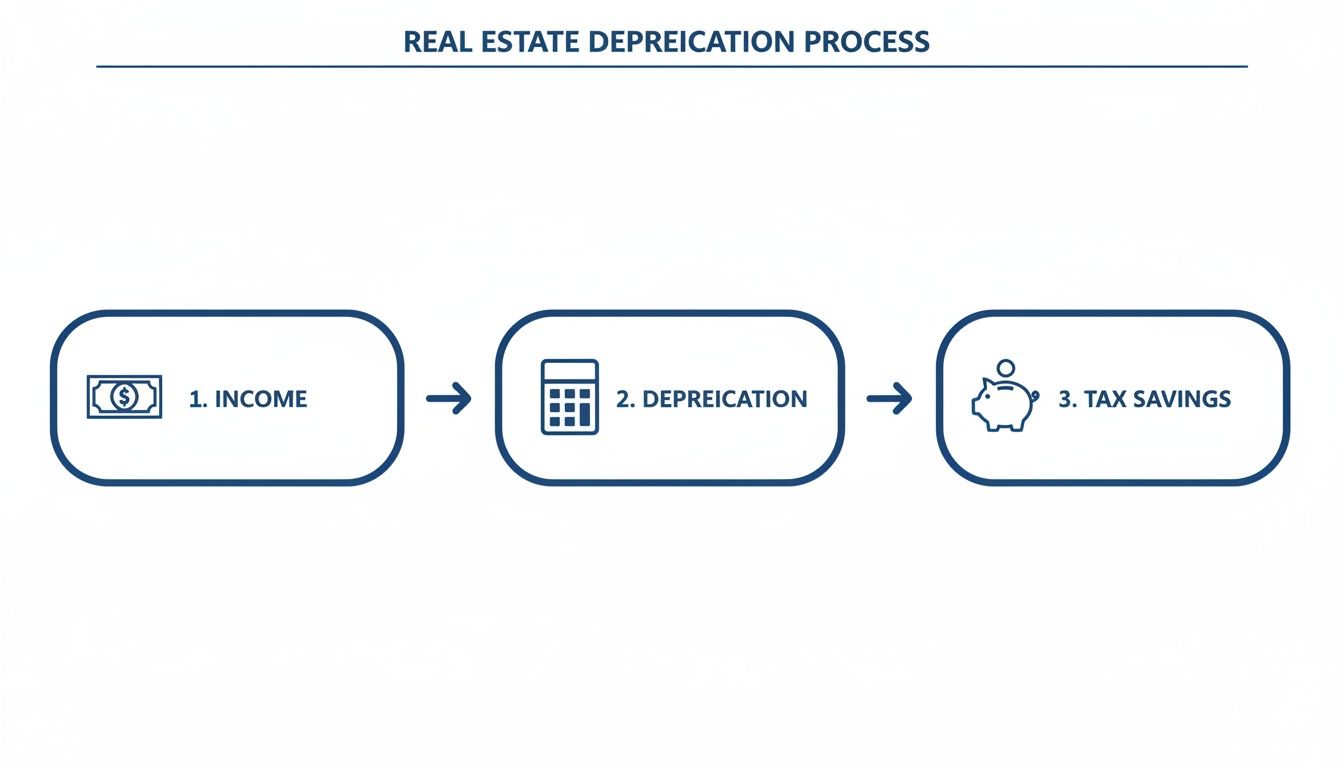
This diagram breaks down how deductions like depreciation directly reduce your taxable income. It’s a simple but powerful visual of the wealth-building engine at work.
Navigating the Strict Rules of a 1031 Exchange
With great power comes great responsibility, and the 1031 exchange is no exception. The rules are rigid, the deadlines are unforgiving, and a single misstep can blow up the entire tax deferral, triggering an immediate and painful tax bill. You absolutely must work with a qualified intermediary to navigate the process.
The two deadlines you cannot miss are:
- The 45-Day Identification Period: From the day you close the sale of your old property (the "relinquished property"), you have exactly 45 calendar days to formally identify, in writing, the potential properties you intend to buy.
- The 180-Day Closing Window: You then have 180 calendar days from that same sale date to actually close on one or more of those identified properties.
These clocks start ticking at the same time and there are no extensions. This means you need to be hunting for your next property long before you've even sold your current one.
A 1031 exchange isn't something you decide to do on a whim. It’s a precisely choreographed financial maneuver. Every step, from hiring the right intermediary to hitting every deadline, has to be perfect. Proactive planning isn’t just a good idea; it’s the only way to succeed.
On top of the timelines, to fully defer your taxes, the new property you buy must be of equal or greater value, and you must carry over at least the same amount of debt. Any cash you pull out of the deal (known in tax lingo as "boot") is taxable.
The UPREIT: A Sophisticated Alternative for Diversification
The 1031 is perfect for investors who want to stay hands-on, swapping one property for another. But what if you’re looking to transition into a more passive role and diversify your holdings? That’s where another advanced strategy, the Section 721 exchange, comes into play, usually through a structure called an UPREIT (Umbrella Partnership Real Estate Investment Trust).
Let’s say you own a valuable apartment building in NYC that’s been fully depreciated. Selling it would trigger a monster tax event, but you're tired of the headaches of being a landlord. An UPREIT offers an elegant way out.
Here’s the game plan:
- Contribution: Instead of selling your property, you contribute it to the operating partnership of a large, often publicly-traded, REIT.
- Receive Units: In return, you get operating partnership (OP) units, which are essentially equivalent to shares in the REIT itself.
- Tax Deferral: Under Section 721, this is generally a tax-free exchange. You’ve just turned a single, illiquid asset into a diversified, professionally managed, and liquid holding without writing a check to the IRS.
You can then hold those OP units, collect the quarterly distributions, and only pay capital gains tax if and when you decide to convert your units into publicly traded REIT shares. For long-time property owners, this is a brilliant exit ramp that unlocks liquidity and diversification while keeping your wealth intact. Understanding both 1031 and 721 exchanges is fundamental for any serious investor planning for the long haul.
Unlocking Deductions with Passive Loss and QBI Rules
While depreciation is a fantastic tool for generating “paper losses,” the IRS, of course, has a say in how you can actually use them. This is where two critical concepts come into play for every serious real estate investor: the Passive Activity Loss (PAL) rules and the Qualified Business Income (QBI) deduction.
Getting these rules right is the difference between watching valuable deductions evaporate and strategically using them to shelter a huge chunk of your other income. Think of the PAL rules as a gatekeeper—they decide which doors your real estate losses are allowed to open.
For most people, rental real estate is automatically classified as a "passive activity." That means any net losses you generate, mostly from depreciation, can only offset income from other passive activities, like the profits from another rental property. Crucially, they can't be used to reduce your active income, like your W-2 salary or profits from your primary business.
Breaking Through Passive Loss Limitations
Fortunately, the tax code carves out a powerful exception for those who are genuinely in the real estate business. If you can qualify as a Real Estate Professional, you can shatter those passive loss limitations.
This special status allows you to reclassify your rental real estate losses as non-passive. Suddenly, you can deduct them against all of your other income, with no ceiling. Imagine taking the paper losses from your property portfolio and using them to wipe out a significant portion of your salary or business income. It's one of the most potent tax advantages in the entire real estate playbook.
Achieving this status isn't for the faint of heart. You have to meet two very specific tests each and every year:
- You must spend more than half of your personal services in real property trades or businesses.
- You must log more than 750 hours a year materially participating in those real estate activities.
This requires a serious commitment and meticulous time tracking. But for a high-net-worth individual or a family office managing a substantial portfolio, the tax savings unlocked by meeting these criteria can be absolutely massive.
Tapping into the Qualified Business Income Deduction
Another essential tool in your tax-reduction arsenal is the Qualified Business Income (QBI) deduction, often called the Section 199A deduction. In simple terms, this rule lets eligible taxpayers deduct up to 20% of their qualified business income—and yes, this can include the net rental income from your properties.
It’s a direct, below-the-line deduction, meaning it simply lowers your total taxable income. You don't even need to itemize to take it. For a profitable property, this is an incredibly straightforward way to shield a fifth of your cash flow from the tax man.
The QBI deduction is a direct reward for engaging in business activities. The IRS even provides a safe harbor to help rental real estate qualify, transforming your holding from a simple investment into a "trade or business" for tax purposes. This unlocks that valuable 20% income shield.
To qualify your rental for the QBI deduction under its safe harbor provision, you need to treat it like a genuine business enterprise. The core requirements include:
- Maintaining separate books and records for each rental property or a consolidated group.
- Logging at least 250 hours of rental services per year (this time can be spent by you, your employees, or even your contractors).
- Keeping contemporaneous, detailed records of all hours, dates, and services performed.
For investors who run a profitable rental operation but don't quite meet the demanding Real Estate Professional tests, the QBI deduction is an absolute gift. It directly lowers your tax bill on the positive income your properties are generating, year after year, boosting your after-tax returns. Mastering both the passive loss rules and QBI eligibility is fundamental to building a truly effective real estate tax strategy.
Taking Your Strategy to the Next Level
Once you’ve got the fundamentals down—depreciation, capital gains, and basic exchanges—it's time to explore the strategies that separate the good investors from the truly great ones. For high-net-worth individuals and family offices, this is where the real magic happens. We're moving beyond simple tax savings and into the realm of sophisticated wealth preservation.
These are the tools that can fundamentally reshape your financial future, helping you navigate everything from multi-state tax headaches to the seamless transfer of your legacy to the next generation.
One of the most powerful tools to emerge in recent years is the Opportunity Zone (OZ) program. It was created to drive investment into underserved communities, but it also offers a fantastic trifecta of tax benefits for investors savvy enough to use it. The core idea is simple: you can roll capital gains from the sale of any asset—stocks, a business, art, another property—into a qualified OZ fund and unlock some serious advantages.
Opportunity Zones are more than just a tax break. They're a strategic play that lets you defer, reduce, and potentially eliminate capital gains taxes entirely, all while reinvesting your profits into projects with real community impact.
Here’s how it works in practice:
- Deferral: First, you get to postpone paying taxes on your original capital gain until the end of 2026 (or until you sell your OZ investment, if earlier). This keeps your capital working for you longer.
- Reduction: While some of the deadlines for this particular perk have passed, earlier investors were able to exclude a portion of their deferred gain from taxation altogether.
- Elimination: This is the real grand prize. If you hold your Opportunity Zone investment for at least 10 years, any and all appreciation on that investment is 100% tax-free.
That 10-year tax-free growth is a game-changer. It makes OZs a cornerstone strategy for anyone with patient capital who wants to maximize their after-tax returns over the long haul.
The Headaches of Multi-State Investing and the SALT Cap
Things get complicated quickly when your portfolio spans multiple states, especially if you're based in a high-tax area like New York City. Every state plays by its own rules when it comes to income, property, and transfer taxes. It’s a tangled web, and if you’re not careful, you can easily get caught. An investor in NYC, for instance, is already starting on the back foot, facing some of the highest tax rates in the country.
The federal $10,000 cap on State and Local Tax (SALT) deductions only adds to the pain. For an investor in New York, where property taxes on a single property can blow past that limit, the cap effectively neuters a major deduction. This reality makes federal-level tools like depreciation and the QBI deduction even more critical; they have to do the heavy lifting to offset the lost value from the SALT cap. Careful planning is the only way to manage your "nexus" (your taxable footprint in each state) and correctly allocate income to avoid penalties or paying more than you owe.
Choosing Your Weapon: The Right Legal Entity
How you own your properties is just as critical as which properties you buy. Your choice of legal entity affects everything from your personal liability to your tax bill. For most real estate investors, the decision boils down to two primary options: the Limited Liability Company (LLC) and the S-Corporation.
Both will shield your personal assets from business liabilities, but they treat taxes very differently.
| Feature | Limited Liability Company (LLC) | S-Corporation (S-Corp) |
|---|---|---|
| Taxation | Pass-through by default. All profits and losses land directly on your personal tax return. | Pass-through. Profits are paid out to shareholders as distributions. |
| Basis Rules | Here's the key: Members can include their share of the property's mortgage debt in their basis, which often means bigger loss deductions. | Shareholders cannot include entity-level debt in their basis. This severely limits the amount of losses they can deduct. |
| Distributions | Highly flexible. Profits can be distributed unevenly among members if the operating agreement allows. | Inflexible. All distributions must be strictly proportional to each shareholder's ownership stake. |
| Best For | The go-to for holding appreciating rental properties. The basis rules are perfectly suited for maximizing depreciation. | Better for active businesses like "fix-and-flip" operations or property management companies with high operating income. |
For the vast majority of buy-and-hold investors, the LLC is the clear winner. That seemingly technical rule about including debt in your basis makes all the difference. It allows you to take full advantage of the paper losses generated by depreciation—losses you might not be able to deduct at all if the property were held in an S-Corp.
Finally, pulling all of this into a comprehensive estate plan is the capstone. By holding your properties in vehicles like trusts, you can ensure a smooth transition of wealth to your heirs. Better yet, they often receive a "step-up" in basis, which can wipe out a lifetime of capital gains tax liability. This kind of foresight is what turns a successful real estate portfolio into a true multi-generational legacy.
Tax Advantages of Alternative Real Estate Investments

Owning property directly isn't the only way to tap into real estate's powerful tax advantages. For investors who prefer diversification and a more hands-off role, structures like Real Estate Investment Trusts (REITs) bring their own unique tax efficiencies to the table.
Think of a REIT as a mutual fund for real estate. It’s a company that owns, operates, or finances a portfolio of income-producing properties. Investing in a REIT gives you a piece of everything from apartment buildings and office towers to warehouses and shopping centers, all without the headaches of being a landlord.
The real magic of REITs lies in their special tax status. To qualify, a REIT must distribute at least 90% of its taxable income to shareholders as dividends. The trade-off? The REIT itself pays no corporate income tax. This completely sidesteps the "double taxation" that plagues typical corporate investments, meaning more of the profits make it directly into your pocket.
Leveraging the QBI Deduction for REITs
The tax perks don't end there. Many of the dividends paid out by a REIT can be eligible for the Qualified Business Income (QBI) deduction. This is a big deal. It means you may be able to deduct up to 20% of that dividend income right off the top, significantly boosting your after-tax return.
By avoiding corporate taxes and passing through the QBI deduction, REITs offer a compelling proposition for high-net-worth investors. The 20% QBI deduction can effectively reduce the top federal tax rate on these ordinary dividends from 37% down to 29.6% (through 2025). You can find more insights on tax implications for REIT investors on Nuveen's website.
Understanding Return of Capital
One of the most powerful, and often misunderstood, features of REIT dividends is the concept of return of capital (ROC). Because REITs generate significant non-cash depreciation deductions, they can pass that benefit along to you. This means a portion of the cash dividend you receive isn't actually considered taxable income for the year.
Return of capital isn't a refund. It’s a non-taxable distribution that lowers your cost basis in the REIT shares. This defers the tax, rather than eliminating it, until you sell your position.
This creates a fantastic one-two punch for tax efficiency:
- Lower Your Current Tax Bill: A chunk of the cash hitting your account arrives tax-free for the year.
- Defer the Tax Hit: The ROC portion reduces your cost basis, which simply increases the capital gain you'll realize down the road when you sell the shares.
This structure allows you to enjoy steady cash flow with a much smaller immediate tax bite, letting your capital compound more effectively. For anyone seeking passive real estate exposure with smart, built-in tax advantages, REITs are an incredibly accessible and efficient alternative to direct ownership.
A Few Common Questions We Hear
When you get into the nitty-gritty of real estate tax law, a few questions always seem to pop up. Let's tackle some of the most common ones we hear from investors, which should help clarify a few key concepts.
"Can I Use a 1031 Exchange for My Personal Home?"
This is a classic point of confusion, and the answer is a firm no. The powerful tax deferral of a Section 1031 exchange is strictly reserved for properties held for investment or used in a trade or business. Your primary residence or a family vacation home just doesn't qualify.
But don't worry, your home has its own fantastic tax break: the Section 121 exclusion. This allows you to exclude up to $250,000 of capital gain ($500,000 if you're married and file jointly) when you sell. For most homeowners, this is a much better deal than a 1031 exchange would be anyway.
What about that vacation home? It could potentially qualify for a 1031, but you have to walk a very fine line. You'd need to severely limit your personal use and run it almost exclusively as a rental property to convince the IRS it was "held for investment."
"How Does the SALT Cap Hit NYC Real Estate Investors?"
The $10,000 cap on State and Local Tax (SALT) deductions stings everyone in high-tax areas, but it's especially painful for New York City real estate investors. For many property owners here, the annual property tax bill alone can blow right past that federal deduction limit.
This reality makes all the other federal tax strategies we've discussed absolutely critical.
With the SALT cap neutralizing a significant deduction, your other tools—like aggressive depreciation and the QBI deduction—have to do the heavy lifting. They become the primary drivers for cutting your federal tax bill and offsetting the financial drag from the cap.
Think of it as a strategic reallocation. The tax savings you can no longer get from your state and local tax write-offs have to be found elsewhere. Meticulous planning around federal real estate incentives is how you do it.
"What's the Biggest Tax Mistake Investors Make?"
Hands down, the most costly and frequent mistake is simply poor record-keeping. When you fail to track every single expense, you are voluntarily giving more of your money to the IRS. We're talking about everything from a $50 repair and mileage for property visits to professional fees and major capital improvements.
Right behind that is misclassifying expenses. It's easy to get this wrong. Fixing a leaky pipe is a repair, which is a current-year deduction. Replacing the entire plumbing system is an improvement, which has to be capitalized and depreciated over time. Confusing the two can lead to an audit and disallowed deductions.
Good, consistent documentation isn't just a best practice; it's your best defense. It's the only way to truly unlock all the tax benefits real estate investing has to offer.
Staying on top of these details requires a proactive and strategic game plan. At Blue Sage Tax & Accounting Inc., our entire focus is on helping NYC-based real estate investors, family offices, and business owners create and implement tax strategies that support their financial goals. Learn how our dedicated team can provide the clarity and confidence you need to optimize your portfolio by visiting us at bluesage.tax.