Filing a business tax extension can feel like a godsend, giving you a precious six-month window to get your paperwork in order. Depending on your business structure, this pushes your final deadline to either September 15 or October 15. But there’s a crucial catch that trips up even seasoned entrepreneurs.
This is an extension to file, not an extension to pay.
Why a Tax Extension Is Not a Payment Holiday
For most business owners, tax season is a mad dash to the finish line. When you can’t make it, an extension seems like a lifesaver. The most common—and costly—mistake is assuming that this extra time to file also means you have extra time to pay what you owe. That’s simply not the case.
Think of it this way: your professor might give you an extra week to polish your term paper, but the tuition was still due at the beginning of the semester. The IRS works on a similar principle. They’ll grant an automatic extension to submit your return, but they expect you to have paid a reasonable estimate of your tax bill by the original deadline.
This timeline gives you a bird's-eye view of the key dates for different business types, from the initial spring due dates to the final fall extension deadlines.
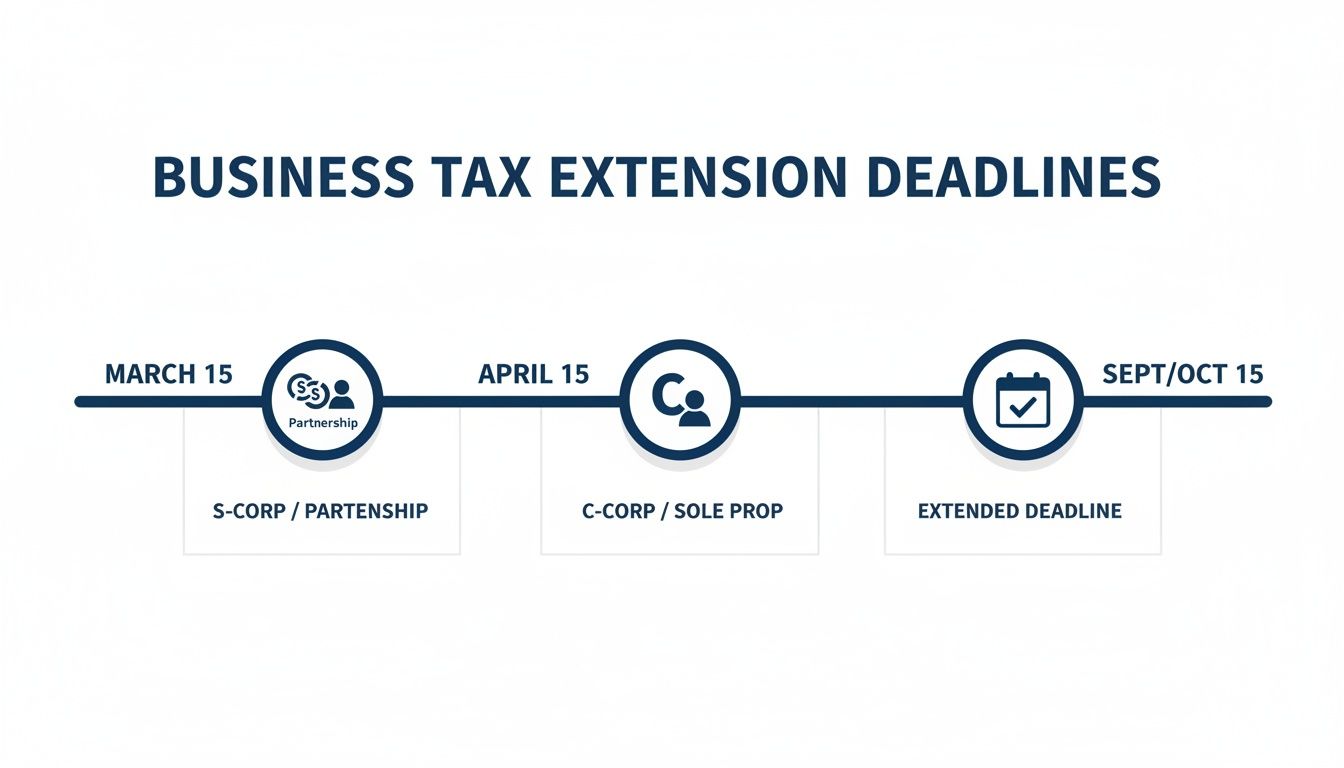
As you can see, the extension provides a significant buffer for gathering documents and finalizing your return, but the clock on your tax payment starts ticking much earlier.
To help you keep these dates straight, here’s a quick summary of the federal deadlines.
Federal Business Tax Deadlines at a Glance
This table provides a clear summary of the standard and extended federal tax filing deadlines for the most common business structures.
| Business Entity Type | Tax Form | Original Filing Deadline | Extended Filing Deadline |
|---|---|---|---|
| S Corporation | Form 1120-S | March 15 | September 15 |
| Partnership | Form 1065 | March 15 | September 15 |
| C Corporation | Form 1120 | April 15 | October 15 |
| Sole Proprietor / LLC | Schedule C (Form 1040) | April 15 | October 15 |
Remember, these dates are for businesses operating on a standard calendar year. If you have a fiscal year-end, your deadlines will be different.
The Critical Distinction: Filing vs. Paying
Getting this concept right is the key to using an extension as a smart business tool, not a financial trap. If you don't, you could face penalties and interest that completely negate the benefit of having extra time.
- Filing is the act of submitting your completed tax forms (like Form 1120-S or Schedule C) to the IRS. The extension gives you more time to do this correctly.
- Paying is the act of sending the U.S. Treasury the money you owe for the tax year. This payment is almost always due on the original deadline in March or April.
The single most important takeaway is this: An extension to file is not an extension to pay. If you don't pay your estimated tax liability by the original due date, you will owe penalties and interest, even with a valid filing extension.
Strategic Planning for New York Businesses
For businesses operating in a complex tax environment like New York, this distinction is even more important. New York State and New York City have their own tax obligations and deadlines, like the NYC Unincorporated Business Tax (UBT).
A federal extension doesn't automatically cover these local requirements. Proper planning means accurately estimating your total tax liability—federal, state, and city—and making those payments on time to avoid a painful cascade of penalties. This foresight turns a stressful deadline into a manageable process, protecting your cash flow and keeping you compliant on all fronts.
Deadlines for S Corps and Partnerships
If you run an S corp or a partnership, you’re on a different tax clock than most other businesses. These "pass-through" entities have an earlier tax deadline, which creates a domino effect for the owners who need that information for their personal returns. Getting a handle on this unique timeline is the first and most critical step to staying compliant.
The standard filing deadline for S corp returns (Form 1120-S) and partnership returns (Form 1065) is March 15 for any business using a calendar year. There's a good reason for this early date: it’s designed to give partners and shareholders their Schedule K-1s in time to meet their own April 15 personal tax deadline.

But let's be realistic. For many businesses, particularly those with complex ownership structures or significant real estate holdings, hitting that March 15 target just isn't in the cards. That’s where a business tax extension deadline becomes an essential tool in your financial strategy.
Getting a Six-Month Breather
By filing Form 7004, S corps and partnerships can get an automatic six-month extension. This simple form pushes the final filing deadline from March 15 all the way to September 15.
Filing Form 7004 is straightforward, but it’s non-negotiable that you submit it by the original March 15 due date. And it's crucial to remember that this is an extension to file, not an extension to pay. You still need to make a reasonable estimate of any taxes owed and pay that amount by March 15 to steer clear of penalties and interest.
The extra time from an extension is invaluable for ensuring your return is complete and correct. This is especially true for the upcoming tax year 2025 filing season. Because March 15, 2026, falls on a Sunday, the initial due date is pushed to March 16, 2026. Filing Form 7004 will move the extended deadline to September 15, 2026. This is a lifesaver for closely held businesses and investors who are often waiting on a stack of K-1s, especially when dealing with multi-state operations in places like New York City where local filings add another layer of complexity. You can find more details in our complete guide to 2025 tax deadlines and how they affect business planning.
Why S Corps and Partnerships Often Need an Extension
The extension isn't just for procrastinators; it's a strategic necessity for many pass-through entities. These businesses don't just report their own numbers—they have the complex job of accurately allocating all profits, losses, deductions, and credits to each individual owner.
Here are a few common reasons why that extra time is so valuable:
- Waiting on K-1s: If your business is an investor in another partnership, you can't finalize your books until you receive a K-1 from that entity. It’s a classic waiting game.
- Complex Transactions: A year involving a major asset sale, a business acquisition, or a significant real estate deal demands more time to get the accounting and tax treatment right.
- Ownership Changes: Bringing on new partners or managing an owner's buyout can make the allocation process incredibly complicated.
- Uncovering Savings: The extra six months give your accountant the breathing room to do a deep dive, uncovering deductions and credits that would almost certainly be missed in a last-minute scramble.
Missing the March 15 deadline without filing for an extension is a costly mistake. The IRS penalty for a late partnership return is calculated per partner, per month, and it adds up shockingly fast. S corporations face similar steep penalties.
Ultimately, the business tax extension deadline for S corps and partnerships is more than a safety net—it’s a fundamental part of a smart annual tax cycle. Using that time well leads to greater accuracy, a lower risk of penalties, and the opportunity to truly optimize your tax outcome.
Extension Rules for C Corporations
Unlike pass-through entities that often have a March deadline, C corporations follow a more familiar schedule. For any C corp on a standard calendar year, the original due date to file Form 1120, U.S. Corporation Income Tax Return, and pay any tax owed is April 15. It’s the same day most of us are thinking about our personal taxes, but for a business, the rules around extensions and payments carry serious weight.
When corporate accounting gets complicated—think multi-state operations or waiting on final financial statements—hitting that April 15 filing deadline just isn't realistic. That's where Form 7004 comes in. Filing this simple form grants an automatic six-month extension, pushing the C corporation’s business tax extension deadline out to October 15. It’s an essential buffer to get the numbers right.
But here’s the catch that trips up so many businesses: that extension is only for the paperwork. The tax payment itself is not extended and is absolutely due on April 15.

The Down Payment Analogy
I often tell my clients to think of their estimated tax payment like a down payment on a house. You wouldn’t expect a seller to hold a property for you for six months without a significant deposit, right? The IRS feels the same way about your tax bill. You have to pay a reasonable portion of what you expect to owe by the original deadline to show you're serious and to steer clear of penalties.
This "down payment" is your best educated guess of your total tax liability for the year. Nailing this estimate is the single most important part of using an extension without getting hit with a nasty financial surprise later.
Meeting the Safe Harbor Requirement
To protect businesses that make a good-faith effort to pay on time, the IRS offers a "safe harbor" rule. To qualify, you generally need to pay at least 90% of the tax you ultimately owe for the year by that April 15 deadline. Meeting this threshold is your best defense against the failure-to-pay penalty, even if your final tax bill comes in a little higher than you estimated.
Fall short of that 90% mark, and the consequences start adding up immediately.
Key Takeaway: The 90% safe harbor isn't a suggestion; it's your shield. If you don't meet it, the IRS will begin charging penalties and interest on the unpaid amount, calculated all the way back to the original April 15 due date, regardless of your extension.
For calendar-year 2025 returns, this means a C corp’s original deadline is April 15, 2026, which an extension pushes to October 15, 2026. This is especially relevant for our clients in New York, like closely held businesses and real estate developers, who often need extensions to sort through complex state and international tax matters. But remember, the taxes are still due by April 15 to avoid a failure-to-pay penalty of 0.5% per month (capped at 25%) plus interest, which recently hovered around 8%. You can learn more about how these 2025 business tax deadlines will shape compliance strategies.
A Strategic Window for Financial Planning
Don't ever think of filing an extension as a sign of being disorganized. When done right, it’s actually a sharp strategic move. That six-month window between April 15 and October 15 is a golden opportunity for a deeper financial review.
Here’s how smart businesses use that extra time:
- Finalize Complex Accounting: It gives you the breathing room to properly account for a merger, acquisition, or a major asset sale from the previous year.
- Optimize Tax Credits: It provides the time needed to perform detailed studies for valuable credits, like the R&D tax credit, which requires thorough documentation.
- Refine Financial Strategies: It allows leadership and their advisors to analyze the full picture of the prior tax year and make smarter decisions for the current one.
For a C corporation, the business tax extension deadline is a tool for precision. By paying a carefully calculated estimate on time and using the extra six months to perfect your return, you turn a simple compliance task into an opportunity for real financial planning.
Filing Extensions for Sole Proprietors
If your business is a sole proprietorship or a single-member LLC, the IRS sees your business and personal finances as a single entity. Unlike a corporation with its own separate tax return, all your business activity gets reported on a Schedule C, Profit or Loss from Business, which is then attached directly to your personal Form 1040.
This setup means your business tax deadline is simply your personal tax deadline. For most, that’s April 15.
When you need more time to get your books in order, you don't file a special business extension. Instead, you'll file Form 4868, the Application for Automatic Extension of Time to File U.S. Individual Income Tax Return. This one form grants you an automatic six-month extension, pushing your filing deadline all the way to October 15. It's a straightforward but essential tool that gives you the breathing room to make sure every deduction is found and every dollar of income is reported correctly.
The Personal Connection in Business Extensions
Because a sole proprietorship isn't a separate tax entity, filing for a personal extension covers your entire financial world. It’s not just for the business income on your Schedule C. It also includes everything else that goes on your Form 1040, such as:
- Investment Income: Think capital gains and dividends from brokerage accounts.
- Rental Properties: All the income and expenses tied to your real estate investments.
- Other Income Sources: W-2 wages, other freelance projects, or any other earnings.
This is especially important for the high-net-worth individuals we work with here at Blue Sage. For them, the October 15 business tax extension deadline is a key component of a much larger financial strategy. That extra time is non-negotiable for gathering documents from dozens of sources—K-1s from various partnerships, 1099s from different investments, and detailed records from their own business operations.
Trying to rush everything for an April deadline often leads to missed deductions or misreported income, which can result in costly mistakes. The extension turns what would be a frantic scramble into a calm, deliberate review of your complete financial picture.
Why October 15 Is a Critical Final Deadline
The October 15 deadline is the final cutoff for a huge number of taxpayers. For sole proprietors, high-net-worth individuals, and owners of pass-through entities, this date is the last chance to file after getting that initial extension with Form 4868. It’s no surprise that e-filing is the preferred method, with rates expected to hit 90% for extension filers in 2025. This move to digital submission cuts processing errors by a remarkable 50% and can shrink refund wait times from six weeks down to just 21 days.
But missing this final deadline brings serious consequences. The average penalty for filing late after an extension is $450 per return. When you factor in interest for balances over $50,000, the total hit can easily climb past $5,000—a painful reality that often affects real estate investors. You can read more about the IRS reminders on the October deadline to grasp the full weight of this cutoff.
Important Reminder: As with every other business entity, Form 4868 gives you more time to file, not more time to pay. You still need to estimate your total tax liability for the year—from both your business and personal sources—and pay that amount by the original April 15 deadline to steer clear of penalties and interest.
Navigating New York and NYC Tax Extensions
Running a business in New York adds a whole other layer to your tax strategy. It’s easy to get a federal extension and think you’re all set, but that’s a dangerous assumption. Your obligations to New York State (NYS) and New York City (NYC) are completely separate, each with its own set of rules, forms, and deadlines.
Think of it like this: your federal tax extension is your main travel visa. It gets you clearance from the national government. But if you're visiting a special region within that country, you might need a separate local permit. In this case, NYS and NYC both require their own specific "permits" to give you more time to file.

This is where so many business owners get tripped up. Assuming one extension covers everything is a common trap that leads to surprise late-filing penalties from the state and city, even if you’ve done everything right on the federal side.
The New York State Extension Requirement
Here’s the deal: New York State won’t automatically give you an extension just because you filed one with the IRS. To get that crucial six-month cushion for your business tax returns, you have to file a separate state-specific form by the original due date.
- For C corporations and S corporations, you'll need to file Form CT-5 or Form CT-5.4.
- For partnerships and LLCs taxed as partnerships, your form is IT-370-PF.
- For sole proprietors, the personal extension you file on Form IT-370 also covers your business filing obligations.
And just like with the IRS, this is an extension of time to file, not an extension of time to pay. You still have to estimate what you owe and pay your NYS tax liability by the original deadline to steer clear of penalties and interest.
Understanding Unique New York City Taxes
If your business operates within the five boroughs, you’ve got one more level of compliance to manage. New York City has its own specific business taxes, and you guessed it—they have their own distinct forms and business tax extension deadline rules that are totally separate from both federal and NYS requirements.
Key Insight: Forgetting to file a separate extension for NYC taxes is one of the most common and expensive mistakes a New York business can make. The city's penalty and interest rates can be unforgiving.
Two of the most common NYC business taxes you need to know are:
- General Corporation Tax (GCT): This is for C corporations doing business in the city. To get an extension, you must request it using Form NYC-EXT.
- Unincorporated Business Tax (UBT): This tax hits partnerships, LLCs, and sole proprietorships operating in NYC. The extension form for this is Form NYC-EXT.1.
Missing the deadline for these city-specific forms will trigger penalties directly from the NYC Department of Finance, no matter what you’ve filed at the federal or state level. For businesses juggling operations in multiple states, complex real estate holdings, or intricate ownership structures, keeping these deadlines straight is a huge challenge. This is exactly where proactive guidance from a firm like Blue Sage becomes so valuable, making sure no deadline slips through the cracks and no unnecessary penalties are paid.
Common Questions About Tax Extensions
When it comes to the business tax extension deadline, a few key questions always seem to pop up. Since misinformation can lead to costly mistakes, getting straight answers is the first step toward making a sound financial decision. Let's tackle the most common points of confusion so you can move forward with confidence.
Probably the biggest myth out there is that filing an extension is like waving a red flag at the IRS, inviting an audit. It’s time to put that one to rest.
Does Filing an Extension Increase My Audit Risk?
No, that’s just a persistent tax myth. There is absolutely no credible evidence to suggest that filing Form 7004 or Form 4868 makes you a more likely target for an IRS audit.
Think about it from the IRS's perspective. They trigger audits based on what’s in the return—things like unusually large deductions that don't match your income, major mathematical errors, or discrepancies between your numbers and what third parties report on 1099s. The date you file is simply not part of their risk analysis.
In fact, the opposite is often true. Using an extension to file an accurate, well-documented return is always smarter than rushing to meet the original deadline with a return full of potential errors. A correct return is your single best defense against an audit.
What Happens if I Miss the Extension Deadline?
This is where things get serious. Missing the final, extended deadline—September 15 for S corps and partnerships or October 15 for C corps and sole proprietors—is a costly mistake. Once that date passes, the protection of your extension vanishes, and the penalties start piling up immediately.
The Failure to File penalty is the big one. It’s calculated at 5% of the unpaid tax for each month (or part of a month) your return is late, and it can grow to a maximum of 25% of your tax bill. On top of that, you'll still be on the hook for the Failure to Pay penalty and compounding interest if you didn't pay your estimated tax by the original spring deadline.
Can I Extend My Time to Fund My Retirement Plan?
This is a great question, and the answer really depends on the type of retirement plan you have. An extension can be a fantastic tool for maximizing contributions, but you need to know the specific rules.
For Business Plans: If you have a business-sponsored plan like a SEP IRA or a solo 401(k), the news is good. You generally have until your extended tax filing deadline (September 15 or October 15) to make contributions for the previous tax year.
For Personal Plans: Unfortunately, that flexibility doesn't carry over to personal accounts. The contribution deadline for Traditional and Roth IRAs is locked in on the original tax day, typically April 15, regardless of whether you file an extension for your tax return.
What if I Am Living and Working Abroad?
The IRS does have special rules for U.S. citizens and resident aliens who are out of the country on the tax filing deadline. If that's you, you typically get an automatic two-month extension to file your personal return, which pushes your deadline from April 15 to June 15.
If you still need more time after that, you can then file Form 4868 to extend your deadline all the way to October 15. But here’s the critical detail: this is an extension to file, not to pay. Interest will still start ticking on any taxes owed from the original April 15 deadline.
Juggling the deadlines for federal, New York State, and NYC taxes requires a sharp eye and proactive planning. To make sure every date is met and your financial strategy is sound, it pays to partner with an expert who sees the whole picture. Contact Blue Sage Tax & Accounting Inc. today to see how we can help.