Navigating New York's sales tax system can feel like just another compliance headache. But what if you saw it as a powerful financial tool instead? This guide is all about reframing New York sales tax exemptions—not as a burden, but as a genuine opportunity for businesses, nonprofits, and real estate investors to boost cash flow and slash operating costs. In a high-tax state like New York, mastering these rules isn't just good practice; it's a critical financial advantage.
A New Way to Look at New York Sales Tax Exemptions
Most business owners treat sales tax as a simple pass-through: collect it, remit it, and move on. But that view misses the bigger picture. Think of the state's tax code less like a solid wall and more like a building with specific, intentional doorways. Those doorways are the exemptions, and knowing how to find and use them can lead to massive savings.
We’ve designed this guide to be your blueprint. We'll start with the basics, like resale certificates, and then move into more complex scenarios involving real estate and manufacturing. By the time you're done, you'll see how a smart, proactive approach to sales tax can become a cornerstone of your financial strategy.
Why Exemptions Exist (And Why They Keep Growing)
New York’s system of exemptions wasn't built overnight. It has evolved significantly over the years. When the state first introduced its sales tax back in 1965, lawmakers wrote in over 40 exemptions to ease the burden. Fast forward to 2009, and that number had ballooned to 145.
That’s a 72.6% increase in just over two decades, a trend that reflects an ever-changing economy and the state's desire to use tax policy to spur growth. This history, detailed in a New York State Senate report on budget and tax reform, shows that these exemptions are deliberate policy tools designed to support key industries and activities.
The real trick isn't just knowing that exemptions exist, but understanding why they exist. Each one—from manufacturing equipment to purchases made by a nonprofit—serves a distinct economic purpose, like preventing tax from being charged on top of tax ("tax pyramiding") or supporting charitable work.
Adopting this mindset shifts compliance from a reactive chore to a proactive opportunity. It allows you to structure your transactions and operations in a way that legally minimizes your tax footprint, freeing up capital for growth, investment, and innovation.
The Core Principles of Sales Tax Exemptions in NY
To really get a handle on New York sales tax exemptions, you have to look past the forms and regulations and understand the "why" behind it all. These exemptions aren't just random loopholes. They're built into the tax code on purpose to keep the system running fairly and efficiently, preventing some pretty unfair tax situations for both businesses and their customers.
The biggest idea to grasp is the prevention of tax pyramiding. Think about a local bakery making bread. The baker buys flour from a supplier. If they had to pay sales tax on that flour, and then you, the customer, also paid sales tax on the finished loaf of bread, the value of that flour gets taxed twice. This kind of tax-on-tax-on-tax situation is what’s known as pyramiding, and it just drives up prices for everyone.
New York's whole system is designed to avoid this by taxing a product just once: at the final sale to the person who will actually use it.
The Relay Race Analogy for Resale
I often think of the supply chain like a relay race. A manufacturer makes a product and passes the baton to a wholesaler. The wholesaler, in turn, passes it to a retailer. No sales tax is collected during any of these handoffs.
It's only when the retailer passes that baton to the final runner—the customer who is taking it home—that the race is over and the tax is finally charged. The resale exemption is what allows every business in that chain to accept the baton tax-free, on the promise that they're just passing it along. This is how the state ensures the tax only hits at the finish line.
An exemption certificate is the official proof that a buyer is a legitimate "runner" in the race and can take the baton without paying tax. For any seller, accepting a valid certificate in good faith is your shield; it protects you from being on the hook for uncollected tax down the road.
Major Categories of New York Sales Tax Exemptions
While the tax code is full of very specific rules, most exemptions fit into a handful of major categories. Getting familiar with these groupings makes it much easier to see the bigger picture of the state's tax policy and spot where your own business might qualify.
To help you get started, here's a quick look at the most common categories of sales tax exemptions in New York.
| Exemption Category | Primary Beneficiary | Example Scenario |
|---|---|---|
| Sales for Resale | Wholesalers, retailers, and distributors | A clothing boutique purchases dresses from a designer to sell in their store. |
| Exempt Organizations | Nonprofits, government agencies, and schools | A registered 501(c)(3) charity buys office supplies for its administrative headquarters. |
| Manufacturing & Production | Manufacturers and industrial producers | A factory purchases machinery that will be used directly and predominantly to produce goods for sale. |
| Exempt Goods & Services | General consumers and businesses | Purchasing basic groceries like milk and bread, or services like medical care, which are not taxed. |
As you can see, each category serves a different purpose, and each comes with its own set of rules and required documents.
Take the manufacturing exemption, for example. It often comes down to the concept of "direct use." This means a piece of equipment you buy must be an active and essential part of the actual production line. A forklift that just moves finished boxes around a warehouse probably won't qualify, but the conveyor belt that moves parts through the assembly process likely will. Understanding these foundational concepts is the first real step toward navigating the system correctly.
How to Claim and Document Your Exemptions Correctly
Knowing the what and why of New York sales tax exemptions is one thing. But getting the how right is what keeps your business safe during an audit. Claiming an exemption isn’t a passive exercise; it’s an active process that demands precise documentation from both the buyer and the seller. If you get it wrong, the financial fallout can be significant.
At the heart of every tax-free sale is one critical document: a valid exemption certificate. Think of it as the legal handshake proving a purchase isn't subject to sales tax. The buyer must provide a complete and accurate certificate when they make the purchase, and you, the seller, have a duty to accept it in "good faith."
This flowchart shows how these certificates function in a typical supply chain, from the factory to the storefront.
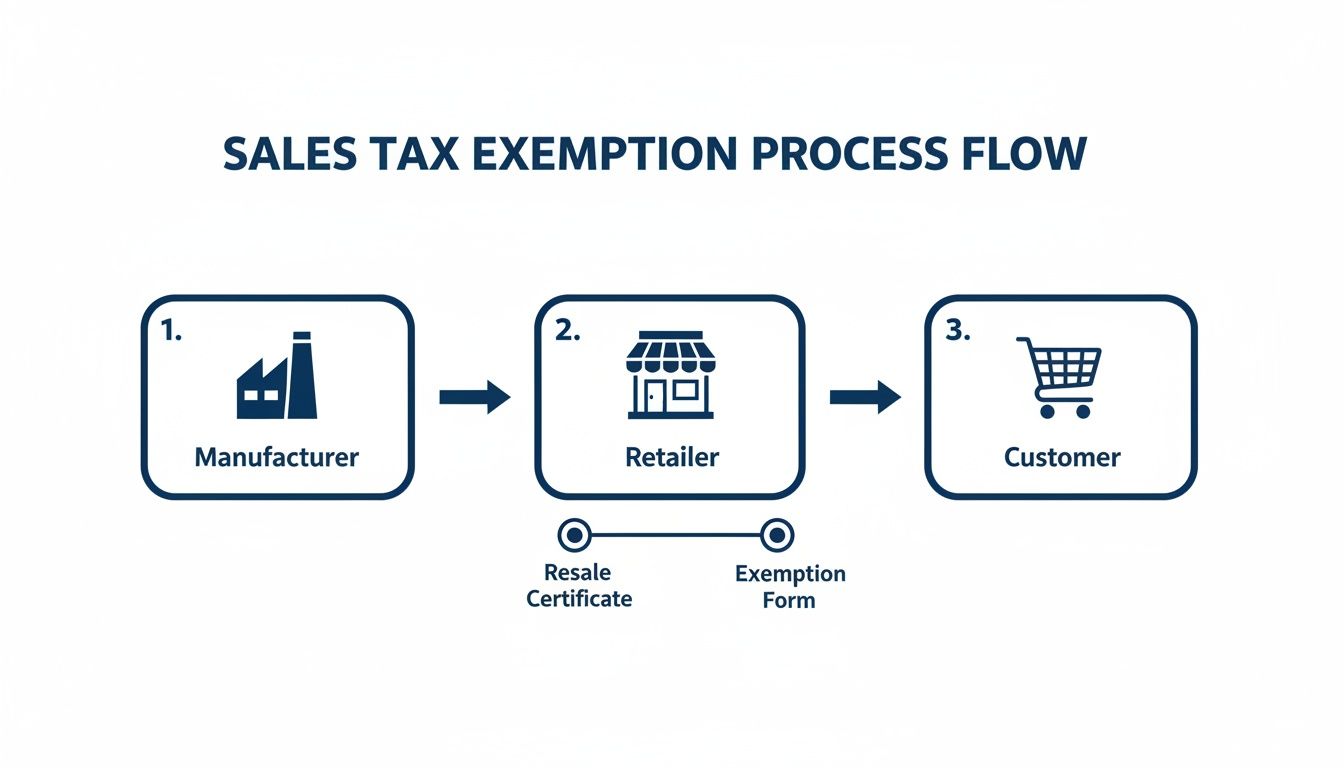
As you can see, these forms are the connecting tissue, making sure sales tax is only charged once—at the very end of the line, to the final consumer.
The Most Common Exemption Certificates
While New York has a form for nearly every situation, you'll encounter two certificates far more than any others. Getting these right is fundamental to your day-to-day operations.
-
Form ST-120, Resale Certificate: This is the workhorse for any business buying goods just to sell them again. When a boutique buys dresses from a designer or a hardware store stocks up on hammers from a distributor, they hand over a Form ST-120. It's their formal declaration that the items are inventory, not for their own use.
-
Form ST-119.1, Exempt Organization Certificate: This one is exclusively for qualified nonprofits, like 501(c)(3) charities, schools, or certain government agencies. They use the Form ST-119.1 to buy supplies for their mission—think computers for a school or food for a soup kitchen—without paying sales tax.
Using the right form is non-negotiable. A for-profit business can't use an Exempt Organization Certificate, and a nonprofit can't use a Resale Certificate for buying office supplies.
Accepting Certificates in Good Faith
So, what does it actually mean to accept a certificate in "good faith"? The New York Department of Taxation and Finance isn't asking you to be a detective, but they do expect you to use common sense. You need to ensure the form is fully completed and that the purchase makes sense for the buyer's business.
Accepting a certificate in good faith means you've done your basic homework. If the form is missing a signature, a tax ID number, or the date, it's invalid. Likewise, if an auto body shop wants to use a resale certificate to buy ten cases of fine wine, you should raise an eyebrow. That purchase isn't a reasonable fit for their line of work.
If you fail to do this, the liability boomerangs right back to you. An auditor who finds a stack of incomplete or obviously questionable certificates will hold your business responsible for all the uncollected sales tax, plus steep interest and penalties. This is one of the most common—and entirely avoidable—audit pitfalls.
Record-Keeping Best Practices
In an audit, your records are your only defense. Just having the certificate isn't enough; you need an organized system to prove your compliance.
-
Connect the Dots: Every tax-exempt sales invoice in your system must be clearly linked to the customer's exemption certificate. Modern POS and accounting software can automate this, but if you're doing it manually, your process has to be airtight.
-
Organize for Easy Access: Whether you use a filing cabinet or a cloud folder, keep your certificates organized, usually alphabetically by customer name. When an auditor asks for the certificate from "ABC Company," you need to be able to find it in minutes, not hours. Remember, you must keep these records for at least three years.
-
Perform Routine Check-Ups: Don't let your files gather dust. Set a reminder to review your certificates periodically. Are any expiring soon? Have you gotten updated forms from your regular tax-exempt customers? This simple, proactive step keeps your files clean and dramatically reduces your risk.
High-Value Exemptions for Real Estate and Development
For anyone in New York real estate—investors, developers, property managers—understanding the difference between a taxable repair and a tax-exempt capital improvement is one of the most critical parts of the state's tax code. It's a distinction that can save you a fortune on major projects or, if you get it wrong, lead to a very expensive audit.
At its core, the concept is straightforward. You pay sales tax on services that repair or maintain property, but you don't on work that qualifies as a capital improvement.
Think about it like this: getting an oil change for your car is a simple repair. It keeps the car running as it should. But swapping out the old engine for a brand-new, high-performance one? That's an upgrade—a capital improvement. The same logic applies to buildings.
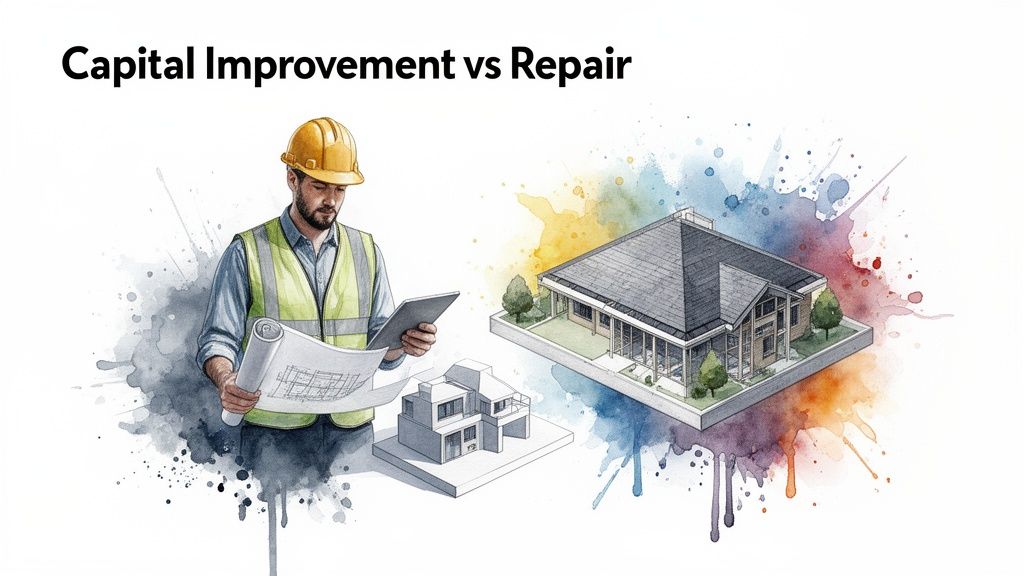
Capital Improvement Versus Taxable Repair
So, what makes a project a capital improvement? It has to be an installation that substantially adds to the property's value, significantly prolongs its useful life, or adapts it for a new use. Crucially, it must also become a permanent part of the real estate.
Let's use a building's roof as a real-world example:
- Taxable Repair: You hire a roofer to patch a few leaks and replace a handful of shingles that blew off in a storm. This is classic maintenance, just restoring the roof to its previous state. The labor for this job is fully subject to New York sales tax.
- Exempt Capital Improvement: Instead of patching, you have a contractor tear off the entire old roof and install a completely new one. This project dramatically extends the building's life and increases its value, which means it qualifies as a tax-exempt capital improvement.
To properly document this and avoid tax, the property owner needs to give the contractor a completed Form AU-262, the Certificate of Capital Improvement. This form officially certifies that the work meets the state's criteria, and it frees the contractor from having to collect sales tax on their labor.
One critical detail: This exemption only covers the services or labor portion of the bill. The contractor still has to pay sales tax on all the materials they buy for the job—the shingles, lumber, nails, and everything else.
Exemptions for Building Operations and Contractors
The capital improvement rule isn't the only high-value exemption in the real estate world. For instance, machinery and equipment used directly and predominantly to produce gas, electricity, refrigeration, or steam for sale can also be exempt. This is particularly relevant for large commercial buildings with their own co-generation plants.
Another major exemption comes into play when contractors are hired by exempt organizations. If a construction company is building a new wing for a nonprofit hospital or a public school, it can purchase the building materials for that project tax-free.
The key here is Form ST-120.1, the Contractor Exempt Purchase Certificate. This project-specific form allows the contractor to buy materials that will become a permanent part of the building without paying sales tax, directly passing those savings on to their tax-exempt client.
New York City's real estate market, a huge driver of the economy, has been shaped by these kinds of tax policies for years. For more context on how New York’s tax policies impact local finance, you can find great analysis from the New York State Association of Counties. Targeted exemptions and abatements have long encouraged development across the boroughs. In fact, just one broad exemption for items under $110 has saved consumers and businesses an estimated $100-200 million statewide each year since 2012.
For anyone involved in a New York real estate project, structuring contracts and purchases with these rules in mind isn't just about compliance—it's a core financial strategy. By carefully classifying the work and using the right exemption certificates, you can unlock significant savings and bring down overall project costs.
Key Exemptions for Nonprofits and Private Businesses
While many New York sales tax exemptions seem to apply to everyone, some of the most powerful rules are designed with specific entities in mind: nonprofits and private businesses. The paths to tax savings for these two groups are completely different, and knowing which one you’re on is the first step to getting it right.
For a registered nonprofit, its tax-exempt status is the golden ticket. For a manufacturer, it’s the operational exemptions that can make or break their pricing strategy. Both can find huge financial benefits, but only by mastering the specific rules that govern their world.
Navigating the Rules for Exempt Organizations
Qualified nonprofits, like the 501(c)(3) charities we're all familiar with, play by a unique set of rules. Their ability to buy things tax-free all comes down to a single, critical idea: the purchase has to directly support the organization's exempt mission.
To make a tax-free purchase, a nonprofit gives its vendor a properly completed Form ST-119.1, Exempt Organization Certificate. But this form isn't a blank check. It's a formal declaration that the items being bought—whether it's printer paper for the main office or supplies for a community outreach program—are essential to carrying out its mission.
A classic mistake nonprofits make is thinking their exempt status covers every single transaction. For instance, if a charity operates a small gift shop to raise funds, it still has to collect sales tax on the t-shirts and mugs it sells to the public, just like any other retailer. The exemption is for what the organization buys for its mission, not what it sells.
That distinction is everything. Using an exempt certificate for purchases that don't directly serve the organization's purpose can get a nonprofit into hot water, potentially even leading to the state revoking its tax-exempt purchasing privileges.
High-Value Exemptions for Private Businesses
For-profit companies have a completely different toolkit of exemptions available to them. These are designed to fuel economic growth and lower the costs of doing business, directly impacting the bottom line by focusing on operational expenses.
Here are three of the most impactful exemptions for private businesses:
-
Manufacturing Exemption: This is a big one. It allows manufacturers to buy machinery, equipment, and even some utilities without paying sales tax, but only if they are used directly and predominantly to produce goods for sale. It’s a huge help in lowering the capital needed to get up and running or expand.
-
Farming Exemption: New York recognizes how crucial agriculture is and provides broad exemptions for items used directly in farm production. This covers the big-ticket items like tractors and combines, but also the day-to-day necessities like feed, seed, and fertilizer.
-
Qualified Empire Zone Enterprise (QEZE) Program: While this program is no longer accepting new applicants, it remains a powerful tool for grandfathered businesses in certain economic zones. It was created to revitalize communities by offering significant tax credits and refunds for creating jobs and investing in those areas.
The world of New York sales tax exemptions has exploded in complexity over the decades. Back in 1990, there were just 84 exemptions on the books. By 2009, that number had shot up to 145—a 72.6% increase. And while New York City jurisdictions account for over 40% of all sales tax collected statewide, programs like QEZE can refund up to 100% of sales tax paid by certified businesses, giving a massive lift to local manufacturers and tech companies. You can dive deeper into these distributions on the New York State Department of Taxation and Finance website.
For any private business, knowing how to find and apply these exemptions isn't just about ticking a compliance box. It’s a strategic financial move that can unlock serious capital for growth, innovation, and a stronger competitive edge.
Common Mistakes and How to Prepare for an Audit
Knowing the rules for New York sales tax exemptions is one thing. Applying them perfectly when an auditor is looking over your shoulder is a whole different ballgame. Even the most careful businesses can make simple errors that snowball into major liabilities. The key isn't just knowing the rules, but building a process that can defend your tax-exempt sales without question.

The New York State Department of Taxation and Finance is laser-focused on one thing: documentation. A missing signature, an expired certificate, or a form that just doesn't make sense for the buyer’s business can completely invalidate the exemption in an auditor's eyes. When that happens, the burden of that uncollected tax—plus penalties and interest—lands squarely on you, the seller.
Frequent Errors That Trigger Audits
After years of helping clients through audits, we’ve seen the same mistakes pop up time and again. These are the red flags that practically invite scrutiny from the state. Your best defense is to spot and fix these issues in your own operations before they do.
Here are the most common tripwires we see:
- Accepting Incomplete Certificates: This is, without a doubt, the number one problem. A customer hands over a Form ST-120, but it’s missing a signature or their tax ID number. To an auditor, that piece of paper is worthless, and the sale is now taxable.
- Misclassifying Capital Improvements: The line between a taxable repair and an exempt capital improvement is notoriously fine. Contractors often make a critical mistake: they start work without getting a fully completed Certificate of Capital Improvement (Form AU-262) from the property owner first.
- Forgetting About Use Tax: Many businesses purchase equipment or supplies from out-of-state vendors who don't collect New York sales tax. What gets forgotten is that if you use that property in New York, you owe use tax on it. Auditors are trained to hunt for these untaxed purchases.
The auditor's mindset is simple: if you can't prove a sale was exempt with complete and valid documentation, it wasn't exempt. Think of your records not as a bookkeeping chore, but as your primary shield in an audit.
Your Proactive Audit Preparation Checklist
Don't wait for that dreaded audit notice to land in your mailbox. The time to prepare is now, by adopting the same critical eye an auditor would use. By strengthening your internal controls today, you minimize your financial risk and build the confidence to handle any inquiry efficiently.
Here's a practical checklist to build a rock-solid defense:
- Validate Every Single Certificate: Create a strict, non-negotiable process for reviewing every exemption form you receive. Check that it’s fully completed, signed, dated, and that it logically applies to the customer’s business.
- Centralize and Digitize Your Records: Keep all your exemption certificates in one organized, central location, whether it’s a digital folder or a physical file. The best practice is to link each certificate directly to its corresponding tax-exempt invoices in your accounting software.
- Train Your Team Regularly: Your sales and accounting staff are your first line of defense. Hold regular training sessions on what makes a certificate valid and, just as importantly, empower them to reject incomplete forms from customers.
- Perform Periodic Self-Audits: Once a year, play auditor yourself. Randomly pull a sample of your exempt sales, then check the invoices against the certificates you have on file. This simple exercise is the best way to find and fix weaknesses in your process before the state finds them for you.
When you treat every exempt transaction with this level of diligence, compliance stops being a reactive headache and becomes a proactive strategy. You’ll be ready to defend every New York sales tax exemption you claim, protecting your business's bottom line.
Answering Your New York Sales Tax Exemption Questions
When you get down to the brass tacks of running a business in New York, the general rules on sales tax can feel a bit abstract. It’s the day-to-day situations that trip people up. Let's tackle some of the most common questions we hear from business owners and investors trying to navigate the system.
Can I Use a Resale Certificate for Personal Purchases?
The answer here is a hard no. This is one of the brightest red lines in New York tax law, and crossing it is a huge mistake.
Your New York State Resale Certificate (Form ST-120) is strictly for buying inventory—items you intend to resell or incorporate into a final product for sale. Using it for anything else, whether it's a new laptop for your office or a TV for your home, is tax fraud. The state’s auditors are specifically trained to spot this kind of misuse, and the penalties can be painful. You absolutely have to keep a firewall between your inventory purchases and anything for internal or personal use.
How Long Are New York Exemption Certificates Valid?
This is a great question, and the answer isn't one-size-fits-all; it really depends on the certificate. A Resale Certificate (Form ST-120), for instance, is what's known as a "blanket certificate." It stays valid as long as you have an ongoing purchasing relationship with your vendor.
That said, smart vendors don't let those certificates gather dust for a decade. A good rule of thumb is to refresh them with your regular customers every few years to ensure your files are always audit-ready. On the other hand, some forms are tied to a specific job, like a Contractor Exempt Purchase Certificate (ST-120.1). That one is only good for the materials on that single project and expires the moment the job is done. Always double-check the rules for the specific form you're using.
One of the biggest mistakes business owners make is assuming a certificate is good forever and for everything. Think of your exemption certificates as living documents that need regular check-ups to keep your business compliant.
What Happens if I Accept an Invalid Certificate?
As a seller, you're the gatekeeper, and the state expects you to accept certificates in "good faith." What does that mean? It means the form you receive looks complete and correct on its face, and the purchase makes sense for the buyer’s type of business. For example, a bakery buying 500 pounds of flour tax-free is reasonable; a bakery buying a speedboat tax-free is not.
If you accept a certificate that's obviously wrong—maybe it’s missing a tax ID number or a signature—the liability flips back to you. If an auditor discovers it, your business could be on the hook for all the uncollected sales tax, plus interest and penalties. This is exactly why you need a rock-solid, documented process for checking every single tax-exempt sale. It’s your best defense against a nasty future tax bill.
Is There a Difference Between NY State and NYC Exemptions?
For the most part, an exemption from the 4% New York State sales tax also gets you out of local taxes, including New York City’s 4.5% slice. This keeps things relatively simple for most resale, manufacturing, and nonprofit transactions.
But there are a few important exceptions where local rules apply. The classic example is the exemption on clothing and footwear under $110. New York City honors this, so the entire 8.875% combined tax is waived on an eligible purchase. Drive a few miles to a locality that doesn't participate, however, and you'd only get the 4% state portion exempted. The lesson? Always know the local rules for where the sale is happening.
Working through these details is where having an expert in your corner really pays off. Blue Sage Tax & Accounting Inc. specializes in proactive tax planning and comprehensive accounting to help New York businesses, nonprofits, and real estate investors stay compliant and keep more of their money. If you’re looking for clarity on sales tax or any other financial challenge, learn how we can help.