Accelerated depreciation is a powerful tax planning tool that lets businesses take a bigger bite out of an asset's cost upfront. Instead of spreading tax deductions evenly over an asset's life, this method concentrates them in the early years. The result? A significant cash-flow advantage right when you need it most—after a major capital expenditure.
Think of it as getting your tax savings on an express train instead of the local.
Understanding Accelerated Depreciation in Simple Terms
Let's say you just invested in a new piece of machinery for your company. The traditional approach, known as straight-line depreciation, would have you deduct a small, equal portion of its cost each year. It’s a predictable, slow-and-steady drip of tax benefits over the asset's entire "useful life."
Accelerated depreciation completely changes the game. It allows you to claim a much larger chunk of that cost as a deduction in the first year or two. This has an immediate and powerful effect: it shrinks your taxable income right away, which means a smaller tax bill and more cash on hand now. For many businesses, that immediate infusion of capital is a lifeline for reinvesting, covering payroll, or simply shoring up the balance sheet.
The Core Concept: It’s All About Timing
It's crucial to understand that you don't get to deduct more money in total over the asset's life. The overall deduction is the same regardless of the method you choose. The magic of accelerated depreciation is all in the timing. It’s a strategy built on a fundamental financial principle: a dollar today is worth more than a dollar tomorrow.
By pulling those tax deductions forward, you can:
- Boost Immediate Cash Flow: A lower tax bill today means more working capital for your business needs.
- Fuel New Investments: Those tax savings can be immediately channeled back into new equipment, technology, or expansion projects, creating a cycle of growth.
- Shelter High-Profit Years: This strategy is especially valuable in years where your income is unusually high, as it can significantly reduce a large tax burden.
The real power of accelerated depreciation isn't about the total amount you deduct; it’s about getting that deduction sooner. This strategic shift in timing can dramatically alter a company's financial health and open up new opportunities for growth.
To really see the difference, it helps to put the two methods next to each other. The table below provides a quick look at how each approach affects your deductions, especially in the crucial first few years after you place an asset in service.
Accelerated vs Straight-Line Depreciation: A Snapshot
This table contrasts the fundamental differences between accelerated and straight-line depreciation methods, showing how each impacts tax deductions and cash flow over an asset's early life.
| Feature | Accelerated Depreciation | Straight-Line Depreciation |
|---|---|---|
| Deduction Timing | Heavily front-loaded; largest deductions occur in the first few years. | Evenly spread; the same deduction amount is taken each year. |
| First-Year Impact | Significantly reduces taxable income, leading to substantial initial tax savings. | Provides a modest, predictable reduction in taxable income. |
| Complexity | More complex calculations, often following specific IRS schedules like MACRS. | Simple and straightforward to calculate and apply. |
| Best For | Businesses seeking to maximize immediate cash flow and reinvest for growth. | Businesses wanting stable, predictable financials or expecting higher income later. |
As you can see, the choice between these methods depends entirely on your financial strategy. Do you want a big impact now, or do you prefer predictability over the long haul?
The Three Core Methods of Accelerated Depreciation
So, you understand the basic idea: accelerated depreciation lets you take bigger tax deductions upfront. Great. But how do you actually do it? The IRS gives you a few powerful tools to work with. Think of it like a contractor's toolkit—you wouldn't use a sledgehammer to hang a picture frame, and you wouldn't use a tiny screwdriver to break up concrete.
The three main tools in your tax-planning toolkit are the Modified Accelerated Cost Recovery System (MACRS), Section 179 expensing, and bonus depreciation. Each one front-loads your deductions in a slightly different way, and picking the right one—or the right combination—depends entirely on your business, the assets you're buying, and your long-term financial goals.
Let's unpack them one by one.
MACRS: The Standard System
The Modified Accelerated Cost Recovery System (MACRS) is the default depreciation system for almost all tangible property in the U.S. It's the foundation of how the IRS sees an asset's "useful life" for tax purposes. Essentially, the IRS has a master list that sorts every business asset you can think of—from computers to commercial buildings—into specific classes with set recovery periods.
Here’s a quick look at how MACRS categorizes common assets:
- 3-Year Property: Certain manufacturing tools, some tractors.
- 5-Year Property: Computers, office machinery, vehicles, and construction equipment.
- 7-Year Property: Office furniture, fixtures, and a catch-all for most other business equipment.
- 27.5-Year Property: Residential rental properties.
- 39-Year Property: Non-residential real estate, like office buildings and warehouses.
With MACRS, you're not just dividing the asset's cost by its useful life. The system uses specific formulas, like the 200% declining balance method, which are designed to be front-loaded. This means your deductions are naturally larger in the early years and taper off over time. It’s inherently accelerated right from the start.
Section 179: A Small Business Powerhouse
Next up is Section 179. For small and medium-sized businesses, this is an absolute game-changer. Instead of spreading deductions over several years, Section 179 lets you treat the entire cost of qualifying equipment as an expense in the year you buy it and put it to work.
Imagine you purchase a $50,000 piece of machinery. With Section 179, you could potentially deduct that full $50,000 from your taxable income this year. The immediate cash flow impact is massive. But there's a catch: it's designed to help smaller businesses invest and grow, so there are annual caps on how much you can deduct and how much you can spend on equipment before the benefit starts to phase out.
The image below gives you a clear visual of how these accelerated methods stack up against the slow-and-steady straight-line approach.
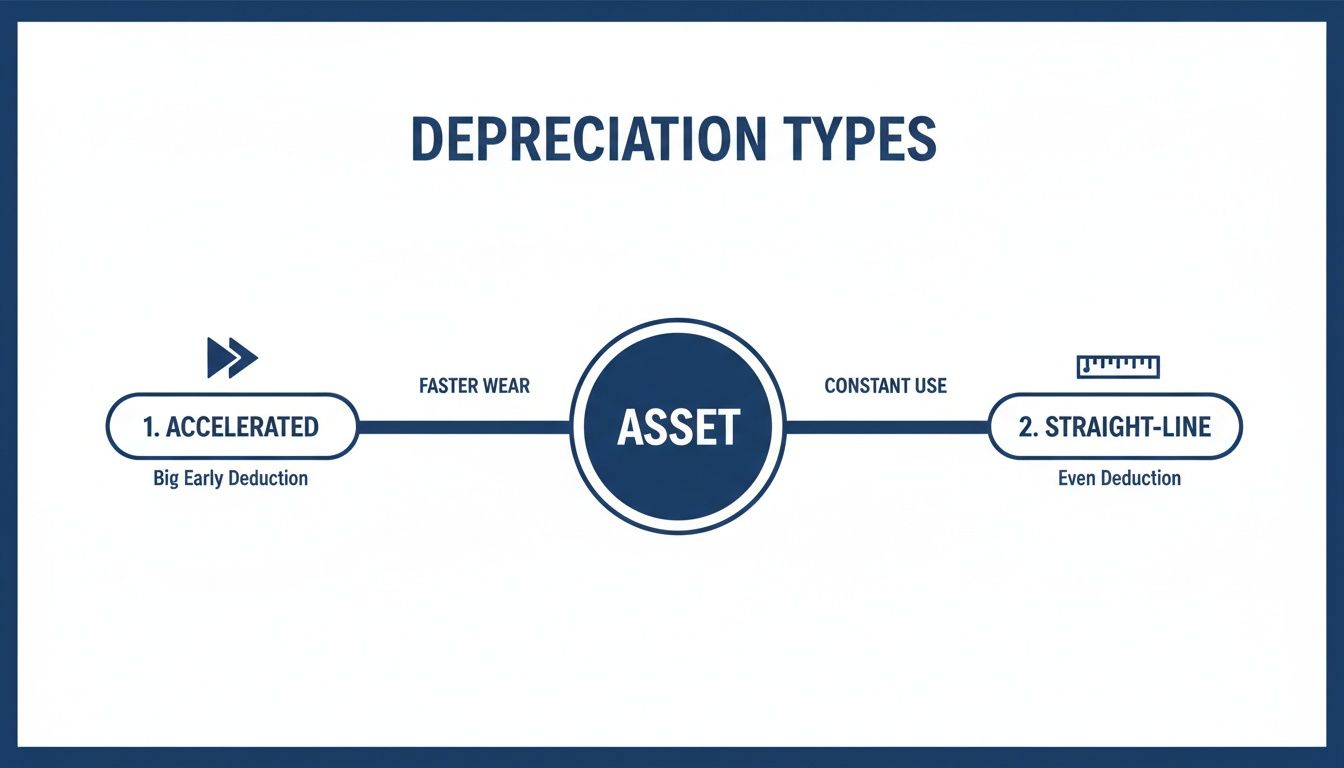
As you can see, accelerated depreciation is all about getting that deduction working for you as soon as possible.
Bonus Depreciation: The Broad-Strokes Incentive
Finally, we have bonus depreciation, a powerful incentive that often works hand-in-hand with MACRS. It allows you to immediately deduct a significant percentage of an asset's cost in the first year. Unlike Section 179, bonus depreciation traditionally hasn't had an annual investment limit, which makes it incredibly valuable for businesses of all sizes making major capital investments.
Bonus depreciation allows you to take an immediate first-year deduction on the adjusted basis of qualified property. It’s a powerful tool for supercharging your tax savings and is applied after any Section 179 deduction but before regular MACRS depreciation.
Its impact on corporate finance has been enormous. One study found that accelerated depreciation, driven primarily by bonus depreciation from the 2017 tax law, led to nearly $67 billion in tax savings for the 25 most profitable U.S. companies between 2018 and 2022. During that period, those companies paid an effective federal tax rate of just 12.2%—well below the 21% statutory rate—largely because this policy let them write off asset costs immediately. You can learn more about how federal tax policies impact corporate savings.
The bonus percentage itself changes with legislation, but the strategy remains a cornerstone of what accelerated depreciation is all about. It applies to both new and used property, giving businesses broad flexibility. Each of these three methods is a unique lever you can pull, and the real magic happens when you work with an advisor to combine them for maximum effect.
Putting Accelerated Depreciation into Action with a Real Example
Theory is one thing, but seeing the numbers in black and white is another. Let's walk through a tangible scenario to see just how powerful accelerated depreciation can be for an investor's bottom line.
Imagine a real estate investor just closed on a commercial property. They wisely invest in a cost segregation study, which is an engineering-based analysis that carves out specific components of the building that can be written off faster. The study identifies $500,000 in qualifying assets—things like specialized lighting, custom cabinetry, and even landscaping—that don't have to be depreciated over the building's long 39-year structural life.
This is where the investor hits a fork in the road. They can take the slow, steady path or the fast track. The difference in their first-year cash flow is nothing short of dramatic.

The Slow Path with Straight-Line Depreciation
First, let's look at the traditional route. For our $500,000 in identified assets, let's assume they fall into a 5-year property class under MACRS.
Using the straight-line method, the math is straightforward:
- Calculation: $500,000 (Asset Cost) ÷ 5 (Years) = $100,000 per year.
A $100,000 deduction certainly helps, but it’s just a fraction of what’s possible. This approach gives you a predictable write-off each year but leaves a massive amount of potential tax savings on the table when you need it most—right after the acquisition.
The Fast Track with 100% Bonus Depreciation
Now, let's see what happens when we use a much more potent tool: 100% bonus depreciation. This powerful tax incentive lets the investor write off the entire cost of those assets in the very first year they are placed in service.
The calculation gets even easier:
- Calculation: $500,000 (Asset Cost) x 100% = $500,000 deduction.
Just like that, the investor gets to deduct the full half-million dollars immediately. This single move can slash their taxable income for the year, freeing up an enormous amount of cash that would have otherwise gone straight to the IRS.
By front-loading the entire deduction, the investor transforms a future, multi-year tax benefit into immediate, tangible capital. This is the core of what accelerated depreciation is designed to achieve.
Comparing the First-Year Financial Impact
To really grasp the difference, let’s put the numbers side-by-side. We’ll assume our investor is in the 37% federal tax bracket.
Here’s a look at how the choice of depreciation method directly impacts the investor's wallet in year one.
First-Year Impact: Straight-Line vs 100% Bonus Depreciation
| Metric | Straight-Line Method (Year 1) | 100% Bonus Depreciation (Year 1) |
|---|---|---|
| Asset Cost | $500,000 | $500,000 |
| First-Year Deduction | $100,000 | $500,000 |
| Tax Savings (37% Bracket) | $37,000 | $185,000 |
| After-Tax Cash Flow Boost | $37,000 | $185,000 |
The table makes it crystal clear. By opting for bonus depreciation, the investor puts an extra $148,000 back into their pocket in the first year alone.
This isn't just a number on a spreadsheet; it’s real, usable cash. That money can be used to pay down high-interest debt, fund the next round of renovations, or even serve as the down payment on another property. This is a perfect illustration of how a strategic tax decision can fundamentally change an investment's financial trajectory from day one.
Advanced Strategies for Real Estate and Business Owners
Once you've got the basics down, the real magic happens. For seasoned real estate investors and sharp business owners, accelerated depreciation isn't just another line-item deduction—it's a core component of your capital strategy. Using it effectively can unlock some serious financial advantages that help you grow your portfolio and protect your wealth.
For anyone in real estate, the conversation almost always starts with a critical, and often missed, first step: a cost segregation study. This isn't just paperwork; it's a detailed engineering analysis that truly unlocks the power of depreciation for your property.
Without one, you're stuck treating an entire building as one big asset, writing it off over a painfully long 39 years for commercial properties. A cost segregation study, on the other hand, meticulously breaks that building down into all its individual pieces, identifying components that have much shorter, more favorable recovery periods.
Unlocking Value with Cost Segregation
Picture a commercial building. The steel frame and concrete foundation are obviously built to last for decades. But what about the carpets? The custom light fixtures? The specialized wiring for the servers or the landscaping outside? Those things won't last nearly as long.
A cost segregation study is how you identify and reclassify those components, pulling them out of the 39-year bucket and into categories with much faster write-offs.
- 5-year property: Think carpeting, certain appliances, and decorative lighting.
- 7-year property: This can include things like office furniture and some types of fixtures.
- 15-year property: This is for land improvements—your parking lot, sidewalks, and professional landscaping.
By carving out these shorter-lived assets, you can hit them with powerful tools like bonus depreciation. This means you can generate enormous deductions in the very first year you own the property instead of trickling them out over nearly four decades. The result is an immediate boost to your after-tax cash flow, giving you capital that can be rolled right into renovations, paying down debt, or funding your next deal.
Strategic Timing for Business Owners
If you're a business owner, the art of accelerated depreciation is all about timing. Making a major capital purchase, like new machinery or a fleet of vehicles, can be strategically timed to land in high-income years where the tax savings will have the biggest impact.
Let's say your company is on track for a blockbuster year. By strategically purchasing and placing new equipment in service before December 31st, you can use Section 179 or bonus depreciation to create a massive deduction that directly offsets that peak income. It’s a smart way to turn a necessary operational expense into a powerful tax-management tool.
The decision to invest in new assets becomes a dual-purpose strategy: one part operational upgrade, one part tax optimization. Aligning these purchases with your financial calendar is a hallmark of savvy business management.
Recent legislation has only amplified these opportunities. The One Big Beautiful Bill Act (OBBBA), passed in mid-2025, brought back 100% bonus depreciation for qualified property acquired and placed in service after January 19, 2025, which completely reversed the previous phase-out schedule.
The act also created Section 168(n), which allows 100% expensing for ‘qualified production property’ (QPP)—basically, certain U.S. non-residential real estate used in manufacturing. This takes its depreciation life from 39 years down to zero. The catch? It comes with a 10-year recapture rule, meaning the property has to stay in its qualified use for a decade to keep the full tax benefit. You can dig into the details on these major updates from leading advisory firms like Carr, Riggs & Ingram.
Navigating State and Local Tax Complexities
Now for the final, crucial piece of the puzzle: state and local taxes (SALT). Just because you get a huge federal deduction doesn't mean your state is going to play along. Many states don't conform to the federal tax code, especially when it comes to bonus depreciation and Section 179.
This "decoupling" can lead to some nasty surprises. You might be planning for a big federal refund, only to get a significant tax bill from your state. This is why proactive SALT planning is absolutely essential. You have to model the impact of your depreciation strategy at both the federal and state levels to see the true bottom-line result. For businesses operating in multiple states, this isn't just a good idea—it's critical for accurate forecasting and staying compliant.
How Accelerated Depreciation Affects Your Financial Statements
A tax strategy as powerful as accelerated depreciation doesn’t just stay on your tax return. It sends ripples across all of your company's core financial statements, and you need to understand exactly how. Lenders, investors, and even your own team will be looking at these documents, and this strategy fundamentally reshapes the story they tell.
While the main event is boosting cash flow by slashing your tax bill, the accounting side of things creates distinct effects on the balance sheet, income statement, and statement of cash flows. Each one offers a different angle on the consequences of front-loading your deductions, and seeing the complete picture is essential for smart decision-making.

The Balance Sheet Impact
Think of your balance sheet as a snapshot in time: what you own (assets) versus what you owe (liabilities). When you use accelerated depreciation, the book value of your assets drops much faster in the early years than it would with the straight-line method.
Why? Because accumulated depreciation—a contra-asset account that offsets the gross value of your assets—balloons quickly. This means the net book value of your equipment or property looks lower, sooner. While this reflects the tax reality, it can make your company appear less asset-rich on paper. That's a crucial point to remember if you're preparing financials for a lender who's laser-focused on asset values.
The Income Statement Story
Your income statement is all about profitability, tracking revenues and expenses to arrive at your net income. Depreciation shows up here as a non-cash operating expense. By booking a much larger depreciation expense in those initial years, you directly reduce your company's reported net income.
A lower net income might sound like a bad thing, but it's the very mechanism that delivers your tax savings. This can be a double-edged sword, though. If you're looking for a loan or trying to woo investors, a lower reported profit could raise a red flag if it isn't explained properly.
It’s all about framing the narrative. You have to communicate that the lower profit isn't from poor performance but from a strategic tax decision designed to maximize cash. Seasoned advisors, like the team at Blue Sage Tax & Accounting Inc., can help you build that story.
The Cash Flow Statement Advantage
Now for the good news. The statement of cash flows is where accelerated depreciation truly shines. This statement connects net income back to the actual cash coming in and going out of the business. And since depreciation is a non-cash expense, it gets added back to net income when calculating cash from operations.
Let's break down how this works:
- Start with Net Income: Accelerated depreciation gives you a lower starting point here.
- Add Back Non-Cash Expenses: You get to add back that huge depreciation amount.
- Result: That bigger add-back gives your cash flow from operations a massive boost.
This boost is a direct result of paying less real cash for taxes. For any business, strong operational cash flow is the ultimate sign of health and stability. Accelerated depreciation directly fortifies this critical metric, proving that a lower net income on paper can create a much stronger cash position in reality.
Staying Out of Trouble: Common Pitfalls and Compliance Issues
Accelerated depreciation is an incredibly powerful tool for boosting cash flow, but it's not a free-for-all. The benefits come hand-in-hand with strict compliance rules, and a simple oversight can trigger costly penalties or wipe out the very tax savings you were aiming for. The best defense is a good offense—be proactive, not reactive.
One of the most common and costly mistakes we see is the misclassification of assets. This happens all the time when a proper cost segregation study isn't done on a property. Shorter-lived assets, like carpeting (a 5-year asset), get mistakenly lumped in with the building's 39-year structural components. That single error could mean leaving tens, or even hundreds, of thousands of dollars in first-year deductions on the table.
Another classic trip-up is just plain poor record-keeping. To stand behind your deductions, you need an airtight paper trail. That means documenting an asset's cost, the exact date it was placed in service, and the depreciation method you chose. Without these records, you're walking into an audit unprepared.
The Sting of Depreciation Recapture
Perhaps the biggest "gotcha" to watch for is depreciation recapture. Think of it as the IRS’s mechanism for clawing back the tax benefit you enjoyed when you sell a depreciated asset for a profit. It’s a concept that can quickly turn a profitable sale into a tax nightmare if you're not ready for it.
Here's the logic: when you sell an asset for more than its adjusted (depreciated) basis, the gain attributable to the depreciation you previously claimed is taxed at your ordinary income tax rate. This rate is often much higher than the preferential long-term capital gains rate.
A Real-World Recapture Scenario
Let's say you purchased equipment for $100,000. Using an aggressive depreciation strategy, you wrote off $80,000 over three years, which lowered its book value to $20,000. A few years later, you sell it for $75,000.
Your total gain is $55,000 (the $75,000 sale price minus the $20,000 book value). Under the recapture rules, that entire $55,000 is taxed as ordinary income—potentially at a federal rate as high as 37%—not as a capital gain.
This rule exists to prevent a double-dip: getting a tax deduction against high-rate ordinary income today, only to pay tax at a lower capital gains rate on that same amount later.
A Compliance Checklist to Keep You on Track
To really make the most of what accelerated depreciation is without getting into hot water, you need a systematic approach. Following a few best practices will ensure you maximize savings while staying on the right side of the IRS.
-
Insist on a Cost Segregation Study: For any significant real estate purchase, this is non-negotiable. An engineering-based study gives you the defensible report you need to properly classify assets and supercharge your write-offs.
-
Keep Impeccable Records: Document everything for every asset. This includes purchase invoices, proof of in-service dates, and clear depreciation schedules for both your federal and state tax returns.
-
Model the Future Impact: Don't just think about this year. Before taking a huge deduction, run the numbers to see how it might affect future years, including the potential tax hit from recapture when you eventually sell.
-
Mind the State-Level Differences: Never assume your state plays by federal rules. Many states, like New York, have decoupled from federal depreciation laws. This means you need a separate analysis for your state returns. Working with a firm like Blue Sage Tax & Accounting Inc. can help you navigate these multistate complexities.
Frequently Asked Questions About Accelerated Depreciation
Once you get a handle on the basics of accelerated depreciation, the real-world questions start popping up. Let's walk through some of the most common ones we hear from business owners and investors.
Can I Use Accelerated Depreciation on Used Property?
Yes, you absolutely can. This is one of the most powerful changes that came out of the Tax Cuts and Jobs Act (TCJA). It opened up bonus depreciation to include both new and used property, which was a game-changer for many businesses.
As long as the asset is new to you and you haven't previously owned it, you can generally apply bonus depreciation the year you put it into service. This is a huge advantage if you're buying used machinery, vehicles, or equipment to grow your operations.
What Is Depreciation Recapture and How Does It Work?
Depreciation recapture is the IRS's way of "taking back" the tax benefit you enjoyed when you sell an asset for a profit. It’s a concept that trips up a lot of people.
Essentially, when you sell an asset for more than its tax-depreciated value, that gain isn't treated as a simple capital gain. Instead, the portion of the gain that's due to the depreciation you took is taxed at your higher, ordinary income tax rate.
Let’s say you bought a piece of equipment for $50,000. You used accelerated depreciation to write it down to a book value of $10,000. If you later sell it for $35,000, you have a $25,000 gain. That entire $25,000 is "recaptured" and taxed as ordinary income.
This is why exit planning is so critical when you use accelerated depreciation. You need to be aware of the tax bill waiting for you down the road.
When Should I Choose Straight-Line Depreciation Instead?
Accelerated depreciation is a fantastic tool, but it's not the right move for every situation. Sometimes, the slow-and-steady straight-line method is the smarter play.
You might lean toward straight-line if you expect your business to be much more profitable in the coming years. By spreading out your depreciation deductions evenly, you can save them for when you’re in a higher tax bracket, making each dollar of deduction more valuable.
Another reason is for appearances. Some businesses prefer to show higher net income on their books to look healthier to lenders, partners, or potential buyers. It all boils down to your long-term financial forecast and strategic priorities.
Navigating the complexities of what accelerated depreciation means for your specific financial situation requires expert guidance. The team at Blue Sage Tax & Accounting Inc. provides proactive planning and advisory services to help high-net-worth individuals, real estate investors, and business owners maximize tax efficiency while ensuring full compliance. Partner with us to build a tax strategy that aligns with your long-term goals. https://bluesage.tax