So, you're thinking about forming an S corporation. It's a smart move for many business owners, but it’s not as simple as flipping a switch. The process really boils down to two key parts: first, you set up a legal entity like an LLC or a C corp, and then you make a special tax election with the IRS by filing Form 2553.
This combination of legal formation and a crucial tax decision is what unlocks the S corp's real power, but you need to get it right from the start.
Is an S Corp the Right Play for Your Business?
Before you even think about paperwork, let’s take a step back. The most critical part of this entire process is making sure the S corp structure actually fits your business. The tax perks are incredibly attractive, but it's not a one-size-fits-all solution. You really need to look at your company's finances, who the owners are, and where you plan to be in five or ten years.
The big draw for most people is avoiding "double taxation." With a standard C corporation, the business pays taxes on its profits, and then you, the owner, get taxed again when you take that money out as a dividend. An S corp sidesteps this headache entirely. It's a pass-through entity, meaning all the profits, losses, and deductions flow directly to the owners' personal tax returns. The business itself doesn't pay federal income tax.
The Big Win: Saving on Self-Employment Taxes
For business owners in New York, and especially in a high-cost environment like NYC, this pass-through status is where the magic happens. Here’s how it works: as an owner who works in the business, you have to pay yourself a "reasonable salary." That salary is hit with the usual payroll taxes—Social Security and Medicare.
But here's the key: any profit left over after paying that salary can be paid out to you as a shareholder distribution. And those distributions? They aren't subject to self-employment taxes. This is the financial engine of the S corp.
Key Takeaway: The ability to split your earnings between a formal salary and tax-advantaged distributions is the single biggest financial benefit of an S corp. It's a strategy that directly lowers your tax bill, which is a massive advantage for any profitable company.
This isn't some new-fangled tax loophole. The S corp has been around since 1958, when President Eisenhower signed it into law to give smaller companies a break from the punishing tax burdens they faced. It caught on quickly. Today, S corps make up over 73% of all corporations in the U.S., making them the go-to structure for businesses with under 500 employees. You can dive deeper into the history and prevalence of S corporations with this resource from Berkman Solutions.
To help you see how these structures stack up, we've put together a quick comparison.
S Corp vs C Corp vs LLC at a Glance
This table provides a clear comparison of key differences between S Corporations, C Corporations, and LLCs, focusing on taxation, ownership structure, and administrative requirements to help New York business owners choose the best entity.
| Feature | S Corporation | C Corporation | LLC (Taxed as S Corp) |
|---|---|---|---|
| Federal Taxation | Pass-through taxation; no corporate-level tax | Double taxation (corporate and shareholder levels) | Pass-through taxation; no corporate-level tax |
| Ownership | Max 100 U.S. citizen/resident shareholders | Unlimited shareholders, including foreign investors | Max 100 U.S. citizen/resident shareholders |
| Stock | Only one class of stock allowed | Multiple classes of stock permitted | N/A (ownership is via membership units) |
| Payroll Taxes | Reasonable salary subject to payroll tax; distributions are not | All dividends are not subject to payroll tax | Reasonable salary subject to payroll tax; distributions are not |
| Formalities | Requires board meetings, minutes, and bylaws | Requires board meetings, minutes, and bylaws | More flexible; less formal requirements |
Choosing the right entity is a foundational decision. While an LLC taxed as an S corp often provides the best of both worlds—liability protection and tax savings—your specific situation dictates the right path.
You Have to Play by the IRS’s Strict Rules
Of course, you can't just declare yourself an S corp and call it a day. The IRS has a very specific set of rules, and you have to meet them—and keep meeting them. If you slip up, the IRS can revoke your S corp status, which can trigger some pretty nasty tax consequences.
Before you go any further, make sure your business ticks all these boxes:
- It must be a U.S. company. No foreign corporations allowed.
- You can have no more than 100 shareholders. This keeps it limited to smaller, closely-held businesses.
- Shareholders must be individuals, certain trusts, or estates. You can't have partnerships, other corporations, or non-resident aliens as shareholders.
- You can only have one class of stock. This is a big one. It means every share must have the same rights when it comes to distributions and liquidation. You can have differences in voting rights, but not economic rights.
That last point trips up a lot of people. If you start distributing profits unevenly among the owners, the IRS might argue that you've created a second class of stock in practice, which would blow up your S corp election. Sticking to these rules isn't optional—it's essential.
The New York S Corp Formation Playbook
Alright, you've done the homework and decided the S corp is the right move for your business. So, how do you actually make it happen? Forming an S corp in New York isn't a one-and-done deal; it's a specific sequence of state and federal filings that you have to get right.
Let's walk through the playbook, from creating your legal entity in Albany to getting the IRS on board.
Your first step is always at the state level. You need to form the underlying legal entity, which for most people means filing a Certificate of Incorporation with the New York Department of State. This is the document that officially gives birth to your C corporation under state law. It establishes the basics—your company name, its purpose, and how its stock will be structured. Think of it as pouring the concrete foundation before you can build the house.
Once New York gives you the green light and your corporation officially exists, the next immediate task is getting an Employer Identification Number (EIN) from the IRS. An EIN is essentially a Social Security number for your business. You absolutely need one to open a bank account, hire anyone, or file taxes. Thankfully, you can apply online directly with the IRS, and it's a fast but non-negotiable step.
Mastering the IRS Form 2553 Election
With your corporation legally formed and your EIN in hand, you've reached the most critical part of the process: filing IRS Form 2553, Election by a Small Business Corporation. This is the formal request you make to the IRS, asking them to treat your C corporation as an S corporation for federal tax purposes. This single form is what unlocks the pass-through taxation benefits you're after.
Timing is everything here. You have a very specific, and tight, window to file Form 2553.
- For a brand-new business: You must file within 75 days of your incorporation date.
- For an existing business: The deadline is March 15 of the current year for the election to apply to that same year.
Miss these deadlines, and you could mess up your tax status for the entire year. The IRS does offer some relief for late filings if you have a solid reason, but it's not a position you want to be in.
The whole game hinges on filing IRS Form 2553 within 75 days of incorporating or by March 15 for an existing business. This election, which has been around since 1958, is what lets you pass income to shareholders' personal returns, neatly sidestepping the 21% C corp tax rate. While New York S corps still pay a fixed dollar tax (up to $4,500 based on receipts), the federal savings are where you really win.
We see this structure work wonders for our clients, from tech founders to nonprofit foundations, because it's a powerful tool for cutting down on self-employment taxes. As an owner, you'll still pay income tax, but you avoid the 15.3% FICA tax on distributions you take above a reasonable salary. That’s a massive advantage, especially in a high-cost area like NYC. Census data from 2017 shows that 89.9% of S corps are small businesses, and they account for 38% of all corporate jobs—a testament to their impact.
Setting Up Your Corporate Governance
While the government filings are the main event, don't forget about the internal paperwork that makes your company a legitimate, defensible entity. These documents are legally required and are what protect your personal liability shield.
First up, you need to adopt corporate bylaws. These are the internal rulebook for your company. They spell out everything from how shareholder meetings are run to the specific duties of each corporate officer. Having clear bylaws provides a solid operational framework and is your first line of defense in any internal dispute.
Next, you have to hold an initial meeting of the board of directors. In this meeting, you’ll formally:
- Appoint corporate officers (President, Secretary, Treasurer, etc.).
- Authorize issuing stock to the founding shareholders.
- Approve the opening of a corporate bank account.
It is absolutely critical to document this meeting with formal minutes. This paperwork proves you are operating as a real corporation, separate from its owners. You can see an example of what a properly documented corporate resolution might look like.
This flowchart gives you a high-level look at the decision-making process before you even think about filing anything.
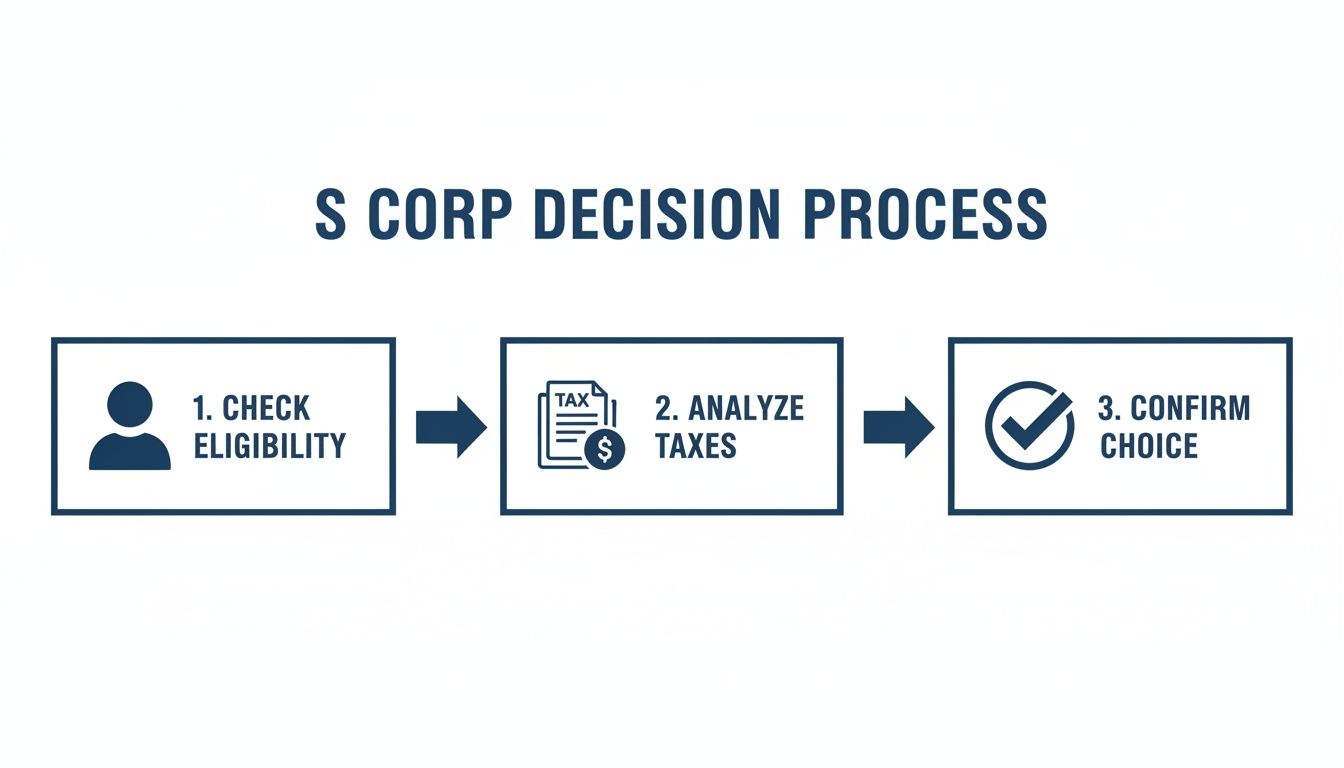
This simple flow—checking eligibility, running the tax numbers, and then confirming the choice—is the strategic foundation. By methodically working through each of these formation steps, you ensure your business is built on a solid legal and financial footing from day one.
Establishing Compliant Tax and Payroll Systems
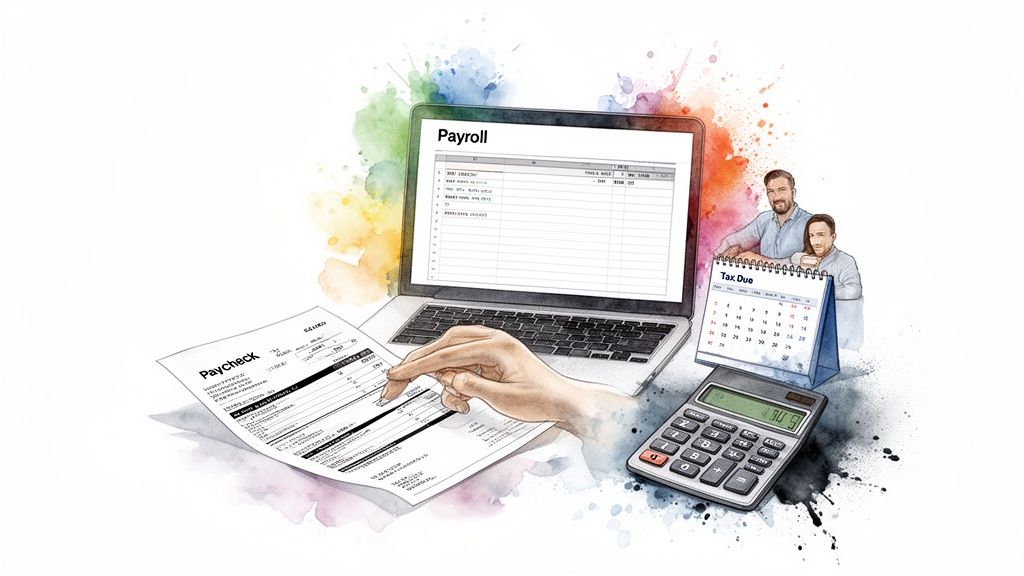
Now that your S Corp is officially on the books, it's time to build its financial engine. This is where the rubber meets the road—handling money, paying yourself and others, and staying on the right side of tax authorities. Getting this part right from the get-go is absolutely critical.
First things first: payroll. As an owner-employee, you can't just dip into the business account for personal cash whenever you want. You must be on the official payroll, just like any other employee. This means setting up a system to properly calculate and withhold federal, state, and local income taxes, not to mention Social Security and Medicare (FICA) taxes.
A good payroll system will also handle depositing those taxes with the IRS and state agencies on time. Dropping the ball here leads to stiff penalties, so it's not something to take lightly. While modern software like Gusto or QuickBooks Payroll can automate a lot of this, remember that the ultimate responsibility for compliance lands squarely on your shoulders.
Defining Your Reasonable Compensation
One of the areas the IRS scrutinizes most closely for S Corps is your salary. You are required to pay yourself reasonable compensation for the work you do before you take any tax-free distributions. This concept is the very foundation of the S Corp tax advantage, and a misstep here can unravel everything.
So, what does "reasonable" actually mean? It's not a number you can just invent. The IRS benchmark is what a similar business would pay someone else for the same services.
To land on a defensible number, you need to weigh a few key factors:
- Your Role & Experience: What do you actually do for the company? Are you the lead salesperson, the head of operations, the chief strategist? What unique skills are you bringing to the table?
- Industry & Location: What are other professionals in your field and geographic area earning for similar work? A marketing consultant in Manhattan will have a different baseline than one in a smaller city.
- Business Performance: Your pay should make sense in the context of the company's financial health, including its gross receipts and profitability.
Just as important as the number itself is documenting how you got there. This research and reasoning will be your first line of defense if the IRS ever comes knocking.
Pro Tip: Don't get cute by setting an artificially low salary to maximize your distributions. The IRS has seen this movie a thousand times. They can—and will—reclassify those distributions as wages, leaving you with a nasty bill for back taxes, penalties, and interest. It’s a costly shortcut.
Managing Salary vs. Shareholder Distributions
Once you’ve paid yourself that reasonable salary, any remaining profits can flow to you as a shareholder distribution. This is where the big tax savings happen because distributions aren't hit with self-employment taxes.
It’s crucial to understand the difference. A salary is a fixed, recurring payment for your labor, processed through payroll with all the usual tax withholdings. Think of it as a standard business expense. Distributions, on the other hand, are a payout of profits that can be taken when the business has enough cash and retained earnings to cover them.
You have to maintain a crystal-clear separation between the two.
- Salary: Paid on a regular schedule (e.g., bi-weekly, monthly) for the work you perform.
- Distribution: Paid out from company profits after all expenses, including your salary, are covered.
Let's look at a real-world example. A tech consultant in NYC decides her reasonable salary is $120,000 a year. After paying herself that salary and covering all other business costs, her S Corp has $80,000 left in profit. That $80,000 can be paid out as a distribution, saving her from paying the 15.3% self-employment tax on that amount.
This disciplined approach isn't just about ticking compliance boxes. It’s about strategically managing your finances to fully and legally leverage the S Corp structure you worked so hard to set up.
Avoiding Common S Corp Management Mistakes
Getting your S Corp formed is a huge win, but let's be honest—that's just the starting line. The real work is in the day-to-day running of the company. It’s the ongoing management and sticking to the strict IRS and state rules that will actually protect your tax advantages for the long haul.
Too many entrepreneurs nail the formation but then drop the ball on compliance, putting their entire S Corp status on the line. Think of it this way: your S Corp election is a privilege, not a permanent right. If you don't keep up with the required corporate formalities, the IRS can take it away.
Let's walk through the most common—and costly—mistakes we see business owners make so you can avoid them from the get-go.
The Reasonable Compensation Trap
This is, without a doubt, the number one mistake that gets S Corp owners into hot water with the IRS. It’s incredibly tempting to pay yourself a tiny salary to maximize those sweet, tax-free distributions. But it's a dangerous game.
Paying yourself a $20,000 salary while your highly profitable consulting firm is clearing $300,000 in distributions just isn't going to fly. The IRS is crystal clear on this: you, as an owner-employee, must be paid a salary that reflects the fair market value of the work you actually do.
If they believe you're lowballing your own paycheck, the IRS has the power to reclassify your distributions as wages. And that’s when things get painful.
You’ll suddenly be on the hook for:
- Back payroll taxes on the entire reclassified amount (both your share and the company's).
- Hefty penalties for failing to pay those taxes on time.
- Interest that’s been piling up on the whole outstanding balance.
This one slip-up can completely erase years of tax savings and leave you with a massive, unexpected bill. Your best defense is to document why your salary is what it is, using real industry data and a clear description of your role and responsibilities.
Botching Shareholder Distributions
Here’s another critical error we see all the time: messing up shareholder distributions. The entire S Corp structure is built on one simple, unbreakable rule: you can only have one class of stock. This means every shareholder must have identical economic rights.
In practice, this means profits have to be distributed proportionally based on how many shares each person owns.
Let's say you have a two-partner S Corp, and you each own 50%. If the company decides to distribute $100,000, you each must get exactly $50,000. You can't give one partner $60,000 and the other $40,000, even if you both agree to it.
An unequal distribution, even an accidental one, can be seen by the IRS as creating a second class of stock. This is a direct violation of S Corp rules and can trigger the termination of your S Corp status, throwing your business right back into the world of C Corp double taxation.
This often happens by accident. Maybe one owner uses the company credit card for a personal dinner and forgets to reimburse the business. That can be viewed as a disproportionate distribution, creating a compliance nightmare. Meticulous bookkeeping isn't just good practice; it's your best defense.
Neglecting Corporate Formalities
An S Corp is still a corporation at its heart, and you have to run it like one. That means observing the legal formalities that prove it’s a separate legal entity from you, the owner. If you don't, you risk "piercing the corporate veil," which could make your personal assets—your house, your car, your savings—vulnerable in a lawsuit.
It's easy to let these things slide when you're busy growing the business, but they are absolutely non-negotiable.
Key Formalities You Can't Ignore:
- Hold Annual Meetings: You need to hold regular meetings for both shareholders and your board of directors.
- Keep Detailed Minutes: Every major decision made in those meetings needs to be documented in formal minutes and kept in your corporate record book.
- Maintain Separate Finances: Never, ever mix business and personal funds. All company money flows through the dedicated corporate bank account.
These aren't just administrative hoops to jump through for the government. They enforce good governance, create a clear paper trail for business decisions, and are your primary shield for the liability protection your corporation offers. Staying disciplined here is fundamental to the long-term health of your S Corp.
Real World Examples of NYC S Corps in Action

It’s one thing to talk about the rules and benefits in theory, but where the S Corp really shines is in practice. Let's look at a couple of real-world scenarios I've seen play out for New York City entrepreneurs. These examples show how making the S Corp election can deliver some serious financial results in different industries.
We'll walk through a real estate investor managing her portfolio and a tech consulting firm that's starting to scale. You'll see exactly how this business structure can protect personal assets, open up tax efficiencies, and lay the groundwork for long-term growth.
A Real Estate Investor in Brooklyn
Let's start with Maria, a real estate investor who owns three multi-family properties in Brooklyn. For years, she ran everything as a sole proprietor, which meant the properties were held in her own name. Things were going well, but this structure left her personal assets—her home, her savings, everything—wide open to any lawsuits connected to her rental business.
A minor tenant dispute was the wake-up call she needed. Maria realized just how much risk she was carrying. We worked with her to form a New York S Corp to hold the property portfolio. This one move immediately put up a legal firewall between her business and her personal life. Now, if a lawsuit pops up at one of her properties, the claim is against the corporation's assets, not her family’s wealth.
But the benefits didn't stop with liability protection.
- Asset Protection: Her home and personal savings were finally shielded from business-related legal claims.
- Tax Efficiency: All the rental income still passes through to her personal tax return, so she avoids getting hit with corporate-level tax. Even better, she can take distributions from the net income without paying self-employment tax on it.
- Simplified Estate Planning: Down the road, passing shares of the corporation to her kids will be much simpler than transferring individual property deeds.
By forming an S Corp, Maria didn't just protect her family’s financial future—she built a more organized, tax-efficient framework for her growing real estate business. It was the move that turned her side hustle into a legitimate, defensible company.
This strategic shift gave her incredible peace of mind and set a solid foundation for buying more properties. In a high-stakes market like NYC, the S Corp gave her the perfect mix of legal protection and tax advantages.
A Manhattan Tech Consulting Firm
Now for a different scenario. Meet David and Sarah, the co-founders of a boutique tech consulting firm in Manhattan. They started as a multi-member LLC, but as the business took off, they were getting crushed by self-employment taxes on their entire share of the company's profits. Their firm was on track to net $400,000 in its third year.
Under their old LLC structure, both David and Sarah would have had to pay the full 15.3% self-employment tax on their entire $200,000 share of the profits. That’s a huge tax bill before you even factor in federal and state income taxes.
Looking for a better way, they elected to have their LLC taxed as an S Corp. This single decision completely changed their financial outlook.
First, we helped them set a reasonable salary for their roles as senior consultants, landing on $120,000 each. This salary is subject to normal payroll taxes. But here's the key: the remaining $80,000 of profit for each of them could now be taken as a shareholder distribution.
The impact was immediate and substantial:
- Salary: $120,000 (subject to payroll taxes)
- Distribution: $80,000 (not subject to payroll taxes)
- Tax Savings: By shielding $80,000 each from that 15.3% self-employment tax, they collectively saved over $24,000 in taxes for the year.
They were able to pour those savings right back into the business, hiring a junior developer and ramping up their marketing. For David and Sarah, forming an S corp wasn't just about paperwork; it was a powerful growth strategy that directly funded their next big move.
When to Bring in a Professional for Your S Corp
You can figure out how to form an S Corp on your own, but the reality is that the process is full of potential missteps. Working with an experienced firm like Blue Sage Tax & Accounting isn't just about filing paperwork correctly—it's about building a solid financial foundation from day one.
Our first step is always to confirm that an S Corp is genuinely the right move for you. We’ll dig into your specific revenue, operating costs, and growth plans to run the numbers. This way, you can see a clear projection of the potential tax savings versus the costs of S Corp compliance, making the decision a strategic one, not a guess.
It's More Than Just the Initial Paperwork
Once we've determined an S Corp makes sense, we'll take the lead on the entire formation process. We handle the state-level incorporation and, most importantly, prepare and file the critical IRS Form 2553 to lock in your S Corp tax status. Our experience means we hit every deadline with accurate filings, helping you avoid those frustrating—and often expensive—delays or rejections.
But honestly, the real value of a professional partnership comes after the initial setup is complete.
We don't just set it and forget it. As your ongoing partner, we'll help you determine a defensible "reasonable compensation" for yourself, structure shareholder distributions for optimal tax efficiency, and spot new planning opportunities as your business grows and changes.
This proactive approach means you’re not just compliant; you're continuously getting the most out of your S Corp structure. We manage the complexities of your tax and payroll systems, freeing you up to focus on what you do best: running and growing your business. It's about building long-term financial health, not just ticking a box on a government form.
Common Questions About New York S Corps
When business owners in New York start thinking about forming an S corp, a handful of questions almost always come up. Let’s walk through the most common ones to give you the clarity you need to make the right call for your company.
What’s the Real Tax Advantage of an S Corp?
The biggest win is pass-through taxation. Unlike a C corp, an S corp doesn't pay corporate income tax. Instead, the profits and losses are "passed through" to you, the owner, to report on your personal tax return.
This setup completely sidesteps the dreaded "double taxation" that hits C corps—where the company is taxed on its profits, and then shareholders are taxed again on the dividends they receive. It also lets owner-employees slash their self-employment tax bill by paying themselves a reasonable salary and taking the rest of the profits as distributions.
Can My LLC Get S Corp Tax Treatment?
Yes, and this is a strategy we see successful businesses use all the time. An existing LLC can simply file Form 2553 with the IRS to be taxed as an S corp.
This move gives you the legal shield and operational freedom of an LLC while unlocking the significant tax savings of an S corp. You get to keep the business structure you already have, but you optimize how it's taxed, which can make a huge difference to your bottom line.
For many New York entrepreneurs, this hybrid LLC/S corp model is the ideal setup. It delivers the strong liability protection of an LLC with the smart payroll tax savings of an S Corp—truly the best of both worlds.
What if I Mess Up and Miss the Form 2553 Deadline?
Don't panic. Missing the filing deadline—typically 75 days from your formation date—is a common mistake, but it's usually fixable.
The IRS has procedures for late election relief, like Revenue Procedure 2013-30. If you had a good reason for filing late and can show you acted quickly once you realized the error, the IRS will often approve your request. That said, this isn't a simple DIY fix. Getting it right requires careful handling, and bringing in a tax professional is the best way to secure your S corp status without a hitch.
Getting your S corp formation and compliance right from the start is critical. The team at Blue Sage Tax & Accounting Inc. has the hands-on experience to guide you through every step, ensuring your business is structured for tax efficiency and future growth. Start a conversation with us today.