When you've built significant wealth, planning for its future is about so much more than just drafting a will. It's about creating a living, breathing strategy that protects your assets, minimizes hefty tax bills, and secures a smooth transfer of your legacy across generations. This isn't a static document you file away; it's a dynamic financial blueprint designed to grow and endure.
Why HNWI Estate Planning Is More Than Just a Will

It’s easy to feel overwhelmed when looking at the complexity of your financial picture. For most people, "estate planning" means one thing: a will. And while a will is a crucial piece of the puzzle, for anyone with substantial assets, it’s just the first step on a much longer journey.
Think of it this way: a basic will is like a paper map for a quick drive across your hometown. It gets the job done for a simple trip, but it's useless if there’s unexpected traffic, a road closure, or if you decide on a new destination. True estate planning for high net worth individuals is more like a sophisticated GPS. It’s a smart system that anticipates changes in tax law, navigates tricky family dynamics, and protects your wealth from risks you might not even see coming.
The Limits of a Simple Will
Relying on a will alone is a risky move for a high-value estate. For starters, a will has to go through probate court, which is a public, often expensive, and time-consuming process. Worse, it offers very little control over how or when your assets are distributed and provides almost no defense against estate taxes, creditors, or legal disputes.
Imagine leaving a multi-million dollar business to your child in a will. That single document does nothing to prepare them to take the reins. It also doesn't provide the cash needed to pay the estate taxes, which could ultimately force your heirs to sell the very company you wanted them to inherit.
An estate plan is not just about distributing wealth after you’re gone; it's about preserving and enhancing that wealth for future generations while you are still here to guide the process.
Building a Comprehensive Strategy
A robust estate plan for high-net-worth families is a proactive strategy that handles all the critical issues a simple will can't touch. This complete system is built to achieve several key goals:
- Minimize Tax Burdens: It uses sophisticated trusts and strategic gifting to slash your exposure to federal and state estate taxes, which can easily devour a huge chunk of an unprotected estate.
- Provide Asset Protection: The right structure acts as a shield, safeguarding your wealth from potential creditors, lawsuits, and even the poor financial choices of a beneficiary down the line.
- Ensure Privacy and Control: By using vehicles like trusts, your estate can bypass the public spectacle of probate court. This also lets you set clear rules for how your assets are managed and passed down through generations.
This guide is designed to help you build that very system. At its core, the most powerful tool you have for preserving your legacy is proactive, thoughtful, and detailed planning. It's how you ensure that what you've worked so hard to build will last.
The Core Toolkit for Advanced Wealth Transfer

When you're dealing with significant wealth, a simple will just won't cut it. A truly effective estate plan relies on a set of specialized legal instruments designed to do three things exceptionally well: protect your assets, minimize your tax burden, and transfer your wealth with precision and control.
Think of these tools not as complex legal jargon, but as practical solutions to specific financial challenges. Understanding how they work is the first step toward building a legacy that lasts for generations.
It's a strange but true fact: a huge gap exists between knowing you need a plan and actually creating one. A recent study found that while 83% of Americans agree estate planning is important, a shocking 55% have no plan whatsoever. For high-net-worth families, especially in places like New York City, that inaction can lead to billions in avoidable taxes and unnecessary family conflict.
The good news? A golden window for planning has just opened. The new 2025 One Big Beautiful Bill Act (OBBBA) boosts the federal estate and gift tax exemption to $15 million per person starting in 2026. This is a game-changer, but only if you act on it. You can explore more findings from the 2025 Trust & Will Estate Planning Report.
Revocable vs. Irrevocable Trusts: The Safe and The Time Capsule
Trusts are the bedrock of modern estate planning. They are simply legal arrangements that let you hold assets on behalf of your beneficiaries. The two main types, however, serve very different purposes.
A Revocable Living Trust is like your personal safe. You put your assets inside, you hold the key, and you can change the combination or take things out whenever you please. It’s a fantastic tool for avoiding the public, time-consuming probate process and for managing your affairs if you ever become incapacitated. The catch? Because you keep full control, the IRS still considers those assets part of your taxable estate.
An Irrevocable Trust, on the other hand, is more like a time capsule. Once you place assets inside and seal it, you generally can't change the terms or take them back. This loss of control is precisely what gives it so much power. By officially removing assets from your ownership, you also remove them from your taxable estate, shielding them from estate taxes and potential creditors down the line.
Advanced Tools for Strategic Gifting
When your estate is more complex, you need more specialized tools. These strategies are cornerstones of sophisticated estate planning for high-net-worth individuals, allowing you to transfer wealth while minimizing the tax bite.
-
Grantor Retained Annuity Trust (GRAT): Think of a GRAT as a structured investment plan with a powerful gifting feature. You place appreciating assets (like company stock or real estate) into the trust for a set term and, in return, receive a fixed annual payment. At the end of the term, any growth above a specific IRS interest rate passes to your beneficiaries completely free of gift tax. It’s an incredibly effective way to transfer future appreciation.
-
Generation-Skipping Trust (GST): This is a financial guardrail for multi-generational wealth. Instead of leaving assets directly to your children, you place them in a GST. Your children can benefit from the trust during their lifetime, but the assets ultimately pass to your grandchildren (or even further). This structure "skips" the layer of estate tax that would have been triggered when your children pass away, preserving a much larger portion of your wealth over time.
A well-structured estate plan uses a combination of these tools, each chosen for a specific purpose, to create a cohesive and tax-efficient strategy for wealth preservation and transfer.
To help clarify which tool fits which situation, here's a quick comparison of the primary vehicles we've discussed.
Comparing Key Estate Planning Vehicles for HNWI
This table provides a side-by-side comparison of common estate planning tools, highlighting their primary purpose, flexibility, tax benefits, and ideal use cases for high-net-worth individuals.
| Vehicle | Primary Purpose | Flexibility (Revocability) | Key Tax Benefit | Best For |
|---|---|---|---|---|
| Revocable Trust | Avoid probate, manage assets during incapacity | High (fully revocable) | None; assets remain in the estate | Organizing assets and ensuring seamless management if you become unable to handle your affairs. |
| Irrevocable Trust | Remove assets from the taxable estate | Low (generally permanent) | Removes assets and appreciation from the taxable estate | Protecting assets from creditors and minimizing federal and state estate taxes. |
| GRAT | Transfer future asset appreciation tax-free | None (irrevocable for the term) | Gift-tax-free transfer of appreciation | Gifting highly appreciating assets (like pre-IPO stock or real estate) in a volatile market. |
| GST Trust | Preserve wealth across multiple generations | None (irrevocable) | Avoids estate tax at the children's generation | Long-term, multi-generational wealth preservation for substantial family fortunes. |
| Family Limited Partnership (FLP) | Centralize and protect family assets, facilitate gifting | Moderate (depends on partnership agreement) | Valuation discounts on gifted partnership interests | Consolidating and managing a family business or real estate portfolio while transferring value to the next generation. |
Each of these vehicles has a distinct role to play. The art of great estate planning is knowing how to combine them to meet your specific family goals.
Structuring Family Assets for The Long Term
Beyond trusts, other legal structures are crucial for managing and protecting family-owned assets, especially closely held businesses or real estate portfolios.
A Family Limited Partnership (FLP) is an excellent way to consolidate family assets—a business, properties, or securities—under one roof. As the senior generation, you can retain control as the general partner while gradually gifting limited partnership interests to your children or other heirs over time.
This strategy offers some powerful advantages:
- Centralized Management: It simplifies the administration of what might otherwise be a messy collection of family assets.
- Valuation Discounts: Because the gifted shares are minority interests and not easily sold, they may be eligible for valuation discounts. This lets you transfer more value while using less of your lifetime gift tax exemption.
- Creditor Protection: Assets held within the partnership are generally shielded from the personal creditors of individual family members.
By skillfully combining these core tools, we can build a flexible and resilient plan that’s perfectly suited to your financial landscape and your family’s unique vision for the future.
Navigating the Complex Tax Landscape
When we talk about estate planning for high-net-worth families, taxes aren't just one piece of the puzzle—they're the entire board. The real challenge isn't a single tax but a tangled web of federal, state, and sometimes international rules that can seriously diminish a lifetime of hard work if you don't have a plan.
A common mistake I see is people looking at different taxes in silos. A smart strategy understands that estate taxes, gift taxes, capital gains, and income taxes are all interconnected. A move you make to lower your estate tax, for example, could accidentally create a huge capital gains problem for your heirs down the road. It all has to work together.
This is especially true because tax laws are always changing. The strategy that worked perfectly five years ago might be inefficient or even detrimental today. Staying ahead of the curve lets you adapt to new legislation and seize opportunities before they vanish.
The Federal Gift and Estate Tax Exemption
At the center of all federal planning is the lifetime gift and estate tax exemption. Simply put, this is the total amount of assets you can pass to others—either during your life or at death—before the federal estate tax kicks in. And that tax is a big one, with a top rate of 40%. For 2025, the exemption is a very generous $13.99 million per person.
This high exemption creates a powerful window for lifetime gifting. By strategically moving assets out of your estate now, you can ensure all their future growth happens on your heirs' side of the ledger, completely tax-free. Think about assets you expect to appreciate significantly, like company stock or real estate. It’s like pruning a tree to make sure the new branches grow outside the tax collector's reach.
Yet, there's a huge gap between concern and action. A recent report found that while 90% of high-net-worth individuals worry about taxes eroding their legacy, only 42% have actually done something about it. This is a risky game to play, especially with the exemption set to rise to $15 million in 2026 under the OBBBA—these high levels aren't set in stone. For entrepreneurs and real estate owners in places like NYC, this is a clear signal to get moving on gifting strategies. You can find more insights in the 2025 State of Estate Planning Report.
Using your lifetime exemption is not an expense; it's an investment in your family's future. Every dollar of appreciation you can move out of your estate today is a dollar that won't be subject to a 40% tax later.
Beyond Federal: The State-Level Maze
For anyone living in a state like New York, the federal exemption is only half the story. New York has its own estate tax, and its exemption is much lower—just over $6.9 million. And here’s the critical part: the NY estate tax is a “cliff tax.”
What that means is if your estate's value is even a little bit over the exemption (by 5% or more), the entire estate gets taxed, not just the amount over the line. It’s an incredibly unforgiving rule that makes precise state-level planning an absolute must.
Here are a few things to keep in mind when dealing with state taxes:
- Decoupled States: New York is one of several states whose estate tax laws are "decoupled" from the federal system. They play by their own rules.
- Residency vs. Domicile: Where you legally live versus where you own property can create a real mess. Owning a vacation home in another state could pull your estate into their tax system, too.
- State-Specific Gifting Rules: Some states have their own gift taxes, while others have "claw-back" provisions that pull large gifts made right before death back into the estate for tax purposes.
Successfully navigating this requires a deep understanding of the specific rules where you live and own property. A New York resident, for instance, might use trusts that are carefully structured to satisfy both federal and state tax laws. The goal is always a single, coordinated strategy that protects your legacy from every angle.
Protecting Illiquid Assets and Business Successions

For so many successful entrepreneurs and investors, real wealth isn't just a number in a bank account. It’s the family business built from scratch, the commercial real estate portfolio acquired over decades, or a significant stake in a private company. While these are powerful assets, they share a common challenge in estate planning: they are illiquid.
You can’t just write a check against the value of an apartment building to pay an estate tax bill. This liquidity crunch is one of the single biggest threats to a high-net-worth legacy. Without a solid plan, your heirs could be backed into a corner, forced into a fire sale of valuable assets at a steep discount just to find the cash to settle your estate.
This forces a critical question: how do you protect the value of everything you've built while ensuring your family has the resources they need? The answer lies in being proactive—combining smart valuation, liquidity planning, and a crystal-clear succession plan.
Creating Liquidity When There Is None
The first move is to create a dedicated source of cash that can be tapped quickly after you're gone. The goal is to give your estate the funds to cover taxes and administrative costs without having to sell the core assets you want to preserve for your family.
An Irrevocable Life Insurance Trust (ILIT) is often the cornerstone of this strategy. An ILIT is a specific type of trust designed to own a life insurance policy on you. Since the trust is the owner, the death benefit is paid directly to the trust, not your estate. This simple move means the entire payout is generally free from federal estate taxes.
Your heirs, as trustees, can then use this tax-free money to:
- Pay off federal and state estate taxes.
- Settle any outstanding debts or expenses of the estate.
- Buy assets from the estate, like shares in the family business. This effectively injects cash into the estate while keeping the asset in the family.
An ILIT essentially turns an insurance policy into a tax-advantaged fund dedicated to settling your estate, keeping your primary assets intact for the next generation.
Think of an ILIT as a financial shock absorber for your estate. It provides the immediate cash to handle all the final obligations, preventing a forced sale and allowing your business or properties to transition smoothly.
Engineering a Seamless Business Succession
If you own a family business, the transition of leadership and ownership is every bit as important as managing taxes. A well-designed succession plan is a detailed roadmap that answers the tough questions before they can cause conflict. Who’s taking over? How will ownership be transferred? What happens if a key partner wants to retire or unexpectedly passes away?
A buy-sell agreement is the legal tool that puts this plan into action. It’s like a prenuptial agreement for your business partners—a binding contract that spells out exactly what happens to a partner's ownership interest upon a "triggering event" like death, disability, or retirement.
This agreement typically defines:
- The Triggering Events: The specific circumstances that activate the buyout.
- The Valuation Method: A clear, predetermined formula for how the business will be valued, which prevents arguments over price down the road.
- The Funding Mechanism: How the buyout will be paid for. This is often funded with life insurance policies on each owner, providing the instant cash needed for the remaining partners to buy out a deceased owner's share from their estate.
This proactive approach is absolutely essential in estate planning for high net worth individuals with business interests. It gives your family certainty, your employees stability, and your company a clear path forward. Without it, you’re leaving the legacy you worked so hard to build entirely to chance.
Building a Legacy That Lasts: Philanthropy and Family Governance
When we talk about wealth, it’s easy to get lost in the numbers. But true legacy planning is about something more—it’s about making sure your wealth reflects your values and continues to do good in the world long after you’re gone. Weaving philanthropy into your estate plan is one of the most powerful ways to turn financial success into a lasting, meaningful impact.
This isn’t just about writing a check. It’s about being smart and strategic, structuring your giving to make the biggest possible difference for the causes you care about while also creating significant tax benefits for your estate. This is a cornerstone of sophisticated estate planning for high net worth individuals.
Making Charity Part of Your Financial Blueprint
Two of the best tools for the job are Donor-Advised Funds and Charitable Remainder Trusts. They work differently, but both give you a structured, tax-savvy way to support your favorite causes.
-
Donor-Advised Funds (DAFs): The simplest way to think of a DAF is as your personal charitable savings account. You can contribute a lump sum of cash or appreciated stock, get an immediate and significant tax deduction, and then recommend grants from the fund to qualified charities whenever you feel inspired. It gives you the tax break now and the flexibility to give later.
-
Charitable Remainder Trusts (CRTs): A CRT is a brilliant tool that lets you have your cake and eat it, too. You place assets into a special type of trust that pays you (or someone you choose) an income for a period of time. When that period is over, whatever is left in the trust—the “remainder”—goes to the charity you designated. The best part? You get an immediate charitable tax deduction right when you set it up.
These aren't just donation vehicles; they are powerful planning instruments. They can shrink your taxable estate, help you sidestep capital gains taxes on highly appreciated assets, and even provide a steady income stream for you or your family.
A well-designed philanthropic strategy doesn't just give money away. It strategically redirects funds that would otherwise be paid in taxes toward causes that truly matter to you and your family.
Creating a Playbook for Your Family's Future
As wealth moves from one generation to the next, the biggest threat often isn't the market or the IRS—it's a breakdown in communication and a lack of a shared vision. This is precisely where family governance comes in. Think of it as creating a constitution for your family's wealth and future.
This "playbook" might be a simple family mission statement or a more detailed family constitution. The key is that it's created together, outlining the family's core values, long-term goals, and the guiding principles for making decisions down the road.
Putting a solid governance structure in place does a few critical things:
- Keeps Everyone on the Same Page: It establishes a common ground for making big decisions, whether about investment philosophy or charitable giving.
- Prepares the Next Generation: It’s a fantastic way to teach younger family members about financial stewardship and the responsibilities that come with wealth.
- Heads Off Conflict: By laying out clear expectations and procedures, it can prevent the kinds of misunderstandings that can ruin relationships and drain family fortunes.
By blending strategic philanthropy with thoughtful family governance, you’re doing so much more than just passing down assets. You’re handing over a legacy of purpose, responsibility, and shared values—the very things that will help your family, and its positive influence, thrive for generations.
Your Estate Planning Roadmap: From Idea to Action
Knowing the concepts is one thing, but putting them into practice is where the real work of estate planning for high-net-worth individuals begins. Let's walk through the practical steps to turn your intentions into a solid, legally-binding strategy.
Think of this less like a one-and-done task and more like a journey. You'll start by building a strong foundation, then move into the specifics of implementation, and finally, settle into a rhythm of regular check-ups.
Assembling Your A-Team
You wouldn't try to build a skyscraper without an architect, an engineer, and a master builder. Crafting a sophisticated estate plan is no different. It requires a team of specialists who can work together seamlessly.
Your core team should include:
- An Estate Planning Attorney: This is your legal architect. They’re the one who will actually draft the wills, trusts, and other documents that form the backbone of your plan.
- A Certified Public Accountant (CPA): Your CPA is your tax guru, making sure every move is designed to minimize gift, estate, and income taxes. They crunch the numbers to make the legal structures work as hard as possible for you.
- A Financial Advisor: This is the person managing your investment portfolio, making sure your assets are working in harmony with your long-term goals for your legacy and liquidity needs.
Each of these experts brings a critical perspective to the table. When they collaborate, your legal strategy, tax planning, and financial goals all click into place, which helps you avoid some very expensive mistakes.
A Step-by-Step Guide to Building Your Plan
Once your team is in place, the process itself is pretty logical. It all starts with you and your vision and ends with signing the documents that make it all official.
- Define What "Legacy" Means to You: This is the absolute most important part. What do you really want to accomplish? Think about what you want for your family, any charitable causes you care about, how you see your business continuing, and how to protect your assets.
- Get Your Financial House in Order: You'll need to create a complete inventory of everything you own and everything you owe. This means investment accounts, real estate, business interests, life insurance, and even digital assets. Getting the valuations right is crucial.
- Map Out Your Strategy: This is where your advisory team shines. They'll look at your goals and your balance sheet to recommend the best tools for the job. You'll decide on the right mix of trusts, gifting strategies, and structures for your business.
- Draft and Sign the Documents: With a clear plan, your attorney will get to work drafting the legal paperwork. The final step is making it real—signing wills, retitling assets to fund your trusts, and finalizing any business agreements.
This process isn't just about the money; it’s about structuring your legacy around what matters most to you.
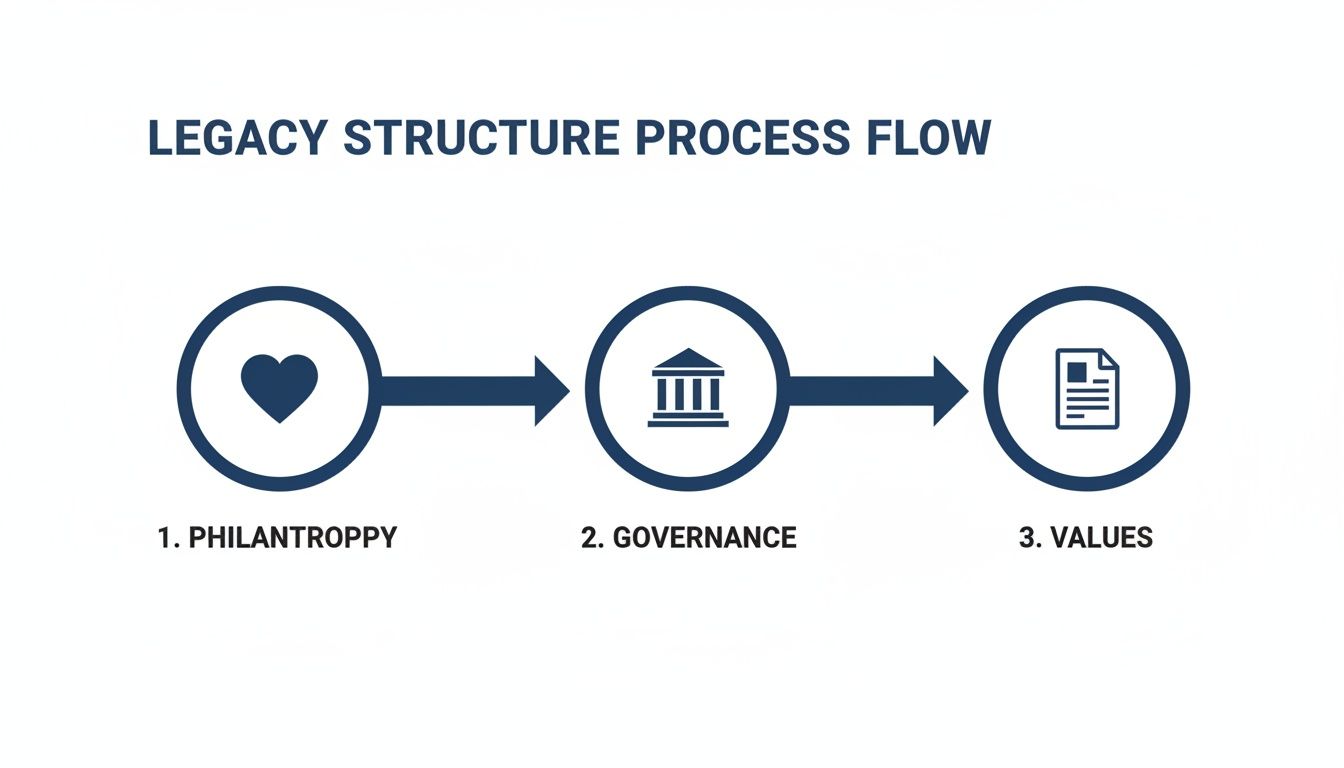
As you can see, a successful plan is built first on a clear sense of purpose and values, not just on financial instruments.
An estate plan is not a "set it and forget it" document. It’s a living blueprint that must adapt to changes in your life, your family, and the law.
Finally, get into the habit of scheduling regular reviews. You should sit down with your team at least every three to five years, or sooner if a big life event happens—like a marriage, divorce, a new grandchild, a major change in your wealth, or new tax laws. This diligence is what keeps your plan effective and ensures the legacy you’ve worked so hard to build is truly protected.
Common Questions About High-Net-Worth Estate Planning
Even with the best roadmap, you're bound to have questions. That’s a good thing—it means you’re thinking critically about your legacy. Here are some of the most common questions we hear from clients as they navigate the estate planning process.
How Often Should I Review My Estate Plan?
The old rule of thumb was to check in on your plan every three to five years, and that’s not a bad starting point.
But the real answer is: review it whenever life happens. Major events like a marriage, a divorce, the birth of a child, or a significant change in your finances (either up or down) should automatically trigger a call to your advisory team. Tax laws also change, sometimes dramatically, so an outdated plan might not just be inefficient—it could be actively working against you.
What’s the Difference Between a Trustee and an Executor?
It’s easy to get these two mixed up, but they have very different jobs. Both are fiduciaries—meaning they have a legal duty to act in someone else’s best interest—but they operate in different arenas.
-
An executor is named in your will. Their job begins after you die and involves steering your estate through the probate process. Think of them as the person who wraps everything up: gathering assets, paying your final bills, and making sure your heirs get what the will says they should.
-
A trustee is in charge of a trust. Their responsibilities can start the day the trust is created and can last for decades after you’re gone. They manage the assets inside the trust and distribute them to your beneficiaries according to the specific rules you laid out.
Can a Single Person Use a SLAT?
The short answer is no. A Spousal Lifetime Access Trust, or SLAT, is a tool designed specifically for married couples. The whole point is that one spouse makes a gift into a trust that benefits the other spouse.
It's a clever way to move assets out of your taxable estate while keeping them accessible to your family through your spouse. Without a spouse, the core mechanism just doesn't work.
For single individuals looking to use their lifetime gift tax exemption, there are plenty of other powerful options. Strategies like Grantor Retained Annuity Trusts (GRATs) or making gifts to trusts for your children are often much better fits.
Think of it like this: the "spousal access" part of the SLAT is its defining feature. No spouse, no SLAT.
At Blue Sage Tax & Accounting Inc., we specialize in creating clear, effective estate planning strategies that align with your unique financial goals. Contact us today to build a plan that protects your legacy.