The New York Pass-Through Entity Tax (PTET) is a clever workaround to the federal cap on State and Local Tax (SALT) deductions. At its core, it lets partnerships and S corporations pay state income tax at the business level, turning what would be a limited personal deduction for the owners into a fully deductible business expense on their federal returns.
Understanding the New York Pass-Through Entity Tax

Let’s say you own a thriving small business in New York. Traditionally, your business profits would “pass through” to you personally. You’d report that income on your own return and pay the New York State income tax that came with it. This was the standard way of doing things for decades.
But then the federal Tax Cuts and Jobs Act of 2017 (TCJA) came along and changed everything. It introduced a major roadblock: a $10,000 annual cap ($40,000 for 2025) on how much state and local tax (SALT) individuals could deduct on their federal income tax returns. For countless business owners in a high-tax state like New York, their state tax bill alone easily blows past that limit.
The result? A huge chunk of the state taxes they paid could no longer lower their federal taxable income, which meant a higher federal tax bill.
A Strategic State-Level Response
New York, seeing how this federal law was hitting its business owners, crafted a smart solution. The state rolled out the Pass-Through Entity Tax (PTET) for tax years starting on or after January 1, 2021. This elective tax gives partnerships and S corporations the choice to pay income tax directly at the entity level, effectively shifting the tax payment from the individual owners to the business itself. If you’re curious about the legislative journey and how it connects to federal rules, this detailed overview from PKF O’Connor Davies is a great resource.
Think of it this way: instead of an owner paying state taxes out of their personal checking account (where the federal deduction is capped), the business pays it from the company account. That payment is then treated as a normal business expense, which is 100% deductible on the business’s federal tax return.
How the PTET Mechanism Works
The whole PTET system hinges on a simple but powerful shift. The business makes an annual, irrevocable election to pay the tax, which is calculated on the company’s income that’s sourced to New York.
To give you a quick snapshot, here’s a table summarizing the key aspects of the PTET.
Key Features of the NY PTET at a Glance
| Feature | Description |
|---|---|
| Eligibility | Available to most partnerships (including LLCs taxed as partnerships) and New York S corporations. |
| Election | An annual, irrevocable election must be made by the due date of the first estimated payment. |
| Tax Base | The tax is calculated on the entity’s total pass-through entity taxable income. |
| Federal Impact | The PTET paid is a deductible business expense, reducing the entity’s federal ordinary income. |
| State Impact | Owners receive a dollar-for-dollar tax credit on their personal NYS income tax returns. |
| Goal | To provide a workaround for the federal $10,000 ($40,000 for 2025) SALT deduction cap. |
This structure creates a win-win scenario, allowing business owners to get the full benefit of their state tax payments on their federal returns.
Here’s a breakdown of the benefits this process delivers:
- Full Federal Deductibility: The PTET payment is deducted on the business’s federal return, which lowers the total profit that ultimately passes through to the owners.
- Lower Federal Taxable Income: Since the owners are now reporting less pass-through income, their personal federal tax bill goes down.
- State Tax Credit: Owners get a dollar-for-dollar credit on their New York State personal income tax return for their share of the PTET the business paid.
It’s an elegant two-step that neatly sidesteps the federal SALT deduction cap. The state gets its tax revenue, and business owners get to realize a full federal tax benefit for their state income tax payments—just through a different door.
Determining if Your Business Is Eligible
So, you’ve heard about New York’s pass-through entity tax and are wondering if your business can get in on the action. It’s a smart question to ask, because this tax workaround, while powerful, isn’t for everyone. New York has some very specific rules about who qualifies, and it all boils down to your business structure and who the owners are.
Let’s start with the basics. The New York PTET is designed for two main types of businesses:
- Eligible Partnerships: Think of any business that files a partnership return, Form IT-204. This covers your standard general partnerships, limited partnerships, and, most commonly, multi-member LLCs.
- New York S Corporations: This is for any corporation that has officially elected to be treated as an S corp for both federal and New York State tax purposes.
Right off the bat, this excludes a few common structures. Single-member LLCs that are “disregarded entities” (meaning their income just flows onto the owner’s personal tax return) are not eligible. The same goes for traditional C corporations and sole proprietorships—they simply don’t fit the pass-through model this law was built for.
The All-Important Ownership Test
This is where things get really specific, and it’s the hurdle where many businesses stumble. It’s not enough to just be an S corp or a partnership; you have to look at who actually owns the business.
Because the PTET is a workaround for the federal SALT cap—which hits individual taxpayers—the law is written to ensure only individuals benefit. An otherwise eligible business can only make the PTET election if 100% of its owners are individuals, estates, or trusts.
This is a black-and-white rule. If you have even one owner that’s a corporation (like a C corp) or another partnership, your business is out. The entire entity gets disqualified.
Key Takeaway: The ownership requirement is absolute. If a C corp or another partnership holds even a 1% stake in your entity, you cannot make the New York PTET election.
This strict rule prevents a loophole where corporations, which aren’t subject to the SALT cap in the first place, could get an indirect tax break.
What About Tiered Partnerships and Out-of-State Owners?
Things can get tricky with more complex business structures. Take tiered partnerships, for instance, where one partnership (the “upper-tier”) owns a piece of another partnership (the “lower-tier”).
For that lower-tier partnership to be eligible for PTET, all its direct owners have to be individuals. If one of its owners is the upper-tier partnership, it fails the test. This shows how strictly the state applies the ownership rule at every single level.
Now for some good news. What if your business has owners who don’t live in New York? Having non-resident owners does not disqualify you, as long as every single one of them is an individual.
When you calculate the PTET, you’ll only base it on the income connected to New York. This keeps things fair and allows businesses with partners scattered across the country to still offer this valuable tax benefit to their New York owners.
Navigating the PTET Election: Deadlines and Key Steps You Can’t Afford to Miss
Deciding to opt into New York’s Pass-Through Entity Tax isn’t something you can do passively. It’s an active choice with a strict, non-negotiable timeline. Get the timing wrong, and your partners or shareholders could lose out on a full year of significant federal tax savings.
Let’s walk through exactly what you need to do and when.
The first and most important step is making the annual election. This isn’t a paper form you mail to Albany; everything happens online.
Your business absolutely must have a Business Online Services account with the New York State Department of Taxation and Finance. This portal is the only way to make the PTET election. If your firm doesn’t have an account yet, setting one up should be priority number one—long before the deadline is looming.
The All-Important March 15th Deadline
The deadline for the annual PTET election is simple but unforgiving: you must make the election by March 15th of the tax year you’re opting into. This date isn’t random. It conveniently lines up with the due date for your first quarterly estimated tax payment, letting you knock out two key compliance tasks at once.
Once an authorized partner or corporate officer logs into the online account and officially opts in, that decision is locked in for the entire year.
Heads Up: The New York PTET election is irrevocable. Once you hit that “submit” button for a given tax year, there’s no going back. You can’t change your mind later, even if your business’s financial forecast takes an unexpected turn. This is why careful planning before March 15th is so critical.
The state’s website is your command center for all things PTET.
This central hub is where you’ll find the links to make the election, send in your payments, and eventually file your annual return. It really underscores the digital-first approach New York has taken with this whole system.
Staying on Top of Quarterly Estimated Payments
Making the election is just the starting gun. To stay in the clear, your business has to make quarterly estimated tax payments all year long. This is New York’s way of ensuring a steady flow of revenue, much like how individuals are required to pay estimated taxes.
The payment schedule is pretty standard:
- March 15th
- June 15th
- September 15th
- December 15th
Here’s the catch: each payment must be at least 25% of your total required annual payment. You can’t just pay the bulk of your tax bill at the end of the year. You need to project your annual PTET liability and pay it in four equal chunks. Underpaying can trigger penalties, so getting your income projections right is essential. For a deeper dive, tax professionals often find the New York pass-through entity tax analysis from Deloitte helpful.
Filing the Annual Return (and What to Do if You Need More Time)
Once the tax year is over, it’s time to file an annual PTET return. This is where you reconcile your estimated payments against your actual tax liability. This return is due on March 15th of the following year. So, for the 2024 tax year, your PTET return is due by March 15, 2025.
What if you’re not ready? You can request a six-month extension, which pushes your filing deadline to September 15th. But be careful—an extension to file is not an extension to pay. You still have to pay your full estimated tax bill by the original March 15th deadline to steer clear of penalties and interest.
Don’t Forget About the New York City PTET
For businesses with operations in the five boroughs, there’s one more layer to this: the New York City Pass-Through Entity Tax (NYC PTET). This is a completely separate, optional tax that comes with its own election process.
While the rules and deadlines for the NYC PTET are designed to mirror the state program, opting into one doesn’t automatically opt you into the other. If your business is eligible for the NYC PTET and it makes financial sense, you must make a second, distinct election through your Business Online Services account by the same March 15th deadline. It’s a dual system designed to give city-based businesses an extra tool to combat high local income taxes.
Calculating the PTET and Allocating Credits to Owners
So, you’ve decided to opt into New York’s pass-through entity tax. Now comes the important part: figuring out the numbers. This is where you’ll see the real-world impact on your business’s bottom line and, ultimately, on the partners’ or shareholders’ personal tax returns.
It’s a multi-step process, but it’s straightforward once you understand the moving parts. Let’s walk through how to calculate the tax, apply the right rates, and ensure the credit flows back to the owners correctly.
Defining PTET Taxable Income
First things first, we need to determine the PTET taxable income. This isn’t just your company’s net profit. It’s a specific figure calculated under New York tax law, and the rules vary slightly depending on your business structure.
- For S Corporations: You’ll start by adding up all the income, gains, losses, and deductions that flow through to shareholders subject to New York personal income tax. This includes income from both New York residents and the New York-sourced income of nonresidents.
- For Partnerships: The logic is much the same. You aggregate all income, gains, losses, and deductions that pass through to the partners who are subject to New York’s income tax.
The key thing to remember is that the PTET base only includes income flowing to individual owners. If one of your partners is another corporation or partnership, their share of the income is carved out and excluded from this calculation.
Applying New York’s Graduated Tax Rates
Once you have your PTET taxable income figured out, you’ll apply New York’s graduated tax rates. This isn’t a flat tax; it’s a progressive system where the rate climbs as income increases, designed to roughly mirror the state’s personal income tax brackets.
This image lays out the high-level annual workflow for the PTET.
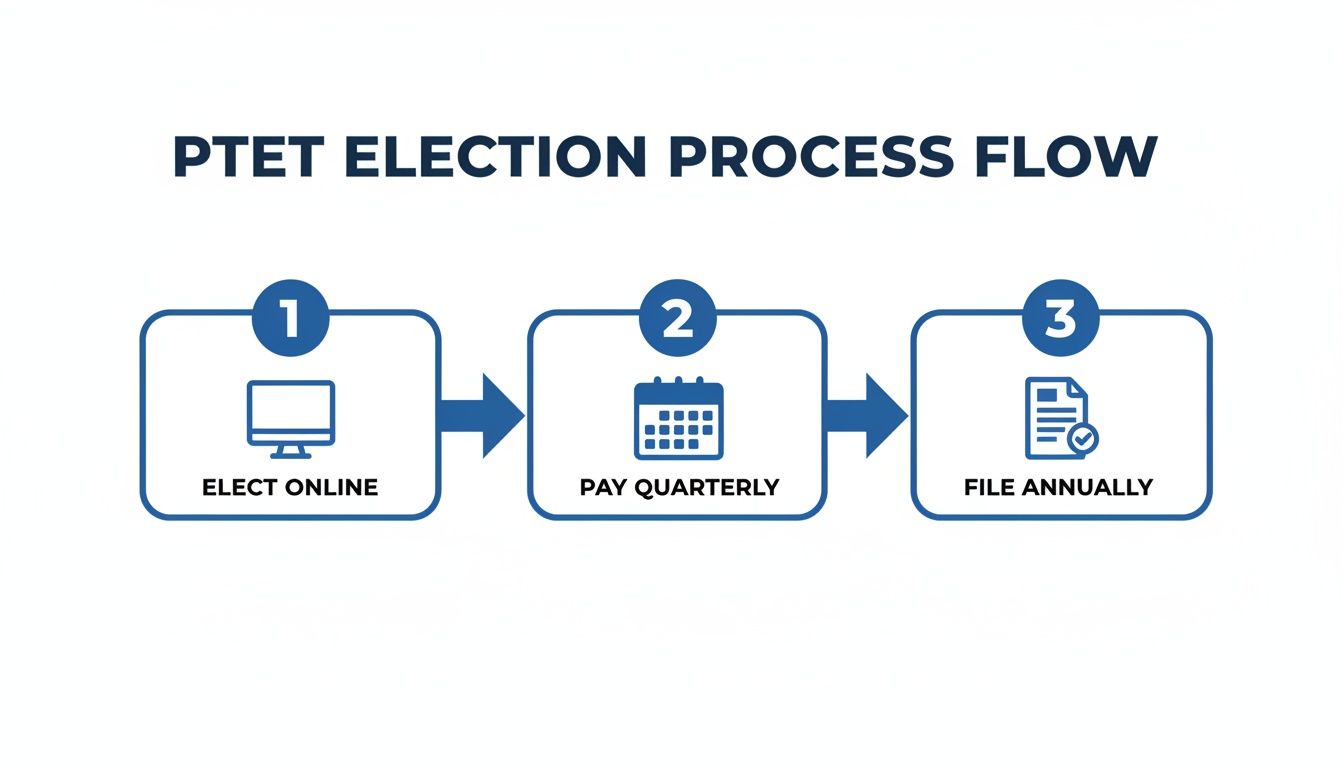
As you can see, it’s not a one-and-done task. It starts with making the election, continues with quarterly payments throughout the year, and finishes with the annual tax filing.
Calculating the tax is the easy part once you have the income base. Below is the official breakdown of the tax brackets.
New York PTET Graduated Tax Rates
This table shows the progressive tax brackets and corresponding rates for the New York Pass-Through Entity Tax.
| PTET Taxable Income | Tax Rate |
|---|---|
| Not over $2,000,000 | 6.85% |
| Over $2,000,000 but not over $5,000,000 | $137,000 plus 10.30% of the excess over $2,000,000 |
| Over $5,000,000 | $446,000 plus 10.90% of the excess over $5,000,000 |
The resulting number is your business’s total PTET liability for the year. This is the amount you’ll pay directly to New York State, and it’s also the figure you can deduct as a business expense on your federal return.
Allocating the PTET Credit to Owners
The final—and most crucial—step is getting the credit into the hands of your owners. After the business pays the tax, that money is converted into a pool of tax credits.
The total credit is then divided among the partners or shareholders in direct proportion to their ownership stake. Each owner gets a credit equal to their share of the total PTET the company paid.
This allocation is reported to the state and directly to the owners. When they file their personal New York income tax returns, they claim this credit, which slashes their personal state tax bill dollar-for-dollar.
Here’s how this plays out in the real world:
- The Scenario: Let’s take a NYC-based consulting partnership, “Urban Advisors LLP,” with two equal partners, Sarah and Tom.
- Calculate Income: The firm has $1,500,000 in New York PTET taxable income.
- Determine PTET: Because their income is under $2 million, the 6.85% rate applies. The firm’s total PTET is $102,750 ($1,500,000 x 0.0685).
- Federal Deduction: Urban Advisors deducts the $102,750 as a state and local tax expense on its federal return, reducing the taxable income that flows to Sarah and Tom.
- Allocate the Credit: As 50/50 partners, each receives a PTET credit of $51,375.
- Claim the Credit: When Sarah files her personal New York tax return, she claims her $51,375 credit, which directly offsets the state tax she owes on her share of the partnership’s income.
This flow-through mechanism is the heart of the PTET workaround, making sure the owners get the full benefit of the tax paid on their behalf at the entity level.
How the PTET Affects Your Federal and State Taxes
Choosing to make the New York PTET election isn’t just a simple box-checking exercise. It’s a strategic move that creates a significant ripple effect, changing how both your business and its owners handle their taxes at the federal and state levels. To really get the most out of it, you have to understand how all the pieces fit together.
The real magic happens on your federal tax return. When your partnership or S corp pays the PTET, that payment is classified as an ordinary and necessary business expense. This means the business can deduct the entire amount of the state tax it paid before calculating its final profit.
This is the whole point of the workaround. By shifting the tax payment from the individual to the business, you transform what would have been a personal state tax payment—stuck behind the $10,000 ($40,000 for 2025) SALT cap—into a fully deductible business expense with no federal limit.
By paying the tax at the entity level, you directly lower the business’s federal taxable income. That means the profit that “passes through” to you as an owner is smaller, which ultimately reduces your personal federal tax bill.
Claiming Your Credit on the New York State Return
While the business writes the check, the benefit comes directly back to you when you file your personal New York State tax return. The PTET is built around a credit system, which cleverly prevents the state from taxing the same income twice.
Once your business pays the tax, you’ll get a statement showing your specific share of the credit. When you file your personal New York return (that’s Form IT-201 for residents or IT-203 for non-residents), you claim this credit, which reduces your state tax bill dollar-for-dollar.
Think of it this way: if your share of the PTET paid by the business was $25,000, you get a $25,000 credit to apply against whatever you owe New York. If that credit is more than your tax liability, the state will typically refund you the difference or let you apply it to next year’s estimated taxes.
This tax has quickly become a massive part of the state’s financial picture. For the 2025 fiscal year, the combination of Personal Income Tax and the PTET generated a staggering $18.5 billion, accounting for 23.0% of New York City’s total tax revenues. It’s a clear sign of just how central the PTET has become to funding the state’s public services. You can dive deeper into New York’s tax revenue data by visiting the Citizens Budget Commission website.
Navigating Multi-State Tax Complexities
Things get even more interesting for businesses that operate in more than one state. Owners often have to file tax returns in several states, and they can usually claim a credit in their home state for taxes they’ve paid elsewhere.
The PTET adds a new twist to this process:
- Credit for Taxes Paid: Claiming the New York PTET credit lowers your New York tax bill. This, in turn, could impact the amount of credit you can claim in your resident state for taxes paid to New York.
- Strategic Planning: Every state has its own rules. You absolutely have to look at how your home state handles credits for entity-level taxes paid to other states. This is the only way to make sure you’re not accidentally creating a tax problem elsewhere and are truly maximizing your savings across the board.
For any non-resident owner, getting a handle on these interactions is vital for accurately forecasting your total tax situation and avoiding any nasty surprises come tax time.
Strategic Considerations Before You Elect

The New York pass-through entity tax can be a game-changer, but it’s definitely not a one-size-fits-all solution. Before you jump in, it’s critical to look past the basic mechanics and really weigh the strategic pros and cons for your specific business. The big prize, of course, is getting around that frustrating $10,000 ($40,000 for 2025) federal SALT deduction cap, which can unlock significant federal tax savings for the owners.
But that benefit comes with some pretty rigid strings attached. Once you make the election by the March 15th deadline, it’s irrevocable for that tax year. There’s no turning back if the company’s financial picture takes an unexpected turn. You’re locked in.
Then there’s the cash flow to consider. The PTET requires you to make quarterly estimated payments, which means the business needs to have enough cash on hand throughout the year to stay compliant. This can be a real headache for businesses with seasonal or unpredictable income, demanding some sharp financial planning to dodge underpayment penalties.
Analyzing Partner and Shareholder Circumstances
Things get even more complicated when you look at the individual tax situations of your partners or shareholders. While the PTET is a huge win for high-income owners who are already maxing out their SALT deductions, it might not be as helpful for others.
You have to dig into each owner’s details:
- Residency Status: A non-resident partner’s home state might not give them a full credit for the PTET paid in New York, watering down the benefit.
- Alternative Minimum Tax (AMT): If an owner is already dealing with the AMT, the workaround provided by the PTET might be less effective or even completely erased.
- Overall Tax Picture: Does an owner have enough other deductions that they aren’t even hitting the SALT cap? If so, the PTET doesn’t do much for them personally.
A smart PTET strategy demands a holistic view. The election affects the entire entity and every single owner. What might be a huge tax-saver for one partner could be a wash—or even a slight negative—for another. This is where open communication and careful, unified planning become essential.
Smart Tax Planning Opportunities
If you’ve run the numbers and the PTET makes sense, you can get proactive to squeeze even more value out of it. For businesses that have some flexibility in timing their income and expenses, there are real opportunities here.
You could, for example, pull certain deductions into the current year or push some income into the next to better manage your PTET taxable income. Playing with these levers can help you land in a more favorable spot within the PTET’s graduated rate structure. This isn’t back-of-the-napkin math; it requires modeling different scenarios with a trusted tax advisor. Firms like Blue Sage Tax & Accounting Inc. can analyze your specific situation to see if the New York pass-through entity tax truly aligns with your long-term goals. The key is to make an informed decision, not just an automatic one.
Answering Your Top Questions About the NY PTET
As business owners start digging into the New York pass-through entity tax, the same questions tend to pop up again and again. It’s a powerful tool, but the rules are very specific. Getting the details right is crucial for making a smart decision.
Let’s clear up a few of the most common points of confusion.
Can We Elect PTET if One of Our Owners is a Corporation?
This is a big one, and the answer is a hard no.
A partnership or S-corp can only make the PTET election if all its owners are individuals, estates, or specific types of trusts. The entire point of the PTET is to create a workaround to the federal SALT cap for individual taxpayers.
If you have a C-corporation or another partnership as an owner, that entity is not eligible, and its share of the income gets excluded from the PTET calculation.
What Happens If We Overpay Our Estimated PTET?
It’s actually pretty common to overpay your estimated PTET, especially if your business income isn’t perfectly predictable. Don’t worry, you won’t lose the money.
The state will either refund the overpayment directly back to the business entity or apply it as a credit to the following year’s PTET. It’s important to remember this refund or credit does not flow through to the owners. The partners or shareholders only get a personal tax credit based on the actual final PTET liability for the year, not the total amount you paid in estimates.
Is the New York City PTET a Separate Election?
Yes, and this is a critical detail for businesses in the five boroughs. The New York City PTET is a completely separate tax election.
Think of it as a parallel system. It has a similar structure and the same March 15th election deadline as the state version, but opting into the state PTET does not automatically sign you up for the city’s. If you want to take advantage of both, you have to make two distinct elections each year through your Business Online Services account.
Navigating state and local tax elections like the PTET takes real planning and foresight. At Blue Sage Tax & Accounting Inc., we specialize in building smart, proactive strategies to help closely held businesses in New York keep more of what they earn. We can run the numbers and help you figure out if the pass-through entity tax makes sense for your specific situation. Learn more about our tax planning services.