If you run a business in New York City that isn't a traditional corporation, you've likely heard of the Unincorporated Business Tax, or UBT. It's one of those local taxes that can catch business owners by surprise, but it plays a crucial role in the city's financial ecosystem. Think of it as the city's way of ensuring that every type of business—from freelance designers to multi-partner law firms—contributes to the services we all rely on.
What Is the NYC Unincorporated Business Tax

Let's break it down with an analogy. Imagine NYC's tax system is a big club. Corporations have their own special entrance, the Business Corporation Tax. Salaried individuals use the personal income tax door. The New York City Unincorporated Business Tax is the entrance for pretty much everyone else doing business: sole proprietors, partnerships, and most LLCs.
The goal is simple: fairness. Without the UBT, a massive part of the city's economy—all the independent contractors, consultants, small professional firms, and family shops—wouldn't pay a direct business tax to the city. The UBT closes that gap.
Established way back in 1966, this tax is a significant, if often overlooked, revenue source. Today, around 31,000 taxpayers file UBT returns each year. That might not sound like a huge number, but it adds up, generating roughly $550 million for the city’s budget. You can dig deeper into the city’s revenue sources on the Independent Budget Office's website.
UBT Fundamentals You Need to Know
At its heart, the UBT is a straightforward 4% tax. It's applied to the net income of an unincorporated business that's specifically earned from its activities within New York City. Getting a handle on this basic concept is the first step to staying compliant.
So, who gets pulled into the UBT net? It boils down to a few key things:
- Your Business Structure: This tax is aimed squarely at any trade, business, or profession run by individuals or unincorporated entities. That means sole proprietorships, partnerships, and LLCs that file taxes as partnerships or are treated as disregarded entities are all on the list.
- Where You Work: You're on the hook if you are "carrying on or liquidating" your business, even partly, within the five boroughs. This is a very broad definition. Having an office, employees, or even just regularly meeting clients and performing services in the city can trigger it.
- How Much You Earn: You don't have to file unless your business income hits certain levels. We'll get into the exact dollar amounts in the next section.
Here's the simplest way to think about it: If you run a business in NYC and you haven’t specifically set it up as a C-Corp or S-Corp, the city probably expects you to be paying the UBT on your profits.
To give you a bird's-eye view, the table below summarizes the key parts of the tax before we jump into the finer details.
NYC Unincorporated Business Tax At a Glance
Here’s a quick-reference table that breaks down the core components of the NYC UBT.
| Component | Description |
|---|---|
| Tax Rate | A flat 4% on net income allocated to New York City. |
| Who Pays | Sole proprietors, partnerships, LLCs (taxed as partnerships), and other unincorporated entities. |
| What Is Taxed | The net profit from a trade, business, or profession conducted within NYC. |
| Key Purpose | To ensure non-corporate businesses contribute to city tax revenues. |
This table covers the basics, but as with any tax, the devil is in the details of calculating income, handling exemptions, and planning effectively.
Who Has to Pay the UBT?
Figuring out if you owe the New York City Unincorporated Business Tax (UBT) can feel like a classic NYC puzzle. But it really comes down to two simple questions: are you running a business that isn't a formal corporation, and are you actually doing business in the five boroughs?
If the answer to both is yes, you're likely on the hook for the UBT.
Let’s be clear: the city’s definition of "doing business" is incredibly broad. This isn't just for businesses with a fancy office in Midtown. A freelance web developer working from their kitchen table in Brooklyn is just as much on the city's radar as a multi-partner accounting firm.
The tax applies to any individual or unincorporated entity that’s carrying on a trade, business, profession, or occupation. This covers most of the business structures people use when they aren't setting up a formal C-Corp or S-Corp.
The Business Structures That Fall Under the UBT
The first piece of the puzzle is your business structure. The UBT is specifically designed to tax businesses that operate outside the traditional corporate framework.
Here are the usual suspects:
- Sole Proprietorships: This is the most common one. If you're a freelancer, independent contractor, or consultant, you're a sole proprietor. That income you report on your federal Schedule C? That's what the city is looking at for the UBT.
- Partnerships: This bucket includes general partnerships, limited partnerships (LPs), and limited liability partnerships (LLPs). For these, the partnership itself files one UBT return and pays the tax on its total income.
- Limited Liability Companies (LLCs): How an LLC is treated for UBT purposes depends entirely on how it's taxed by the IRS. If you have a single-member LLC taxed as a "disregarded entity" (which is just a fancy way of saying it's treated like a sole proprietorship) or a multi-member LLC taxed as a partnership, then you're required to file and pay the UBT.
Basically, if you haven't gone through the process of forming a C-Corp or an S-Corp, you need to pay close attention.
The Two Filing Thresholds You Can't Ignore
Just having one of these business structures isn't enough to trigger the tax. You also have to earn enough money. The city has two distinct income thresholds, and you only need to cross one of them to be required to file a UBT return.
- The Gross Income Test: If your business brings in more than $95,000 in gross income—that's total revenue before a single expense is deducted—you must file a UBT return. This is true even if your business ends up losing money for the year.
- The Net Income Test: If your business's net income (your profit after all deductions) is more than $0, you must file. Yes, that means even a tiny profit can create a filing obligation.
The big takeaway here is that high revenue alone can force you to file, even if you don't make a profit. This is a crucial detail that catches a lot of new business owners by surprise. You have to check both your top-line sales and your bottom-line profit.
Seeing the UBT in Action: Real-World Scenarios
Let's put this into practice and see how it works for different kinds of NYC businesses.
- The Freelance Consultant: A marketing strategist works from her apartment in Queens. She bills her clients $120,000 over the course of the year. Because her gross income is well over the $95,000 threshold, she absolutely has to file a UBT return, regardless of whether her expenses push her final profit below that number.
- The Neighborhood Restaurant: A popular eatery in the Bronx is set up as a multi-member LLC and taxed as a partnership. It pulls in $1 million in gross revenue. After paying for food, staff, rent, and everything else, it walks away with an $80,000 net profit. Since its net income is greater than zero, it has a clear requirement to file and pay the UBT.
- The Law Firm: A law firm operating as an LLP has its main office in Manhattan. It generates $5 million in revenue and has a net profit of $2 million. As a partnership doing business in the city with substantial income, there's no question—it has to file and pay the UBT.
As you can see, the UBT is a fact of life for a huge range of businesses in New York City, from a one-person shop to a large professional practice.
How to Calculate Your UBT Liability
Figuring out your New York City Unincorporated Business Tax can feel like a headache, but let's break it down. The process is more logical than it seems. The tax rate itself is a flat 4%, but the real work is in figuring out exactly what income that 4% applies to.
You don't just slap the tax on your gross sales. It's a step-by-step calculation. We'll start with the income you report to the IRS, make a few key adjustments for NYC rules, and then apply the tax rate to that final number.
Your Starting Point: Federal Business Income
Everything begins with the net profit or loss you've already calculated for your federal tax return. This is your baseline.
- If you're a Sole Proprietor: Grab your Schedule C (Form 1040). The net income or loss figure on that form is where you start.
- If you're a Partnership or LLC: Your starting point is the ordinary business income or loss shown on your Form 1065.
Think of this federal number as the raw material. It’s your total business income before we factor in any of NYC's specific quirks.
The flowchart below gives you a quick visual on whether you even need to worry about filing in the first place.
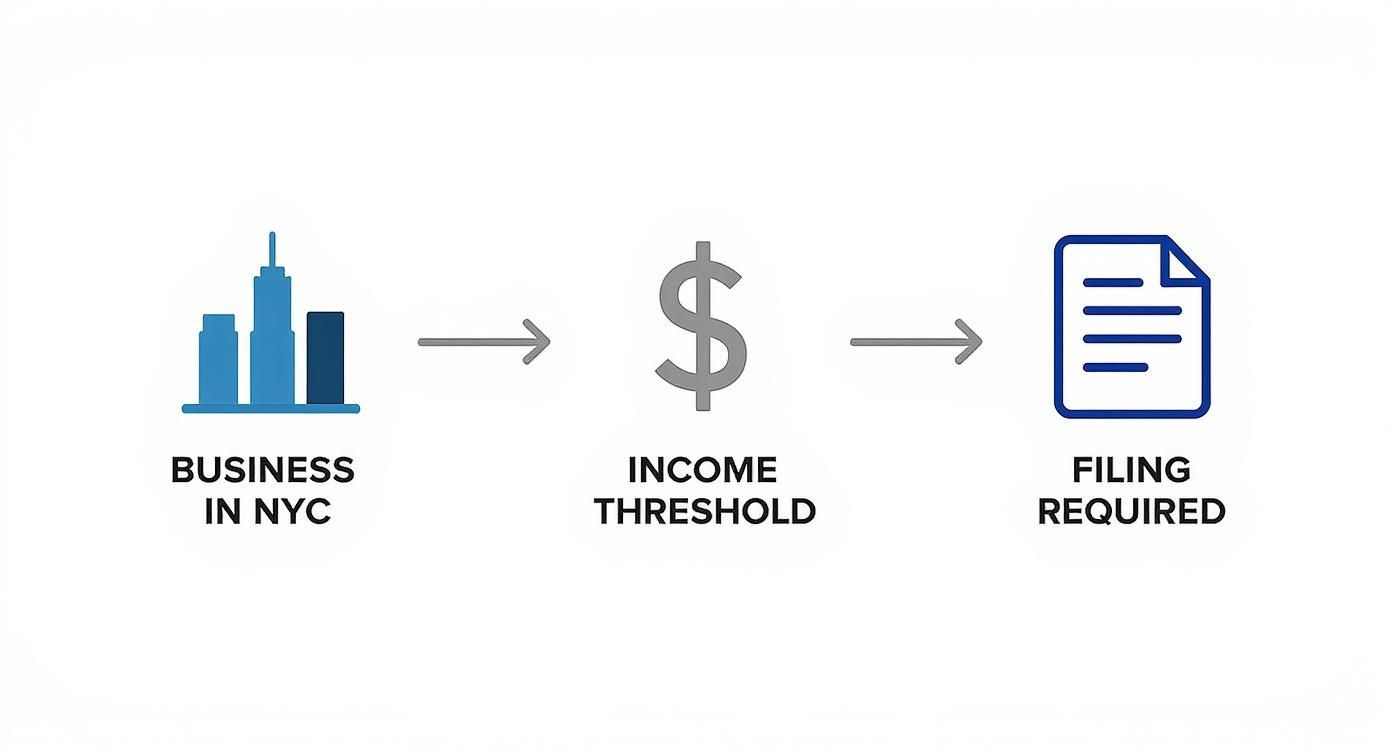
As you can see, it really boils down to two things: running a business in the city and hitting a certain income level.
Making NYC-Specific Adjustments
Once you have your federal net income, the next step is to account for your business expenses. The good news? Most deductions you take on your federal return—like rent, employee salaries, and advertising costs—are also allowed for the UBT. This makes things much simpler.
But there are some crucial differences, especially when it comes to money paid to the business owners.
Here's the number one rule to remember: You cannot deduct payments made to yourself (as a sole proprietor) or to partners. This includes salaries, guaranteed payments, and even health insurance premiums paid for owners. If you deducted these on your federal return, you have to add them back to your income for UBT purposes.
Allocating Your Income to New York City
What if your business earns money both inside and outside the five boroughs? This is a common scenario, and it's where income allocation comes in. You only owe UBT on the slice of your income that's directly tied to your NYC business activities.
To figure this out, you need to calculate your business allocation percentage (BAP). This is usually done with a three-factor formula that looks at your:
- Property: The value of your business property in NYC versus everywhere else.
- Payroll: The total wages you pay to employees based in NYC versus everywhere else.
- Receipts: Your sales and revenue generated from NYC sources versus everywhere else.
You find the percentage for each factor, add them up, and divide by three to get an average. This BAP is the key. If your BAP is 75%, you'll only pay UBT on 75% of your adjusted net income.
A Walkthrough: UBT Calculation Table
Let's put all the pieces together. The table below outlines the exact sequence of steps to arrive at your final tax bill.
| Step | Action | Example/Notes |
|---|---|---|
| 1 | Find Federal Net Income | Start with the profit/loss from your federal Schedule C or Form 1065. |
| 2 | Make NYC Adjustments | Add back any non-deductible expenses, like payments to owners. |
| 3 | Calculate Business Allocation Percentage (BAP) | Determine the percentage of your business activity that occurs within NYC. If 100% of your work is in the city, your BAP is 100%. |
| 4 | Determine NYC Taxable Income | Multiply your adjusted income (from Step 2) by your BAP (from Step 3). |
| 5 | Calculate the Tax | Apply the flat 4% tax rate to your NYC Taxable Income (from Step 4). This is your UBT liability. |
This structured approach ensures you don't miss a step and end up paying the correct amount of tax—no more, no less.
A Practical Example
Let’s see how this works for a freelance graphic designer who is a sole proprietor working from her apartment in Brooklyn.
- Federal Net Income: She reports $150,000 in net profit on her federal Schedule C.
- NYC Adjustments: As a sole proprietor, any "salary" she paid herself is already baked into the net profit figure and wasn't a separate deduction on the Schedule C. So, no adjustment is needed here. Her adjusted income remains $150,000.
- Income Allocation: Since 100% of her work is done in NYC, her BAP is 100%. Her income allocated to the city is the full $150,000.
- Tax Calculation: Now, she just applies the 4% UBT rate.
- $150,000 x 0.04 = $6,000
Her total Unincorporated Business Tax liability for the year is $6,000. As this example shows, the tax is straightforward once the taxable base is correctly calculated according to city rules. For a deeper dive into the nuances of the tax base, this New York State Bar Association report provides extensive detail.
Key Exemptions and Credits That Can Lower Your Tax Bill
Figuring out your Unincorporated Business Tax is just the first step. The real art is knowing how to legally shrink that number. Thankfully, New York City has built-in relief through a handful of key exemptions and credits, designed to prevent double taxation and encourage certain types of business.
Think of these as safety valves in the tax code. They make sure income that’s already been taxed isn’t taxed again, and that people who are basically employees aren't getting hit with a business tax. Getting a handle on these can make a huge difference to your bottom line.
Are You a Business or an Employee?
One of the most important distinctions is the exemption for services you perform as an employee. The UBT is a tax on businesses, not on wages. If you get a W-2, that income is off the table for UBT. Simple enough, right?
But it gets tricky for freelancers, consultants, and gig workers who might have a long-term relationship with one major client. The city uses the classic tests to figure out where you stand: Who controls how the work gets done? Who’s supplying the tools and equipment? What does the relationship actually look like day-to-day? If you're a true independent contractor setting your own schedule and methods, you're a business. If you're treated just like a regular employee, that income is exempt.
The "Passive Investor" Carve-Out
Another major area for relief is the exemption for passive investment activities. The UBT is aimed at active trades, professions, and businesses—not the money you make just by owning assets. This is a big one for individuals and family offices managing their own portfolios.
So, what counts as passive?
- Trading for Your Own Account: If you're buying and selling stocks, bonds, or other securities for your personal portfolio, those gains are generally exempt from UBT. The crucial point here is that you aren't a dealer and you're not managing money for other people.
- Passive Real Estate Income: Actively managing a bunch of rental properties is definitely a business. But if you have a truly passive stake in a real estate deal with very little hands-on involvement, that income might be exempt.
The line between an active business and passive investing can be surprisingly thin. The city looks very closely at your level of day-to-day involvement. Keeping meticulous records that draw a bright line between your business operations and personal investment management is non-negotiable if you plan to claim this exemption.
The Power of Tax Credits
Exemptions are great because they pull income right out of the calculation. But tax credits are even better—they reduce your final tax bill, dollar-for-dollar. They're like cash back from the city, and a few are incredibly powerful for NYC businesses.
The undisputed champion of UBT credits is the UBT Paid Credit. This is how the city prevents you from being taxed twice on the same income. Because you, the business owner, are paying the UBT, this credit lets you subtract that UBT payment from your personal New York City income tax.
Let's walk through a quick example:
- Your business owes $6,000 in UBT for the year, and you pay it.
- That same profit flows through to your personal city income tax return (Form NYC-202).
- On that personal return, you can claim a credit for the $6,000 you paid in UBT, which directly wipes out the city income tax you would have owed on that profit.
It's a brilliant little mechanism that ensures you don’t get hit twice. While there are other, more niche credits available—like for hiring in certain economic zones or for sales tax paid on equipment—the UBT Paid Credit is the one that every single filer needs to know about.
How to File and Pay Your UBT on Time
Knowing what the Unincorporated Business Tax is all about is the first step. The second, and arguably more stressful part, is actually filing and paying it on time. Getting the logistics right is non-negotiable if you want to steer clear of penalties and interest charges.
Let’s walk through the key dates and what you need to do to stay compliant with the New York City Unincorporated Business Tax.
Annual Filing Deadlines and Extensions
For the vast majority of businesses, the UBT return lines up perfectly with your federal income tax deadline. If you're a calendar-year filer, that means your magic date is April 15th. Mark it on your calendar, because missing it will cost you.

Of course, life happens. If you need a bit more breathing room, the NYC Department of Finance offers a six-month automatic extension to file. All you have to do is submit Form NYC-EXT, which pushes your filing deadline out to October 15th.
Crucial Point: An extension to file is not an extension to pay. The City still expects you to estimate your UBT liability and pay at least 90% of what you owe by the original April 15th deadline. If you don't, you'll be hit with underpayment penalties.
The Role of Estimated Tax Payments
Just like with your federal taxes, you can't just settle up your entire UBT bill in one lump sum after the year ends. The City uses a pay-as-you-go system.
If you anticipate owing more than $1,000 in UBT for the year, you’re required to make quarterly estimated tax payments. This keeps you on track and prevents a nasty surprise come tax time.
These payments are due on four key dates:
- April 15th
- June 15th
- September 15th
- January 15th (of the next year)
The idea is to pay roughly 25% of your total estimated UBT with each installment. Underestimating or simply skipping these payments is one of the most common—and expensive—mistakes we see business owners make. The penalties add up fast.
Navigating the Filing Process
When it's time to file, you need the right paperwork. Partnerships and most LLCs will use Form NYC-202. If you're a sole proprietor or a single-member LLC, you’ll file Form NYC-202S. These are the forms where you'll report your business income, calculate the tax, and claim any credits you qualify for.
Thankfully, the NYC Department of Finance has a pretty solid online portal with all the forms, instructions, and updates you might need. Filing and paying electronically through the city’s website is by far the easiest and most secure method.
For our clients, the team at Blue Sage Tax & Accounting Inc. manages this entire process, from crunching the numbers for estimated payments to filing the final return, ensuring everything is handled correctly and on time.
Common UBT Mistakes and Strategic Planning
Getting a handle on the New York City Unincorporated Business Tax is about more than just hitting your filing dates. It’s about thinking ahead. Too many business owners, caught up in the day-to-day grind of running their company, stumble into common traps that cost them real money in overpayments or penalties.
By seeing these pitfalls for what they are and planning proactively, you can turn tax compliance from a headache into a smart business practice.
The most common mistake I see is how owners handle their own compensation. They forget that salaries or guaranteed payments to themselves or their partners are not deductible for UBT. This simple oversight can seriously inflate your tax bill. Another big one is failing to claim the UBT Paid Credit on your personal city tax return—essentially letting yourself get taxed twice on the same dollar.
Finally, a major tripwire is getting your income allocation wrong. If your business earns money both inside and outside the five boroughs, using a poorly calculated Business Allocation Percentage (BAP) means you're paying city tax on income that has zero connection to NYC.
Avoiding Frequent UBT Errors
Steering clear of these common blunders comes down to disciplined record-keeping and knowing the rules. You'd be surprised how a few small tweaks to your process can make a world of difference.
- Document Your Allocation: Don't just pull a number out of thin air for your BAP. Keep meticulous records of where your property is, what your payroll looks like by work location, and where your sales actually happen. This proof is your best defense if the city ever comes knocking.
- Segregate Owner Draws: Instead of calling payments to yourself "salary" in your books, clearly label them as owner draws. This creates a clean line in your accounting and stops you from accidentally taking a deduction you'll just have to add back later.
- Calendar Everything: It’s not just about the annual return. Set reminders for all four of your quarterly estimated tax payments. Falling behind on those is the quickest way to rack up penalties.
"Strategic tax planning isn't about finding secret loopholes. It's about understanding how the tax code is built and making smart decisions that line up with your business goals. For UBT, that means looking at your business entity and compensation structure with a critical eye."
Adopting these simple habits creates a solid foundation for compliance and sets the stage for smarter, more advanced planning.
Strategic Planning for UBT Optimization
True tax optimization means looking beyond just this year's return. The choices you make today about your business structure and financial management will echo in your UBT bills for years to come.
One of the biggest strategic moves you can make is to re-evaluate your business entity. Operating as a sole proprietorship or a partnership is straightforward, but it automatically puts you on the hook for UBT. As your profits grow, this can become a very heavy cost to carry.
This is where making a federal election to be taxed as an S corporation can be a game-changer. S-Corps are not subject to the UBT. Instead, the business pays the city's General Corporation Tax (GCT), which can often lead to a much lower tax bill, especially if you pair it with a well-documented "reasonable salary" for yourself as an owner-employee.
This move isn't a silver bullet for every single business, but for many, it's the single most powerful strategy for legally minimizing the bite of the New York City Unincorporated Business Tax.
Thinking ahead is also critical as tax laws change. Big shifts in federal policy can have a massive ripple effect on city taxes. For example, after the federal Tax Cuts and Jobs Act (TCJA) of 2017, NYC's business tax liability jumped by an incredible 46.2% in 2018. Today, business income taxes make up 14.1% of all city tax revenues, which shows just how important this income stream is to the city. You can find more about recent trends in the city’s business income taxes from the NYC Comptroller.
Working with a tax professional who stays on top of these trends can help you structure your business to be more resilient, no matter what changes come down the pike.
Your UBT Questions, Answered
When you get down to the nitty-gritty of the Unincorporated Business Tax, a few common questions always seem to pop up. Let's tackle them head-on with some straight answers.
Does the UBT Apply to Income from My NYC Rental Properties?
For most landlords, the answer is yes. If you’re actively managing rental properties in the city, NYC sees that as running a business, not just holding a passive investment.
Think of it this way: if you’re collecting rent, dealing with tenants, and arranging repairs—especially across multiple units—you're in the business of real estate. That net income is almost certainly subject to the UBT. Only in rare cases where the income is purely passive, with zero involvement, might you be exempt.
I Have a Single-Member LLC. Do I Still Have to File a UBT Return?
This is a big one. If your single-member LLC (SMLLC) is treated as a "disregarded entity" for federal taxes (which is the default), then yes, you're on the hook for the UBT. The city essentially looks right through the LLC and treats you as a sole proprietor. If you're doing business in NYC and hit the income thresholds, a UBT return is required.
The only way out is if you’ve specifically filed paperwork with the IRS to have your SMLLC taxed as a corporation (either an S-Corp or a C-Corp). In that case, you'd be filing the city’s corporate tax returns instead.
Your federal tax election is the key here. It directly controls which New York City business tax applies to you. Sticking with the default "disregarded entity" status for your SMLLC means you're in the UBT system.
Can I Deduct My UBT Payment on My Federal Tax Return?
Absolutely. You can deduct what you pay for the New York City Unincorporated Business Tax as a business expense on your federal return (like on your Schedule C). It's considered a state and local tax (SALT) that's directly tied to running your business.
This deduction helps lower your federal taxable income, which softens the blow of the UBT. Keep in mind, though, that this deduction gets lumped in with your other state and local taxes, and the total is subject to the $10,000 federal SALT cap for individuals.
At Blue Sage Tax & Accounting Inc., we turn confusing tax rules into clear, practical advice. If the UBT has you tied in knots or you're trying to plan your business's next move, our team is here to help you find the best path forward. See what we can do for you at https://bluesage.tax.