Ever heard of selling a valuable asset without immediately getting hit with a tax bill? That’s the magic of a 1031 exchange. It’s a section of the tax code that allows real estate investors to sell one property and reinvest the proceeds into a new, “like-kind” property, all while deferring capital gains taxes.
Think of it less like a sale and more like trading up. Instead of cashing out and losing a chunk of your profit to taxes, you get to roll your entire investment forward.
Unlocking the Power of Tax Deferral
At its heart, a 1031 exchange is about maintaining the continuity of your investment. When you sell a property the traditional way, the IRS wants its cut of your profit right then and there. That tax payment shrinks the capital you have left to put into your next deal, slowing your growth.
A 1031 exchange flips that script. By treating the transaction as a continuous investment—swapping one property for another—you keep 100% of your capital in the game. This isn't some shady loophole; it's a long-established part of the U.S. tax code specifically designed to encourage reinvestment in the real estate market.
A Century of Investment Growth
This powerful tool has been a cornerstone of American tax law for over a century, offering a stable and predictable path for investors to grow their portfolios.
Its history shows a clear commitment to this principle of reinvestment.
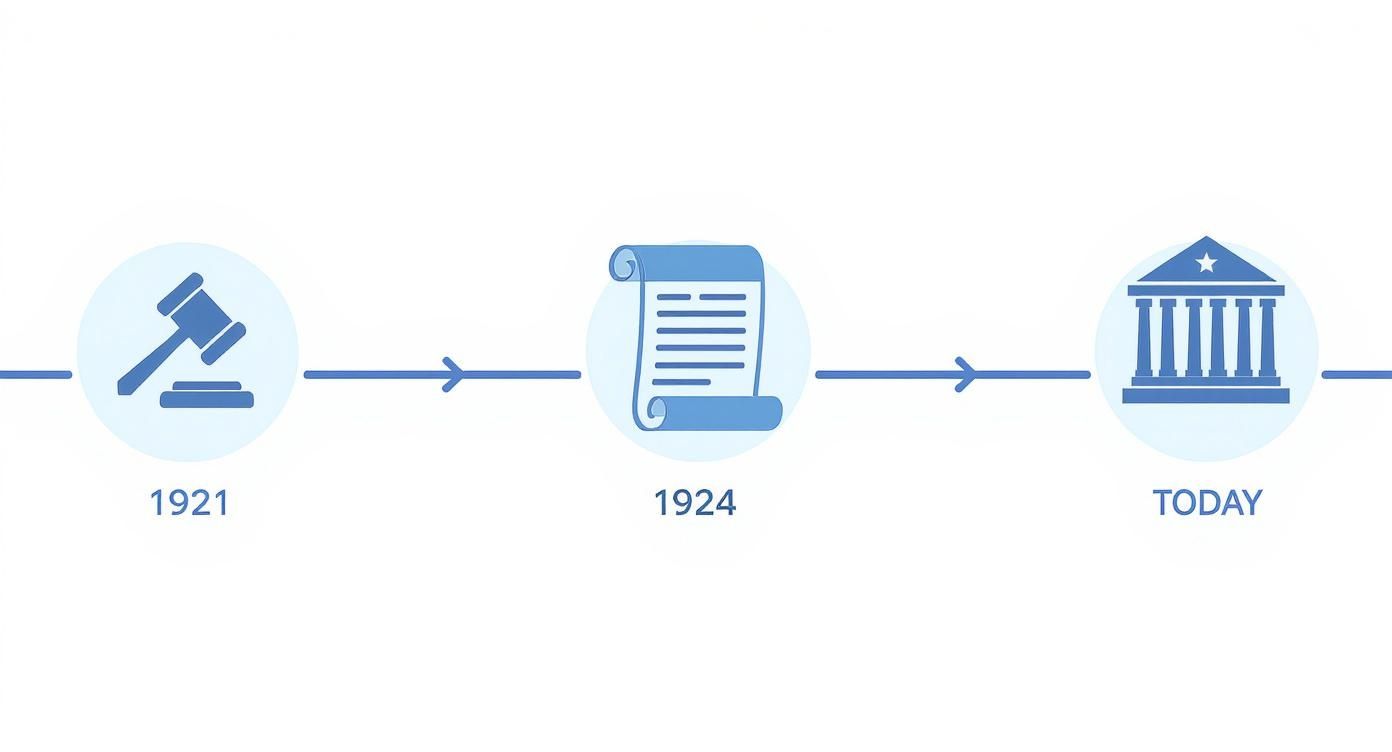
The concept first appeared in the Revenue Act of 1921. Early versions were quite broad, but by 1924, the law was tightened to focus specifically on the "like-kind" swaps we know today. If you're interested, you can explore the full history of the 1031 exchange and see how it has evolved.
Key Takeaway: The primary benefit of a 1031 exchange is the ability to defer capital gains tax, freeing up 100% of your equity to acquire a bigger or better property. This tax deferral acts like an interest-free loan from the government, accelerating your portfolio's growth potential.
To keep things clear, here’s a quick summary of the core components you'll need to know.
Key Elements of a 1031 Exchange at a Glance
| Component | Description | Critical Rule |
|---|---|---|
| Like-Kind Property | Exchanging one investment or business property for another of a similar nature. | Property must be held for investment or productive use in a trade or business. |
| Qualified Intermediary (QI) | A neutral third party who facilitates the exchange by holding the funds from the sale. | The investor cannot have actual or constructive receipt of the sale proceeds. |
| 45-Day Identification Period | The investor has 45 calendar days from the sale of the relinquished property to identify potential replacement properties. | Identification must be in writing and specific. |
| 180-Day Exchange Period | The investor has 180 calendar days from the sale of the relinquished property to close on the replacement property. | This timeline is strict and includes the 45-day identification period. |
This table provides a high-level view, but mastering these rules is essential for a successful exchange. Each component has nuances that can make or break your tax deferral strategy.
The 45 and 180-Day Rules: Don't Mess With the Clock
The second you close the sale of your property, two clocks start ticking. These aren't suggestions; they are rigid, non-negotiable deadlines set by the IRS. Miss either one, and the whole deal falls apart, leaving you with a hefty tax bill. Weekends, holidays, bad weather—none of it matters. The deadlines are absolute.
To keep everything above board, the IRS mandates you work through a Qualified Intermediary (QI). Think of them as a neutral third party who holds onto your sale proceeds. This is critical because it prevents you from having "constructive receipt" of the money, which would immediately trigger taxes. Your QI is your guide and gatekeeper for these deadlines.

The 45-Day Identification Period
From the day you sell your original property, you have exactly 45 calendar days to officially identify potential replacement properties.
This isn't just about window shopping. You have to put your choices in writing and deliver the list to your Qualified Intermediary before midnight on the 45th day. For most investors, this is the highest-pressure part of the entire exchange. It forces you to move quickly and decisively.
Rules for Identifying Properties
The IRS gives you three ways to play this game. You only have to follow one of these rules:
- The Three-Property Rule: This is the one most people use. It’s simple: you can identify up to three properties, no matter what they cost. Most investors pick their top choice and then add one or two solid backups.
- The 200% Rule: Need more options? You can identify more than three properties, but there's a catch. Their total value can't be more than 200% of the property you sold. So, if you sold a property for $1 million, you could list five potential replacements as long as their combined value is $2 million or less.
- The 95% Rule: This one is rare. You can identify as many properties as you want, but you have to actually buy at least 95% of the value of everything you listed. It’s really only used for complex deals, like acquiring a large portfolio of properties.
Once that 45-day window slams shut, your list is final. You can't add, swap, or change your mind. That’s why doing your homework before you even sell is so important.
The 180-Day Exchange Period
The second clock runs for 180 calendar days. This is your deadline to actually close on and take ownership of one or more of the properties you identified.
Here’s what trips people up: the 180 days start at the same time as the 45-day period. It is not 45 days plus another 180. You have a total of six months to get the entire deal done, from sale to purchase.
Important Timeline Nuance: While you get up to 180 days, you might get less. The exchange period ends on the earlier of 180 days or the due date of your tax return for that year (including extensions). If you sell a property in November, for example, you’ll likely need to file a tax extension to get your full 180-day window.
A Real-World Timeline Example
Let’s walk through how this plays out:
- April 1st: You sell your property. The countdown begins immediately for both deadlines.
- May 16th: Day 45. Your written identification list must be in your QI's hands by midnight.
- September 28th: Day 180. You must have closed and officially acquired your new property by this date.
Miss the May 16th deadline? The exchange is over. Miss the September 28th deadline? The exchange fails. The unforgiving nature of these timelines is precisely why you need an experienced team. Working with professionals like the team at Blue Sage Tax & Accounting ensures you have a clear plan to navigate every critical step.
Getting to Know the Different Types of 1031 Exchanges
The beauty of a 1031 exchange is its flexibility. While the goal—deferring capital gains tax—is always the same, the path you take can vary. The right structure really boils down to your situation. Have you already found your next property? Does it need a lot of work? Answering these questions will point you to the best strategy.
Think of it this way: the real estate market rarely waits for anyone. That’s why the tax code provides a few different ways to structure an exchange to match the realities on the ground.

The Delayed Exchange: Sell First, Buy Later
This is the one you hear about most often. The Delayed Exchange, sometimes called a Forward or Starker Exchange, is the workhorse of the 1031 world. It's the most common and for good reason—it’s a logical, straightforward process.
First, you sell your current property (the "relinquished" property). The cash from the sale goes directly to a Qualified Intermediary (QI), not to you. This is a critical step. From there, the clock starts ticking, and you have to acquire your new property (the "replacement" property) within the strict 45/180-day timelines.
This structure is perfect for most investors. It gives you time to sell your asset and then thoughtfully search for, negotiate, and close on the right replacement.
The Reverse Exchange: Buy First, Sell Later
What happens when you stumble upon the perfect property before you've even thought about selling your old one? In a hot market, you can't risk letting it get away. That’s exactly what the Reverse Exchange is for.
As its name implies, it flips the sequence. You buy your new property first, then sell your old one. But since the rules say you can’t own both properties at once, an Exchange Accommodation Titleholder (EAT)—a special third party—steps in to temporarily "park" one of the properties.
- Parking the New Property: The EAT buys and holds the new property for you. You then have 45 days to officially identify which property you plan to sell and a total of 180 days to get it sold.
- Parking the Old Property: You take title to the new property immediately. The EAT takes title to your old property, giving you 180 days to find a buyer and close the deal.
Why would you do this? A Reverse Exchange is a powerful tool for aggressive investors who need to act fast. Be warned, though: they are far more complex and costly, often requiring you to have significant cash or financing ready to go.
The Improvement Exchange: Build Your Ideal Property
Sometimes the right property has great bones but needs a major overhaul. Or maybe you've found the perfect plot of land and want to build from the ground up. The Improvement Exchange (also known as a Construction Exchange) lets you do just that.
This strategy allows you to use your tax-deferred sale proceeds to pay for construction and renovations on the replacement property. To keep everything compliant, the property is held by an EAT while the work is underway.
The most important rule here is that the final value of the improved property, when it's deeded back to you, must be equal to or greater than the value of the property you sold. And it all has to happen fast—all improvements must be finished within the 180-day exchange window. This makes tight project management and reliable contractors non-negotiable, but it’s an incredible way to create value right out of the gate.
Understanding Your Tax Implications
Let's clear up one of the biggest myths about 1031 exchanges right away: they don't make your capital gains taxes vanish. What they do is defer them. Think of it as hitting the snooze button on your tax bill, giving you the power to roll your entire pre-tax profit into a new, bigger, or better property.
This is a critical distinction for any serious investor. The tax liability from your original property doesn't just disappear into thin air. Instead, it gets passed on to the replacement property. To see how this affects your wallet, we need to talk about two fundamental concepts: boot and basis.
How "Boot" Can Trigger an Unexpected Tax Bill
In the lingo of 1031 exchanges, boot is anything of value you receive in the deal that isn't the replacement property itself. It’s the part of the transaction that falls outside the tax-deferred umbrella, making it taxable in the year of the sale.
Boot usually shows up in one of two ways:
-
Cash Boot: This one is easy to spot. Let's say you sell your property for $800,000 but only use $750,000 to buy the new one. That leftover $50,000 that comes back to you in cash is considered boot, and you’ll owe capital gains tax on it.
-
Mortgage Boot: This happens when you take on less debt with the new property. Imagine you paid off a $400,000 mortgage on the property you sold. If the mortgage on your new property is only $350,000 (and you don't add $50,000 of your own cash to balance it out), that $50,000 reduction in debt is also treated as taxable boot.
The golden rule for a completely tax-free exchange is simple: trade up or equal. You need to reinvest all your equity and take on the same or a greater amount of debt. Any leftover value that comes back to you is boot.
Calculating Your New Tax Basis
The second piece of the puzzle is your basis, which is essentially your investment in the property for tax purposes. When you do a 1031 exchange, the basis from your old property doesn't go away—it carries over to the new one.
Here’s a simple example to see how it works:
- Original Buy: You purchase Property A for $300,000. This is your starting basis.
- The Exchange: Years later, you sell Property A for $800,000 and use a 1031 exchange to buy Property B for the same price.
- New Basis: Your basis in the new Property B isn't its $800,000 price tag. Instead, your original $300,000 basis simply transfers over.
This is how the IRS keeps track of your deferred gain. If you decide to sell Property B down the road without another exchange, your taxable profit will be calculated from that much lower $300,000 starting point, not the $800,000 you actually paid for it.
This carryover basis is the very mechanism that ensures the tax is eventually paid. A 1031 exchange is a powerful wealth-building tool, but it's a long-term strategy of deferral, not a permanent escape from taxes.
This strategy is a major engine in the real estate world, with like-kind exchanges making up between 10% and 20% of all commercial property transactions. And it works—research shows that up to 88% of properties acquired through an exchange are eventually sold in a taxable transaction, proving the system is about deferral, not evasion. To get a better sense of how this all came to be, you can explore detailed insights on the history of 1031 exchanges.
Using 1031 Exchanges to Build Wealth
Knowing the rules of a 1031 exchange is the first step. But the real magic happens when you start using those rules to make strategic moves. For smart investors, this isn't just a tax loophole; it's an engine for growing a real estate portfolio, letting you make bigger and better plays with each transaction.
Think of it as an accelerator. By keeping your entire pre-tax capital in the game, you're not just deferring taxes—you're putting that money to work. Instead of handing over a huge chunk of your profits to the IRS after every sale, you reinvest the full amount. This lets you harness the power of compounding to build equity much faster than you otherwise could.
The Strategy of Trading Up
One of the most common—and effective—strategies is to "trade up" or consolidate your holdings. This is where you sell off several smaller, often high-maintenance properties and roll the proceeds into a single, larger, more valuable asset.
Imagine you own three separate single-family rentals. Each has its own mortgage, its own repair issues, and its own set of tenant headaches. You could sell all three and use a 1031 exchange to channel that combined equity into one multi-unit apartment building or a commercial property with a solid, long-term tenant on a triple-net lease. This kind of move can be a game-changer.
- Better Cash Flow: Bigger properties often throw off more reliable and substantial rental income.
- Economies of Scale: It's almost always cheaper and more efficient to manage one large property than three small ones.
- Less Management Hassle: Swapping out residential tenants for a single, stable commercial tenant can seriously simplify your life.
This is how investors transition from being hands-on landlords to becoming strategic asset managers, building a truly sophisticated portfolio along the way.
Diversifying Your Real Estate Portfolio
The 1031 exchange is also a fantastic tool for diversification. It gives you a tax-free runway to pivot your investment strategy without having to cash out and take a tax hit. You can shift your capital between different property types or even move into different geographic markets to reduce risk and chase new opportunities.
For instance, an investor might sell a portfolio of high-maintenance rental homes in a stagnant market. They could then exchange that equity into a medical office building located in a booming Sun Belt city, repositioning their capital from one asset class to another in a far more dynamic economic environment.
This flexibility is crucial. It lets you react to market trends, getting out of properties that have hit their peak and into new ones with more room to grow—all while keeping your hard-earned capital intact.
Fueling the Broader Economy
Beyond the benefits for individual investors, the 1031 exchange is a vital lubricant for the entire real estate market. It keeps capital flowing. By encouraging property owners to continuously reinvest, it stimulates transactions, creates liquidity, and supports countless jobs. Every time a property is upgraded or repurposed through an exchange, it creates work for contractors, architects, lenders, and property managers, boosting local economies.
The numbers are staggering. Equity raised through 1031 exchanges skyrocketed from $170 million in 2010 to around $5.5 billion by 2021. A 2021 study found that these transactions supported nearly 568,000 jobs, generated $27.5 billion in labor income, and added a massive $55.3 billion to the U.S. GDP in that year alone. You can read the full economic impact study to see just how powerful these ripple effects are.
Common Mistakes and How to Avoid Them
The rules for a 1031 exchange are notoriously strict. One small slip-up, and you could face a massive, unexpected tax bill. Honestly, success is all in the details, and knowing where investors trip up is the best way to ensure you don’t.
Let's walk through the most common traps we see people fall into. By understanding these pitfalls before you start, you can sidestep them completely, keeping your tax deferral safe and your investment strategy moving forward.

Missing the Strict Deadlines
This is, without a doubt, the most common and unforgiving mistake. You have exactly 45 days to identify potential replacement properties and a total of 180 days to close on one. These deadlines are set in stone—the IRS doesn’t grant extensions, not for weekends, not for holidays, not for anything.
- How to Avoid It: Don't wait. The best defense is a good offense. Start looking for your next property long before you even close on the one you're selling. If you have a list of solid options ready to go, you can make a clear decision and get your formal identification list to your Qualified Intermediary (QI) with time to spare.
Mishandling Exchange Funds
Here's another deal-breaker: touching the money. If the proceeds from your sale hit your personal or business bank account, even for a second, it's considered "constructive receipt." The moment that happens, your exchange is dead in the water, and the entire gain is taxable.
- How to Avoid It: This is precisely why a Qualified Intermediary is mandatory, not just a good idea. The QI is an independent third party who holds your funds in a secure account from the moment you sell until the moment you buy. The money must never be under your control.
Expert Insight: A great QI is more than just a bank account. They're your procedural coach, making sure every document and deadline meets IRS rules. Choosing a reputable, insured, and experienced QI is one of the most critical decisions you'll make in this process.
Errors in Property Identification
The IRS is incredibly specific about how you identify your potential new properties. A vague idea of what you want to buy just won't cut it. If you don't follow the identification rules—like the Three-Property Rule or the 200% Rule—to the letter, your exchange will be disqualified.
- How to Avoid It: Your identification list has to be in writing, crystal clear, and delivered to your QI before midnight on day 45. Use exact property addresses or legal descriptions. Most investors stick with the Three-Property Rule because it’s straightforward: name your top choice and two reliable backups in case the first deal doesn't work out.
Not Reinvesting All Proceeds
To defer 100% of your capital gains, two things must happen: you must reinvest all the net cash from the sale, and you must buy a new property of equal or greater value. If you pull cash out or buy a cheaper property, you’ll have what’s called "boot," which is taxable.
- How to Avoid It: Before you do anything, run the numbers with a professional. A tax advisor, like the team at Blue Sage Tax & Accounting, can calculate precisely how much you need to reinvest. They’ll help you structure the deal to avoid both cash boot and mortgage boot, ensuring you get the full tax deferral you're looking for.
Common 1031 Exchange Mistakes and Prevention Strategies
Navigating a 1031 exchange requires careful attention to detail. The table below summarizes the most frequent errors investors make and provides clear, actionable steps to help you avoid them.
| Common Mistake | Why It's a Problem | How to Avoid It |
|---|---|---|
| Taking Control of Funds | Instantly disqualifies the exchange due to "constructive receipt," making all gains taxable. | Use a reputable Qualified Intermediary (QI) to hold all proceeds in escrow from sale to purchase. Never let funds enter your personal or business accounts. |
| Missing the 45/180 Day Deadlines | These deadlines are absolute and have no grace periods. Missing either one invalidates the entire exchange. | Start scouting for replacement properties before closing on your relinquished property. Have a pre-vetted list ready to identify. |
| Improperly Identifying Properties | Vague or non-compliant identification (e.g., not in writing, missing details) will void the exchange. | Provide your QI with a written, signed list specifying exact addresses or legal descriptions before the 45-day deadline. Use the Three-Property Rule for clarity. |
| Acquiring Ineligible Property | A 1031 exchange is only for "like-kind" investment or business-use real estate. A personal residence or "fix-and-flip" property doesn't qualify. | Ensure both the old and new properties are held for productive use in a trade, business, or for investment. Consult with an advisor if unsure. |
| Failing to Reinvest All Equity | Any cash kept from the sale ("cash boot") or reduction in debt ("mortgage boot") is treated as taxable income. | To defer all taxes, purchase a replacement property of equal or greater value and reinvest all net proceeds from the sale. |
By proactively addressing these common issues with a knowledgeable team, you can ensure your transaction is smooth, compliant, and successful.
Common Questions About 1031 Exchanges
Once investors get the hang of the basics, a lot of "what if" questions naturally pop up. Let's walk through some of the most frequent ones we hear, cutting through the jargon to give you straight answers.
Can I Use a 1031 Exchange on My Primary Residence or a Vacation Home?
The short answer is no, not for your primary home. A 1031 exchange is exclusively for property held for investment or business use. Your personal residence falls into a different category, though you might be able to take advantage of the separate (and also very generous) Section 121 capital gains exclusion when you sell it.
A vacation home sits in a bit of a gray area. It can qualify, but the burden of proof is on you to show it was primarily an investment. This means you have to severely limit your personal use of the property and keep meticulous records—like rental agreements and income statements—to prove its main purpose was to make money, not for personal getaways.
The Litmus Test: It all comes down to intent. Was the property mainly for your own enjoyment? If so, it won't qualify. But if you can clearly show its primary function was to generate rental income or appreciate in value, you might have a case. The rules here are notoriously strict, so this isn't something to attempt without expert advice.
What Happens If I Can't Find a Replacement Property in 45 Days?
This is the big one. If you don't officially identify potential replacement properties in writing to your Qualified Intermediary within the 45-day window, the exchange is over. It fails.
This deadline is non-negotiable—there are no extensions for any reason. The moment that 45th day passes without a valid ID, your Qualified Intermediary must release the funds back to you. You'll then owe the full capital gains tax on your original sale. This is exactly why savvy investors start hunting for their next property long before their old one even closes.
Do I Have to Reinvest Every Penny From My Sale?
Yes, if you want to defer 100% of your capital gains tax, you need to roll everything over. The spirit of the law is to maintain a continuous investment.
To make that happen, you have to stick to a few core rules:
- Go Across or Up in Value: The property you buy must be worth the same as, or more than, the one you sold.
- Roll Over All Your Equity: Every dollar of cash profit from the sale has to go into the new deal.
- Replace Your Debt: You also have to take on at least as much debt on the new property as you had on the old one. If you want to use less debt, you'll have to make up the difference by adding your own cash to the purchase.
Any cash you pull out of the deal ("cash boot") or any reduction in debt that you don't cover with fresh cash is considered a taxable gain in the year you make the exchange.
Getting a 1031 exchange right is all about careful, forward-thinking planning. At Blue Sage Tax & Accounting Inc., we specialize in structuring these transactions to ensure you hit every deadline, follow every rule, and maximize your tax deferral. Contact us today for a consultation and let's explore how we can help you use this strategy to grow your real estate portfolio.