Think of the Net Investment Income Tax—often just called the NIIT—as a 3.8% surtax that high-earning individuals, estates, and trusts might have to pay on their investment income. It’s not for everyone. You only have to worry about it if your income crosses a certain line and you have earnings from your investments.
A Simple Look at the Investment Income Tax

Here’s a good way to picture it: Imagine an "investment earnings highway." Most people's income keeps them on the local roads, so they never see this toll. But if your income is high enough to put you in the express lane, this is an extra tax you might pay on the profits your money generates.
It’s crucial to remember that this isn't a tax on all your income—just the investment part. For the NIIT to even be on your radar, two things have to be true:
- You must have Net Investment Income. This is money from things like interest, dividends, rental income, and capital gains.
- Your Modified Adjusted Gross Income (MAGI) must be over a set limit. Your total income has to cross a specific threshold that depends on your tax filing status.
If you only meet one of these conditions, you can breathe a sigh of relief. You won't owe the tax. For instance, you could have a high salary but no investment income, or you could have investment income but a total MAGI that falls below the threshold. Both conditions have to be met.
Who Is Subject to the NIIT?
The NIIT came into the picture with the Health Care and Education Reconciliation Act of 2010. It’s a 3.8% surtax that applies when the MAGI of individuals, estates, or trusts goes above certain levels.
This tax was designed to ensure that higher earners contribute to Medicare from their investment profits, not just their paychecks. It’s a parallel to the Medicare taxes paid on wages. You can find more details about its background in this in-depth NIIT guide.
To give you a clearer picture, here are the specific income thresholds that trigger the NIIT. If your MAGI is higher than the amount for your filing status, you’ll need to figure out if you owe this tax.
NIIT Income Thresholds by Filing Status
| Filing Status | MAGI Threshold |
|---|---|
| Married Filing Jointly | $250,000 |
| Qualifying Surviving Spouse | $250,000 |
| Single | $200,000 |
| Head of Household | $200,000 |
| Married Filing Separately | $125,000 |
As you can see, the tax is clearly targeted at taxpayers with substantial income. Our goal here is to give you a solid foundation of what the NIIT is all about, without getting bogged down in jargon. With this basic understanding, you'll feel much more confident as we dive into the details.
What Counts As Net Investment Income?
To get a real handle on the Net Investment Income Tax, you have to look under the hood. The whole calculation boils down to one simple question: what does the IRS actually consider "investment income"?
Think of it like sorting your money into different buckets. The NIIT only cares about one specific bucket—the one filled with profits your money makes for you, not the money you make from your job.
That distinction is everything. Your salary, wages, and bonuses are in a completely separate bucket and are not part of this conversation. Same goes for self-employment income, Social Security benefits, or money you take from retirement plans like a 401(k) or traditional IRA. The IRS specifically carves those out, which is a big relief for most people.
Instead, the NIIT zeros in on the income you earn more passively. Let's break down exactly what that means.
The Three Buckets of Investment Income
When you start adding things up, the IRS generally groups investment income into three main categories. You’ll need to see what you have in each of these to figure out where you stand.
1. Interest, Dividends, Annuities, Royalties, and Rents
This is the most common bucket. It includes all the classic investment earnings:
- Interest from savings accounts or corporate bonds.
- Dividends from stocks you own (both qualified and non-qualified).
- Income from annuities that aren't inside a retirement account.
- Royalties from things like intellectual property.
- Rental income from your investment properties.
2. Income from Passive Business Activities
This one is huge for business owners and partners. It covers income from a business where you do not "materially participate." For instance, if you’re a silent partner in an S-corp or a limited partner whose main contribution is cash, any distributions you get are usually considered passive and are squarely in the NIIT's sights. We'll dig into what "material participation" really means a bit later on.
3. Net Capital Gains
This is the big one for active investors. It’s simply the net profit you make from selling capital assets. When you sell stocks, bonds, mutual funds, or real estate for more than your purchase price, that profit is a capital gain. This also applies when you sell your ownership stake in a partnership or S-corp. Both your short-term and long-term gains get pulled into this calculation.
Why Does This Tax Exist? The NIIT was rolled out to ensure that high-earners who make most of their money from capital contribute to programs like Medicare at a rate similar to those who earn a traditional paycheck. It’s been a hot topic since 2010, sparking debates about fairness and its overall impact. For a deeper dive into the policy behind it, check out this analysis of the Net Investment Income Tax.
Don't Forget the "Net" in Net Investment Income
Okay, so adding up all that income is just step one. The tax is on your net investment income, which is great news because it means you get to subtract certain related expenses. This is where good record-keeping really pays off.
It's just like running a business. You wouldn't calculate your profit based on total sales alone; you'd subtract your costs first. The same logic applies here.
You can deduct expenses directly tied to generating your investment income, such as:
- Investment Interest Expense: Interest you paid on a loan you took out to buy investments, like margin interest.
- Investment Advisory and Brokerage Fees: What you pay your financial advisor or broker to manage your portfolio.
- Rental and Royalty Expenses: The direct costs of owning a rental property (repairs, depreciation, taxes) or managing a royalty-producing asset.
- State and Local Income Taxes: The portion of your state and local taxes attributable to your investment income.
Tracking these deductions is absolutely critical. It’s the difference between paying tax on your total investment revenue versus paying it on your actual profit. By carefully accounting for every legitimate expense, you can seriously shrink the income base that gets hit with the 3.8% NIIT, making sure the tax is applied only to your true financial gain.
How to Calculate Your NIIT Liability
Alright, let's get into the mechanics of how this tax is actually calculated. Once you have your two key figures—your Modified Adjusted Gross Income (MAGI) and your Net Investment Income (NII)—the rest is surprisingly straightforward.
The entire calculation boils down to a simple comparison. You will pay the 3.8% tax on whichever of these two amounts is smaller:
- Your total Net Investment Income (NII).
- The amount your MAGI is over the income threshold for your filing status.
This "lesser of" rule is the single most important concept to grasp. It means you could have millions in investment income, but if your MAGI is only barely over the line, your tax base will be small. On the flip side, a huge MAGI won't trigger a massive NIIT bill if you have very little investment income that year.
To make this crystal clear, let’s first visualize how your Net Investment Income is determined.
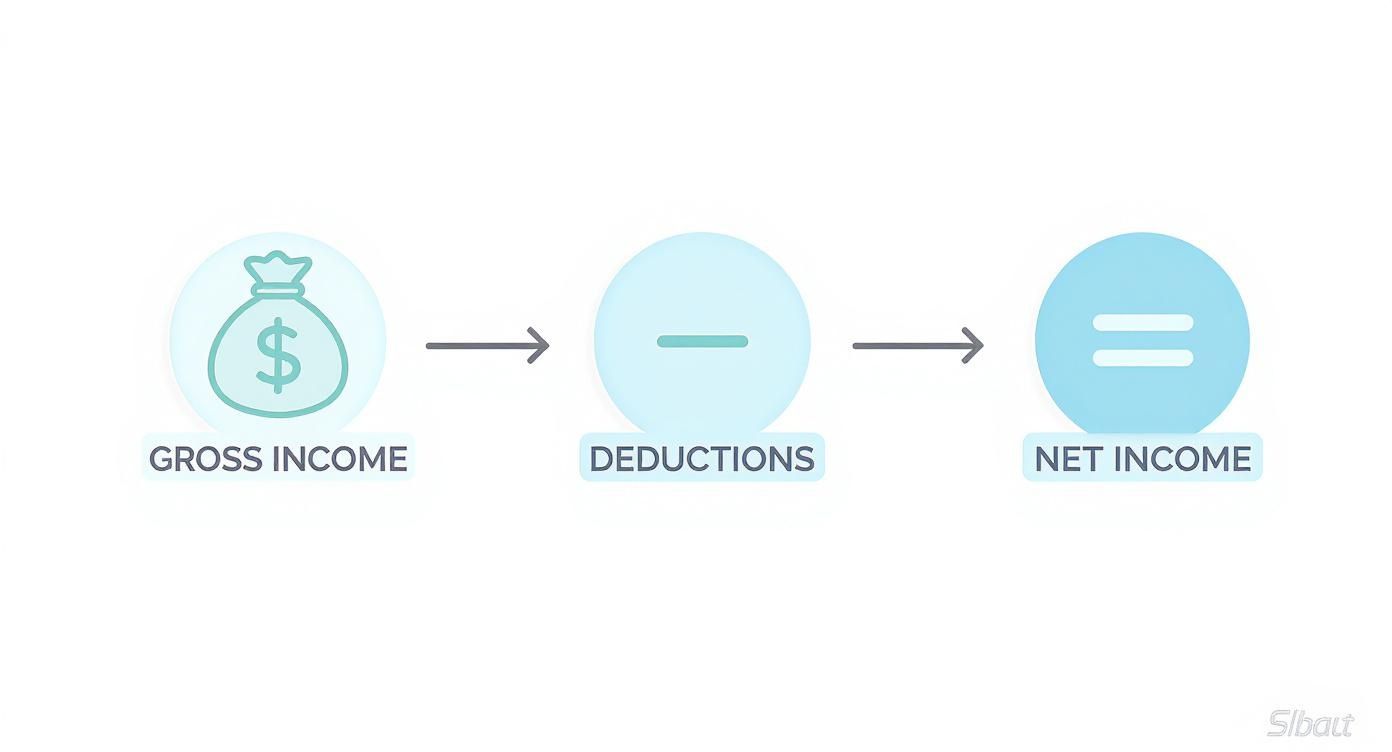
As you can see, you start with your gross investment income, subtract the expenses directly related to earning it, and what's left is your NII. Now, let's walk through a few real-world examples to see how this plays out.
Scenario 1: Single Filer with High MAGI
Let’s meet Alex. He’s a single filer with a solid income.
- Salary: $250,000
- Net Investment Income (NII): $50,000 from capital gains and dividends
- Modified Adjusted Gross Income (MAGI): $300,000 ($250k + $50k)
- Filing Status: Single (Threshold: $200,000)
First, we figure out how much his MAGI exceeds the threshold.
- MAGI Excess: $300,000 (MAGI) – $200,000 (Threshold) = $100,000
Next, we compare that number to his NII to find the smaller of the two.
- Comparison: The lesser of $100,000 (MAGI Excess) and $50,000 (NII) is $50,000.
Finally, we calculate the tax.
- NIIT Liability: $50,000 x 3.8% = $1,900
In Alex's case, the tax applies to his entire NII because it was the lower figure.
Scenario 2: Married Couple with High NII
Now let's look at Ben and Chloe, who are married and file their taxes jointly.
- Salaries: $200,000 (combined)
- Net Investment Income (NII): $80,000 from a rental property
- Modified Adjusted Gross Income (MAGI): $280,000 ($200k + $80k)
- Filing Status: Married Filing Jointly (Threshold: $250,000)
First, we see how far over the threshold their income is.
- MAGI Excess: $280,000 (MAGI) – $250,000 (Threshold) = $30,000
Then, we compare that to their NII.
- Comparison: The lesser of $30,000 (MAGI Excess) and $80,000 (NII) is $30,000.
And now, the tax calculation.
- NIIT Liability: $30,000 x 3.8% = $1,140
This is a perfect example of the "lesser of" rule in action. Even though their investment income was $80,000, they only paid the tax on the $30,000 that pushed them over the income limit.
The Calculation in a Nutshell
The heart of the NIIT calculation is a simple two-step dance. First, find your NII and your MAGI excess. Second, pick the smaller of those two numbers. That's your tax base. Multiply it by 3.8%, and you've got your final tax.
Scenario 3: Investor Using Capital Losses
Finally, let's look at Diana, a single investor who actively manages her portfolio.
- Salary: $240,000
- Capital Gains: $60,000
- Capital Losses: $50,000
- Net Investment Income (NII): $10,000 ($60k gains – $50k losses)
- Modified Adjusted Gross Income (MAGI): $250,000 ($240k salary + $10k NII)
- Filing Status: Single (Threshold: $200,000)
First, we calculate her MAGI excess.
- MAGI Excess: $250,000 (MAGI) – $200,000 (Threshold) = $50,000
Next, we find the lesser value.
- Comparison: The lesser of $50,000 (MAGI Excess) and $10,000 (NII) is $10,000.
Finally, we calculate her tax liability.
- NIIT Liability: $10,000 x 3.8% = $380
By strategically harvesting losses, Diana slashed her NII, which in turn dramatically reduced her NIIT bill. These examples show that understanding the math isn't just an academic exercise—it's the foundation for smart, effective tax planning.
Special NIIT Rules for Real Estate and Business Owners
When most people think about investment income, their minds jump to stocks, bonds, and mutual funds. But for entrepreneurs and real estate investors, the picture gets a lot more complicated. The Net Investment Income Tax (NIIT) rules for these assets are incredibly nuanced, and everything boils down to one crucial question: How involved are you, really?
Think of two different landlords. The first one is a hands-off investor who lives states away, relying entirely on a property manager to handle everything from leaky faucets to finding new tenants. The second landlord is on the ground, personally screening applicants, arranging for repairs, and actively managing the properties day-to-day. In the eyes of the IRS, these two aren't in the same boat at all.
This distinction is what separates passive income from non-passive income. As a general rule, passive income gets hit with the 3.8% NIIT, while income you earn from a business you're actively running does not.
The Material Participation Test for Real Estate
For real estate investors, sidestepping the NIIT on rental profits means proving you are a "real estate professional" who materially participates in the business. This isn't just a title you can give yourself; the IRS has a series of strict tests to see if your involvement is regular, continuous, and substantial.
Simply owning a rental property isn't nearly enough. You have to be in the trenches.
The most common way to prove material participation is by showing you spent more than 500 hours during the year working on your real estate activities.
Other tests can also get you there, such as:
- Substantially All Participation: Proving that you did basically all the work required for the activity all year.
- 100-Hour Test: Participating for more than 100 hours, as long as nobody else (like a property manager) put in more time than you did.
The concept of "material participation" is the dividing line between an investment and a business in the eyes of the IRS. Crossing this line can mean the difference between paying the 3.8% NIIT on your profits or having that income be exempt.
If you can't meet these tests, your rental income is automatically deemed passive. If your income is already over the NIIT threshold, that rental cash flow will be part of the calculation.
Navigating NIIT for Business Owners
This same passive-versus-active logic applies directly to owners of partnerships, S corporations, and LLCs. The money you take out of these businesses could easily be subject to the NIIT if your role is a passive one.
This catches many business owners by surprise. They assume that because it’s a business, the income is exempt. But if you’re a silent partner, an early investor who is no longer involved, or a non-managing member of an LLC, the distributions you receive are almost certainly passive investment income.
Imagine a doctor who invests in a surgical center partnership but continues working at her own separate practice. Any profits she receives from that partnership are passive and fair game for the NIIT. Meanwhile, the surgeons who actually work at the center every day are materially participating, so their share of the income isn't subject to the tax.
To figure out where you stand, you have to honestly assess your involvement. Ask yourself:
- Am I involved in the day-to-day management and big decisions?
- Do I spend a significant amount of time on business operations each year?
- Is my involvement consistent and substantial, not just occasional?
Getting the answers to these questions right is critical. For both real estate investors and business owners, understanding and documenting your level of participation isn't just paperwork—it's the core strategy for managing your NIIT liability.
Reporting Your NIIT on Form 8960
Knowing the theory behind the Net Investment Income Tax is one thing, but it all gets very real at tax time. The IRS has a dedicated form for this calculation: Form 8960, Net Investment Income Tax. This is the official worksheet you'll use to figure out exactly what you owe.
Think of Form 8960 as the bridge between all your investment activities and your main tax return, the Form 1040. It’s designed to walk you through the math step-by-step, making sure all the right income and deductions are included before you land on a final tax figure.
The form isn't just a jumble of boxes; it tells a story about your financial year. It forces you to categorize your income—from taxable interest and dividends to capital gains—and then lets you subtract the expenses directly related to earning that income. This structure ensures you’re only taxed on your actual net profit.
Breaking Down the Form's Logic
Form 8960 is laid out in three parts, each with a specific job. This methodical approach keeps you from missing a step and makes that tricky "lesser of" rule we talked about much clearer.
Here’s how it’s organized:
- Part I: Investment Income: This is where you tally up all the relevant income. You’ll be pulling numbers from other places in your tax return, like the interest reported on Schedule B or the capital gains from your Schedule D.
- Part II: Investment Income Deductions: Next, you get to subtract your allowable expenses. This could include investment interest expense, advisory fees, or even the slice of state income taxes you paid on your investment earnings.
- Part III: Tax Computation: The final section puts it all together. It has you calculate your final net investment income (Part I minus Part II) and then compare it to your MAGI threshold excess. The form then guides you to apply the 3.8% tax rate to whichever of those two numbers is smaller.
The Final Destination
Once you've worked through Form 8960, the final NIIT amount isn't paid with a separate check. You carry that number over to your Form 1040, where it’s added to your total tax liability for the year.
Common Filing Mistakes to Avoid
While Form 8960 follows a certain logic, it’s a minefield for common errors. A simple mistake can cause you to overpay your tax or, worse, trigger a notice from the IRS. Knowing what to watch out for is half the battle.
One of the most frequent slip-ups is misclassifying income. A business owner, for instance, might accidentally report passive income as active (or the other way around), which completely changes the NIIT picture. Another classic mistake is forgetting to claim all your allowable deductions, like failing to allocate a portion of your state tax payments against investment income.
At the end of the day, Form 8960 is the tool for getting this right. If you understand how it works and why it’s structured the way it is, you can report your liability with confidence, knowing you’ve met your obligations without paying a dollar more than you have to.
Actionable Strategies to Reduce Your NIIT

Knowing how the Net Investment Income Tax works is one thing; doing something about it is another. With some smart planning, you can dramatically lower—or even completely sidestep—your 3.8% NIIT liability. Think of it this way: your MAGI and your Net Investment Income are the two triggers for this tax, and you have levers to control both.
By making intentional moves to manage one or both of these figures, you can often keep your income below the thresholds or simply shrink the pool of money the tax applies to. These aren't shady loopholes. They’re established, legitimate strategies that just require a bit of foresight. Let's dig into some of the most effective tactics.
Control Your Income Thresholds
The most straightforward way to avoid the NIIT is to keep your MAGI below the magic number for your filing status. If your income is right on the cusp—say, near $200,000 as a single filer or $250,000 for married couples—even small, simple adjustments can push you back into the safe zone.
One of the best ways to do this is by maxing out your contributions to tax-deferred retirement accounts. Every dollar you put into a traditional 401(k), SEP IRA, or similar plan lowers your MAGI for the year. It's a classic win-win: you’re saving for your future while simultaneously cutting your current tax bill, potentially dodging the NIIT in the process.
The Power of Deferral
Think of contributions to tax-deferred accounts as more than just a way to put off paying income tax. They act as an immediate shield against the NIIT, making them an incredibly effective tool, especially if your income is hovering near the threshold.
Reduce Your Net Investment Income Base
If getting your MAGI down isn't in the cards, your next move is to attack the "NII" side of the calculation. This means finding ways to reduce the amount of taxable investment income that hits your return in the first place.
Two classic strategies really shine here:
-
Tax-Loss Harvesting: This is the art of selling investments at a loss to cancel out the capital gains you've realized from your winners. The losses first offset gains, and if you have any left over, you can even deduct up to $3,000 against your ordinary income. It directly cuts down your NII.
-
Investing in Tax-Exempt Bonds: Interest from most municipal bonds is exempt from federal income tax, which also means it’s exempt from the NIIT. Moving some of your fixed-income allocation into these "munis" can effectively make that income invisible to the NIIT calculation.
Advanced Planning for Assets and Property
For investors with more complex holdings, especially in real estate, there are some more advanced plays that can lead to significant savings. These take some careful planning but are often well worth the effort.
For example, you could gift appreciated assets, like stocks you've held for years, to a child or another family member who is in a much lower tax bracket. When they sell the stock, any capital gain they realize will be taxed at their lower rate and is far less likely to get hit with the NIIT.
Another powerful strategy is for real estate investors to qualify as "real estate professionals" by meeting the IRS material participation tests. If you can properly document over 500 hours of active involvement in your rental activities, that income can be reclassified from "passive" to "active," pulling it completely out of the NIIT's reach.
Combining a few of these strategies can create a solid defense against the NIIT. This isn't about tax evasion; it’s about smart financial management to make sure you're not paying a penny more than you legally owe. You can learn more about how the experts at Blue Sage Tax & Accounting build these kinds of personalized plans for our clients.
Common Questions About the Net Investment Income Tax
When you start digging into the Net Investment Income Tax, a few common questions always pop up, especially around big life events like selling a home or tapping into retirement funds. Let's clear up some of that confusion.
I'm Selling My House. Will I Get Hit With the NIIT?
For most people, the answer is a relieving "no." The tax code gives homeowners a generous break when they sell their main home, and that break extends to the NIIT.
You can exclude up to $250,000 of gain if you’re single, and a whopping $500,000 if you’re married filing jointly. As long as your profit from the sale is under that amount, it’s not considered investment income, and the NIIT doesn't apply. It’s only the taxable gain above those exclusion limits that gets pulled into the NIIT calculation, and even then, only if your total income is high enough.
The bottom line: The same home sale exclusion that protects you from capital gains tax also shields you from the NIIT.
What About My 401(k) or IRA Withdrawals?
Here’s more good news: distributions from your retirement accounts are safe. Money you pull from a 401(k), 403(b), traditional IRA, or similar qualified retirement plan is specifically excluded from the definition of net investment income.
Now, there's a small catch. While the withdrawal itself isn't taxed at the 3.8% rate, it does count toward your Modified Adjusted Gross Income (MAGI). A large withdrawal could potentially push your MAGI over the NIIT threshold, causing other investment income (like dividends or capital gains) to become subject to the tax. It’s a crucial distinction—your retirement money isn't directly taxed, but it can affect the big picture.
Can Capital Losses Help Reduce My NIIT Bill?
Yes, they absolutely can. Using capital losses to offset gains is one of the smartest ways to manage your NIIT liability. The math is simple: capital losses cancel out capital gains, which directly lowers your net investment income.
If you have more losses than gains for the year, you can use up to $3,000 of that excess loss to wipe out other investment income, like interest or dividends. Any leftover losses can be carried forward to slash your tax bill in future years. This is why tax-loss harvesting is such a powerful strategy for anyone dealing with the NIIT.
Thinking ahead is the best way to handle your tax situation. The experts at Blue Sage Tax & Accounting Inc. specialize in building smart strategies for high-net-worth individuals and family offices to minimize their tax burden. Contact us today for a consultation and let's get a plan in place for you.