Figuring out the R&D tax credit can feel like a puzzle at first, but it really comes down to a clear, logical process. It's about connecting your company's innovative work to the money you spent to get it done.
Think of it like this: First, you pinpoint the projects that qualify under the IRS's technical rules. Then, you gather up all the associated costs. Finally, you pick a calculation method to figure out your final credit amount.
This guide will walk you through the whole thing, from identifying the right activities to filling out the forms. Getting a handle on these foundational pieces is the key before you get into the number-crunching.

What Goes into the R&D Credit Calculation?
At its core, calculating your credit means getting three things right. Each one builds on the last to create a solid, defensible claim.
- Qualified Research Activities (QRAs): This is the what. You'll need to identify the specific projects you worked on to create new or better products, processes, or software. The key is that they must have involved some sort of experimentation to overcome uncertainty.
- Qualified Research Expenses (QREs): This is the how much. Once you know which projects qualify, you tally up the costs. This usually includes wages for the employees involved, the cost of supplies used up in the research, and any money paid to U.S.-based contractors for their help.
- Calculation Method: This is the how to. The IRS gives you two main ways to do the math: the Regular Credit (RC) and the Alternative Simplified Credit (ASC). Which one you choose has a big impact on your final credit.
Choosing Your Calculation Method: Regular vs. Simplified
One of the first big decisions you'll make is whether to use the Regular Credit (RC) or the Alternative Simplified Credit (ASC). This choice shapes the rest of your claim.
The RC method can potentially yield a larger credit—20% of current-year QREs over a base amount. The catch? It requires you to dig up historical financial data, sometimes going all the way back to the 1980s, to establish that "base amount." For many companies, especially newer ones or those without meticulous records, this is a non-starter.
That's where the Alternative Simplified Credit (ASC) comes in. It's much more straightforward. Instead of complex historical calculations, it simply looks at your R&D spending over the previous three years.
A bit of practical advice: take a hard look at your record-keeping. If you have pristine, detailed financial and R&D spending records from the mid-80s, the Regular Credit might be worth the effort. For almost everyone else, the Alternative Simplified Credit is the go-to choice. It's simpler, less burdensome, and often just as beneficial.
To help you see the difference, here’s a quick breakdown of how the two methods stack up.
R&D Credit Calculation Methods At a Glance
| Feature | Regular Credit (RC) | Alternative Simplified Credit (ASC) |
|---|---|---|
| Credit Rate | 20% of QREs over a base amount. | 14% of QREs over 50% of the average QREs for the prior 3 years. |
| Record-Keeping | Requires extensive historical data, often back to the 1980s. | Only requires R&D spending data for the previous 3 years. |
| Complexity | High. Calculating the "base amount" can be very complex. | Low. The calculation is much more straightforward. |
| Best For | Established companies with consistent, well-documented R&D history. | Startups, companies with fluctuating R&D, or those without old records. |
Making this choice early on will give you a clear direction as you move forward. It sets the stage for how you'll gather your data and ultimately calculate your tax credit.
What Counts as a Qualifying R&D Expense?

Before you can even think about calculating the credit, you first have to figure out which activities and expenses actually count. The IRS has a very specific set of rules for this, centered around something called the Four-Part Test.
Think of this test as the gatekeeper. Every single project you want to claim must pass all four criteria to be considered a Qualified Research Activity (QRA). It’s not about whether your project was a runaway success—it’s about the nature of the work itself.
The Four-Part Test Demystified
Let's cut through the jargon. If a project doesn't tick all four of these boxes, any money you spent on it can't be included in your R&D credit calculation.
- Permitted Purpose: The whole point of the research must be to create a new or improved product, process, software, or formula. The goal has to be making something better—improving its performance, quality, or reliability.
- Technological in Nature: The work has to be grounded in the "hard sciences." We're talking about engineering, computer science, chemistry, physics, or biology. This is key because it weeds out research in the "soft sciences," like marketing studies or new management techniques.
- Elimination of Uncertainty: This is a big one. At the very beginning of the project, you must have faced a real question about if you could achieve your goal or how to do it. The uncertainty could be about the right design, the best method, or your technical capability to even pull it off.
- Process of Experimentation: You can't just stumble into a solution. You have to show you used a systematic process to figure things out. This could involve building prototypes, running simulations, systematic trial and error, or other forms of testing and analysis to evaluate different approaches.
These tests ensure the credit goes to companies doing genuine technical problem-solving, not just making routine tweaks to their business.
A common misconception I see is that the work has to be "new to the world." It doesn't. The innovation only needs to be new or improved for your company. You can't just copy-paste a competitor's design, but you can absolutely conduct R&D to develop a similar product through your own unique process.
Identifying Your Qualified Research Expenses
Once you've flagged the activities that pass the Four-Part Test, it's time to gather up the costs directly tied to that work. These are your Qualified Research Expenses (QREs). The IRS is pretty strict about what makes the cut.
Most QREs fall into three buckets.
In-House Research Wages
For most companies, this is the biggest piece of the pie. The wages you pay to employees for performing qualified R&D services are the primary driver of the credit. And it's not just for the engineers coding or the scientists in the lab.
Wages for employees who directly supervise or directly support those technical activities count, too.
- Performing R&D: This is the hands-on work—the developer building an algorithm, the chemist mixing formulas.
- Direct Supervision: Think first-line managers who oversee the technical team. This is the engineering lead, not the VP of Sales.
- Direct Support: These are people who directly help the R&D team, like a lab tech who prepares samples.
If an employee splits their time between R&D and other duties, you can only claim the portion of their wages for the time they spent on qualified activities. This is where good time-tracking becomes invaluable.
Cost of Supplies
This category includes the cost of tangible property (not land or depreciable assets) that is used and consumed during the R&D process. The key words here are "used and consumed."
Imagine a manufacturer developing a new molding process. The raw plastic resin they use to test dozens of prototypes? That’s a qualifying supply expense. But the expensive new injection molding machine they bought for the project? That's a depreciable asset and does not count as a supply.
For software companies, this category is usually pretty small since most of their expenses are tied up in wages.
Contract Research Expenses
It’s common to bring in outside experts for specialized work. You can include 65% of the amount you pay to third-party contractors to perform qualified research for you.
But there are a few ground rules:
- The work must be done within the United States.
- Your company must keep substantial rights to the research results.
- You must bear the economic risk. This means if the contractor’s work fails, you still have to pay them.
For example, say you hire a U.S.-based firm for $100,000 to run performance testing on a new app you're building. As long as the work meets the Four-Part Test and you own the results, you can include $65,000 ($100,000 x 65%) in your QREs.
Getting this foundation right—properly identifying your QRAs and accurately tallying your QREs—is the most critical part of the entire process. Once you have these numbers nailed down, you’re ready for the actual calculations.
Picking the Right Calculation Method: Regular vs. Simplified
Once you’ve nailed down your total Qualified Research Expenses (QREs), you’ve reached a critical decision point. Now you have to choose how you’re going to calculate the actual credit. The IRS gives you two ways to do this: the Regular Credit (RC) method and the Alternative Simplified Credit (ASC) method.
This isn’t just a procedural step; it’s a strategic choice. The path you take directly controls how the numbers work out and can dramatically change the final credit amount you claim. Each one has its own logic, benefits, and headaches, designed for different types of businesses.
The Old School Way: The Regular Credit (RC) Method
The Regular Credit is the original formula, and on the surface, it looks pretty attractive. It offers a 20% credit on your current year's QREs that are over a calculated "base amount." For certain long-established companies with a very specific financial history, this can sometimes produce the biggest credit.
But here’s the catch—that "base amount" is notoriously difficult to calculate. It involves a deep, often painful, dive into your company’s historical financials. You have to figure out a "fixed-base percentage," which means digging up gross receipts and R&D spending data from as far back as 1984-1988.
For most companies, especially startups or any business that hasn't kept perfect, decades-old records, this is a huge hurdle. Finding, verifying, and making sense of that old data can be a massive project, and frankly, it's often impossible.
I’ve seen it time and again: unless a company has been around forever and has pristine, easily accessible financial records from the Reagan era, the Regular Credit method is usually more trouble than it’s worth. The administrative nightmare can easily eclipse the benefit of a slightly higher credit.
The Modern Approach: The Alternative Simplified Credit (ASC) Method
Thankfully, the IRS recognized how complicated the RC method was and created the Alternative Simplified Credit (ASC). It has quickly become the default choice for the vast majority of businesses, and for good reason—it’s just so much easier.
With the ASC, you get a 14% credit on the amount of your current year’s QREs that exceeds 50% of your average QREs from the last three years.
Let's see that in action. Imagine your numbers are:
- Average QREs (last 3 years): $200,000
- 50% of that average: $100,000 (this is your base)
- Current Year QREs: $300,000
- Credit Calculation: 14% of ($300,000 – $100,000) = $28,000 credit
The ASC completely sidesteps the need for ancient financial records. It’s a lifesaver for companies with fluctuating R&D budgets or those that are relatively new. Better yet, if you didn’t have any QREs in one of the past three years, your base amount becomes zero, and you can take a 6% credit on your entire current year QRE total.
Running the Numbers: A Side-by-Side Comparison
To see how this plays out, let's walk through a scenario with a hypothetical tech company, "Innovate Solutions Inc."
Innovate Solutions Inc. Financials:
- Current Year QREs: $500,000
- Average QREs (Prior 3 Years): $300,000
- Regular Credit Base Amount (hypothetical): $250,000
Here's how the math shakes out for each method.
| Calculation Step | Regular Credit (RC) | Alternative Simplified Credit (ASC) |
|---|---|---|
| 1. Determine Base Amount | $250,000 (From historical data) | $150,000 (50% of $300,000 avg) |
| 2. Calculate Excess QREs | $500,000 – $250,000 = $250,000 | $500,000 – $150,000 = $350,000 |
| 3. Apply Credit Rate | 20% of $250,000 | 14% of $350,000 |
| 4. Final Credit Amount | $50,000 | $49,000 |
In this case, the RC method results in a slightly larger credit. But the ASC is right behind it, delivering almost the same benefit without any of the historical data headaches. For most founders and CFOs, that's an easy trade-off to make. It really underscores why you should run the numbers both ways if you can.
This idea of rewarding a percentage of R&D spend isn't unique to the U.S. By 2024, 34 of the 38 OECD countries offered some form of tax incentive to encourage innovation. The specific calculations differ, but the core principle is the same. France, for instance, offers a 30% credit on the first €100 million of R&D spend. You can explore more insights on how these incentives fuel global innovation at Worldbank.org.
So, Which Method is Right for Your Business?
There’s no single right answer, but we can make the decision pretty simple based on your company’s situation.
The Regular Credit (RC) might be for you if:
- You’re a well-established company with perfect financial records going back to the 1980s.
- Your gross receipts have grown much more slowly than your R&D spending over the decades.
- You have the time and accounting resources to do the complex historical calculations.
You should almost certainly choose the Alternative Simplified Credit (ASC) if:
- You’re a startup or younger company without a long financial history.
- Your records from the 1980s are spotty, lost, or simply don't exist.
- Your R&D spending has been growing quickly or is inconsistent year-to-year.
- You want a straightforward, predictable, and less stressful calculation.
For the vast majority of businesses I work with, the ASC is the clear winner. It makes the R&D credit accessible to the small and mid-sized companies that are the real engines of innovation today, not just massive, legacy corporations.
Squeezing Every Last Dollar from Your Credit with Key Tax Elections
Once you've got a preliminary credit amount, a few final decisions can make a huge difference in its real-world value. Calculating the credit is one thing; actually getting the maximum bang for your buck is another.
These critical elections, which you make when you file your return, determine how the credit plays with your other tax obligations. They can even inject some much-needed cash flow right back into the business.
The Section 280C Election: To Reduce the Credit or Reduce the Deduction?
This brings us to a big one: the Section 280C(c)(3) election. You have a choice to make. You can either claim your full R&D credit and reduce your business's R&D expense deduction by the same amount, or you can elect to take a slightly smaller credit and keep your full R&D deduction.
So, why would you ever choose a smaller credit? It usually comes down to your company's marginal tax rate. For businesses in higher tax brackets, the value of keeping that full expense deduction can easily outweigh the small slice of credit you have to give up.
Let's walk through a real-world example to see how this plays out:
- Total R&D Credit Calculated: $100,000
- Company's Marginal Tax Rate: 35%
Scenario 1: You Don't Make the Election
You take the full $100,000 credit. But, you have to reduce your deductible R&D expenses by that same $100,000. This makes your taxable income higher, creating an extra $35,000 in tax you owe ($100,000 x 35%). Your net benefit is $65,000.
Scenario 2: You Make the 280C Election
You choose to take a reduced credit. The credit is lowered by the top corporate tax rate (21%), so you claim $79,000 ($100,000 x (1-0.21)). Crucially, your R&D expense deduction stays completely untouched. Your net benefit is $79,000.
In this case, making the election puts an extra $14,000 in your company's pocket. It’s a vital calculation, and I always recommend having your tax pro model this for your specific situation.
This visual flow chart gives a great overview of the two main paths to your initial credit calculation—the Regular Credit (RC) vs. the Alternative Simplified Credit (ASC).
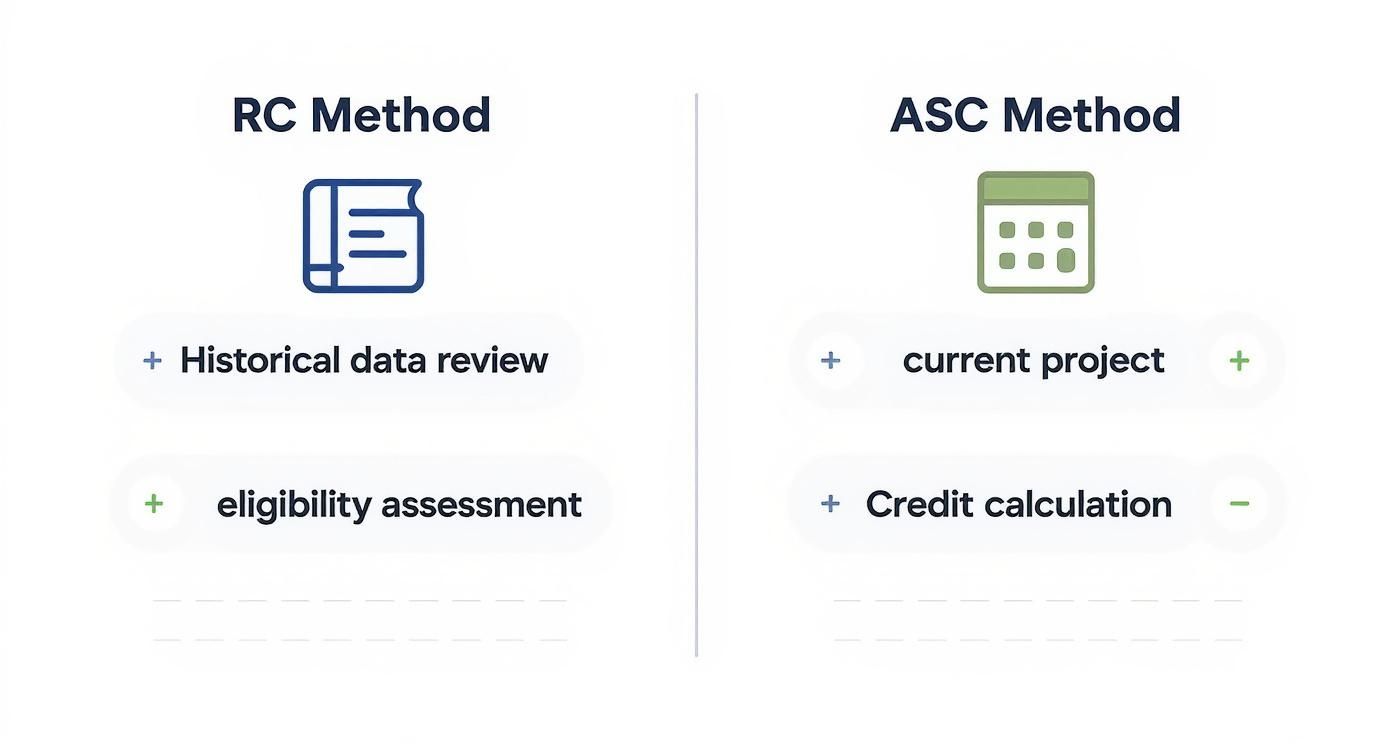
As you can see, the Regular Credit method often involves digging up complex historical data, whereas the ASC offers a much more straightforward lookback over the last three years.
A Game-Changer for Startups: The Payroll Tax Offset
For a lot of early-stage companies, the R&D credit feels like a benefit they won't see for years. After all, if you aren't profitable yet, you don't have any income tax to offset. This is where the payroll tax credit election becomes an incredibly powerful tool for immediate cash flow.
A Qualified Small Business (QSB) can choose to apply up to $250,000 of its R&D credit directly against the employer's share of Social Security taxes. This move instantly turns a future tax asset into cash in your bank account, helping you fund the very innovation that earned you the credit.
To qualify for this election as a QSB, your company has to hit two targets for the tax year:
- Have gross receipts under $5 million.
- Have zero gross receipts for any tax year before the 5-year period ending with the current tax year.
This election is an absolute lifeline for startups. Instead of waiting years to become profitable, you can reduce your quarterly payroll tax bill and directly improve your burn rate. It extends your runway, and it’s one of the most impactful provisions out there for new, innovative businesses.
You make this election on Form 6765 when you file your income tax return. The credit is then applied to your payroll taxes in the calendar quarter after you file. It’s a strategic move that transforms the R&D credit from a deferred asset into an immediate operational advantage.
How to Build an Audit-Proof Documentation Trail

An R&D tax credit claim is only as solid as the paperwork backing it up. While getting the numbers right is a huge part of the process, the real test is proving those numbers are legitimate and directly tied to qualified work. The best way to do this is to build your documentation trail as you go, not scramble to recreate it months later.
This habit is called contemporaneous documentation—creating records while the R&D is happening. It’s the difference between telling the IRS a clear, organized story and frantically digging through old emails for proof. A well-documented claim drastically reduces your risk of a challenge or having your credit slashed during an audit.
Core Documents for Every R&D Project
Think of your documentation as telling the story of your project. It needs a beginning (the technical problem), a middle (your experimentation process), and an end (the outcome), all backed by solid evidence. For every project you include in your R&D credit calculation, you should have a dedicated file.
Your audit-ready file should contain these essentials:
- Project Plans & Design Docs: These set the stage, outlining the project's purpose and the technical hurdles you were trying to overcome from day one.
- Test Plans & Results: This is your proof of experimentation. It includes testing protocols, raw data, analysis, and the conclusions you drew from it all.
- Meeting Notes & Tech Presentations: Records from brainstorming sessions, design reviews, and project updates are goldmines for details about the challenges you faced and the different solutions you considered.
- Developer Notes or Lab Notebooks: These day-to-day logs offer a real-time account of the trial-and-error process at the heart of R&D.
Organizing these documents by project creates a narrative that’s easy for an auditor to follow and defend.
Creating the Nexus Between Activities and Expenses
The most critical piece of the puzzle is the nexus—the direct line connecting the qualified work you did to the specific costs you're claiming. If you can't establish that link, the claim falls apart. An auditor wants to see exactly how a specific engineer’s salary or a particular supply purchase directly contributed to a qualified research activity.
I always tell my clients to create a 'nexus document' for each major R&D project. It’s a simple summary sheet that lists the project’s qualified activities and then maps the associated wages, supply costs, and contractor fees directly to that work. It’s your Rosetta Stone for the claim, translating technical work into financial data.
This shows you've done more than just estimate your expenses; you've meticulously tracked and allocated them.
Financial and Supporting Documentation
Alongside your project files, you need the hard financial records to substantiate every dollar you claim. Your accounting system is your best friend here.
Make sure you can easily pull these key financial documents:
- General Ledger Reports: These should detail every wage, supply, and contractor expense you’re claiming.
- Payroll Records: For each employee included, you'll need records showing their gross wages for the year.
- Timesheets or Allocation Sheets: These are vital for proving the percentage of time each person spent on qualified R&D versus their other job duties.
- Contractor Invoices and Agreements: For any contract research, you absolutely must have the signed agreements and detailed invoices spelling out the work performed.
Building this documentation trail isn't just about compliance; it's about giving yourself confidence. When your records are clear, organized, and complete, you can file your claim knowing it’s solid, defensible, and ready for any scrutiny.
Watch Out for These Common Filing Mistakes
You've done the heavy lifting—pinpointing qualified activities, adding up the expenses, and crunching the numbers. But before you hit "file," it's worth taking one last look. A final quality check can be the difference between a smooth claim and a long, painful audit. Getting this last part right means you're not just maximizing your credit; you're building a defensible claim from the ground up.
One of the most common red flags for the IRS is misclassified wages. It’s easy to think that anyone who touches an R&D project should be included, but that's a fast track to getting your claim questioned. Wages for senior executives, sales staff, or marketing team members—even if they pop into R&D meetings—almost never qualify. The IRS wants to see wages for people with their hands on the technical work or those directly supervising and supporting it.
Getting Supplies and Contractors Wrong
Another area where companies get tripped up is with supplies and contractor costs. It's a simple rule for supplies, but often misinterpreted: they must be used and consumed in the R&D process. A classic mistake is trying to include the full cost of a new server or a piece of testing equipment. Those are depreciable assets, not consumable supplies, and they don't belong in your QRE calculation.
With contractors, it all comes down to the paper trail. If you can't produce a detailed invoice or a clear contract outlining the specific R&D work they did for you, that expense is as good as gone in an audit. You have to prove two things: that the contractor was doing qualified research on your behalf and that you kept substantial rights to whatever they developed.
A key piece of advice: Think of your claim as a story backed by data. An auditor needs to be able to draw a straight line from an expense on your books to a specific qualified activity in your project notes. If that connection isn't crystal clear, the expense is at risk.
Forgetting About State-Level Credits
Don't get so focused on the federal credit that you miss out on what's available in your own backyard. More than 30 states have their own R&D tax incentives, and some of them are incredibly valuable. Each state has its own rulebook, but this creates a whole separate opportunity to get cash back for your innovation.
Ignoring state credits is like leaving money on the table. A software company in California or a manufacturer in Ohio, for instance, could potentially double their total tax benefit just by filing at both the federal and state levels. Make investigating these programs a non-negotiable part of your process.
Run through this quick final checklist before you file:
- Wage Check: Did you filter out all non-technical management and administrative salaries from your QREs?
- Supply Audit: Are the supplies you've included genuinely consumable items, not depreciable equipment?
- Contractor Proof: Do your contracts and invoices clearly spell out the qualified work performed by vendors?
- Connecting the Dots: Can you link every single dollar you're claiming back to a specific qualified project?
- State Credit Search: Have you looked into whether your state offers an R&D credit you could be claiming?
Taking a few extra minutes for this review will help you file with confidence, knowing your claim is as strong as it can be.
Navigating the world of R&D tax credits takes a careful eye for detail. At Blue Sage Tax & Accounting Inc., we live and breathe this stuff, helping businesses claim the incentives they've rightfully earned. Let us handle the complexities so you can focus on your next big idea. Contact us today to learn more about our R&D credit study services.