When you get down to it, the real difference between S Corp and LLC tax benefits comes down to one thing: payroll taxes.
An S Corp can potentially save you a significant amount on self-employment taxes because it lets you take profit distributions. A standard LLC, on the other hand, forces you to pay those taxes on all your net earnings. But this S Corp advantage isn't free—it comes with more complex administrative demands, like actually running payroll.
Choosing Your Business Tax Structure
Deciding whether to operate as a Limited Liability Company (LLC) or elect S Corporation tax status is one of the most important financial decisions you'll make as a business owner. This choice directly shapes your tax bill, your administrative workload, and your overall financial flexibility.
Both structures share the crucial benefit of pass-through taxation, which means the business profits are taxed on your personal return, neatly sidestepping corporate taxes. The big difference, however, lies in how they treat the income you earn as the owner.
An LLC is all about simplicity and flexibility, making it a fantastic starting point for many entrepreneurs. You get personal liability protection with very few compliance headaches. On the other hand, electing to be taxed as an S Corp introduces more formal requirements but can unlock a powerful tax-saving strategy. This guide will dig into the real-world financial and administrative trade-offs to help you make the right call for your specific situation.
High-Level Tax Differences S Corp vs LLC
To get a quick sense of the landscape, it helps to see the core distinctions side-by-side. The table below outlines the major tax and operational differences between a standard LLC and a business that has elected S Corp tax status.
| Attribute | LLC (Default Taxation) | S Corporation |
|---|---|---|
| Profit Taxation | All net profits are subject to self-employment taxes (Social Security & Medicare). | Only a "reasonable salary" is subject to payroll taxes; remaining profits can be taken as distributions. |
| Owner Compensation | Owners take "draws" from profits. They cannot be W-2 employees. | Owners working in the business must be W-2 employees and paid a reasonable salary. |
| Administrative Burden | Lower; fewer formal requirements for meetings and record-keeping. | Higher; requires payroll processing, formal meetings, and corporate minutes. |
| Ownership Flexibility | High; allows for unlimited members, including corporations and non-U.S. residents. | Restricted; limited to 100 shareholders who must be U.S. citizens or residents. |
| Distribution of Profits | Highly flexible; profits can be distributed disproportionately to ownership stakes. | Strict; profits and losses must be distributed in proportion to ownership percentages. |
As you can see, the S Corp's potential for tax savings comes with much stricter rules around who can be an owner, how you pay yourself, and how profits are divided. An LLC provides a much more flexible and low-maintenance framework, but that simplicity might mean leaving money on the table.
How Pass-Through Taxation Works for Your Business
At the center of any S corp vs. LLC debate is one core concept: pass-through taxation. It's the powerful, shared advantage that sets both of these structures apart from a traditional C corporation. Getting a handle on this idea is the first step to understanding how your business structure directly hits your personal bottom line.
Think of a pass-through entity as a conduit. Instead of the business itself paying a separate corporate income tax, all the profits (and losses) "pass through" directly to the owners' personal tax returns. This elegant setup completely sidesteps the dreaded "double taxation" that C corps get stuck with.
Avoiding the Double Taxation Trap
So, what exactly is double taxation? It’s when a business’s profits get taxed twice: once at the corporate level, and then again when they’re paid out to the owners. For a C corp, the painful process looks like this:
- Corporate Tax: The business earns a profit and pays corporate income tax right off the top.
- Individual Tax: The owners then get their share of what's left as dividends, and—you guessed it—pay personal income tax on that money.
Pass-through entities wipe out that first layer of tax. The profits only get taxed once, at your individual rate, which can lead to some serious tax savings right out of the gate.
While both LLCs and S corps share this fundamental benefit, this is where the simple part of the story ends. The real devil is in the details. How those profits are treated for things like self-employment tax is where the two structures diverge, creating wildly different outcomes for your total tax bill. This is where the true comparison begins. For a deeper dive, check out this guide on how pass-through entities are structured on mycorporation.com.
The Qualified Business Income Deduction
There's another huge piece of the puzzle: the Qualified Business Income (QBI) deduction. Created under Section 199A, this is a major tax break designed specifically for owners of pass-through businesses.
The QBI deduction is a game-changer. It lets eligible owners of LLCs, S corps, partnerships, and sole proprietorships deduct up to 20% of their qualified business income directly on their personal return. It effectively lowers your taxable income without you having to spend a dime.
Let's put that into perspective. If your S corp or LLC generated $100,000 in qualified business income, you could potentially deduct $20,000. That means you'd only be paying income tax on $80,000 of that profit.
Now, it's not quite that simple. The QBI deduction is notoriously complex and comes with some guardrails. The final amount you can take is often limited by:
- Your Taxable Income: The deduction starts to phase out for higher-income individuals.
- The Nature of Your Business: Certain fields, especially in professional services, face stricter rules.
- W-2 Wages Paid by the Business: For many taxpayers, the size of the deduction is tied to how much the business pays in employee wages.
This is where expert tax planning really pays off. While both LLCs and S corps can qualify for the QBI deduction, the S corp's requirement to pay owner-employees a W-2 salary can sometimes create a strategic advantage, especially for high earners navigating the deduction's limitations.
Payroll vs. Self-Employment Tax: The Real Difference
When you're trying to decide between an S corp and an LLC, the most important conversation revolves around how you're taxed. This isn't just a minor detail—it's often the single biggest reason a profitable small business chooses to make the S corp election. The entire distinction boils down to two concepts: self-employment tax for LLCs and payroll tax for S corporations.
If you run a standard single-member LLC, the IRS sees you and your business as a single entity. That means every last dollar of net profit is treated as your personal income. As a result, that entire profit gets hit with the 15.3% self-employment tax, which is how you pay into Social Security and Medicare.
While this approach is beautifully simple, it gets expensive as your business scales. The self-employment tax applies to every dollar of profit up to the annual Social Security limit, and the Medicare portion continues on forever.
This is where the idea of pass-through taxation really comes into play. It's a fundamental advantage shared by both LLCs and S corps over traditional C corporations, as it avoids that first layer of corporate tax.
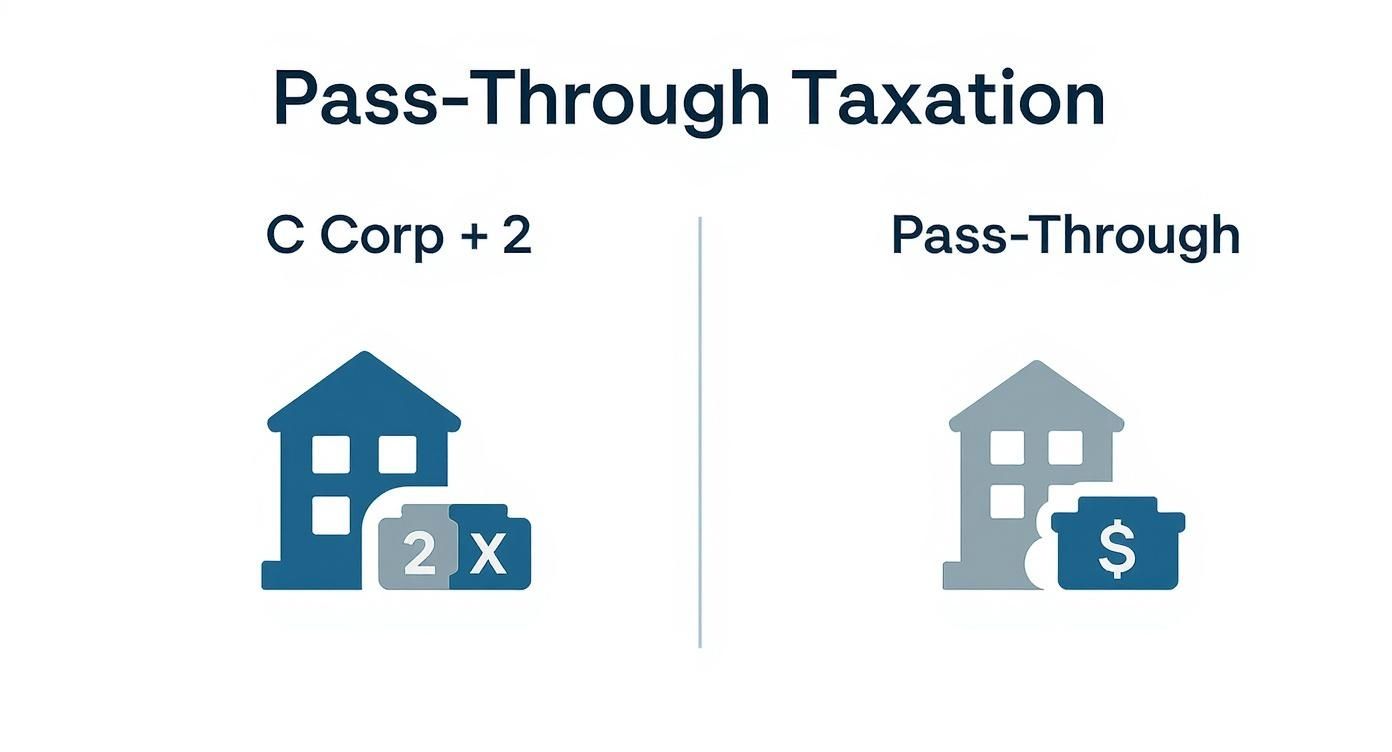
As you can see, the pass-through model is inherently more efficient. From here, the S corp election takes that efficiency a step further.
The LLC Self-Employment Tax Scenario
Let's put some real numbers to this to see how it works. Say your LLC, which is taxed as a sole proprietorship, brings in a net profit of $150,000 this year.
As the LLC owner, that entire $150,000 is considered self-employment income. The tax math is straightforward but painful:
- Net Profit: $150,000
- Self-Employment Tax Rate: 15.3%
- Total Self-Employment Tax: $22,950
This $22,950 is due on top of your regular federal and state income taxes. It's a heavy price to pay for the simplicity of the default LLC structure. You do get to deduct half of this amount on your personal return, but the initial tax bite is still substantial.
The S Corp Advantage: The Salary and Distribution Model
Now, picture that same business with the same profit, but you've elected to be taxed as an S corporation. This is where things get interesting. As an S corp owner who is active in the business, you are legally an employee. This means you have to pay yourself a reasonable salary.
That salary is subject to FICA taxes—Social Security and Medicare—which are the employee/employer equivalent of self-employment taxes. The magic happens with the money left over. Any profit remaining after you've paid your salary can be taken as a distribution, and this part is not subject to FICA taxes.
The core S corp tax benefit is this division of income. By splitting your earnings between a W-2 salary and shareholder distributions, you can legally and ethically reduce your Social Security and Medicare tax burden.
Let's crunch the numbers for that $150,000 profit scenario again, this time as an S corp. After talking with your CPA, you decide that a reasonable salary for the work you do is $60,000.
Here’s how it breaks down:
- Reasonable Salary: You pay yourself $60,000 as a W-2 employee. This amount is hit with payroll taxes, which come out to $9,180.
- Shareholder Distribution: The leftover $90,000 in profit is yours to take as a distribution. This income is completely free from self-employment or FICA taxes.
- Total Tax Savings: Your payroll tax bill is just $9,180, a huge drop from the LLC's $22,950 self-employment tax bill.
In this direct comparison, making the S corp election saves you $13,770 in taxes for the year. That's a powerful demonstration of the primary tax benefit of an S corp vs. an LLC.
The Importance of a Reasonable Salary
This entire strategy hinges on the concept of a "reasonable salary." The IRS is very clear on this: your salary must be a fair market wage for the job you're doing. You can't just pay yourself $10,000 a year to maximize your tax-free distributions.
Figuring out what's "reasonable" isn't a guessing game. You need to consider several factors:
- Your role and responsibilities in the company
- Salary data for similar jobs in your industry
- Your experience and professional background
- The complexity of your business
Trying to lowball your salary is one of the biggest red flags you can wave at the IRS. If they audit you and decide your salary was too low, they can reclassify your distributions as wages, which completely erases your tax savings and could lead to steep penalties.
The S corp's treatment of self-employment tax is a significant advantage. While an LLC member pays this tax on their entire profit share, an S corp owner is both an employee and a shareholder. They draw a fair salary subject to payroll taxes, but the remaining profits can be taken as distributions, which are not. This difference can lead to huge savings—analyses from sources like incorp.com show how an S corp shareholder can save thousands each year, especially as business profits climb.
Don't Get Blindsided by State and Local Taxes
It’s easy to get tunnel vision on federal self-employment tax savings—that’s often the main event in the S corp vs. LLC debate. But stopping there is a huge mistake. Federal savings are just one piece of the puzzle. Where your business is located can completely change the math, and sometimes, state tax laws can make one structure a clear winner over the other.
Why? Because states don't have to follow the federal government's lead. Many have their own entity-level taxes, franchise fees, or even taxes based on gross receipts instead of profit. The very structure that saves you thousands with the IRS could stick you with a much larger state tax bill, wiping out those federal gains.
So, making a smart choice means looking beyond federal rules and digging into your specific state and local tax code. This is the only way to avoid nasty surprises and truly optimize your bottom line.
A Tale of Two Taxes in California
California is a perfect real-world example of how differently states can treat LLCs and S corporations. The state's approach shows why you can't just assume federal benefits will trickle down. In the Golden State, how your tax bill is calculated is worlds apart for these two entities.
- LLCs: Face an annual $800 minimum franchise tax, no matter what. But on top of that, they're hit with an LLC fee based on total California gross receipts, which can soar as high as $11,790 for businesses with high sales.
- S Corporations: They also pay that $800 minimum franchise tax. The big difference is that instead of a fee on gross receipts, they pay a 1.5% tax on their net taxable income.
This is a fundamental split: taxing top-line revenue versus bottom-line profit. It creates situations where choosing to be an S corp can lead to massive state tax savings, completely separate from any federal perks.
Running the Numbers in a High-Revenue Scenario
Let’s put some real numbers to this. Imagine a California business pulling in $3 million in gross receipts but with a net taxable income of $150,000. The entity choice here creates two wildly different tax outcomes.
An LLC with those numbers would get hit with the $800 minimum tax plus a hefty fee based on its gross revenue. The same business operating as an S corp would only pay tax on its much smaller net income. When you run the detailed breakdown, the LLC would owe thousands more than the S corp. It's a stark reminder of how state rules can heavily favor one structure. For a complete analysis, you can see the California LLC vs S Corp tax differences on windes.com.
The key takeaway here is that state tax law is not a monolith. A high-revenue, low-margin business in a state like California could get hammered as an LLC. In that scenario, an S corp election becomes less of a choice and more of a necessity for state tax survival.
And this isn't just a California problem. States like New York, Texas, and Tennessee have their own unique franchise taxes and entity-level rules that can tip the scales. If you operate in New York City, for instance, the General Corporation Tax (GCT) applies to S corporations, adding another layer of complexity. If you ignore these State and Local Tax (SALT) details, you’re flying blind. You could be leaving a ton of money on the table or, worse, setting yourself up for a shockingly high state tax bill.
Comparing the True Costs of Administration
Tax savings look great on paper, but they never tell the whole story. The big lure of the S corp—slashing your self-employment tax bill—comes with a hefty trade-off: a major uptick in administrative complexity and real-world costs. If you ignore these operational burdens, you can end up with a structure that creates more headaches than it solves.
When you elect S corp status, you’re suddenly wearing two hats: business owner and employee. This one change sets off a chain reaction of formal requirements that a standard LLC owner gets to skip entirely. In fact, the operational freedom and simplicity of the LLC are a huge part of its appeal.
The S Corp Compliance Checklist
Choosing S corp status means you’re signing up for a new level of administrative duty. The IRS expects you to act like a corporation, and that means a checklist of non-negotiable tasks that will cost you both time and money.
- Mandatory Payroll: This is the big one. You must set up and run a formal payroll system for yourself as an employee-owner. That means calculating withholdings, making tax deposits on time, and filing payroll tax returns every quarter and year. It's not optional.
- Formal Meetings: S corporations are legally required to hold regular meetings for shareholders and directors. Yes, even if it's just you in the room, you have to document that the meeting happened.
- Corporate Minutes: Every significant decision—from setting your own reasonable salary to buying a major piece of equipment—needs to be documented in official corporate minutes. This creates the paper trail that proves you're respecting the corporate structure.
- Separate Finances: While a good idea for any business, it’s absolutely critical for an S corp. Mixing business and personal funds can lead to "piercing the corporate veil," which could put your personal assets on the line in a lawsuit.
The day-to-day difference is night and day. An LLC owner just takes a draw from their business account whenever they need funds. An S corp owner has to run a formal payroll, issue a pay stub, and then handle any extra profit as a separate shareholder distribution.
Calculating the Financial Burden
All these extra tasks translate directly into higher operating costs that can easily chip away at your tax savings. Before you jump on the S corp election, you need to run the numbers. The primary s corp vs llc tax benefits can disappear fast if you aren't ready for the new line items in your budget.
Think about these real-world costs that come with running an S corp:
- Payroll Service Fees: Very few owners do this themselves. You’ll likely hire a service like Gusto or ADP, which usually runs $40 to $100+ per month.
- Increased Accounting Fees: Your tax return just got a lot more complicated. S corps have to file a separate business return (Form 1120-S), which takes more time and expertise than the simple Schedule C a single-member LLC uses. Expect to pay an extra $500 to $2,000+ per year for tax prep.
- State Filing Fees: Many states charge higher annual report fees or franchise taxes for corporations than they do for LLCs.
At the end of the day, the math has to work. Are the self-employment tax savings you're gaining truly greater than the sum of all these new administrative costs? For a business with modest profits, the answer is often a resounding no. The simplicity and low overhead of the LLC usually make it the smarter financial choice until your income grows large enough to justify the S corp's extra work.
So, Which Structure Actually Fits Your Business?
Knowing the theory behind S corp and LLC tax benefits is one thing. Applying it to your real-world business is where it gets interesting. The "right" choice isn't a one-size-fits-all answer; it really hinges on your industry, how much you're making, and what you want to do with the business down the road.
Let's walk through a few common scenarios. By looking at how these concepts of payroll tax, distributions, and administrative hassle play out for different entrepreneurs, you can get a much clearer picture of what makes sense for you.
The Solo Consultant or Freelancer
If you're a freelance designer, an independent IT consultant, or a marketing strategist just getting started, the LLC is almost always the best place to begin. The simplicity is a lifesaver when you're just trying to land clients and get work done. Your main goal is protecting your personal assets, and the LLC does that beautifully without bogging you down with corporate rules.
But there's a tipping point. Once your net income starts to consistently clear the $60,000 to $80,000 mark, it’s time to re-evaluate. At that level, the potential tax savings from an S corp election often start to look a lot bigger than the extra costs for payroll and accounting.
Picture a consultant netting $120,000 a year. They could set a reasonable salary for themselves at $70,000, which gets hit with payroll taxes. The other $50,000 can be taken as a distribution, potentially saving thousands in self-employment taxes. Suddenly, those S corp administrative costs look like a smart investment.
The Growing Agency or Startup
Now think about a digital marketing agency with a couple of employees. They're in growth mode, plowing every spare dollar back into the business to hire more people, upgrade their tech, and expand their marketing. The owners aren't really taking big paychecks home.
For this kind of setup, an LLC taxed as a partnership offers crucial flexibility.
- Profit Reinvestment: There's no requirement to pay yourself a "reasonable salary" when the profits are being used to scale the company. Owners can just take guaranteed payments when they need them.
- Flexible Profit Distribution: The LLC operating agreement allows for special allocations. Let's say one partner puts in the cash and another puts in the sweat equity. You can split the profits in a way that reflects those different contributions—something an S corp's strict one-share-one-vote rule just doesn't allow.
The S corp election only really comes into play once the business has stabilized and is throwing off consistent profits well beyond what's needed for reinvestment.
The Real Estate Investor
For anyone whose business is holding rental properties, the LLC is the hands-down winner. The logic here goes way beyond simple tax savings and gets into the nitty-gritty of real estate financing and liability.
First off, the LLC is perfect for isolating risk. It’s common practice for investors to set up a separate LLC for each property. That way, if a lawsuit happens at Building A, the assets of Building B are completely walled off. It’s a clean, simple, and effective strategy.
Second, and this is a big one, is how debt and basis work. In an LLC, members can add their share of the property’s mortgage to their basis. This often allows them to deduct paper losses that are greater than their actual cash investment—a huge tax advantage. S corp shareholders typically don't get this benefit, making the LLC the clear choice for nearly every real estate investment playbook.
Common Questions from Business Owners
Even after laying out all the details, I find that business owners often have a few specific, nagging questions. Let's tackle some of the most common ones I hear when people are wrestling with the S Corp vs. LLC decision.
When Should I Flip the Switch from an LLC to an S Corp?
This is the big one. The short answer is: when your profits start to consistently outpace what you’d need to pay yourself as a "reasonable salary."
As a rule of thumb, many accountants start this conversation once a business is netting $50,000 to $60,000 a year. Around that point, the money you could save on self-employment taxes often starts to be more than the extra costs and hassle of running payroll and keeping up with S Corp formalities. But this isn't a hard-and-fast rule; you really need to sit down with a tax pro to run the numbers for your specific situation.
Can My LLC Be Taxed as an S Corp?
Absolutely. This is actually one of the most popular and effective strategies out there. You can set up your business as a Limited Liability Company (LLC) to get that great liability protection and operational simplicity, and then simply file Form 2553 with the IRS to be treated as an S Corp for tax purposes.
This hybrid model truly offers the best of both worlds:
- You get the legal protection and easy management of an LLC.
- You unlock the payroll tax savings of an S Corp.
For many small business owners, this is the ideal setup. It delivers the tax benefits of an S Corp without forcing you into the more rigid legal structure of a traditional corporation.
Think of it this way: you keep the simple, flexible legal "shell" of an LLC while swapping out its default tax engine for the more efficient S Corp engine. It's a strategic move to optimize your tax bill without complicating how you run your business day-to-day.
What Exactly Is a "Reasonable Salary" for an S Corp Owner?
A "reasonable salary" is simply what you'd have to pay someone else to do your job. The IRS is very clear on this: S Corp owners who work in the business must receive fair market pay for their labor before taking any of the profits as tax-free distributions.
There's no magic number here. Instead, the IRS looks at a combination of factors:
- What are your actual duties and responsibilities?
- How much time and work do you put into the business?
- What do similar companies pay for the same kind of work?
- Do you have special skills or experience that command a higher salary?
It's crucial to document your reasoning. A good practice is to research salary data for your role and industry from places like the Bureau of Labor Statistics and save it. Trying to game the system by paying yourself a ridiculously low salary is one of the biggest red flags for an IRS audit, and it can result in back taxes, interest, and steep penalties.
Figuring out the nuances of an S Corp election, reasonable compensation, and New York state tax law isn't something you should do alone. The team at Blue Sage Tax & Accounting Inc. lives and breathes this stuff, helping NY business owners make smart tax decisions that fuel their growth. Schedule a consultation with our experts today to see what makes the most sense for you.