

A Queens business owner can have a profitable real estate entity, a family investment partnership, several individual returns, and a nonprofit board obligation on the same calendar. The hard part isn't finding another tax form. It's deciding how those pieces should work together before a transaction, audit, expansion, or family transfer makes the decision urgent.
That's where professional consultant services become useful. They connect tax, accounting, financial modeling, entity structure, and risk management so owners and family offices can make decisions with a clearer view of the consequences. For New York clients, that often means looking beyond federal tax and considering New York State, New York City, SALT exposure, investor reporting, and the practical demands of managing multiple entities.
What Professional Consultant Services Really Mean
Consider a closely held company in Astoria owned by two generations of the same family. The company has operating income, a Manhattan property, several related entities, and owners who live in different states. The tax preparer can prepare returns. The bookkeeper can organize transactions. But someone still needs to ask whether the entities are structured properly, whether estimated payments reflect current income, and whether the next acquisition creates an avoidable tax or reporting problem.
That diagnostic and planning role is the center of consulting. Compliance records what happened and reports it correctly. Consulting helps decide what should happen next. The two functions support each other, but they aren't interchangeable.
A consultant may review historical financial statements, build projections, compare entity structures, model a transaction, or coordinate with attorneys and investment professionals. The work is less about completing one isolated task and more about interpreting information before the client commits capital, signs an agreement, changes ownership, or files a position that may attract scrutiny.

Consulting serves more than large corporations
A high-net-worth individual may need help coordinating personal, business, trust, and investment decisions. A family office may need consistent reporting across partnerships, properties, charitable vehicles, and family members. A technology founder may need planning around equity compensation, research activities, or a possible liquidity event.
Nonprofits and foundations have different pressures. Their boards need reliable financial information, disciplined controls, and preparation for questions from auditors, regulators, donors, and grantmakers. Real estate owners need visibility into property-level performance, debt, investor allocations, and state and local tax obligations.
The common thread is complexity. When several decisions affect one another, a narrow transaction-by-transaction approach can leave important consequences undiscovered.
Year-round clarity changes the relationship
A return filed in April can't tell you what a transaction signed in June will do to your cash flow. A year-end meeting can't repair every planning opportunity that passed during the year. Effective consulting creates a regular process for reviewing results, updating projections, identifying exposure, and assigning next steps.
Practical rule: Use compliance to confirm the past, and use consulting to make the next decision with context.
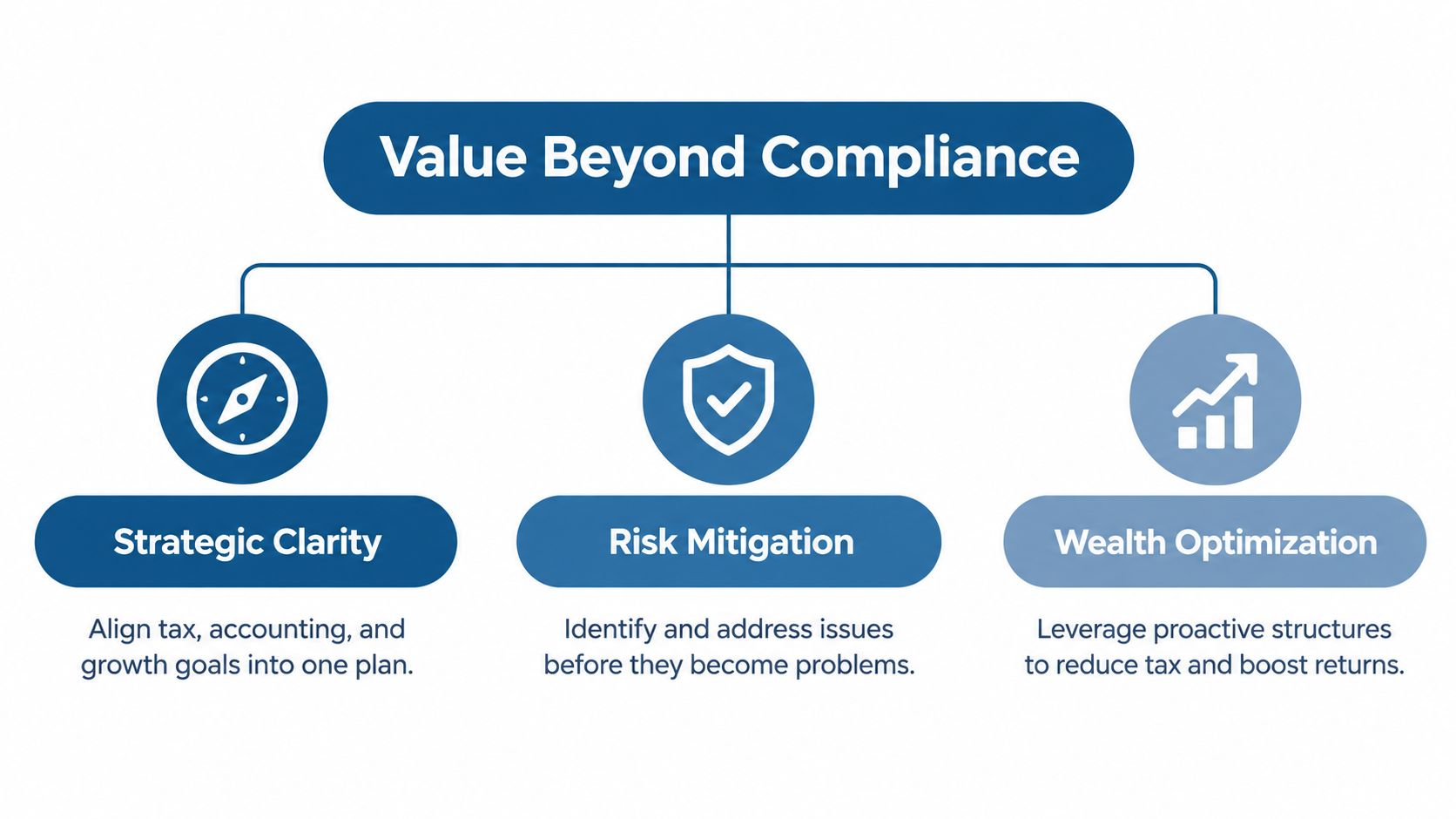
How Professional Consulting Creates Value Beyond Compliance
The easiest way to understand consulting is to compare it with a building inspection. A tax return resembles the inspection report. It describes conditions and records findings. Consulting is the conversation about which repairs matter, which risks deserve immediate attention, and how the owner should plan the next project.
For a New York family office, value may come from coordinating an estate plan with business ownership and investment activity. For a real estate group, it may come from clarifying how a planned acquisition affects cash needs, entity reporting, and state filings. For a nonprofit, it may mean strengthening the financial process before an audit rather than reacting to questions after fieldwork begins.
The benefit isn't limited to a lower tax bill. A good engagement can improve decision quality, cash flow visibility, documentation, and risk control. It can also help the client explain financial choices to family members, lenders, investors, board members, and other advisors.
Start with the decision, not the document
Owners often begin with a technical question, such as whether an entity should change, whether a payment is deductible, or whether a project may qualify for a credit. The better starting point is the business decision behind the question.
Ask:
- What are we trying to accomplish? Preserve liquidity, transfer ownership, acquire property, improve reporting, or reduce uncertainty?
- What could go wrong? A missed filing, unsupported position, poor documentation, unexpected tax, or conflict among stakeholders?
- What information is missing? Current books, updated projections, ownership records, transaction documents, or state activity?
- How will we know the work succeeded? A completed model, an approved structure, a documented control, or a decision supported by clear alternatives?
This approach makes the engagement more measurable. Instead of paying for vague access, the client can identify deliverables tied to a decision or risk.
Why the cost question deserves a better answer
Consulting costs money, but the relevant comparison isn't fee versus no fee. The useful comparison is the fee against the cost of making a poorly informed decision, discovering a problem late, or losing the ability to explain a position.
Client satisfaction matters here. A peer-reviewed study found that satisfaction with the consulting team positively influences consulting fees and can provide a stronger pricing signal than generic service-quality measures in some consulting settings, as discussed in this peer-reviewed study of consulting fees and team satisfaction. In practical terms, clients pay for trusted judgment, dependable execution, and knowledge transfer, not just a finished document.
Types of Professional Consultant Services You Can Engage
The right service depends on the trigger. A real estate investor preparing to buy property needs a different analysis from a nonprofit preparing for an audit or a family office coordinating a multistate transfer.
| Consulting Service Type | Primary Purpose | Best For |
|---|---|---|
| Tax planning and advisory | Model tax consequences and identify planning opportunities before deadlines or transactions | High-net-worth individuals, owners, partnerships, and family offices |
| Accounting and financial advisory | Improve reporting, forecasting, controls, and decision support | Closely held businesses, real estate entities, and nonprofits |
| Estate and gift planning | Coordinate ownership, transfers, liquidity, and family objectives with legal counsel | Multigenerational families and significant business owners |
| SALT and multistate tax | Review state and local exposure across locations, entities, and activities | NYC businesses, remote owners, real estate groups, and investors |
| R&D credit studies | Document qualifying activities and related costs for a supportable credit position | Technology companies and businesses developing products or processes |
| International tax | Analyze cross-border ownership, income, reporting, and withholding issues | Families, investors, and businesses with foreign activity |
| Sales tax reviews and audit representation | Test collection and filing practices, then support the client during inquiries or examinations | Retail, service, real estate, and other exposed businesses |
Tax planning is most useful before income is earned, property is sold, or ownership changes. Accounting advisory becomes valuable when the financial statements answer historical questions but don't give management enough information to run the business.
Estate and gift planning usually requires coordination with an estate attorney. The accountant's role may include modeling tax consequences, reviewing ownership records, estimating liquidity needs, and showing how different decisions affect family members and entities.
For NYC owners, SALT work deserves special attention. State and local exposure can arise from where a person lives, where a business operates, where employees work, where property is located, and how income is sourced. A business may need a review when it expands, hires outside New York, acquires property, or begins serving customers in new jurisdictions.
Technology founders should ask whether an R&D credit study includes a defensible process for identifying activities and preserving records. International families and investors need a coordinated review rather than separate answers from advisors who don't share information.
A practical accounting and advisory guide for NYC businesses can help owners identify which questions belong in a broader engagement.

Engagement Models and How Pricing Is Changing
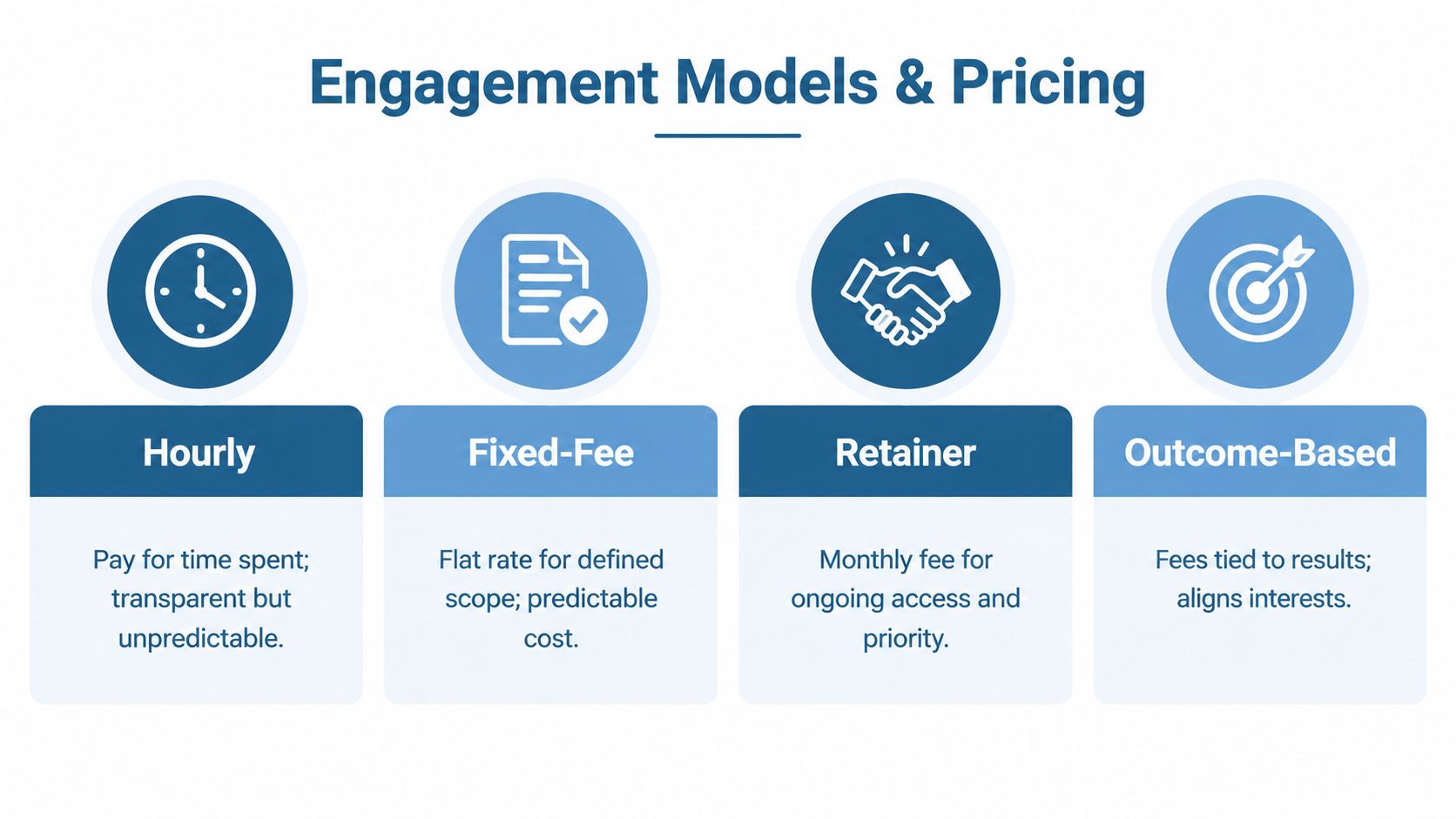
Consulting pricing works best when the fee matches the uncertainty, effort, and value of the assignment. The four familiar models are hourly, fixed-fee, retainer, and outcome-based pricing.
What each model means
Hourly billing gives the client a direct connection between time and cost, but the final amount can be hard to predict when records are incomplete or the scope changes. Fixed-fee work offers clearer budgeting when the deliverables and assumptions are well defined.
A retainer usually provides ongoing access, recurring reviews, or priority support. It can be appropriate for a family office or owner who expects regular questions, but the agreement should specify what the client receives, how unused time is handled, and what falls outside the arrangement.
Outcome-based pricing connects some portion of the fee to a defined result, such as a documented tax saving, a completed transaction milestone, or a risk-reduction deliverable. The structure needs careful wording because tax outcomes can depend on facts, law changes, client decisions, and actions taken by other professionals.
Why traditional billing is under pressure
Professional services firms commonly target billable utilization in the 75% to 85% range, while consulting benchmarks often cluster around 70% to 80%, according to Certinia's professional services maturity benchmark. The same benchmark notes that utilization above about 80% can increase burnout and reduce time for proposals, business development, and methodology work, while lower utilization may point to excess capacity or weak demand.
Those economics help explain why firms are reconsidering time-based pricing. AI can compress the labor involved in research, drafting, data review, and recurring analysis. A client shouldn't automatically pay the same fee for a result because a tool allowed the consultant to complete the work faster. The proposal should explain the judgment, review, responsibility, and deliverables that remain human-led.
Industry coverage describes a shift toward value-based and subscription pricing, with over 60% of large enterprises preferring outcome-oriented fee structures, as reported in this professional services market analysis. The same source reports sector revenue growth of 5.2% in 2025, compared with a 10% healthy target, and EBITDA of 9.9%, reinforcing pressure to redesign packaging and pricing.
Questions to put in the proposal
Ask how scope changes are approved, which assumptions support the fee, how savings or risk reduction will be measured, and who owns the final review. For a multi-entity client, require a list of included entities, jurisdictions, meetings, models, and deliverables.
The strongest proposal doesn't promise a vague retainer. It defines the work, the client's responsibilities, the consultant's review process, and the evidence used to evaluate completion.
How to Evaluate and Choose the Right Consulting Firm
A polished proposal isn't enough. The firm needs the technical knowledge, communication habits, and control environment to handle sensitive financial decisions.
Begin with credentials and relevant experience
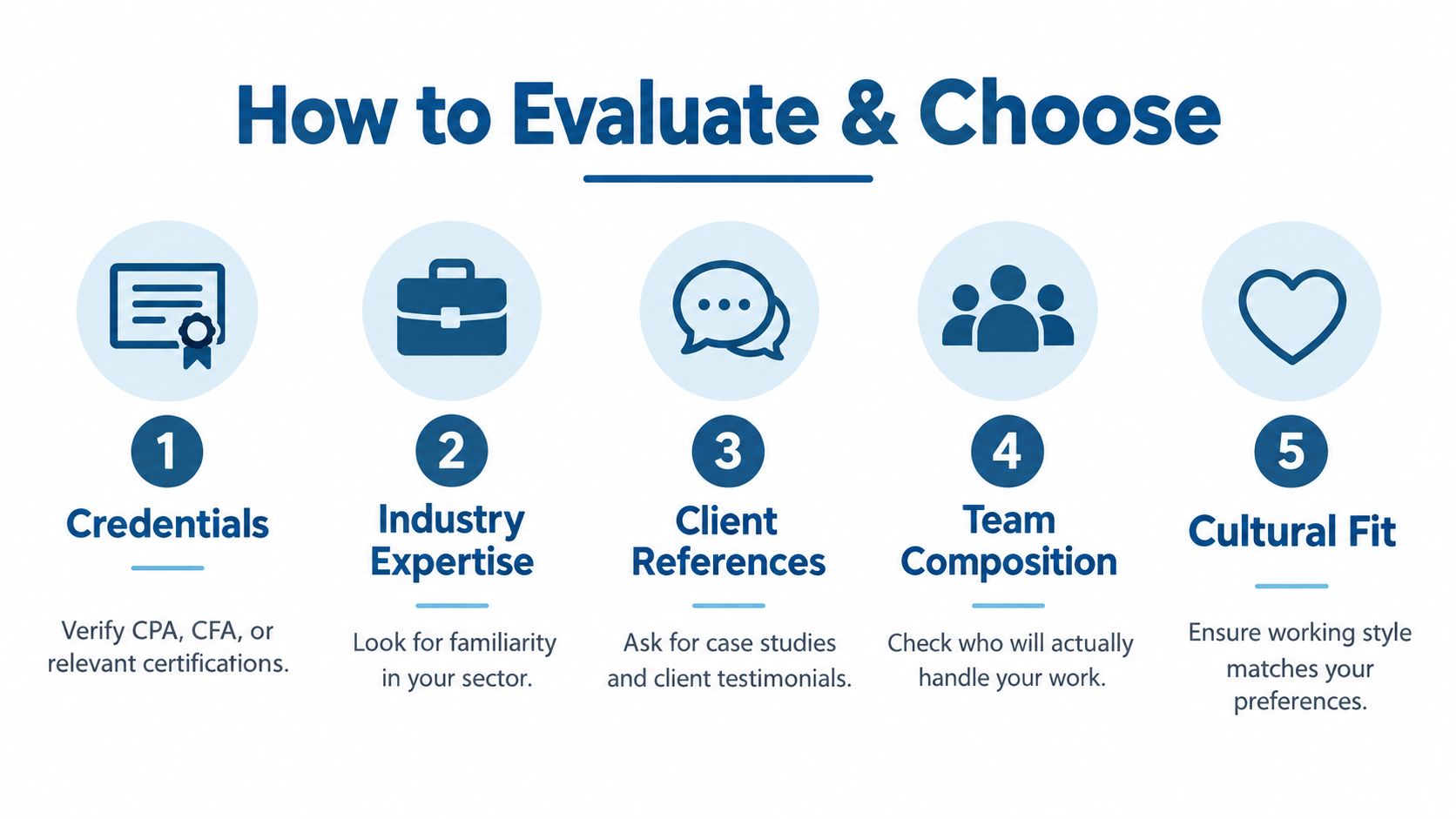
Confirm the professionals who will perform the work and whether their credentials fit the assignment. A CPA may be central to tax and accounting work, while other engagements may require complementary legal, valuation, investment, or specialized industry expertise.
Then test sector familiarity. A real estate client should ask about property entities, investor reporting, debt arrangements, and state and local tax exposure. A nonprofit board should ask how the firm supports audit readiness, restricted funds, grant reporting, and board-level communication. A technology company should ask how the team documents development activities and evaluates R&D credit positions.
Look at the actual delivery team
The person who sells the engagement may not be the person who builds the model or handles the audit response. Ask for names, roles, review responsibilities, expected response times, and a backup plan when the primary contact is unavailable.
Request references or relevant examples, but evaluate them carefully. A useful example explains the problem, the process, the deliverables, and the client's role. It shouldn't rely only on a dramatic result that can't be independently understood.
Ask directly: Who reviews the technical work, how are disagreements documented, and what happens when the facts change?
Treat AI governance as a selection criterion
AI-enabled consulting creates opportunities, but it also creates questions that matter to family offices, real estate entities, nonprofits, and taxpayers with sensitive records. Ask whether client data can be entered into an AI tool, whether the tool retains or trains on that information, who can access outputs, and how the firm separates drafts from approved work product.
The Management Consultancies Association's discussion of 2026 growth expectations reports that 78% of consultants identify digital technology and AI as key to 2026 growth and 71% of professional services firms are deploying generative AI. Those figures make governance more important, not less.
A responsible firm should explain human review, source checking, confidentiality controls, retention practices, and audit trails. For tax or regulatory advice, the firm must be able to show who accepted responsibility for the final conclusion.
Real World Use Cases for NYC Family Offices and Businesses
A Queens family office may have a founder, adult children, trusts, investment partnerships, and beneficiaries living in different states. The immediate question may sound simple, such as whether to transfer an interest or sell an asset. A coordinated engagement can map ownership, estimate tax and liquidity effects, identify missing records, and give the family attorney and investment team a common set of assumptions.
The outcome isn't a single magic structure. It's a decision that the family can understand, document, and revisit as facts change.
A real estate investor provides a second example. The investor owns properties through separate entities, has partners receiving different allocations, and is considering an acquisition outside New York. A consulting team can review SALT exposure, investor reporting, estimated payments, cash reserves, and the effect of the new entity on the existing structure.
The practical result is better preparation. The investor sees which assumptions drive the model and which questions must be answered before signing.
A nonprofit faces a different version of the same problem. Its finance committee may have timely books but inconsistent supporting documentation, unclear approval procedures, or reporting that doesn't give the board enough visibility. An advisory engagement can organize the close process, clarify controls, prepare schedules, and help management respond to audit requests with less disruption.
For owners thinking about compensation and retention, a playbook for executive compensation planning can also serve as a prompt for questions about cash flow, tax treatment, incentives, and governance.
These scenarios share a decision framework:
- Identify the pressure point: A transfer, acquisition, expansion, audit, compensation decision, or reporting weakness.
- Map the affected parties: Owners, beneficiaries, partners, employees, board members, lenders, and other advisors.
- Define the evidence: Financial statements, projections, agreements, tax records, ownership documents, and operating data.
- Set the deliverable: A model, written recommendation, control plan, filing position, or meeting-ready explanation.
- Assign accountability: Name who reviews the work and who approves the decision.
Making Professional Consulting Work for Your Next Stage of Growth
A business owner doesn't need every consulting service at once. The useful starting point is the decision in front of you. Match that decision to the relevant expertise, agree on a deliverable, choose a pricing model that reflects the scope, and confirm how the firm will protect confidential information and review AI-assisted work.
For a family office, that might mean coordinating estate, gift, entity, and multistate planning. For a real estate group, it might mean connecting SALT analysis with acquisition modeling and investor reporting. For a nonprofit, it could mean building a cleaner path from bookkeeping to board reporting and audit readiness.
The strongest relationship develops through a repeatable rhythm. Financial results are reviewed, projections are updated, open questions are assigned, and decisions are documented while there's still time to act.
A useful consultant doesn't just answer the question on your desk. The right advisor helps you ask the next question before it becomes expensive.
Blue Sage Tax & Accounting Inc. provides tax planning, accounting, business advisory, estate and gift planning, SALT, R&D credit studies, international tax, sales tax reviews, and audit representation for NYC individuals, family offices, businesses, real estate entities, and nonprofits. Visit Blue Sage Tax & Accounting Inc. to discuss a professional consultant services engagement built around your next decision, measurable deliverables, and practical year-round guidance.