
A founder-owned manufacturing group can look profitable on paper and still have a compensation problem. The owner takes $900K of salary, pays no bonus, and has no deferred compensation. Meanwhile, a general manager who keeps production moving is listening to a competitor's equity offer. The owner's wealth remains concentrated in an illiquid business, personal tax costs remain high, and the company has no serious retention instrument beyond goodwill.
That's the situation executive compensation planning should solve. The right plan allocates cash, equity, and future promises across base pay, variable compensation, deferred compensation, and ownership-linked incentives. It must work for the executive, the company, the owners, and the eventual transition.
For closely held businesses, four lenses matter most: tax efficiency, retention, liquidity, and continuity. Public-company governance still offers useful lessons, including the evolution of shareholder oversight through say-on-pay, but an owner-managed company usually faces a more immediate question: can the business retain the people who make it valuable while helping the owner diversify wealth and prepare for succession?
What Executive Compensation Planning Really Solves
The manufacturing owner in the opening example has treated compensation as a payroll decision. That's understandable, but incomplete. A $900K salary creates current taxable income without creating a structured path for retirement funding, deferred payouts, or performance-based retention. The general manager, meanwhile, sees a competitor offering equity and may reasonably conclude that the current employer has no long-term place for them.
The problem has three connected parts:
- Personal income tax drag: Concentrating compensation in current salary can produce immediate taxable income without matching the owner's future liquidity needs.
- Key-person retention exposure: A critical executive may leave because the company hasn't converted future business value into a credible reward.
- Owner illiquidity: The owner's net worth remains tied to the company, even when personal cash flow and retirement planning require diversification.
Executive compensation planning is the deliberate allocation of compensation among tools that perform different jobs. Salary supports current living costs and certain benefit calculations. Bonuses recognize annual results. Deferred compensation creates a future payment obligation. Equity or synthetic equity gives executives a reason to remain through growth, a sale, or another defined liquidity event.
Practical rule: Don't ask only whether total compensation is competitive. Ask which risk each compensation dollar is intended to manage.
The governance lesson
Say-on-pay matters because it shows how executive pay moved from a private boardroom issue toward a broader governance and accountability issue. The United Kingdom introduced its first mandatory annual non-binding shareholder vote on executive pay in 2002, while the United States had permitted shareholder resolutions on executive compensation under SEC Rule 14a-8 in 1992. Congress later formalized say-on-pay through the Dodd-Frank Act of 2010, with SEC implementing rules effective for meetings on or after January 21, 2011, as described in this historical analysis of shareholder oversight and executive pay.
A closely held company won't face the same proxy process, but owners still need governance discipline. Document why a bonus exists, why an equity award vests over a particular period, and why a deferred promise fits the business's cash position. That record becomes important when family members, minority owners, lenders, or future buyers challenge the arrangement.
The rest of the planning exercise should stay practical. Build a package that preserves cash when liquidity is tight, rewards measurable contribution, gives key people a reason to stay, and helps the owner prepare for a transition without promising more than the company can fund.
The Core Compensation Vehicles and When to Use Each
Each compensation vehicle should manage a defined business need. Closely held owners create problems when salary or an annual bonus must also fund retention, preserve liquidity, and support continuity through a transition.
Salary establishes the base
Base salary provides predictable household cash flow and a clean payroll record. It also supports benefit calculations, retirement contributions, and payroll tax administration. For an owner, the amount must withstand a reasonable-compensation analysis, particularly in an S corporation or closely held C corporation.
Salary pays for the role performed today. It does not, by itself, reward an executive for staying through a difficult transition, building a business for a future sale, or accepting a long implementation period. Keep the base defensible and predictable, then use other vehicles for future-focused objectives.
Bonuses reward the current year
A bonus works when the company can identify annual objectives, such as operating profit, cash collection, production quality, or customer retention. It gives the company flexibility and connects current pay to current results.
Set the formula around cash as well as earnings. A bonus based only on accounting profit can drain working capital precisely when the company needs liquidity. Cash bonuses generally create current taxable income when paid, while also requiring the company to fund the payment at that time.
Deferred compensation protects future liquidity
A nonqualified deferred compensation plan postpones taxation on eligible compensation until a later payment date, subject to the plan terms and Section 409A. The Government Accountability Office discussion of nonqualified deferred compensation explains the central trade-off: deferred amounts are generally excluded from the executive's current taxable income at deferral, while the employer generally cannot deduct them until they become taxable to the executive.
Use this vehicle when an executive values future cash, the company needs to preserve current liquidity, or the promise is tied to retirement or a sale. The arrangement also creates an unsecured promise unless the company uses a properly structured design. The executive must understand employer-credit risk before accepting the benefit.
Equity aligns the executive with long-term value
Profits interests can fit pass-through entities. Restricted stock and options may fit a corporation. Phantom equity or appreciation rights can tie compensation to company value without issuing actual ownership.
Equity can support retention through growth, succession, and a liquidity event, but it raises valuation, dilution, governance, transfer, and exit questions. Before issuing it, the owners should document what happens at termination, death, disability, a sale, or a disagreement among shareholders. A poorly defined buyback or vesting provision can create a continuity dispute when the company can least afford one.
SERPs anchor retention and retirement
A supplemental executive retirement plan, or SERP, promises a future benefit outside qualified-plan limits. It can retain a key executive and help an owner structure future retirement income. Before signing the promise, model the liability, payment timing, investment strategy, and funding method.
| Vehicle | Primary Purpose | Tax Timing | Best Used For |
|---|---|---|---|
| Salary | Current compensation and payroll foundation | Current taxation | Ongoing role responsibilities |
| Bonus | Annual performance reward | Generally taxed when paid | Short-term operating objectives |
| Deferred compensation | Future cash promise and liquidity management | Generally taxed when paid, subject to compliance | Retirement, sale, or long retention periods |
| Equity or synthetic equity | Long-term value alignment | Depends on the instrument and event | Growth, succession, and liquidity-event retention |
| SERP | Supplemental retirement or retention benefit | Generally taxed when paid | Senior executives and owner retirement planning |
Use a combination rather than forcing one vehicle to carry the entire plan. Salary pays for the job, bonus rewards the year, deferred compensation preserves cash for a future obligation, equity connects the executive to enterprise value, and a SERP defines a retirement promise. The right mix depends on the owner's liquidity needs, retention risk, and continuity timetable.
Tax and Compliance Issues Every Planner Must Address
A compensation design can look attractive on paper and still fail when its documents, elections, or payroll treatment are wrong. Compliance determines whether the intended tax timing survives, so review it before the company promises a benefit or redirects cash from current compensation.
Section 409A controls the promise
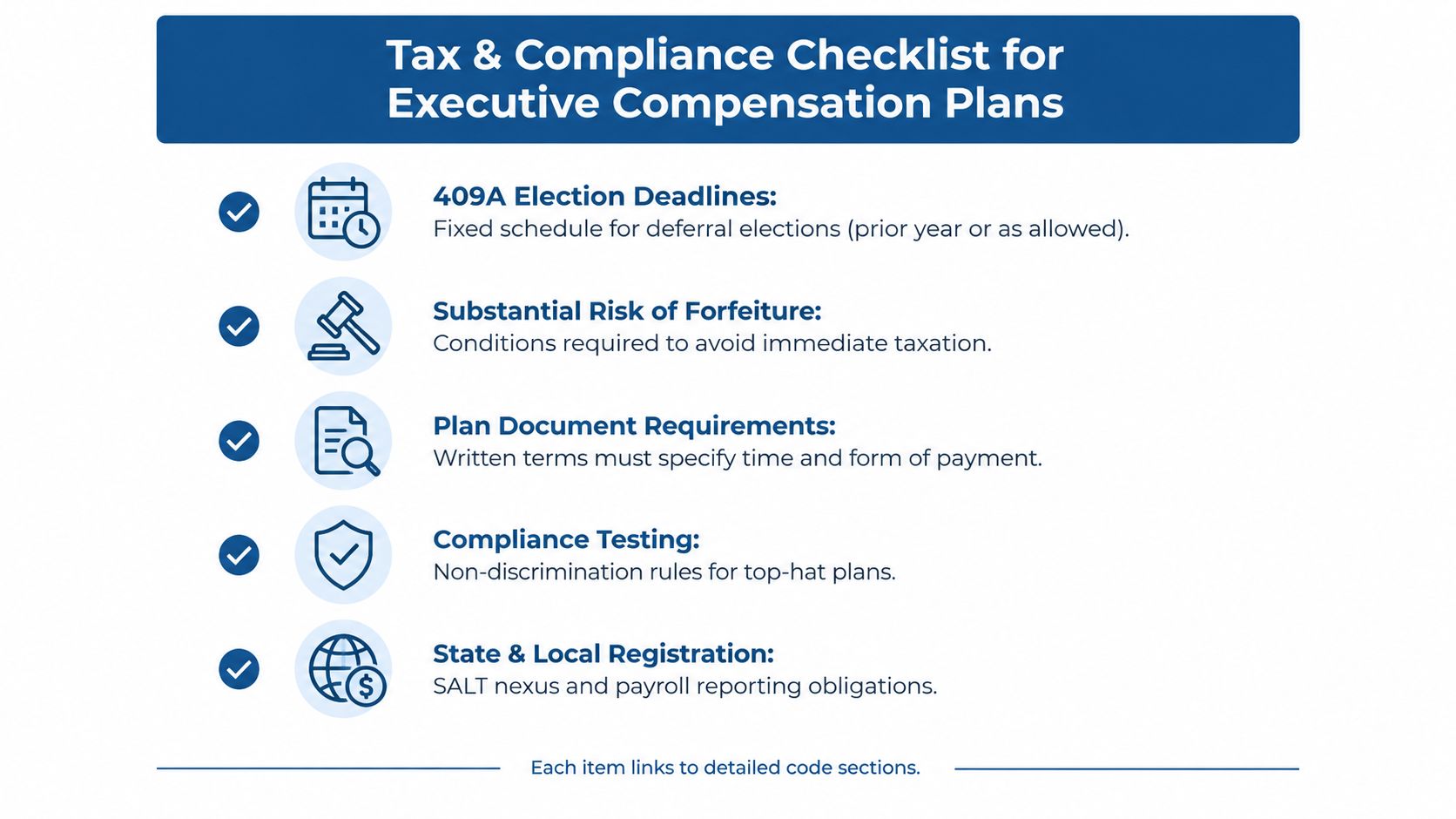
Section 409A applies broadly to nonqualified deferred compensation arrangements. The plan must specify election deadlines, permissible payment events, the form of payment, and limits on acceleration. Allowing an executive to choose payment after the applicable deferral window, or permitting an informal acceleration, can create a serious tax failure.
A failure can trigger immediate income inclusion for vested deferred amounts and a 20% additional tax. The GAO report on nonqualified deferred compensation summarizes these consequences. Have tax counsel review the plan before payroll begins and before the first deferral election. Correcting a defective arrangement later is harder than approving the mechanics at the outset.
ERISA and creditor protection require separate analysis
An unfunded plan for a select group of management or highly compensated employees may qualify for top-hat treatment, but the exemption depends on careful design and administration. A rabbi trust can segregate assets operationally while keeping them exposed to the employer's creditors. It does not convert an unsecured promise into a guaranteed benefit.
Ask three questions before funding anything:
- Who participates? A broad employee population raises different ERISA concerns from a plan covering a select executive group.
- What is funded? A corporate reserve, rabbi trust, and insurance-backed strategy carry different liquidity and creditor implications.
- What does the document promise? The funding arrangement must match the benefit obligation and payment schedule.
Payroll and state tax mechanics matter
Deferred compensation creates payroll complications, including coordination of income-tax withholding and FICA treatment. Identify when wages become subject to payroll tax, and stop the company from treating a deferred promise like ordinary cash compensation.
Apply the same discipline to supplemental wage withholding, state withholding reciprocity, and reasonable-compensation reviews for C and S corporations. An executive who works across state lines or relocates can create multistate payroll and SALT obligations. Work location belongs in the plan file, not in a later correction.
For a practical visual reference on how payroll, reporting, and advisory work fit together, use this accounting and advisory guide for New York City businesses. Use it to coordinate tax, payroll, legal, and human resources teams before the arrangement affects owner liquidity or executive retention.

Building a Working Compensation Model
A compensation plan belongs in a working model, not only in a memo. The model must show what the executive receives, what the company funds, when tax and payroll obligations arise, and whether the arrangement still works when performance weakens or liquidity is delayed.
Build the model from verified inputs:
- Current salary, bonus history, benefits, and existing equity.
- Projected EBITDA, cash balances, debt service, and owner distributions.
- The executive's target retirement age and desired payment period.
- Marginal tax rates by state and the executive's work locations.
- Vesting conditions, termination rules, valuation assumptions, and possible liquidity events.
Project at least the plan's operating horizon, including base pay, annual incentives, deferred accruals, equity vesting, employer payroll cost, and estimated after-tax cash. Show a base case, downside case, and liquidity-event case. Value equity under each scenario. A single optimistic valuation hides the retention and continuity risk that matters most to a closely held owner.
A disciplined example
Assume a closely held C corporation pays an executive $4 million annually and moves $400,000 from a current bonus into a SERP. The available facts do not establish a tax rate, payout date, investment return, or valuation assumption, so the model should not invent them. Show the mechanics and label every unresolved assumption.
| Metric | Year 1 | Year 2 | Year 3 | Year 4 | Year 5 |
|---|---|---|---|---|---|
| Current bonus removed | $400K | $400K | $400K | $400K | $400K |
| SERP accrual | $400K | $400K | $400K | $400K | $400K |
| Current executive cash | Lower than bonus case | Lower than bonus case | Lower than bonus case | Lower than bonus case | Lower than bonus case |
| Company current deduction | Compare under governing tax rules | Compare under governing tax rules | Compare under governing tax rules | Compare under governing tax rules | Compare under governing tax rules |
| Future SERP obligation | Accumulates | Accumulates | Accumulates | Accumulates | Accumulates |
| Future payout tax | Not yet triggered unless paid | Not yet triggered unless paid | Not yet triggered unless paid | Not yet triggered unless paid | Not yet triggered unless paid |
The shift may preserve company cash and strengthen retention, but it does not create free tax savings. The company generally deducts deferred compensation when it becomes taxable to the executive, rather than necessarily when the obligation accrues. Confirm the timing under the governing tax rules before presenting projected savings.
Modeling discipline: Separate accounting accrual, tax deduction, payroll tax, cash funding, and executive after-tax value. They are different lines.
Test the FICA gap on deferred compensation, check whether Section 162(m) limits apply, and model equity value under delayed, partial, and failed liquidity events. Tie the funding schedule to projected cash and debt service. A plan that works only if the company sells on schedule does not protect continuity. For a closely held owner, the model should show who carries the obligation if a sale is postponed, performance falls, or the executive leaves before value is realized.
Two Sample Structures for Different Owners
Owner priorities determine whether compensation supports liquidity, retention, and continuity, or creates obligations the business cannot carry.
Founder-led operating company
A founder-led operating C corporation has 12 employees, $9 million of EBITDA, and an owner age 58. The owner wants to diversify wealth and fund retirement. The company also needs senior operators to remain through a transition, so annual cash compensation alone leaves a retention gap.
A workable package could include a $650K base salary, a discretionary bonus tied to cash generation and operating performance, a 409A-compliant SERP accruing 25% of pay, and a profits interest grant vesting over four years, if the entity and tax structure support that instrument. Salary establishes predictable personal cash flow. The bonus responds to current performance without creating a fixed promise. The SERP builds a retirement-oriented benefit, while the equity award keeps the general manager focused on value creation through the transition.
The owner must also model the downside. The SERP creates a future company liability, and the equity grant needs explicit rules for termination, forfeiture, and a sale. Coordinate both with the shareholder agreement, buy-sell terms, estate documents, and any planned recapitalization. If liquidity is delayed, the plan should identify who funds the obligation and whether the company can preserve debt service and operating cash.
Single-family office
A single-family office with a 45-year-old principal-investor and three key employees faces a different retention problem. The principal may not need a large current salary, while the team needs incentives tied to investment results, long-term service, and the value of managed entities. Paying everything through an annual bonus can reward short-term outcomes and weaken continuity after a disappointing year.
A stronger structure may use modest base compensation, a performance bonus tied to documented investment outcomes, a long-deferred compensation plan vesting at age 65, and carried interest in eligible managed entities. This approach preserves capital, rewards measurable results, and gives key employees a future tied to the platform rather than one annual check. Document valuation, vesting, eligibility, and payment conditions before presenting the arrangement.
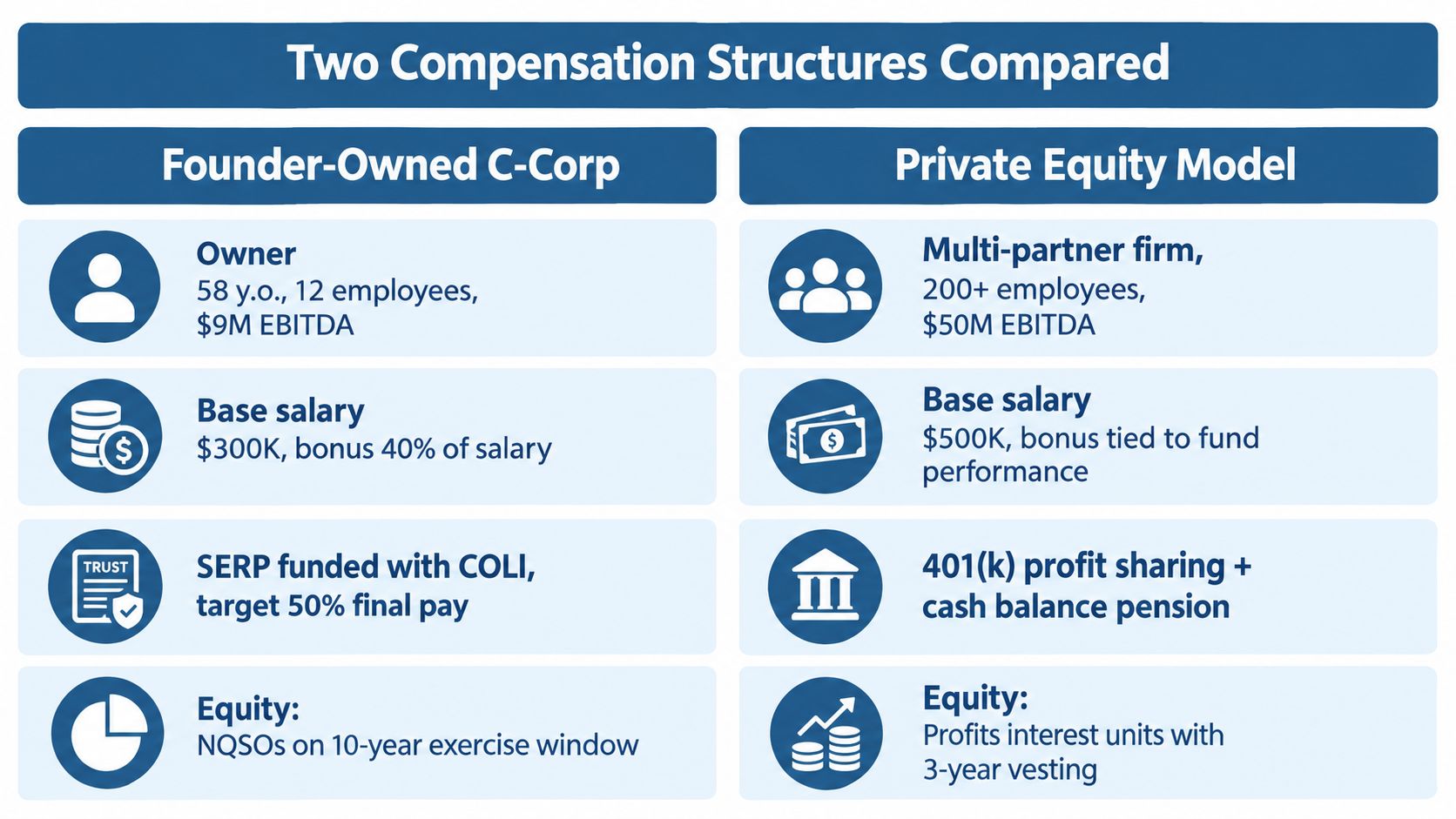
The founder package prioritizes retirement funding and transition readiness. The family-office package prioritizes patient retention and investment alignment. Neither should be copied without reviewing entity classification, ownership rights, valuation, vesting, and tax reporting.
Retention duration should determine payment duration. Use a bonus when the business needs an executive for the next annual cycle. Use deferred or equity-linked compensation when continuity through a sale, succession, or delayed liquidity event matters. The vehicle must match the risk the owner is trying to manage.
Implementing the Plan Step by Step
Implementation should begin with the owner's actual risk, not with a preferred compensation vehicle. A closely held business may need to preserve cash, retain a key executive through a sale, fund retirement, or prepare for succession. Those priorities determine the design and the order of execution.
Start with objectives and existing obligations
Confirm the owner's priorities and the entity's constraints. Review payroll, bonus arrangements, equity records, shareholder agreements, buy-sell provisions, estate documents, and debt covenants before adding anything new. These records can reveal payment promises, ownership conflicts, or financing restrictions that change the recommendation.
Decide what to add, amend, or terminate. Do not place a SERP on top of an outdated bonus promise because the SERP appears more advanced. Reconcile every existing obligation first, then document the intended retention, liquidity, tax, and transition outcomes.
Draft, approve, and operationalize
The written package should address deferred compensation, SERP terms, equity awards, vesting, payment triggers, forfeiture, and treatment on a change in control. Build Section 409A requirements into the elections and payment terms from the beginning. Fixing defective language after payroll or payments begin is expensive and may not restore the intended tax treatment.
Use this implementation order:
- Confirm objectives: Define the retention, liquidity, tax, and transition priorities.
- Review existing arrangements: Reconcile payroll, ownership documents, debt terms, and prior promises.
- Select vehicles: Match salary, bonus, deferred compensation, SERP, and equity to the business risk being managed.
- Draft documents: Have counsel specify elections, payment events, vesting, forfeiture, and ERISA treatment.
- Secure approvals: Obtain required board, shareholder, trustee, or investment committee consents.
- Set up administration: Update payroll, W-2 reporting, valuation files, participant statements, and payment calendars.
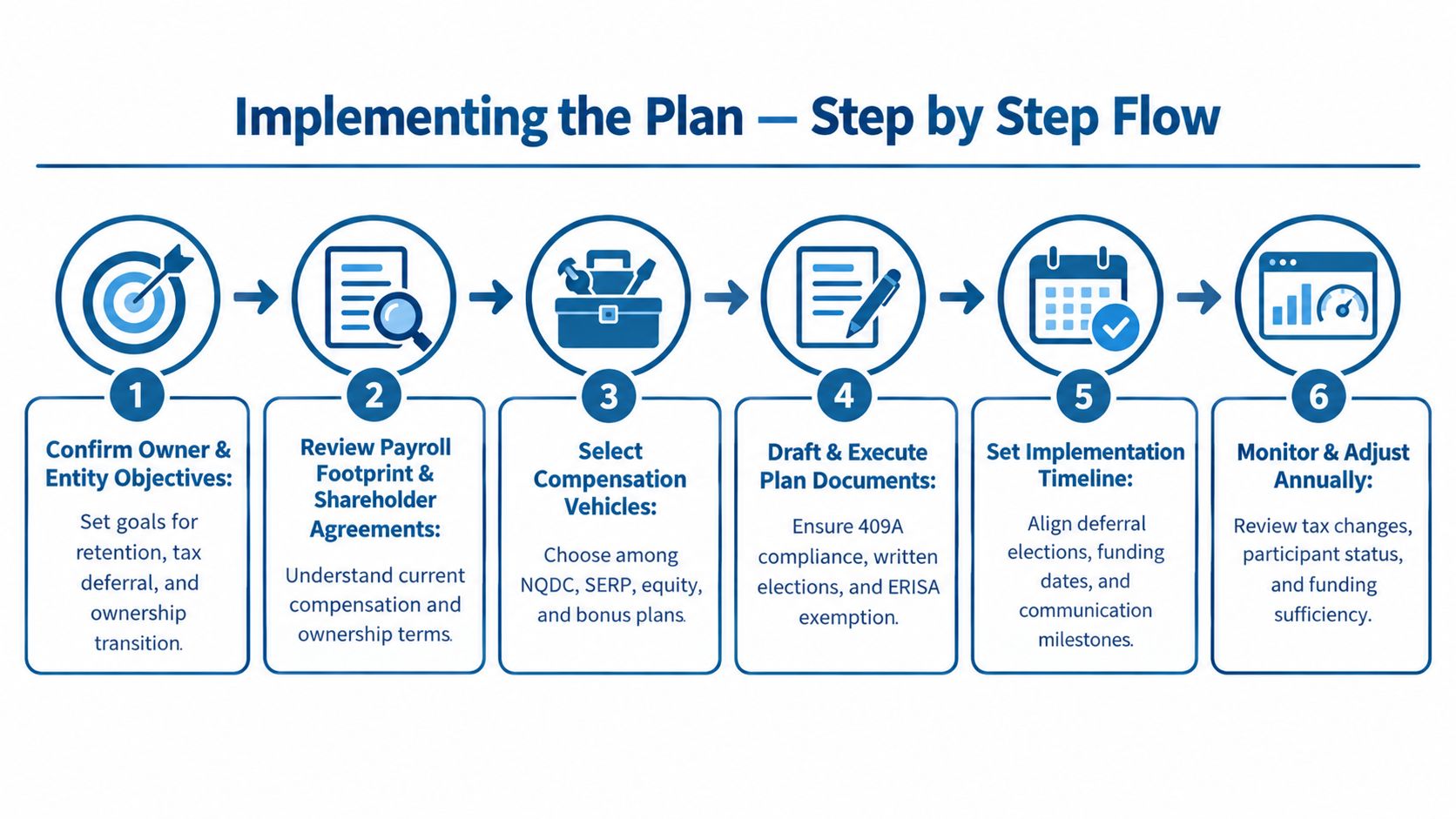
Sequencing errors usually appear in operations. A mid-year adoption may require prorating. An executive may miss the initial election deadline. A buy-sell agreement may conflict with an equity award, or payroll may classify a new payment incorrectly. Assign an owner to each setup task and confirm completion before the first payment or deferral.
Schedule the first annual review before implementation ends. Revisit the arrangement after an ownership change, new debt, executive relocation, material revenue shift, family succession event, or approaching liquidity event. Compensation planning must track the business plan throughout its life, not sit in a file after signature.
A Client Facing Checklist and Final Principles
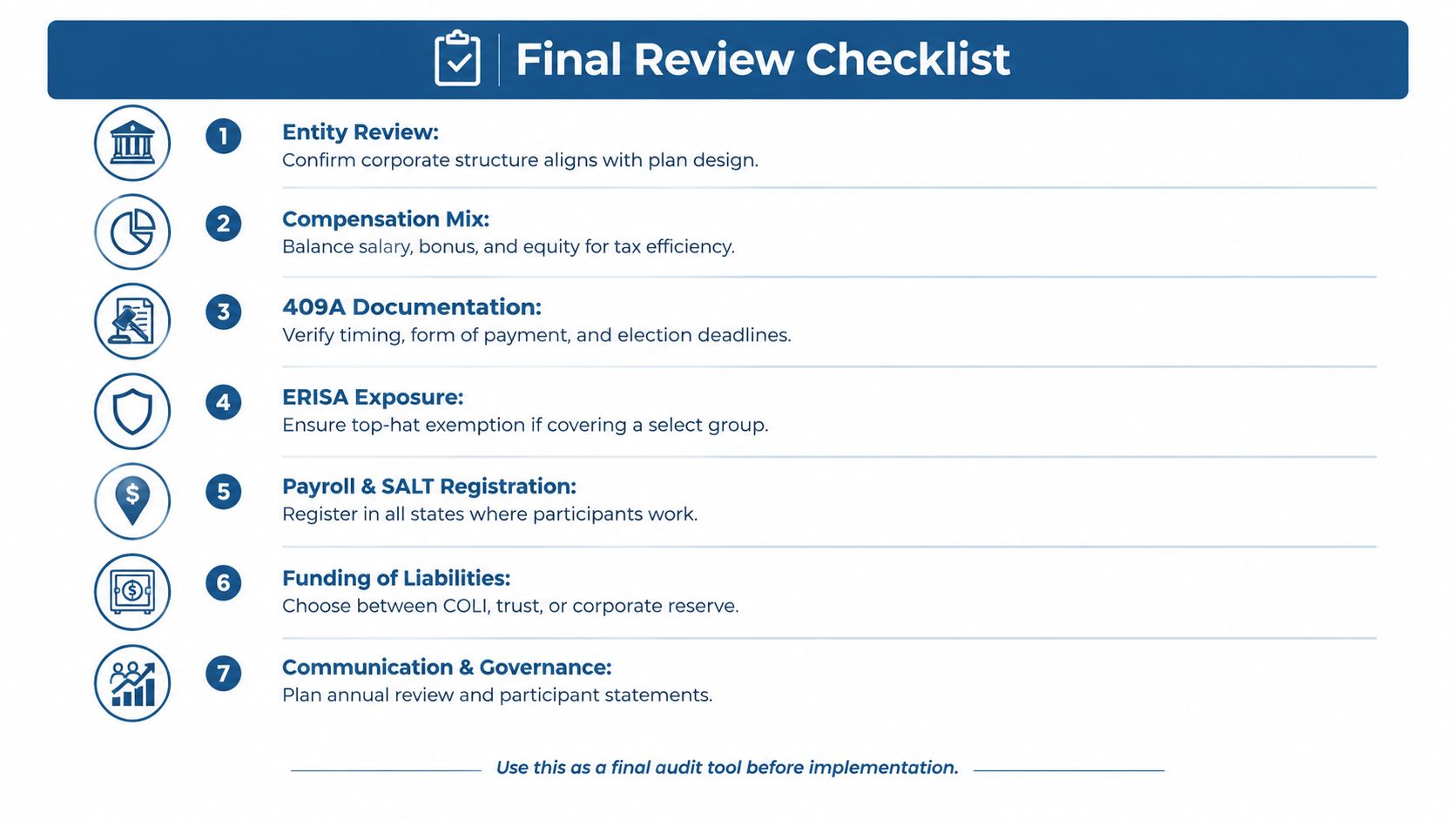
A closely held owner may face a cash squeeze, a key executive's departure, or a succession decision at the same time. The final checklist must expose those risks before anyone signs. Keep it to one page, and require an answer on every line.
- Entity review: Confirm that the corporation, partnership, or pass-through structure supports the proposed compensation vehicle.
- Compensation mix: Set the intended balance among salary, bonus, deferred compensation, SERP benefits, and equity.
- 409A documentation: Verify election timing, payment events, payment form, and limits on acceleration.
- ERISA exposure: Determine whether the arrangement is unfunded, whether top-hat treatment is available, and how participants will receive information.
- Payroll and SALT: Identify each state where the executive works, travels, relocates, or receives reportable compensation.
- Funding strategy: Choose a corporate reserve, rabbi trust, insurance arrangement, or another funding method, and explain the resulting creditor risk.
- Governance and review: Obtain approvals, communicate the package, maintain participant statements, and set annual review triggers.
Five principles should control the recommendation.
First, align pay with liquidity events. Do not promise a large near-term cash payout while the business needs working capital. Match the vehicle to the retention period, and fund what you promise. If the promise remains subject to employer-credit risk, state that plainly.
Document decisions when they are made, not after a dispute starts. Review the arrangement after any material change in ownership, family circumstances, debt, executive responsibility, or revenue. This discipline protects continuity and gives owners a clear record when liquidity or succession plans change.
Blue Sage Tax & Accounting Inc. provides tax planning, projections, accounting, and multistate advisory support for executives, family offices, and closely held businesses. Visit Blue Sage Tax & Accounting Inc. to review the existing payroll footprint, deferred compensation obligations, equity arrangements, and the next planning decision before implementation.